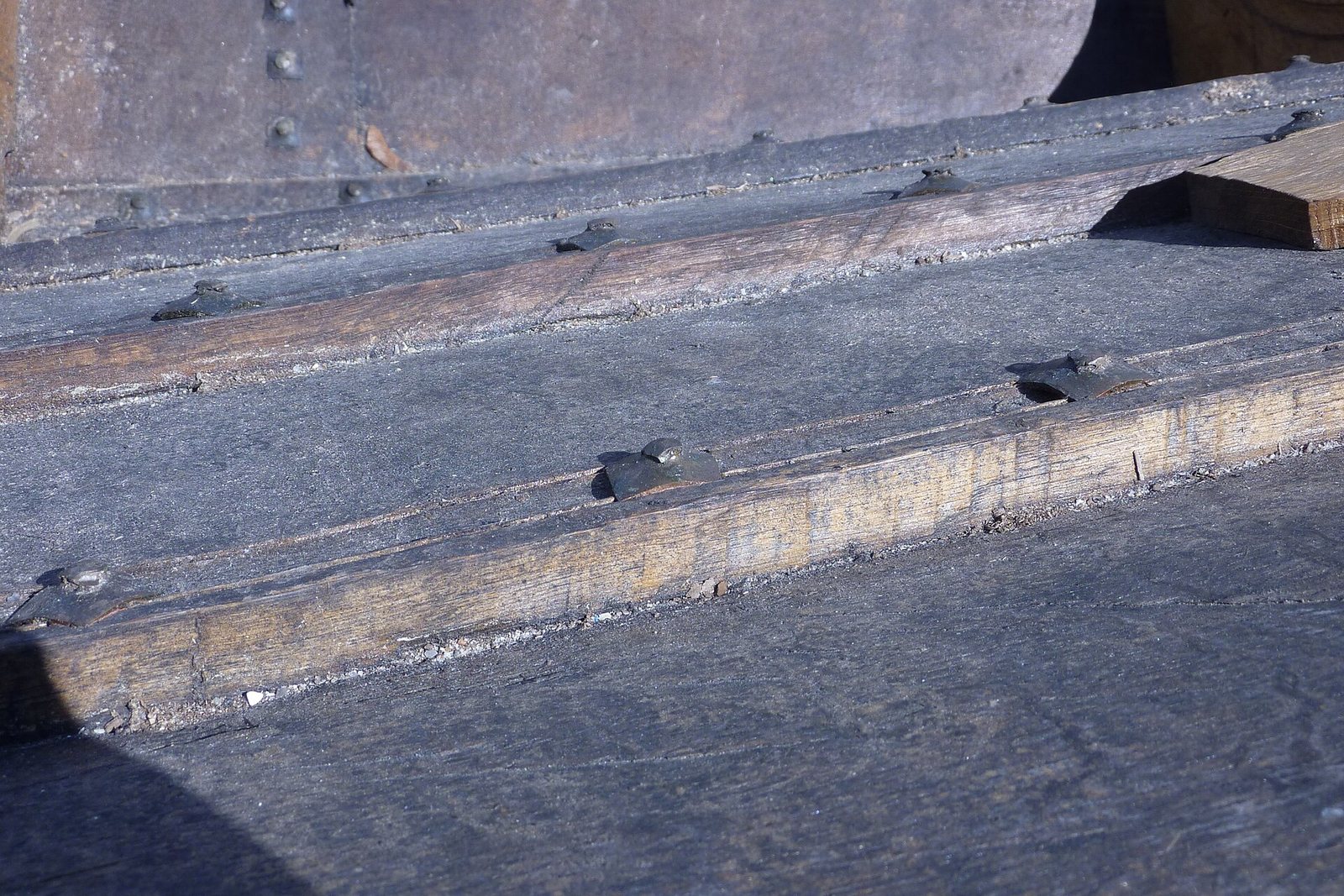
A Viking ship is made of oak, but much of what holds it together is iron: many small rivets, each secured by a little plate. How many there were, who forged them and where the metal came from is often told with great confidence in books and videos. This article sorts out what excavations and reconstructions actually show, what can only be estimated roughly, and where the evidence stays thin.
Looking at a Viking ship, you see the line first: the raised stem, the shallow hull, the overlapping planks. The metal stays out of sight, because rivets and roves are small and sit inside the seams. Yet iron is one of the conditions that allowed such hulls to be light, flexible and seaworthy. This article therefore asks about the inconspicuous: how does the joint work, what is attested about it, and how far do the numbers in circulation carry?
One caveat shapes the whole text. For the total number of rivets in any particular Viking ship I found no figure that I could check myself against a primary publication or a museum page. The numbers that circulate are therefore treated here as unverified. What can be supported is the building method, the spacing of the rivets and, in broad terms, the origin of the iron. That is less spectacular than a round number, but it survives follow-up questions.
The ships in question are mainly the Gokstad ship from Norway and the wrecks from Skuldelev in Roskilde Fjord. Both have pages of their own here: the Gokstad ship and the Skuldelev ships. The general overview of the craft is in Viking shipbuilding; this article deals only with the iron side.
Clinker building means that the planks of the outer skin lie on one another like roof tiles. Each plank overlaps the one below by a narrow strip, and the rivets sit in that strip. This differs from carvel building, in which planks meet edge to edge and are fixed to a frame. In clinker building the shape of the hull comes first from the planks; the frames are added afterwards.
For the Gokstad ship, English Wikipedia, which I use here only as a secondary source, gives these figures: about 23.8 metres long, about 5.1 metres wide, built largely of oak, with 16 tapered strakes per side. Adjacent planks overlap by about 30 millimetres. The iron rivets are said to be about 180 millimetres apart on straight stretches and about 125 millimetres apart where the hull curves. According to the same source the lowest nine strakes per side are about 2.5 centimetres thick and tied to the frames with withies, while the upper planks are about 3 to 4 centimetres thick. These are reference-work statements; I did not trace their original source in detail.
The idea behind them matters. The seam between two planks is a short, narrow strip in which the wood must not move enough to open the joint, while the hull as a whole should be able to twist in a seaway. Closer rivet spacing in the curves spreads the forces. That is a technical explanation, not a statement handed down by the builders; how they set the spacing, we do not know.
A ship rivet has two parts. The shank is an iron pin pushed through both planks, with a head on the outside. On the inside a small plate is slipped over the shank, called a rove (Danish rove), and the protruding end is then hammered flat while cold. The Viking Ship Museum in Roskilde describes this joint, as it makes it on its reconstructions, as a pointed rivet with a loose rivet plate, held together by cold-hammering the end. The text I read gives no dimensions.
Other pages of this blog write the plate as “Rooer” or “Rove”. The same part is meant. I know of no single settled German spelling; both forms appear in the shipbuilding literature.
For Gokstad itself I could not check the riveting against a primary source; it rests here on reference works (English Wikipedia and a University of Chicago page, both secondary). The wording from Nicolay Nicolaysen, who led the 1880 excavation, belongs to a different find: in the digitised book at Project Runeberg he describes on page 0031 the Nydam boat, found in 1863 in the Nydam bog in Schleswig, whose planks he says are “indbyrdes fæstede … med klinknagler af jern”, that is, fastened to one another with iron clinch nails. The Nydam boat is much older than the Viking Age; the passage only shows that the technique was securely described in nineteenth-century excavation literature. The page is uncorrected OCR with scrambled line order. It also notes that such nails were used on many other wooden objects such as chests and caskets, and that earlier scholars too quickly attributed several iron rivets in a burial mound to a ship.
“… med klinknagler af jern.”
Nicolay Nicolaysen, Langskibet fra Gokstad ved Sandefjord, Kristiania (Kristiania, section on the Nydam boat; digitised at Project Runeberg, page 0031; own translation of the fragment: “… with clinch nails of iron.”)
The Gokstad ship was discovered in 1880 in a burial mound near Sandefjord. According to Wikipedia, the sons of the farm owner found a boat's bow while digging in frozen ground; Nicolaysen directed the excavation. Dendrochronological dating, again as reported there, puts the felling of the timber around the year 890. That dates the tree, not the ship: some years may lie between felling and building, and more between building and burial.
Skuldelev is a different case. Several ships were sunk in Roskilde Fjord as a barrier and were recovered from the mud in the 1960s. The ships survive in parts, and the Skuldelev page of this blog describes how planks with rivet holes emerged from the silt. That the wrecks show rivet holes and rivets is secure. How many rivets remained in each wreck and how many of the original joints can be reconstructed I could not establish. For wrecks that survive only in fragments, the number of original rivets is in any case a different question from the number of rivets in the whole ship.
A distinction is needed here. Counting rivets on a find is an observation. Extrapolating from the find to the whole ship is an estimate. And when a reconstruction serves as the basis, it is an estimate built on a reconstruction that itself contains assumptions. In popular texts these blur quickly into a single, seemingly secure number.
The total cannot be answered from a checked source, but one can estimate the order of magnitude. This is my own, explicitly rough calculation based on the Gokstad figures above. The hull has 16 strakes per side, so 15 overlap seams between them, 30 seams in all. Assume cautiously that each seam is at least as long as the ship, about 24 metres, and apply the straight-run spacing of 180 millimetres: that gives roughly 130 rivets per seam and about 4,000 in total. Because the planks are longer than the ship on account of the hull's curvature, because spacing is closer in the curves and because further joints at the stems come on top, the real number would tend to be higher. On the other hand, not every strake runs the full length, which lowers it.
The result is a number in the four figures, with considerable uncertainty; the calculation is my own and unchecked. The calculation does not deliver an exact figure and I do not present it as a finding. It only shows that the phrase “thousands of rivets”, found in the literature and on neighbouring pages of this blog, is plausible. Anyone who wants to give a concrete number for Gokstad, Oseberg or a Skuldelev ship needs the evaluation of the original finds or the build records of a reconstruction. I have seen neither.
I think it likely that such numbers exist in specialist publications, because museums and yards document their reconstructions closely. But likely is not a source. This article therefore gives no rivet count for any single ship.
Popular accounts often mix up nails and rivets. A nail is driven into the wood and holds by friction. A rivet passes through both planks and is deformed on the far side, and the rove stops the hammered end from sinking into soft wood. In Viking Age clinker building the plank joints are rivets with roves, as the Roskilde museum describes it. That does not exclude treenails or other fastenings in the same ship. In the Gokstad ship the lower strakes are in addition fastened to the frames with organic lashings, as noted above. Iron was not the only joining technique in the hull.
On the details of where treenails, lashings and rivets alternate, I can say nothing reliable from what I have read. That is a matter for shipbuilding research and can only be settled on the wrecks and reconstructions.
On origin, the Viking Ship Museum states in a news item on its reconstruction work that most scholars agree the bulk of iron in Viking Age Denmark came from bog ore, which was roasted, smelted and forged into objects. This is a careful formulation (“most scholars agree”) and refers to Denmark. For Norway, where the Gokstad ship was built, I checked no statement of my own. That other ores and deposits were also used in the North is possible; accounts differ, and I did not evaluate them.
Bog ore, also called swamp ore (Danish myremalm), forms in wet ground as a nodular, iron-bearing deposit. That is basic geology and does not come from a particular source of this research. The deposits were widespread but individually small, which suggests that iron was produced in many small operations rather than a few large ones. Whether and how strongly shipbuilding depended on local ore in a given case is a point on which blanket statements need care.
For smelting and the workshop, the article Viking blacksmithing on this site goes further. It describes the bloomery process, which ran at temperatures below the melting point of pure iron and produced a slag-laden mass, the bloom. I did not re-check that description here; it corresponds to the generally known picture of pre-industrial iron production.
The bloom had to be forged to press out slag. After that the smith had iron in bars or ingots that could be worked further. A rivet then came about by forging a bar into a shank, pointing it and forging a head. The rove was cut from sheet or a flat piece and punched. This sequence is a technical reconstruction, not an eyewitness account; I know of no Viking Age description in which a contemporary describes rivet forging.
Who forged the rivets is unknown. Smiths specialised in ship supply are conceivable, so are smiths of a settlement such as Hedeby, or the yard itself. The Roskilde museum calls blacksmithing an essential part of clinker boatbuilding, but nothing follows from that about Viking Age organisation. I know of no evidence for any particular yard. Whoever claims that “the smith sat next to the keel” is writing imagination rather than source.
What can be said is an inference from the technique itself: so many identical parts call for a practised routine. Whether rivets were forged in stock or as needed during building, whether cut from bars or shaped one by one, can partly be seen on the wrecks. I have read no study on this.
The total weight of iron in a Viking ship follows from the number times the weight of each piece, plus losses in forging and smelting, because a quantity of ore yields much less usable iron. For none of these factors did I read a reliable figure. Neither the museum nor the Wikipedia entries I consulted give a weight for the rivets of a particular ship. Anything I put in kilograms or working hours here would be invented. That applies also to the widespread claim that shipbuilding consumed the largest iron quantities of the Viking Age. It appears on a neighbouring page and sounds plausible, but I could not check it against a source and pass it on only as a conjecture.
Something else is indirectly attested: even the Viking Ship Museum has formulated the question of how to make rivets from bog ore only as a planned research programme. That suggests the method was not applied in earlier reconstructions (see the next section), and there are therefore no experience values for effort and yield that could be transferred to the Viking Age.
The Roskilde museum writes that earlier reconstructions, including the six Skuldelev replicas, used rivets and roves of modern, industrially produced iron, mainly Siemens-Martin steel or ARMCO iron. The first Skuldelev model, “Roar Ege”, was according to the museum retired in 2016 after 32 years of active service. The “Sea Stallion from Glendalough”, the reconstruction of Skuldelev 2, was built, according to the museum's page, between August 2000 and September 2004.
A caution follows for our topic. When a yard says it needed a certain number of rivets for a reconstruction, that refers to rivets of modern industrial material. The number and arrangement follow the evidence from the wreck; the effort of forging does not follow the Viking Age process. Anyone who transfers working hours from a reconstruction to an original is not comparing like with like.
With “Skuldelev 3 Revisited” the museum, according to its statement, takes a different route and uses copper rivets and roves instead of modern iron ones. The museum gives as reasons that copper does not split the planking the way modern iron does, that less repair is needed and that suitable oaks are becoming scarce. It concedes that both solutions are “in principle equally wrong”, since copper rivets were not used in the Viking Age; results for iron fastenings modelled on Viking Age iron are still missing. It is also noteworthy that the museum itself distinguishes between today's industrial iron and the iron of the Viking Age.
The sagas and chronicles tell a great deal about ships, voyages and battles. I know of no passage that gives the number of rivets in a ship or describes rivet forging. That is no proof that none exists, since I did not search the sources systematically. But it is a warning sign for texts that write “chronicles report that a longship had so many rivets” without a citation. What is known about rivet technique rests on archaeological evidence and shipbuilding experiments, not on texts.
None of the surviving ships can be matched to a ship named in the sagas. Anyone who equates the two joins two separate traditions. An overview of ship types is given in Viking ship types, and of the warships in Longships.
That we know ships with preserved rivets we owe in good part to graves. The Gokstad ship served as a burial ship, as did the ships of Oseberg and Ladby; Ladby has a page of its own. That many well-known ships come from graves has a consequence for research: the ships we know are also burial ships, not necessarily everyday ships. More in Boat burial.
Were Viking ships nailed or riveted? The planks of clinker building were riveted: an iron pin through both planks, a plate on the inside, the end hammered flat while cold. Lashings and other fastenings occur alongside.
How many rivets did the Gokstad ship have? I have no checked figure. From length, number of strakes and rivet spacing one gets a rough order of magnitude of several thousand; more cannot be said without the original documentation.
Where did the iron come from? According to the museum in Roskilde, mostly from bog ore, at least for Denmark. For other regions that is not checked here.
Who forged the rivets? That is not recorded. Smiths are the obvious candidates, but whether they belonged to the yard or supplied it cannot be shown.
Why are modern reconstructions no measure of the effort? Because they mostly use industrial iron instead of iron smelted from bog ore. The labour of ore extraction drops out.

Viking Shipbuilding · The longships · The Gokstad Ship · The Skuldelev ships · Viking Smithing.
All History & Finds articles →
Few images from the Viking world stir as much excitement – and as much argument – as the shield-maiden: the woman with …
Read more →The shield wall was the basic battle formation of the Viking Age: a dense line of warriors holding their round wooden …
Read more →A longship had no cabins, no bunks and no permanent roof. So where did the crew sleep: on the rowing benches, under a …
Read more →Many lists of Viking weapons give the sling a passing clause: cheap, everywhere, surely in use. Test the evidence piece …
Read more →