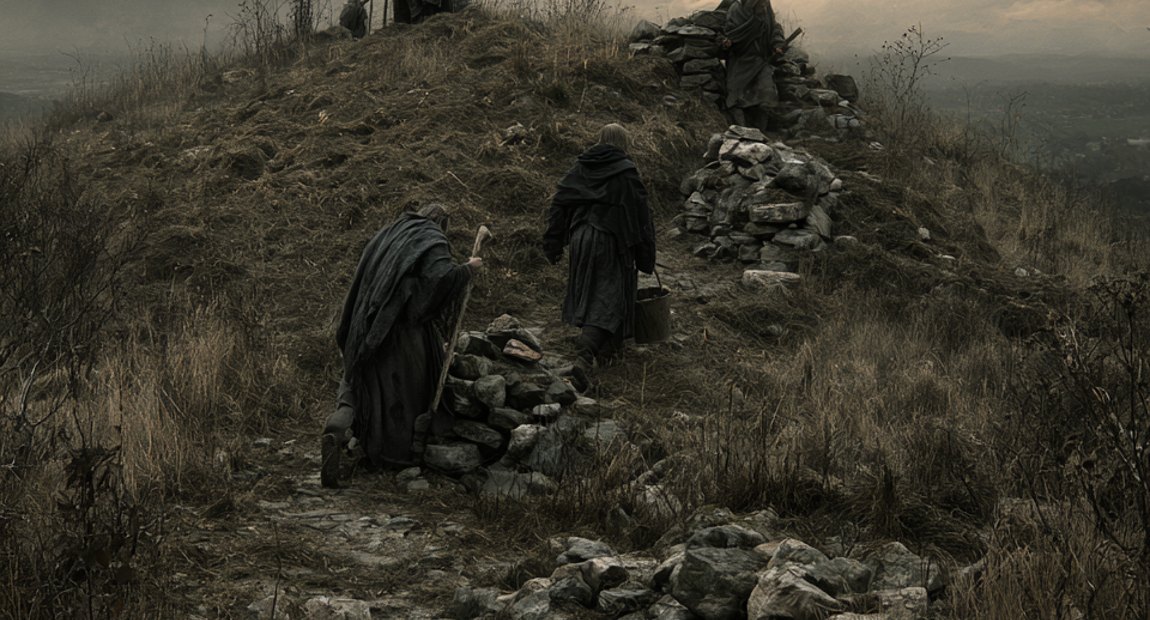
No timber is left of the ship, only its imprint in the ground and more than 2,000 iron nails that trace it. Even so, the mound at Ladby on Funen counts among the key witnesses of Viking Age Denmark: a ship grave with eleven horses, several dogs and over 600 finds or fragments, discovered in 1935 by a pharmacist. This article follows the discovery, separates find from interpretation, explains why the date "around 925" is only as firm as its basis, and tests the claim that Ladby is Denmark's "only" ship grave. Where my sources are silent or disagree, the text says so.
According to English Wikipedia, the grave was found on or around 28 February 1935 near Kerteminde in north-eastern Funen. The finder was Poul Helweg Mikkelsen, a pharmacist and amateur archaeologist. Wikipedia names Mikkelsen's original drawings and those of Gustav Rosenberg, a conservator at the Danish National Museum, as the primary source material. That matters: anyone writing about Ladby today relies on documentation made between 1935 and 1937, because the ship's timber had rotted away and could not be lifted.
According to the Danish encyclopedia lex.dk, excavation ran from 1935 to 1937, with a further investigation in 1984. I found no reliable account of how the work proceeded – how many weeks, which methods, who was on site. The standard publication is Anne C. Sørensen's monograph "Ladby. A Danish Ship-Grave from the Viking Age" (Roskilde 2001), which I could not consult. The Ladby museum also says that eleven smaller graves were found along with the ship grave in 1935. How these relate to the mound is not clear from that page; lex.dk mentions only a burial ground of the same period next to the mound.
After excavation the grave received a concrete vault. Wikipedia says Mikkelsen himself paid for the arched protective building, which was then covered with earth and grass; lex.dk gives the concrete vault of 1937 and the restoration of the mound. Most finds went to the National Museum. Since 1994 responsibility has rested with the museums of Kerteminde, and since an extension in 2007 many pieces are back on site.
The grave lies by the village of Ladby, about three kilometres south-west of Kerteminde. According to lex.dk, the place name is first attested in 1383 and derives from Old Danish lath ("landing place") and -by ("settlement"). Whether a landing place existed here at the time of the burial cannot be concluded from this; the name is about 450 years younger than the grave.
The mound had, according to lex.dk, a diameter of roughly 30 metres and was edged by closely set posts. That is notable because it shows the mound was shaped, not just heaped up. Why the posts stood there – screen, boundary or symbol – the sources I read do not say. It is an open question, not a gap I want to fill with guesses.
The timber was completely rotted; my sources do not name the wood species. According to lex.dk, only the imprint in the soil survived and showed the shape. The ship was clinker-built: the planks overlap and are joined with rivets or nails. The iron left in the earth marks the position of planks and frames. From the heavy iron spikes, lex.dk concludes that the ship had 17 frames, that is, 17 cross-ribs.
The length is given differently. The Ladby museum says "almost 22 metres", the Viking Ship Museum in Roskilde says 22 metres, and lex.dk says about 21.5 metres; the width is about three metres. Why the values differ by half a metre the sources do not say. It is conceivable that an imprint without timber leaves the end points ambiguous, but that is not documented. Anyone reading "22 metres" should hear "about".
The museum says the ship was built for 30 to 32 oarsmen and carried a sail estimated at 60 square metres. Both statements are reconstructions. As the museum itself says, nothing of sail or mast survives. Seven rigging rings along the gunwale indicate, according to the museum, that the vessel was seaworthy. More than 2,000 nails and spikes held it together. At the bow lay an iron anchor with its chain and remains of rigging.
Iron also survives from the ornament of the prow: the twisted iron spiral of a "mane" on the dragon head. That the prow was a dragon head is the museum's reconstruction; the head itself was wood and has vanished. So one part is observed (the iron curls) and one is inferred (the shape of the whole stem). This applies to many pictures of the Ladby ship that show a complete dragon boat.
According to the museum, eleven horse skeletons lay in the bow. They are said to resemble today's Icelandic horses; only one was fitted with a harness. The Viking Ship Museum says the horses were sacrificed, and the Ladby site says horses and dogs were placed in the ship "in front of the king" as companions for his journey. The word "journey" belongs to interpretation; the find itself is that animals were killed and laid down in the ship. What belief lay behind this we do not know from any text belonging to this grave. I know of no contemporary writing that describes this burial.
For the wider setting of horses in the North this site has two further articles: Viking horses and sacred horses. Both show that the horse had a double role – mount, status symbol and sacrificial animal – but neither replaces a find from Ladby.
Dogs were part of the furnishing too. The museum speaks of probably four to five animals of differing size, which it says follows from teeth and bones. The number is therefore an estimate based on skeletal remains, not a count of complete skeletons. A gilded bronze piece described as part of a dog leash was also found, along with dog harnesses.
That gilded bronze piece matters far beyond the dogs: according to Wikipedia it is a link from a dog harness decorated in the Jelling style, and the dating of the grave to the early 10th century rests on this connection. More in the section on dating.
The museum counts over 600 objects or fragments. Highlighted pieces include a silver belt buckle, pieces of silver plate, a bronze dish, fittings, and remains of the dead man's clothing with sewn-in gold thread. Added to these are spurs, stirrups, a shield boss, an axe and a bundle of 45 arrowheads, plus a baton and a board game. That the dead man lay on a kind of couch is shown by the reconstruction in the museum, which by its own description offers "a qualified suggestion". How much of this the find supports and how much is supplement does not emerge from the pages.
Reading this list, one easily gets the impression of a rich weapon set. Caution is needed: an axe, a shield boss and a bundle of arrowheads are what remained, not the original equipment. A sword is not mentioned in my sources. Whether it was never there or was taken cannot therefore be said. The "magnificent weapons" the museum mentions belong to the Rosenlund grave, a different find.
The grave was not intact. lex.dk writes that it was broken into already in ancient times; the dead man and much of the grave goods were removed. Wikipedia speaks of extensive damage and names only a few small bones as the sole human find. That fits the over 600 pieces and fragments: many grave goods apparently survive only in pieces.
Why the grave was opened is unresolved. Wikipedia sets two interpretations side by side. The first: the pagan grave was converted into a Christian one. The second: a power struggle between Harald Bluetooth and his son Sweyn Forkbeard led to desecration, with the body removed and the grave goods chopped into hundreds of pieces. Both are interpretations, not findings. On the pages I read, the museum mentions neither looting nor desecration; it describes the king as buried in the ship.
Between the second interpretation and the date "around 925" there is a tension I cannot resolve. Wikipedia says the desecration happened "within a few years" of the burial. Harald Bluetooth belongs, by the usual chronology, to the second half of the 10th century (not rechecked here); a struggle between him and Sweyn would then fall some 60 years after 925. Either the burial must be dated later, or the removal came much later than "a few years", or Wikipedia joins two things that do not belong together. Anyone explaining the looting by Harald should know this. More on Harald and his parents: Harald Bluetooth, Gorm the Old and Christianisation.
Ladby would not be alone with a looting. In my search I came across an article in the journal Antiquity on the plundering of the ship graves of Oseberg and Gokstad as power politics; I know only its title and short entry, not its content, and cite it only as a reading tip. Both ship graves have their own articles here: Oseberg and Gokstad.
The museum says the ship was pulled ashore "in or around 925" and the king buried in it. The Viking Ship Museum says "around the year 925". lex.dk is vaguer: the beginning of the 10th century. Wikipedia bases the early 10th-century date on the gilded bronze link of the dog harness in the Jelling style. That is, as far as I can see, the date follows a stylistic placing of a small find, not a tree-ring measurement on the ship.
Tree-ring dating (dendrochronology) is not possible for a ship of which only the imprint and iron remain. Whether other scientific methods, such as radiocarbon dates on the animal bones, exist I did not find. The sources therefore yield: "around 925" is a rounded figure; they do not state how wide the margin is. The style itself is named after the royal site of Jelling, not after a date.
The museum calls him the "Ladby King" and a "powerful person", and also uses the term chieftain; lex.dk says "høvding". No source I read gives a name. The material shows a person of high rank: ship, animals, silver and gold thread are expenditure. Whether he was a "king" ruling a territory or a regionally powerful man is open. The museum says burial in a warship was a privilege reserved for kings and princes. That is the museum's interpretation; where it comes from is not stated there.
I know of no contemporary text that tells of this man. What people in the North thought about lasting reputation is shown by an Eddic stanza that is no witness for Ladby but preserves a pattern of thought in which a burial mound could become memory:
Cattle die, and kinsmen die, / And so one dies one's self; / But a noble name will never die, / If good renown one gets. Hávamál, stanza 76, trans. Henry Adams Bellows (1923, public domain)
The source position is clear here and yet more nuanced than the sentence sounds. The Viking Ship Museum calls Ladby "Denmark's only known Viking ship-grave". Wikipedia says it is the only Viking Age ship burial discovered in Denmark. Both formulations contain the same qualifier: known, discovered. Nobody can exclude an undiscovered grave, and a damaged or levelled one could go unrecognised.
Then comes the question of borders. Wikipedia names as a counterpart the boat chamber grave of Hedeby, which lies in today's Schleswig-Holstein, that is Germany, but was then a Danish settlement. Depending on whether one asks by modern borders or by the Viking Age, the answer differs. Everything also hangs on the definition of "ship": smaller boats in graves are another category. How many such boat graves there are in Denmark I did not check in this research; a Swedish research portal on my hit list deals with unburnt boats in Viking graves, but I have not read it.
One more point: stone settings in the shape of a ship are something different from a real ship in a grave, see stone ships. The overall picture stands: "Denmark's only known ship grave" is correct as the museums' statement, with the qualifications "known", "ship" and today's borders.
Wikipedia places Ladby in a group: the same type of burial as the Hedeby boat chamber grave and the south Norwegian ship graves of Oseberg, Borre, Gokstad and Tune, all of the 9th and 10th centuries. The article gives no more. On this site, the comparison can be followed through boat burials in general, Oseberg, Gokstad and the Anglo-Saxon Sutton Hoo.
What sets Ladby apart from the Norwegian graves is the state of preservation: here the timber is, according to lex.dk, "helt forrådnet", completely rotted; how the wood fared at Oseberg and Gokstad my sources for this article do not say, so I do not compare. The museum shows a reconstruction of the burial at the site of the grave. For shipbuilding itself, longships and shipbuilding are the better places to look.
The Vikingemuseet Ladby stands at the mound. After the 2007 extension, part of the finds and a reconstruction of the burial are shown there. An overview of further places is under Viking museums.
According to lex.dk there were two replicas. The older "Imme Gram" was built in 1963 and sank in 2009 off Lyø. The "Imme Sejer" was launched on 4 August 2012. A 1:10 model of 1999 served as the starting point for a full-size copy begun in 2011 and, according to the encyclopedia, due for completion in 2017; whether that was achieved I do not know. A replica answers questions about seaworthiness, not about appearance: since only imprint and iron survive, planks, stem and rigging remain assumptions.
Where is the Ladby ship? By the village of Ladby, about three kilometres south-west of Kerteminde on the Danish island of Funen. The Vikingemuseet Ladby stands there too.
When was Ladby discovered? In 1935. Wikipedia gives around 28 February; excavation ran, according to lex.dk, from 1935 to 1937, with a further investigation in 1984.
How many horses and dogs were found? Eleven horses and probably four to five dogs, according to the museum. The dog number rests on teeth and bones and is an estimate.
Was the Ladby grave looted? According to lex.dk it was opened in ancient times, and the dead man and much grave goods were removed. The reason is unknown; interpretations range from conversion into a Christian grave to a power struggle.
Is Ladby really Denmark's only ship grave? It is the only known Viking Age ship grave, say the museums. The qualifications "known", "ship" and today's borders belong with it.
Boat burial · Oseberg · Gokstad ship · Sutton Hoo · Hedeby · Jelling · Harald Bluetooth · Viking horses · Ideas of death · Longships

Boat burial – the burning ship · The Oseberg ship & the two women · The Gokstad Ship · The Jelling stones · Hedeby.
All History & Finds articles →
Norway's history is usually told as the history of its kings. Harald Fairhair, Olaf Tryggvason, Saint Olaf. But around …
Read more →Many accounts present the Lacringi (Latin Lacringi, German Lakringen) as a Vandal subgroup alongside the Hasdingi. The …
Read more →In the first century the Lombards were a small tribe on the lower Elbe. In 568 they founded a kingdom in Italy that …
Read more →