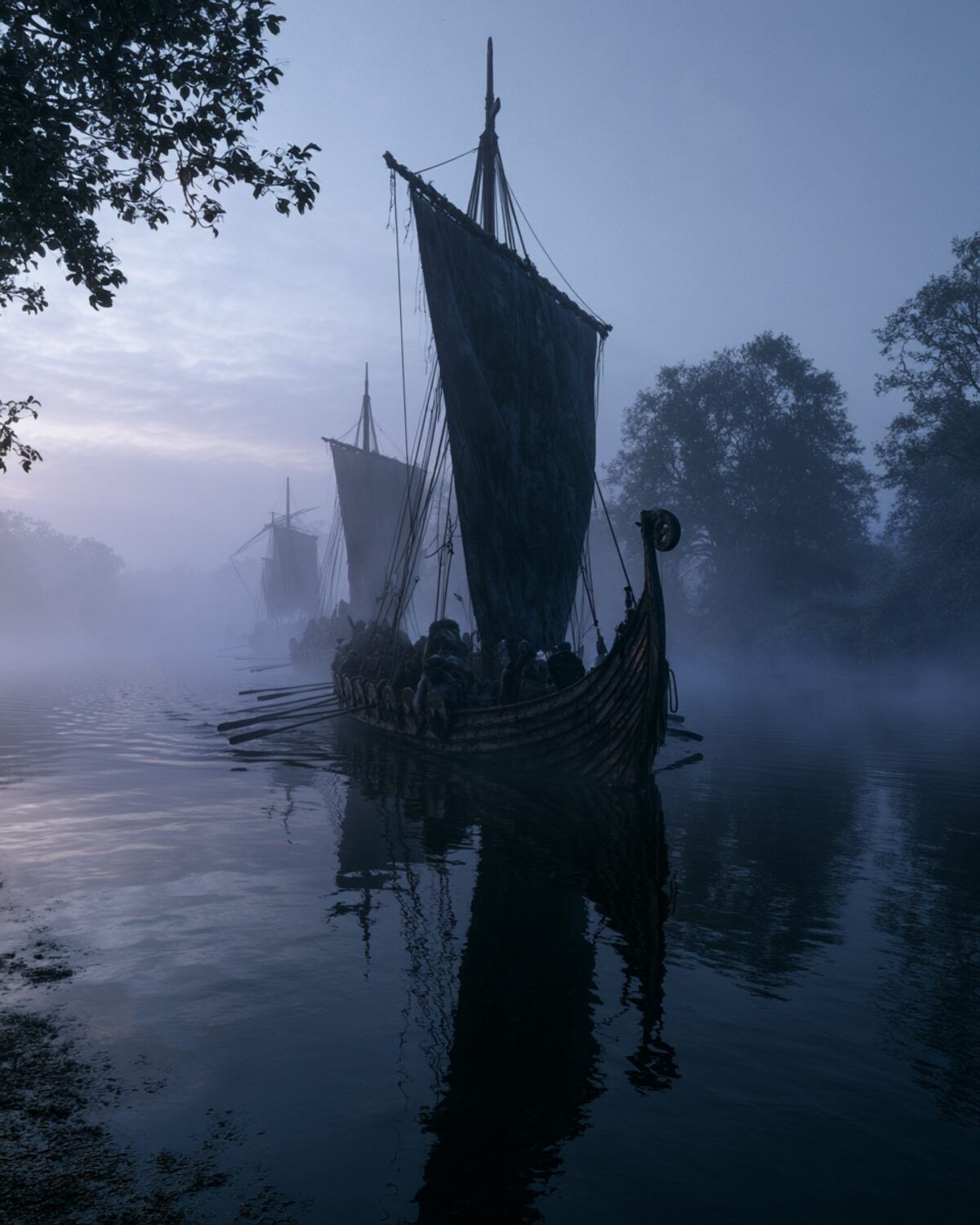
A longship had no cabins, no bunks and no permanent roof. So where did the crew sleep: on the rowing benches, under a tent, ashore? The question sounds simple, but the evidence is thin and scattered: remains of tent frames from graves, verses from skaldic poetry, a handful of passages in Danish and Icelandic texts of the 12th and 13th centuries. Added to that are the experiences of modern replica crews, which are valuable but cannot stand in for a Viking Age source. This article separates the layers and says openly where we can only guess.
From Viking Age ships we have hulls, planks, nails, mast steps and occasionally pieces of equipment. From the people aboard we have almost nothing direct. Nobody kept a diary on a longship, and the sleeping places of a crew leave no trace in the ground. Anyone who wants to know how men, and occasionally women, spent a night at sea or in a strange bay has to read four very different kinds of evidence together: grave finds, poetry, narrative texts and modern experiments.
Each group has its own weakness. Grave finds show what was given to the dead, not necessarily what a raiding voyage needed. Skaldic verse is praise poetry with fixed imagery. The sagas were often written generations after the events, and the Danish sources of the 12th century describe fleets of their own time. Replicas, finally, answer the question of what is possible on such a hull today, not what was usual a thousand years ago. Every statement below therefore carries its provenance.
The Gokstad ship from Norway, which we discuss on a page of its own, measures just over 23 metres in length (sources give anything from 23.2 to 23.8 metres) and just over five metres in beam, by commonly given figures. It had 16 rowing stations, which means 32 oars. The deck was not a fixed surface but loose planks resting on ledges of the crossbeams. There was no cabin of the kind known from later merchant ships. I have read the dimensions and the deck description only in a summary, not in the excavation publication.
One sober consequence follows for the sleeping question: whoever slept aboard slept in an open hull. There was room between the crossbeams and over the loose deck planks, but not much. This differed greatly by ship type. A slim warship like Skuldelev 2 offered dozens of men little space; a broad cargo vessel, the knarr (a high-sided freighter, see ship types), had a cargo hold amidships and smaller deck areas at the ends. For the crew of a knarr, the sources I could consult contain no explicit statement about sleeping. Whether there were fixed sleeping places cannot be shown.
The difference between voyage and layover matters. A longship under sail or oar was a workplace where every square metre was needed. When it lay still, at anchor, in harbour or hauled up on a beach, the situation changed. The sources we examine next deal almost exclusively with this second state.
The only solid archaeological remains connected with tents on Viking Age ships come from two Norwegian ship graves. The Oseberg grave (see Oseberg) contained wooden parts that the excavation report by Brøgger and colleagues, published between 1917 and 1927, interpreted as tent frames. I know this report only through the description of a modern reconstruction by the Hurstwic authors, who reproduce it at length.
According to it, nine pieces, all of ash, belong to the smaller of the two tents: four "shear legs" of about 4.10 metres, each with a carved animal head at the top, two transoms of about 4.50 metres, two long ground poles of roughly 5.60 to 5.70 metres, and a ridge pole of about 5.05 metres. Some pieces have small paired or triple holes, interpreted as fastenings for the fabric. A single wooden locking peg survives. The animal heads of the shear legs were painted; according to the report, one was bright yellow with black lines. The frames themselves no longer exist; they decayed after excavation.
The gaps matter just as much. No fabric could be securely identified as tent cover; linen survives in the grave, but not recognised as a tent roof. There also seem to have been two similar tents, and parts of the larger one may have ended up in the assembly of the smaller. Some pieces may be misassigned, and the ridge pole looks strikingly slight for the load of a tent. So this is a frame whose form had partly to be inferred, and the tents displayed today are reconstructions on that uncertain basis.
Whether these tents stood on the ship itself, in a land camp or at a festival site, the find does not say. The carvings, too, point to a prestige object: a tent with painted animal heads probably belonged to a person of high rank. It does not serve as evidence for the everyday sleeping of an ordinary crew.
According to a summary relying on St. Clair (2018), the Gokstad grave also held a tent among its goods, beside three small boats, a sledge and riding equipment. Two "tent boards" from the burial chamber are on display in the museum according to the same text, without an individual source being named. For the dimensions and construction of the Gokstad parts, I found no information in the texts I consulted. A later overview is said to summarise the tent frames of both ship graves; I could not read that either.
The Gokstad grave is also known for a bed in which the dead man lay. This is sometimes confused with sleeping aboard, but it has nothing to do with it: it was a grave bed in a timber burial chamber. Reading it as a "ship bed" transfers a burial custom onto seafaring. More in our article on the Gokstad ship.
The older written trace leads into poetry. The researcher Rikke Malmros, whose article the Viking Ship Museum in Roskilde published on 8 July 2007, collected several stanzas in which tents and ships meet. I give them as she renders them; I have not read the Old Norse originals myself.
In the Haraldskvæði of around 900 (Malmros: tenth century), Harald Fairhair has "foam-covered tents" at his disposal. Sigvatr Þórðarson calls Olaf Haraldsson the one who destroys the "black tent-horse"; in her reading the tent-horse is the ship. In Arnórr, Magnus the Good leads ships onto dark seas or spends much of his time "under the foam-covered tent". A jarl of Orkney "wore the black tent" when away from the islands, and Þjóðólfr Arnórsson has Harald Hardrada "sling the long tent off him" off Nidaros. Malmros regards the Orkney passage as the clearest example that tents were used while sailing.
Two things must be kept apart here. The verses are regarded as poetry of the 10th and 11th centuries, preserved in later manuscripts, and are cast in kennings, the encoded circumlocutions of skaldic verse. That "tent" in such images points to a cover over the ship is Malmros's interpretation. A kenning can also be figurative: a "black tent" might simply mean the dark silhouette of the ship or the sail. The verses alone cannot settle this. Her reading is supported, however, by later prose texts in which tents aboard are explicitly mentioned.
Things become more concrete with Ælnoth, a 12th-century author whom Malmros names among the Danish sources. She cites him in Hans Olrik's translation: with the king's permission the men weigh anchor, take down the tents that had been put up, raise the masts and set sail. The Latin phrase is tentoria superaffixa, "tents fixed on top". It is usually read to mean that the tents stood on the ships. Malmros notes that Olrik's translation does not express this unambiguously and that another Danish translation seems wrongly to place the tents on land. A practical problem appears: the location of the tents depends on the translator, and I could not check the Latin myself.
A second example appears in Saxo Grammaticus and, almost identically, in the Knytlinga saga (chapter 120). King Valdemar and his men pitch tents on their anchored ships off the coast of the Wends and take a nap after the meal. Archbishop Eskild rebukes them for lying as if in graves instead of fighting. Malmros infers that the tents may have been low and elongated, like gravestones or burial mounds. That is a conjecture about imagery, not evidence for shape. What counts as evidence is this: two sources report that in the 12th century tents stood on anchored Danish warships and the crew rested beneath them.
From the early 13th century Malmros names Sverris saga and the Böglunga sögur: when a ship was cleared for battle, the tents were taken down. From the time of Håkon Håkonsson she cites a passage saying that the gunwale of a new ship was as high as the "telt-ås", the tent spar, of an older one. She reads it as a hint of a longitudinal beam amidships under the sail. This too is interpretation. All that is secure is that the Norwegian royal fleet of the 13th century had a word for such a beam.
A find of such a tent spar aboard is not known to me, and Malmros names no archaeological find in her article. For the Viking Age in the narrow sense, the 8th to 11th centuries, the evidence is very thin. The prose sources are later, the verses are ambiguous, and the graves of Oseberg and Gokstad show tents, but not their use at sea.
In books, museum shops and re-enactment groups one often meets the Viking fur sleeping bag. The Old Norse dictionary knows a word usually rendered "leather bag" or "hide sack" (húðfat); I only saw the dictionary entry in a list of search results and did not open it. What role such an item played in sleeping aboard I could not establish from the sources I read. There is no find I could safely call a sleeping bag, and no saga passage whose wording I have checked.
That does not mean such covers did not exist. It means that the statement "Vikings slept aboard in fur sacks" does not rest, in this form, on a source I have verified. The same holds for blankets, furs and cloaks as bedding. That people in the north used furs, wool and cloaks for warmth is well supported by finds of textiles and clothing (see Viking clothing). That they slept aboard with them is an obvious inference, but an inference.
Many accounts describe the crew going ashore in the evening, pitching tents and cooking at a fire. That is plausible, because a ship drawn up on a beach creates room for a camp. The sources I could consult do not confirm it, though. The passages in Ælnoth and Saxo concern anchored ships, not a land camp. Where the tents stood is, in Ælnoth's case, even a matter of translation.
Traces of a single night on a beach would hardly be expected archaeologically, and I know of no find that could be clearly assigned to such a night. How often a crew actually spent the night in the open or ashore therefore cannot be quantified. How voyages without compass and fixed charts could succeed at all is covered on our page about navigation.
Replicas of Viking Age ships have existed for a long time. The Sea Stallion from Glendalough (Havhingsten fra Glendalough) is a reconstruction of Skuldelev 2, a longship sunk in Roskilde Fjord (see Skuldelev). The Roskilde museum gives the crew for longer voyages as about 65 people; they would have slept "in shifts" and in rather cramped conditions. That is the only concrete statement about sleeping on this ship that I could read. The logbooks of the 2007 voyage to Ireland, which the museum has published, I know only as a directory: the texts themselves were not shown to me.
Notable is what prompted the tent question at the museum. Malmros's article arose because the Sea Stallion's rain-soaked passage from Roskilde to southern Norway raised the question of whether tents were spread over ships in the past. What the crew concretely experienced, the article does not say. This is also one of the limits: from a rainy voyage one cannot derive that Vikings spent their nights that way, only that rain protection is a real problem. How far present-day crews use modern clothing and safety technology varies from voyage to voyage and was not checked here. Replicas supply experience, not testimony.
The Hurstwic tent reconstruction belongs in this category too. There, 50 metres of linen at 210 grams per square metre were stretched over a frame of North American woods, two rope braces per side panel were added because the frame seemed too weak, and the animal heads were scaled down to fit. It shows well how much creative input is needed to turn remains into a usable tent. It does not show that the original looked like that.
That a crew cannot all sleep at once while the ship is sailing or lies in unsafe waters is obvious. The Sea Stallion crew slept in shifts, according to the museum. For the Viking Age itself I have seen no source describing a watch order, watch times or sleeping shifts. The assumption that they existed follows from the circumstances, not from testimony.
The distribution of places aboard is a similar field. The Gokstad ship had 16 rowing stations; whether each place was assigned to a fixed crew member is a question for maritime research that I cannot document here. On watch order and sleeping places see also our pages on longships and shipbuilding.
A short example shows how slim the wording is on which the tent question rests. It is my own English rendering of Malmros's English version, not the Old Norse text.
"… foam-covered tents stood at his disposal."Haraldskvæði (Hrafnsmál), stanza 5, around 900, about Harald Fairhair (in Malmros: “ræðr tjöldum drifnum”); own wording after the English rendering by Rikke Malmros, Viking Ship Museum Roskilde, 2007 (original not read by me)
The situation can be described in three steps. First: there were tents with frames, deposited in high-ranking graves; Oseberg is best documented, Gokstad less so. Second: skaldic verses from the 10th century onward that link tents with ships probably indicate that tents were known on ships. Third: in the 12th and 13th centuries prose sources report tents on anchored warships, taken down before battle.
What remains open is how far these steps may be transferred to the Viking Age in the narrow sense and to ordinary crews. That concerns whether simple rowers had tents, whether a tent aboard covered the whole ship or only part, whether it stood at sea or only during layovers, and what served as bedding. For none of these questions do I know a source that answers clearly. Anyone who claims it is "established" what this looked like goes beyond what can be shown.
Did longships have cabins? None is known on the ships I discussed. The Gokstad ship had loose deck planks and rowing stations, according to the figures I read, but no sleeping room.
Were tents up while sailing? A skaldic stanza about an Orkney jarl is read that way. For the Viking Age as a whole it is not established.
Is there archaeological proof of sleeping bags? Not in the sources I read. An Old Norse word for a hide sack exists, but I could not document its use for sleeping aboard.
How did the Sea Stallion crew sleep? According to the Viking Ship Museum, in shifts and in cramped conditions with about 65 people. I could not read further details from the logbooks.
Were there watches? Probably, but I found no testimony for a Viking Age watch order.
Longships · The Gokstad ship · Oseberg · Skuldelev · Viking ship types · Shipbuilding · Clothing · Navigation

The longships · The Gokstad Ship · The Oseberg ship & the two women · The Skuldelev ships · Viking clothing & fashion.
All History & Finds articles →
Many lists of Viking weapons give the sling a passing clause: cheap, everywhere, surely in use. Test the evidence piece …
Read more →A sainted king, a murdered bishop, a castle builder and a peace treaty: these are the ingredients of the story of the …
Read more →A great deal has been written about Viking swords: about pattern welding, about inlaid blade inscriptions, about hilt …
Read more →The Scordisci were a tribal confederation at the confluence of the Sava and the Danube, on the ground where Belgrade …
Read more →