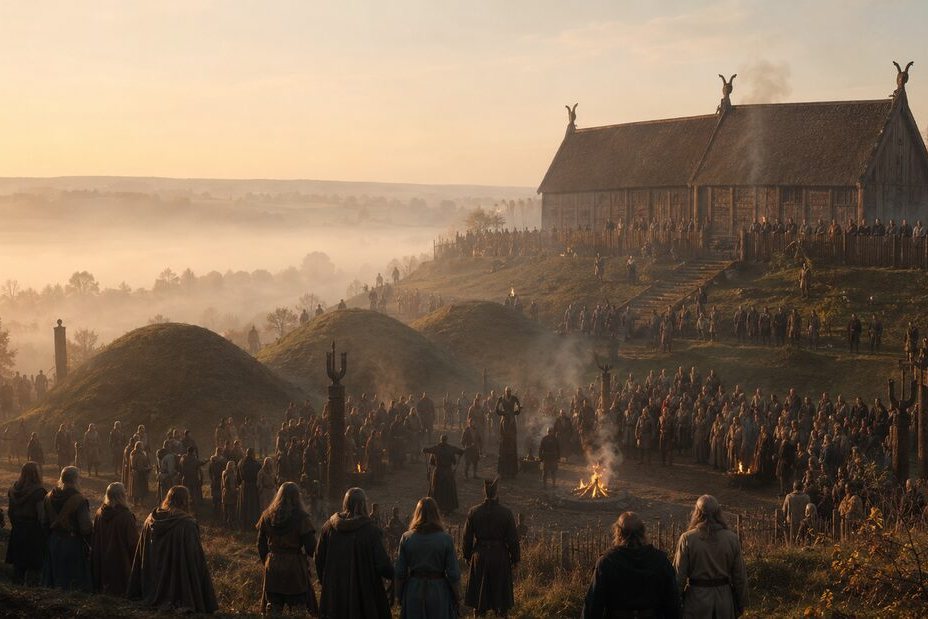
A sainted king, a murdered bishop, a castle builder and a peace treaty: these are the ingredients of the story of the three "Swedish Crusades" to Finland. It can sound like the last Viking voyage east, but it does not belong to the Viking Age. The events begin around 1150 at the earliest, in the Christian high Middle Ages, and the count of "first, second, third" is modern. This article separates what contemporaries recorded from what legends and rhymed chronicles told generations later, and shows why scholars still argue over whether the word crusade fits at all.
By the usual convention the Viking Age ends in the late eleventh century. There is no fixed end date, though 1066, the year of Stamford Bridge and Hastings, often serves as a marker. Even the earliest date offered for the supposed first expedition to Finland lies about three generations later. Anyone sailing east from Sweden around 1150 came from a realm with Christian kings and bishops and, if the tradition is right, invoked a missionary purpose.
The confusion is understandable. The same sea lanes had carried people east for centuries, as the articles on Vikings in the Baltic and the Ingvar stones show. But castles, papal letters, dioceses and a border treaty with Novgorod belong to another era. Finland adds a further problem: written sources start late here, and that is exactly what makes the subject hard.
No medieval author speaks of a "first" or "third Swedish crusade". In his entry on Finland in the encyclopedia The Crusades (2006), the historian John H. Lind traces the scheme to a tradition founded by the Swedish historian and poet Erik Gustaf Geijer (1783–1847), for whom the Swedish conquest of Finland came about through three successive crusades. Lind ties the label "Crusade Age" for roughly 1150 to 1350 to the same tradition.
The scheme turns a long, uneven process into a tidy sequence. The "third crusade" shows this best: according to Lind the name covers a whole series of attacks, not one campaign. The larger label is retrospective as well. In her 2021 article Caroline Wilhelmsson, citing Eric Christiansen, notes that "Northern Crusades" is a scholars' term. Lind himself still uses the numbers, but in quotation marks. This article does the same.
The story of the first expedition is quickly told. King Erik, later called Erik the Saint, sails against the Finns together with Bishop Henry, many accept baptism, and the bishop later loses his life. It comes from the Life of St Erik, a saint's legend whose surviving form is generally placed in the late thirteenth century. According to the Bergen catalogue of medieval Nordic Latin texts, its oldest witness together with the miracle collection is the Registrum Ecclesie Upsalensis of 1344. Some scholars argue for an earlier text, so opinion is not unanimous.
That puts some 100 to 150 years between the event and its description. A saint's life also exists to promote veneration rather than to report. It is meant to show that its subject was holy. The legend gives no precise year. According to English Wikipedia nearly every year of the 1150s has been proposed, most often 1150, 1155, 1157 and 1158. Lind gives 1155–57 as the usual dating, reasoning that the Life has Erik set out as king and that his predecessor died around 1155/56.
Erik himself stands on firmer ground. That he was killed around 1160 and soon counted as a martyr is supported by sources older than the legend: according to the Bergen catalogue the Vallentuna Calendar of 1198 notes his sanctity, and Lind likewise points to a cult in place by 1198 and infers that some version of the Life probably existed by then. Whether it contained the Finnish expedition cannot be firmly established. I know of no archaeological proof of the campaign; English Wikipedia flatly denies there is any, though without a citation. Wilhelmsson wonders whether a dip in activity at the Lieto hillfort in the twelfth century might be connected. That remains her hypothesis.
Henry is regarded as the patron saint of Finland. Tradition makes him an English-born bishop of Uppsala. The Bergen catalogue dates his legend to the 1290s and the accompanying liturgical office probably to between 1292 and 1296, about 140 years after his supposed death. Tuomas Heikkilä, who produced the standard edition, holds that the Life contains almost nothing concrete about Finland and could have been written anywhere. That is how English Wikipedia reports his views; I could not consult the book itself.
Outside the legend the record is thin. No contemporary source confirms that a bishop called Henry lived in Finland. According to English Wikipedia, papal letters mention an unnamed bishop of Finland from 1209, but the first holder of the office securely known is Thomas in 1234. The linguist Mikko K. Heikkilä therefore asks in his 2016 book whether Henry was a historical person at all; I have read only the publisher's abstract of it, not his answer.
A letter of 1298 from the archbishop of Uppsala offers a clue about timing. According to English Wikipedia, citing Martti Linna's source collection Suomen varhaiskeskiajan lähteitä (1989, p. 113), it names Erik and Henry as martyrs and seeks their intercession in the war over Karelia, which had begun in 1293. So the cult gained weight in the years Sweden was fighting there. One may suspect that the legend of the first crusade helped to justify the third. That inference is this article's, not a statement of Linna's known to me.
The best-known scene in Henry's story does not appear in the Life. There the bishop is killed, "ipsumque crudeliter trucidauit" in the Latin, but according to English Wikipedia, drawing on Tuomas Heikkilä, the text gives neither the place nor the name Lalli. Lalli, the peasant who cuts him down with an axe on the ice of Lake Köyliö, comes from the Finnish folk poem on the bishop's death. Its date is uncertain and the statements vary. According to the same account, Köyliö as the scene appears only in a fifteenth-century bishops' chronicle, and finds on Kirkkokari island suggest veneration only from the second half of the fourteenth century.
Lalli himself is therefore not attested. A farm called "Lallis bolstadh" in a medieval document proves a name, not a killer. As a figure he lives on, in the folk-poetry collection Kanteletar, and his axe appears beside Henry's mitre in the arms of the former municipality of Köyliö. That helps explain why the scene is so often told as fact.
Set the legends aside and the twelfth century leaves few but genuine traces. The Novgorod First Chronicle reports under 1142 that a "Knyaz of the Svei", a prince of the Swedes, with a bishop and sixty boats fell upon merchants, Novgorodian ones according to Lind. The entry does not say where the fleet was bound. Lind thinks Finland conceivable, because it was not heading for Novgorod.
The key document is a letter of Pope Alexander III, known from its opening words as Gravis admodum. The Finns, he complains, promise the Christian faith whenever an enemy army threatens and ask for preachers; when the army leaves, they deny the faith and persecute the preachers. It is addressed to the archbishop of Uppsala, his suffragans and Jarl Guthorm. Lind dates it to 9 September 1171 or 1172 and calls it the first source giving secure knowledge of Swedish crusading activity in Finland; Wilhelmsson lists the same text under 1165 (SDHK 207). So the statements differ here. The content matters more than the year: well before the legends, the Curia knows of military pressure on the Finns and of a faith that does not hold. The excerpts available to me name neither a King Erik nor the year of any particular campaign.
South-western Finland was also evidently not simply pagan. Lind points to linguistic and archaeological signs of an older Christianity, and Wilhelmsson names the church at Ravattula as possibly the earliest church building in Finland. From this Lind draws a far-reaching thought: the expeditions may have aimed less at converting pagans than at bringing existing Christians under the control of the Western Church.
Scepticism does not mean the expedition was certainly invented. Lind argues exactly this in "The 'First Swedish Crusade' against the Finns" (2015). He warns against simply discarding the Lives and sets the campaign in the framework of the Second Crusade of 1147. The wording of Gravis admodum reminds him of Bernard of Clairvaux's slogan against the Wends, who were to accept the faith or perish; the article on Vikings and Slavs leads into that setting. Lind therefore does not rule out a date earlier than usually assumed, in response to the calls for the Second Crusade, without committing himself to it. English Wikipedia, drawing among others on Olesen, assumes only a short undertaking and says yearly summer expeditions gave Sweden no lasting control.
The debate therefore does not end in "real" or "fake". An armed expedition under Erik remains possible. A conquest of Finland around 1150 is not documented.
Birger Magnusson, known as Birger Jarl, was one of the most powerful men in thirteenth-century Sweden. His campaign against the Tavastians (Finnish Häme, the people of central Finland) long had a firm place in the calendar: 1249. The only detailed medieval source is Erik's Chronicle, a fourteenth-century Swedish rhymed chronicle that Wilhelmsson calls the oldest surviving Swedish chronicle. It tells the story about a century later and names no year. It merely places the campaign between the battle of Sparrsätra (1247) and King Erik's death (1250). The figure 1249 comes, according to English Wikipedia, from one edition of the Finnish bishops' chronicle by Paulus Juusten.
As early as 1852 Peter Andreas Munch objected that the saga of Hákon Hákonarson keeps Birger on the Norwegian border until summer 1249. In 1926 Rolf Pipping accused Munch of misreading the saga and defended a date between 1247 and 1250. In 1946 Jarl Gallén moved the campaign to 1238/39 (Wilhelmsson shortens this to 1239), arguing that the chronicle contains obvious chronological errors; this puts it after Pope Gregory IX's letter of December 1237, which cites an alleged Tavastian uprising. Gisela Nordstrandh read the chronicle in 1990 as poetry that arranges episodes deliberately rather than by the calendar. Lind joined the early dating in 1991 and wrote in 2006 that the campaign must have taken place in 1238/39. In the chronicle, he notes, Birger is called "forman" here, a leader acting for the king, so he could have led the expedition before becoming jarl in 1248.
The question has consequences. On the early dating, the Tavastian campaign comes before the Swedish defeat on the Neva in 1240 at the hands of Alexander of Novgorod. On the late dating, after it. Opinion is not unanimous: Wilhelmsson cites Christiansen for 1249 but says many modern scholars reject that year, and she finds 1239 more coherent. Dick Harrison, according to Wikipedia, also finds the early date more probable. That Innocent IV took Finland under his special protection in August 1249 without mentioning Sweden shows how unclear Sweden's position there still was.
Line and Lind suspect the campaign was rather unspectacular, given the silence of contemporary sources. The effect can be grasped: from 1249, according to English Wikipedia, Finland Proper and Tavastia generally appear in the sources as part of Sweden.
Erik's Chronicle mentions a "taffwesta borg". Tradition identifies it with Häme Castle in Hämeenlinna. That identification lacks hard proof. According to Wikipedia a royal document of 1308 knows only one castle in Häme, and Wilhelmsson reports Jussi-Pekka Taavitsainen's case for the Haga hillfort (Finnish Hakoinen), about seventeen kilometres from Hämeenlinna, as the "taffwesta borg"; English Wikipedia also considers Hakoinen more likely. The age of today's Häme Castle is disputed. Birger Jarl as its builder cannot be presented as secure.
From here the record thickens, because both sides are writing. King Valdemar had already obtained a crusading bull against the Karelians from Pope Alexander IV (1254–1261), according to Wikipedia after Karelian raids in 1257. The campaign itself came only under the marshal Torkel (Tyrgils) Knutsson, who founded Vyborg in 1293 at the harbour and market of Suomenvedenpohja. According to Lind the fortress blocked the entrance to the river Vuoksi. The castle stood on the site of an older, burned Karelian fort, as Taavitsainen writes according to Wikipedia. Lind sees a major motive in the wish to control the trade routes to Novgorod.
The other side noted it briefly:
"The Svei, 800 of them, came in arms to ravage, 400 went against the Korel, and 400 against the Izhera […] The Svei having come put up a town in the Korel land."Novgorod First Chronicle, entries for 1292 and 1293, in the public-domain English translation by Robert Michell and Nevill Forbes (1914), wording here as quoted by Wilhelmsson 2021, p. 64 (citing Michell/Forbes p. 111).
These lines say nothing of a crusade. That the chronicler had Rome in view is clear from the entry for 1300: the introduction to the 1914 edition quotes from it the "special master from the great Pap of Rim", a papal envoy with the Swedish army.
The rest follows a familiar pattern of castle and counter-attack. According to English Wikipedia, drawing on Erik's Chronicle, Novgorodian forces besieged Vyborg in vain in 1294. A Swedish garrison at Karelian Kexholm (Korela) was destroyed; English Wikipedia says 1294, an account following the Russian and Swedish annals 1295. In 1300 Sweden built the fortress of Landskrona on the Neva; in 1301 Novgorod took and razed it. Some of the details come from a single partisan rhymed chronicle. According to the same account, King Birger justified the war in a letter of 4 March 1295 by long-standing robbery and the mistreatment of Swedish travellers.
On 12 August 1323 Sweden and Novgorod made peace on the Neva island of Oreshek (Swedish Nöteborg, Finnish Pähkinäsaari). King Magnus Eriksson was seven years old. The Karelians and other peoples affected had no part in the talks. Lind calls the outcome the first fixed border between Sweden and Russia. Novgorod ceded three parishes to the Swedes: Savilahti, Jääski and Äyräpää. According to the account based on Kimmo Katajala and on Gallén and Lind, 18 border points define the line; the southern part across the Karelian Isthmus is described precisely, the northern part vaguely. Its end reads "nor i haffuit" in the Swedish text, "Kajano more" in the Russian, "Helsingh haff" in the Latin.
The original is lost. We know the treaty only from copies, which differ from one another. This is one reason the debate over the north has run since the nineteenth century. Did the line lead to the Arctic coast, to the White Sea or to the Gulf of Bothnia? Building on Gallén's work, Lind proposed a further solution in the 1990s: the treaty drew two borders, with a broad zone of common land in northern Ostrobothnia and Lapland between them. That is how English Wikipedia reports it. In the north, then, the 1323 treaty would not be a sharp line on a map. Until the Treaty of Teusina in 1595, according to Wikipedia, Russian–Swedish treaties kept confirming this border.
The conflict was not over in 1323. Magnus Eriksson led another crusade against Novgorod (Lind: 1347–1351) and took Nöteborg in August 1348, but the castle was lost again as early as 1349. For Finland, according to Lind, it had little importance.
Whether the Swedish expeditions meet the definition of a crusade has, according to Wilhelmsson, long been disputed; she refers to Lind's 2005 piece on Scandinavian crusade historiography. The answer differs from one campaign to the next. For Erik I know of no papal call. For the Tavastian campaign only the early date offers a suitable papal letter, as Dick Harrison argues according to Wikipedia. For the Karelian war, papal backing and the envoy of 1300 come closest to showing that contemporaries saw it that way.
Nor were the motives purely religious. Lind stresses that the Swedes saw themselves as fighting paganism, yet trade interests helped shape their policy towards Novgorod. His conclusion is sober: the main lasting result was the integration of Finland into the Latin West. Unlike the Germans in Livonia, he writes, the Swedes never tried to dominate the local population. In the long term the Finns fared better than the Wends, since they kept their language. In Sweden itself the crusades left few traces.
Lind describes the process as the incorporation of Finland over about 150 years, not as three thunderclaps. English Wikipedia accordingly calls the second campaign an unusually bloody phase of that incorporation rather than a war of conquest. Martti Linna's works of 1989 and 1996 belong to this conversation; what he writes about the term crusade itself I could not consult, so I do not report it.
Were the Swedish Crusades part of the Viking Age? No. By common convention the Viking Age ends in the late eleventh century, while the campaigns are dated from about 1150.
Did the first crusade really happen? That cannot be firmly established. The legends are late, but the twelfth-century papal letter shows military pressure on the Finns. Lind considers the campaign possible; others allow at most for a short foray.
Did Bishop Henry exist? That remains open. No contemporary mention exists, and the legend was written in the 1290s.
Why is the year 1249 disputed? Erik's Chronicle gives no year, and the figure comes from Juusten's bishops' chronicle. Gallén and Lind place the campaign in 1238/39.
What did the Treaty of Nöteborg settle? In 1323 it fixed a border between Sweden and Novgorod for the first time. The south is described precisely; the northern end is still debated.

Finland in the Viking Age: at the heart of the Baltic network, but was it Scandinavia? · The Kvens · The Christianisation of the Germanic Peoples · The Varangian route.
All History & Finds articles →
A great deal has been written about Viking swords: about pattern welding, about inlaid blade inscriptions, about hilt …
Read more →The Scordisci were a tribal confederation at the confluence of the Sava and the Danube, on the ground where Belgrade …
Read more →Seven names stand side by side in one line: Harudes, Marcomanni, Triboci, Vangiones, Nemetes, Sedusii, Suebi. Six of …
Read more →Some peoples leave behind vast empires. Others leave behind a single sentence. The Segusiavi managed neither, but they …
Read more →