A runestone in central Jutland was raised by a queen in memory of her mother. She writes in Norse runes and calls herself the wife of Harald, son of Gorm, and the daughter of a man with a Slavic name. That small inscription already holds most of what defines the relationship between Scandinavians and Slavs: closeness, politics, and two worlds that refuse to separate cleanly. This article does not retell the individual sites. It cuts across them and asks how the relationship actually worked. Who traded with whom, who married whom, who raided whom, and who in the end sold whom? The answers are less one-sided than the familiar picture of the Viking and his Slavic victim would suggest.
"Vikings" and "Slavs" are umbrella terms, and both imply a unity that did not exist. The people in this story thought of themselves as Danes, Gotlanders or people of Birka, as Obodrites, Rani, men of Wolin or Krivichians. There was no single Slavic nation acting as one on the Baltic, any more than a Scandinavian one. The Obodrites around Wismar and the Lutici further east were often at odds, and rival Danish claimants could fight each other just as bitterly.
Most of the names also come from outsiders. Saxons and Franks spoke of Wends, Norse texts of Vindr and Vindland. Arabic writers used Saqaliba, a particularly slippery word: it can mean Slavs, but it often covers many more peoples of eastern and central Europe. In 922 Ibn Fadlan calls the king of the Volga Bulghars "king of the Saqaliba", although those Bulghars were not Slavs. In the ninth century Ibn Khurradadhbih even describes the Rus as a kind of Saqaliba.
The evidence is lopsided too. The Baltic Slavs of the Viking Age left no history of their own. We know them from Frankish annals, Saxon and Danish chronicles and the sagas, which means almost always from opponents or missionaries. Archaeology corrects some of this, but it can rarely tell us what language a person spoke. A Slavic bowl in a grave does not make the dead woman a Slav.
The Sønder Vissing stone, DR 55 in runological catalogues, dates from the second half of the tenth century. Its text is short and remarkably exact.
Tófa had the monument made, Mistivi's daughter, in memory of her mother, the wife of Harald the Good, son of Gorm.Sønder Vissing runestone (DR 55), second half of the 10th century, my own translation from the Old Norse normalisation in Rundata: "Tófa lét gera kuml, Mistivis dóttir, ept móður sína, kona Haralds hins góða, Gorms sonar."
Grammatically, "wife of Harald" refers to Tófa herself, not to her mother: the patron is the consort of Harald Bluetooth. Her father appears in runes as mistiuis. Scholars usually identify him with the Obodrite prince Mstivoj. Whether the Billung or Billug named in other sources is the same man or a relative is a matter on which accounts differ. The stone itself says nothing about Obodrites, so the identification is well argued but inferred.
What matters is what the inscription shows: a woman with a Norse name who defines herself through a Slavic father and a Danish husband, using the script and monument type of her new surroundings. Whether she was born Tófa or took the name in Denmark, we do not know. More on the marriage and its political purpose is in our article on Harald Bluetooth.
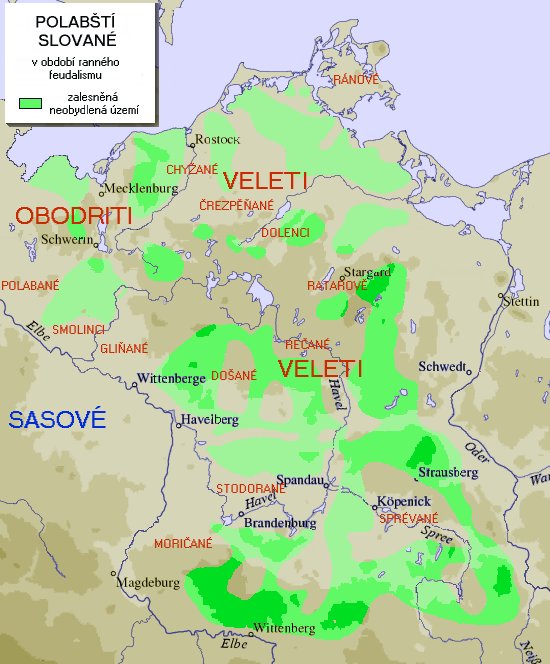
The first well-dated chapter of this relationship is set on the Bay of Wismar. The Royal Frankish Annals report for 808 that the Danish king Godfred marched into Obodrite territory, destroyed the trading place of Reric, took the merchants with him and sailed with his fleet to the harbour of Sliesthorp on the Schlei. The following year, the annals say, Godfred's men killed the Obodrite prince Thrasco at Reric, after he had handed over a son as a hostage.
This is often told as a Viking attack on the Slavs. The annals describe something else. The Wilzi, Slavic neighbours and old enemies of the Obodrites, joined Godfred of their own accord, according to this account, and the Linones and Smeldingi went over to him as well. Thrasco's Obodrites, by contrast, were allies of the Franks. So the front ran between two camps, each with Slavs in it. The Obodrites paid heavily: Godfred had one of their leaders, Godelaib, hanged and made two thirds of them pay him tribute.
The probable site at Groß Strömkendorf fits this mixture. Its tree-ring dates begin around 735 and end in 811. The dominant pottery is Slavic Sukow ware, joined by Norwegian schist whetstones and, in the cemetery, boat graves with iron rivets of Scandinavian construction.
Who is the guest and who the host? At the trading places of the southern Baltic this is hard to answer, and that is exactly the finding. At Ralswiek on Rügen most of the pottery is Slavic, along with objects of Scandinavian form. According to the find catalogue, the silver hoard from one of the houses holds at least 2,211 coins and fragments, the latest struck in 841/842.
At Menzlin on the Peene, Ulrich Schoknecht found eight small ship-shaped stone settings, a grave form familiar from Scandinavia, as well as oval brooches and an iron ring with Thor's hammers. Yet some remains of women in Scandinavian dress were placed in vessels of Slavic make, and after the site ended, life on the Peene went on in Slavic form.
The balance of size shows most clearly at Wolin. Around 1075 Adam of Bremen calls the town of Jumne the largest in Europe, inhabited by Slavs and other peoples. That is an exaggeration, but it shows the direction of his gaze: the greatest Baltic port he describes lies in Slavic territory and is run by Slavs. According to Adam, the deposed Harald Bluetooth fled there around 985/87 and died of his wounds. A fallen Danish king took refuge in a Slavic town.
The closeness also shows in technology. The Ralswiek boats are clinker-built, with overlapping planks like Scandinavian ships, but their joints rely heavily on wooden treenails of the kind known from West Slavic boatbuilding. For Wolin, the excavator Wojciech Filipowiak noted that the boat finds are almost all local builds, not Norse longships. The Baltic Slavs were no landlubbers waiting for foreign ships. They built their own and adopted what worked next door.
One word travels the same way, against expectation. Old Norse torg, "market", which survives in Swedish and Norwegian torg and Danish torv as the word for any market square, is generally taken as a loan from Slavic, related to Old East Slavic tŭrgŭ, trade or marketplace. So the Vikings did not simply bring trade to the Slavs. For the very place of trade, they took a word home from the east.
Exchange also reached the eastern Danish islands, as Anna-Elisabeth Jensen's work on South Zealand, Lolland-Falster and Møn shows. Slavic place names are attested there, and the pottery is dominated by so-called Baltic ware, which has a Slavic character. The village of Tillitze combines a Slavic name with Norse runic inscriptions. Jensen describes these islands as a buffer zone of the Danish crown, lacking key signs of royal power such as early monasteries, international trading places and central royal seats. How many people there spoke Slavic, and for how long, cannot be clearly established.
Tove was no isolated case. Thietmar of Merseburg, a well-informed contemporary, reports that a daughter of Mieszko I of Poland and sister of Bolesław married Sweyn Forkbeard and bore him two sons, among them Cnut the Great. He gives no name. The modern label Świętosława is a disputed reconstruction, and the identification with the Sigrid of the sagas remains uncertain. On Thietmar's word, the ruler of the North Sea empire had a Polish mother, as our article on Cnut the Great discusses.
The web grows denser in the eleventh and twelfth centuries. The Obodrite prince Gottschalk married Sigrid, a daughter of the Danish king Sweyn Estridsson. Their son Henry grew up in Denmark after the uprising of 1066, in which Gottschalk was killed; he returned with Danish help and from 1093 ruled a broad Slavic territory. According to Saxo, when King Niels took his mother's lands in Denmark from him, he raided the south of the country.
The next generation is more tangled still. The Danish prince Canute Lavard was recognised by Emperor Lothair III as ruler over the western Wends. He married Ingeborg, daughter of Grand Prince Mstislav of Kiev and the Swedish princess Christina. Canute was murdered in 1131, days before his son was born. The mother named the child after her grandfather, Vladimir Monomakh: Valdemar. This Danish king with a Rurikid name took the Rani sanctuary at Arkona in 1168 with Bishop Absalon. The man who destroyed this pagan centre of the West Slavs was himself descended from Kievan princes and from a recognised lord of the Wends. What drove such wars was not a clash of peoples but rule, tribute and faith.
These marriages were treaties, and they did not prevent war. The sources say very little about the women themselves; Tove is the rare exception because she raised a stone herself.
It was not only brides who changed sides. At Bodzia in Kuyavia, near the Vistula close to Włocławek, Polish archaeologists uncovered a cemetery of chamber graves in use from about 980/990 to 1030. The grave goods include Viking-type swords, western European coins and knives, and many parallels to Kievan Rus and Scandinavia. The finds include a sign, a bident with a cross, which the excavators, Andrzej Buko and Iwona Sobkowiak-Tabaka, read as presumably indicating a link to the Rurikids.
Their reading: these were elite warriors and their families, among them migrants from Scandinavia and, as the authors note with a question mark, perhaps from Kievan Rus, who belonged to the leading stratum of the Polish state as allies of the early Piasts. That is an interpretation rather than a fact attested in writing, but it fits a picture in which Scandinavian warriors also served Slavic rulers.
Popular imagination mostly knows the dragon ship off the defenceless coast. For the southern Baltic that is only half the truth:
1043. Magnus the Good, king of Norway and Denmark, destroys Jomsborg and plunders Jumne, according to the saga tradition. Soon after he defeats a Wendish army on Lyrskov Heath near Hedeby. The army sizes and death tolls in later texts are unreliable; Heimskringla was written almost two centuries afterwards.
1066. West Slavic forces burn Hedeby, in the same year that the uprising costs Gottschalk his life. The town on the Schlei does not survive for long; its people gradually move to the opposite shore, where Schleswig grows up.
1135. The Pomeranian duke Ratibor attacks Konungahella, today's Kungälv in Sweden and then a Norwegian trading town. Snorri speaks of 550 ships with 44 men and two horses each, which nobody takes literally any more. The historian Roman Zaroff reckons with a fraction of that, some 50 to 70 boats and 1,000 to 1,500 men, and dates the raid to 10 August 1135. The town burned and survivors were carried off into captivity. Snorri wrote in the following century that the merchant town never regained its former importance. Zaroff disagrees: the place was rebuilt slightly further west and still mattered later in the twelfth century.
12th century. Helmold of Bosau depicts Denmark as a land whose islands suffer under Slavic pirates. He is partisan and scorns the Slavs as dangerous pagans, while also portraying a Danish crown unable to protect its coasts. Stefan Pajung and Lone Liljefalk warn in the Danish journal Historisk Tidsskrift that his account of Rügen is at bottom as tendentious as those of Saxo and Knýtlinga saga. In such texts, Valdemar's campaigns and the fall of Arkona become a just reply; the chroniclers did not, however, invent the piracy. Our article on the Rani goes through the dates.
That Scandinavians seized and sold people is well attested, and our article on slavery among the Vikings treats it in detail. For the Rus, the Persian geographer Ibn Rusta reports in the early tenth century that they sailed against the Saqaliba to take captives and sell them to Khazars and Bulghars. In 922 Ibn Fadlan describes Rus on the Volga who bring slave women to sell. Emperor Constantine VII describes the Rus leading their slaves in chains for six miles overland past the Dnieper rapids.
Helmold offers two passages that mirror each other. For the years around 1164 he reports that Slavs fled war and famine in the Obodrite land to the Pomeranians and the Danes, and that the Danes sold them mercilessly to Poles, Sorbs and Bohemians (read in Polish translation, not in the Latin). Here Scandinavians are selling Slavs to Slavs. Conversely, Helmold (ch. 109) is said to report that on a single day at the market of Mecklenburg, 700 Danish captives were put up for sale. The historian Kurt Villads Jensen gives the year 1171 and writes that there were too few buyers that day; other accounts place the passage in 1168 and speak of high demand. I could not consult the Latin wording, so the year and circumstances remain open. The figure comes from a partisan chronicler and is no measurement. That Danes sat in Slavic captivity Helmold also confirms as an eyewitness, mentioning priests from Denmark he saw held prisoner among the Slavs (Book I, ch. 83, after Pajung and Liljefalk).
Trade also ran inside the Slavic world. The Raffelstetten toll regulations on the Danube, drawn up between 903 and 906, name Slavic traders de Rugis vel de Boemanis, from the Rugians or the Bohemians, offering wax, slaves and horses. The Rugians are commonly, though not universally, taken to be the Rus. Prague counts as a transit point for captives from the pagan lands further north, who reached Muslim Spain through France or Venice across the Alps. The business rested on a simple rule: people preferred to enslave those outside their own group or faith. On the Baltic, where these boundaries lay close together, that could strike anyone.
A market for people looks archaeologically like any other. For Ralswiek, Menzlin or Wolin specifically, slave trading is therefore likely but not directly proven.
The story is often told as a neat formula: Vikings caught Slavs, so slaves are called slaves. According to Wolfgang Pfeifer's etymological dictionary of German, "Sklave" shares its origin with "Slawe": Medieval Latin Sclavus goes back to the self-designation of Slavic peoples, which entered Latin through Greek sklabos. That is the accepted derivation.
The when and where are more interesting. Pfeifer points to ninth-century Carolingian charters from Bavarian monasteries in which Sclavus can mean both a member of Slavic tribes and an unfree person. He tentatively places the shift of meaning in the slave trade of the ninth and tenth centuries, for instance in the Balkans, and gives the tenth century for the Medieval Latin of Italy. Błażej Stanisławski and Aleksander Musin cite Ottonian charters for Magdeburg from 937 as the attestation usually named as earliest, while Michael McCormick sees the new meaning as early as 857 in East Frankish lands. Stanisławski and Musin also doubt that a real predominance of Slavic slaves lay behind it. The word's history yields no specific point of origin, let alone Viking authorship.
In German the distinction between "Slawe" and "Sklave" only settled in the eighteenth century; before that, forms such as "Schlave" circulated. The parallels are familiar: English slave, Dutch slaaf, French esclave. According to the linguist Émile Benveniste this is a common pattern: the unfree person is the foreigner, often named after the people he comes from. A late echo survives in the Italian greeting ciao, which goes back through Venetian s'ciavo, "your slave, your servant", to the same root. The direction always runs from the people's name to the word for the unfree. "Slav" itself does not mean "slave"; the origin of the name is not finally settled and is mostly connected with slovo, "word".
East of the Baltic, the balance shifts. On the Volkhov, Dnieper and Volga the Scandinavians were far from home, few in number and dependent on the land they travelled through. The finest document of this comes from an emperor who knew both groups only from afar. Around 950, in De administrando imperio, Constantine VII gives the Dnieper rapids two names each, "in Rus" and "in Slavic". The second rapid he calls Oulvorsi and Ostrovouniprach, and both can be read as "island rapid", once as Norse holmfors, once as Slavic ostrovĭnyj pragŭ. Not every equation is secure, but the principle is clear: two language groups travelled the same river and named the same obstacle alike, each in its own way.
The same source shows the power relations. The Krivichians and other Slavic groups cut dugouts in winter, bring them to the river in spring and sell them to the Rus. Constantine also calls these Slavs tributaries of the Rus, and he describes the poliudia: in winter the Rus princes tour the Slavic lands with their retinue and live off their dues.
This dependence was not accepted without resistance. The Primary Chronicle, a Kievan work of the early twelfth century, has the Ilmen Slavs and their neighbours drive out the Varangians under the year 862 and refuse tribute, before calling in princes from across the sea. This later origin story has elements of a migratory legend, but it assumes what the sites show: Slavs, Finns and Scandinavians living side by side around Ladoga and Lake Ilmen.
The envoys of the 911 treaty with Byzantium, preserved in the chronicle, bear almost entirely Norse names: Karl, Farlof, Veremud. In the list of 944, discussed name by name in our article on the Rus treaties, most are still Norse, but Slavic names such as Volodislav and Predslava appear at court. And the princely house itself takes the step: Igor and Olga, whose names are considered Norse, are followed by Sviatoslav and then Vladimir.
That does not prove who spoke what in daily life, but it strongly suggests an elite fitting in. What remained of Norse speech are mostly isolated traces, such as Norse personal names on Novgorod birchbark or a spindle whorl from Zvenigorod with the runic name Sigrid. The link to the north did not break. It now ran through marriages: Yaroslav the Wise married the Swedish princess Ingegerd, and his daughter Elisabeth married the future Norwegian king Harald Hardrada.
Whether the Rus were "really" Scandinavians or Slavs is the so-called Normanist controversy, argued since the eighteenth century and at times heavily politicised. Current research has largely moved beyond this standoff: the Norse share in the early leading stratum is well attested archaeologically and linguistically, while the population and soon the culture of the realm were predominantly Slavic and Finnic. For more depth see our articles on Normans and Varangians and Kievan Rus.
Were Slavs and Vikings enemies? Sometimes yes, sometimes no, and often both at once. The same families intermarried and went to war with each other. Political camps did not follow language, as Godfred's alliance with the Wilzi already shows.
Where does the word "slave" come from? From the name of the Slavs, through Greek sklabos and Medieval Latin sclavus. The change of meaning is thought to have happened in the slave trade of the ninth and tenth centuries, not among any single people of traders.
Were there Slavic Vikings? If you mean sea raiders, yes, such as the Rani and Pomeranians of the twelfth century. But in the sources "Viking" normally means Scandinavians, so "Slavic piracy" is the more accurate term.
Did Vikings settle in Slavic lands? Scandinavians demonstrably lived at places such as Menzlin and probably Bodzia, and they were present at Ladoga and other sites of the Rus. There was no large-scale colonisation of the southern Baltic. Conversely, place names on Lolland and Falster also indicate Slavic-speaking people on Danish soil.
Vikings in the Baltic · The Vikings in the East · The Obodrites · Wolin · Reric · Ralswiek · Kievan Rus · Slavery among the Vikings · Ibn Fadlan

The Vikings in the East – Varangians, the Rus & Byzantium · Vikings on the Baltic · The Abodrites · Wolin & Jomsborg · Slavery among the Vikings.
All History & Finds articles →
For about 170 years, chronicles and charters report Northmen on the coasts of Spain and Portugal: ships burned near A …
Read more →When a Norseman steps out of the fog on screen, he carries a sword. When an archaeologist opens a weapon grave, he …
Read more →Genuine Viking symbols include Thor’s hammer, the Valknut, the raven, the dragon ship and the Norse animal styles – all …
Read more →Does mitochondrial DNA "prove" that Viking women colonised new lands? A 2014 headline said so. The study behind it …
Read more →