For about 170 years, chronicles and charters report Northmen on the coasts of Spain and Portugal: ships burned near A Coruña, a bishop killed in battle, daughters carried off, a town on the Miño left in ruins. In the ground almost nothing of this survives. No secure Viking camp, no grave, no ship. This article sets the two archives side by side, the written and the archaeological, and tests the best-known candidates: the Torres de Oeste at Catoira, the storm finds of Os Moutillós, the boat beneath Seville's Plaza Nueva, and Olaf's supposed raid on Galicia.
Look for Vikings in Ireland and you can excavate their camps. Look for them in England and you find graves, coin hoards and hundreds of place names. Iberia is different. Víctor Aguirre, in his study of the ninth-century expeditions, says flatly that there is no archaeological evidence for them. José Carlos Sánchez Pardo reached much the same conclusion in 2010 in his essay on the attacks on Galicia: apart from a small casket in León, no Scandinavian material from the period is known on the peninsula.
The written sources, by contrast, leave no doubt that the Northmen came. They reach us from three directions: the Christian north (Asturian and Leonese chronicles, charters of monasteries and bishops), the Muslim south (Arabic histories, nearly all written down much later) and Scandinavia (skaldic verse and sagas of the eleventh to thirteenth centuries). Sánchez Pardo warns against taking the clerical chroniclers' picture of the raiders or their fleet sizes at face value.
This article concentrates on the northwest, on Asturias, Galicia and northern Portugal, because the attacks there run over the longest period. The voyages further south are told in the articles on the Madjūs and the Vikings in the Mediterranean.
The earliest event is also among the best attested. The Frankish Annals of St-Bertin record that Northmen sailed up the Garonne to Toulouse and that some then attacked Galicia, where they perished, partly by missiles and partly in a storm. Others reached southwestern Spain. Asturian tradition knows the episode independently. The Chronicle of Alfonso III survives in two versions, and each tells it slightly differently.
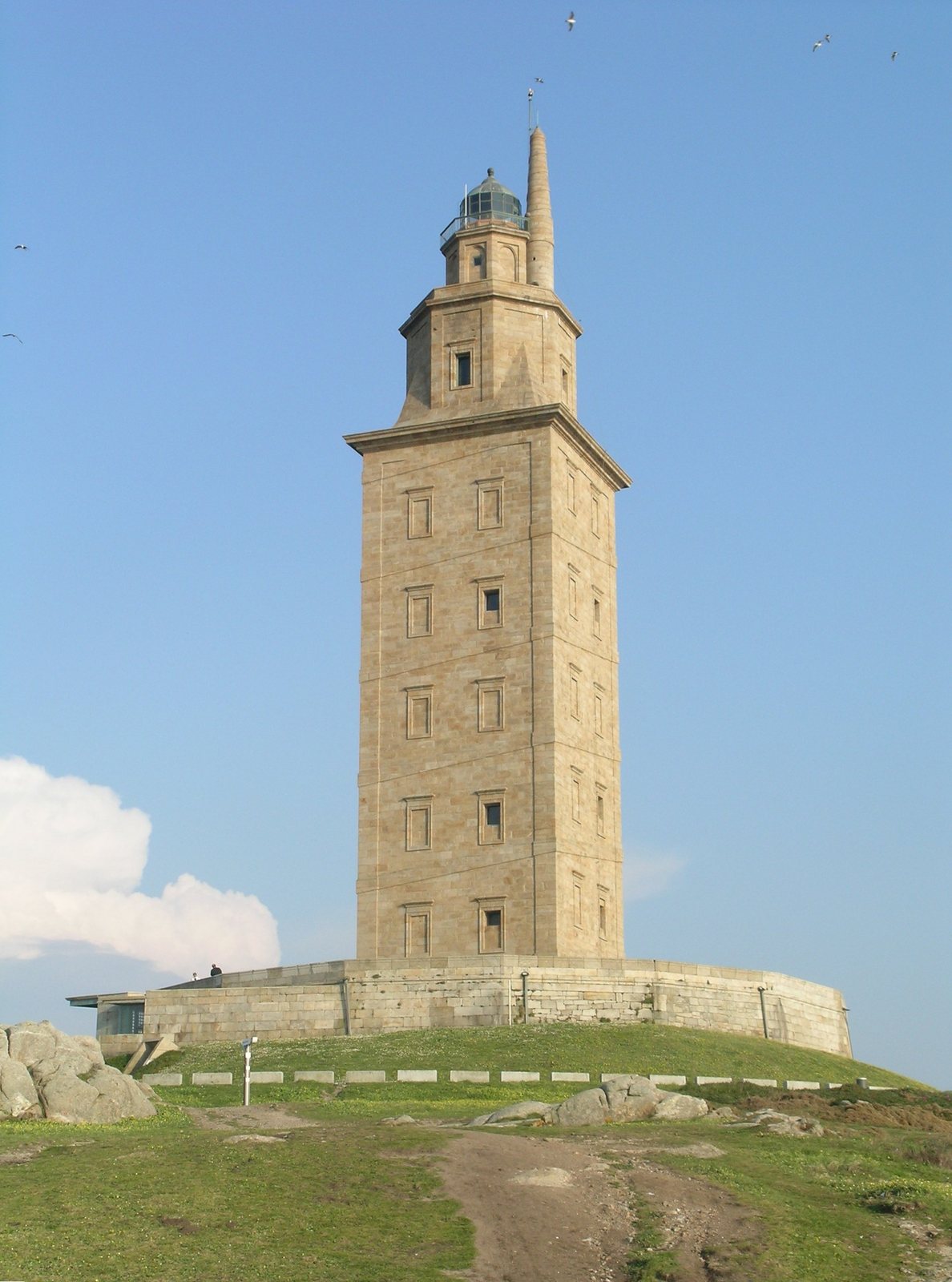
The Rotensis has King Ramiro I raise an army and defeat the strangers at the Faro de Brigancio, the Roman lighthouse at A Coruña now known as the Tower of Hercules. The version "Ad Sebastianum" adds a stop: the fleets first landed at Gijón on the Asturian coast. Both speak of many dead and of burned ships, without a number. Only the later Historia Silense gives 70 burned ships; some editions and authors have 60, and Sánchez Pardo thinks the figure inflated. The so-called Prophetic Chronicle, another late ninth-century text, supplies a day: according to Ann Christys 31 July or 1 August, and 842 or 844 depending on how the Roman numeral is read. The Chronicle of Alfonso III works out at 843. Christys finds 844 the likeliest year.
No find confirms this battle. The lighthouse still stands, but as a Roman building it says nothing about 844. The sources speak only of "Northmen" and name no leaders.
From Galicia the voyage continued south. Arabic authors report ships off Lisbon and an occupation of Seville lasting about a week, before the emir's army defeated the raiders in November at Ṭalyāṭa (Tablada). Fleet figures range from 54 to 80, and all these accounts come from later compilations such as those of Ibn al-Qūṭiyya and Ibn Ḥayyān. The details are in the article on the Madjūs. In 859 ships entered the Guadalquivir again, but this time did not reach Seville.
For the finds, something else matters. During metro construction at Seville's Plaza Nueva in 1981, workers came upon the remains of a boat and, according to press reports some eleven metres down, a large anchor that the specialist literature treats as Byzantine. Word later spread that this was a Viking ship from the raid of 844, since the date range fitted. The nautical archaeologist Carlos Cabrera Tejedor studied the material and showed in 2013, in the proceedings of the first Spanish congress of nautical and underwater archaeology, that the boat was Andalusi. A University of Cádiz thesis of 2022 notes that the false report kept circulating anyway, on social media and in some newspapers. A find from the right time window quickly becomes a "Viking find"; the correction travels more slowly.
The great fleet that went on into the Mediterranean seems to have struck the northwest first. The date varies: Sánchez Pardo gives 858 as the majority view, while some authors prefer 859. The Chronicle of Alfonso III merely notes that "Northman pirates" came again to "our shores". The Chronicle of Albelda, from about the same time, says that the "Lordomani" who came for the second time were killed on the Galician coast by Count Pedro.
Everything else comes from later texts. Spanish chronicles, according to Sánchez Pardo, give 100 ships. He summarises the tradition as follows: the fleet entered the Ría de Arousa and sacked the episcopal town of Iria Flavia, its people fled to Compostela, the city was besieged and paid tribute, and Count Pedro's army finally drove the raiders off. King Ordoño I then sought to move the see to Santiago, and Pope Nicholas I allowed this provided that Iria survived as a secondary seat. Whether the raid caused this or merely offered a welcome occasion for a development already favouring Santiago cannot be clearly established.
The river Ulla flows into the Ría de Arousa and was the most direct waterway to the apostle's city. Hence the fame of Catoira.
Sánchez Pardo calls 968 the most violent attack Galicia suffered. It is also where source criticism becomes awkward. The Chronicle of Sampiro, probably written in the eleventh century, does not survive as an independent text. We know it only through twelfth-century works: the Historia Silense, the Liber chronicorum of Pelayo of Oviedo and the Chronica Naierensis. Everything said about the leader Gundered hangs on this one strand.
According to it, in the second year of Ramiro III a fleet of about 100 ships arrived under a King Gunderedus. Bishop Sisnando of Santiago confronted them and fell at Fornelos, according to Sánchez Pardo on 29 March, struck by an arrow; other versions speak of a sword. The bishop is the one person in the story who can be securely identified. The raiders then supposedly moved far inland, the Silense says as far as the "Pireneos montes Ezebrarii", which García Losquiño identifies with O Cebreiro on the border of León. In the third year a count destroyed them, killed their king and burned their ships.
Accounts of the victor differ. The Historia Silense names a Guillelmus Sánchez (known to me only second-hand), whom modern authors read as the Galician count Gonzalo Sánchez or as William Sánchez of Gascony. The place varies too: one account sets the decision in the mountains of Cebreiro, while Sánchez Pardo reports a tradition in which Count Gonzalo Sánchez won the battle near Ferrol. Tradition also credits Saint Rosendo with organising the defence.
And who was Gundered? The name sounds like Old Norse Guðrøðr. Attempts to connect him with a son of Harald Fairhair of that name in Heimskringla remain conjecture. One outside note does support the timeframe: the Annales Toledani I record "lordomani" for 970. The three-year stay, the 100 ships and the final destruction are chronicle, and no find site is known.
The most tangible effect of the raids may lie in fortification. The Chronicon Iriense credits Bishop Sisnando with walls, towers and ditches around Compostela and with the strongholds of A Lanzada and Cadafeita. Further fortifications followed in the eleventh century under Bishop Cresconio; according to information I know only second-hand (English Wikipedia, citing Christys), he even allowed the Sunday rest to be broken in 1055 during attacks by Saracens or Northmen. His synod at Compostela is otherwise dated 1056; I could not check the text of the provision.
On rocky heights above the Galician coast there are also small early medieval castles, which Sánchez Pardo cautiously reads as refuges and watch posts against attack from the sea. But a wall does not reveal whom it was meant to stop. García Losquiño treats the coastal defences as a response to Viking and Arab piracy alike. They were built by locals, and as a trace of the Vikings they serve only indirectly.
The most famous work of this kind stands at Catoira, where the Ulla widens into the ría. Of perhaps seven towers, the remains of two survive, in marshy ground. The Xunta de Galicia and many guidebooks present them as a bulwark against the Northmen. Popular overviews often name Alfonso III as builder in the ninth century. The specialist literature is more restrained.
Sánchez Pardo dates the complex as we can now see it to the mid-eleventh century under Bishop Cresconio, according to tradition built over Roman remains, and later improved by Diego Gelmírez; before that, Alfonso V is said to have raised a citadel on the island of "Oneste" against the Northmen. The historian Diego Piay puts it this way: a fortification began in the tenth century and grew until the fourteenth. Manuel Chamoso Lamas dug here in 1949 and Alberto Balil's team from 1970 to 1973. Contrary to what Chamoso had supposed, Balil's work found no securely Roman masonry in the towers.
What can be better grasped at this site is something else entirely. Swords from around 1300 BC are read by Piay as offerings in the river. Then come a pre-Roman settlement with sparse finds and a Roman site with pottery from the first century BC onward, possibly a transfer point between sea and river trade, to which Piay and José Luis Naveiro devoted a study in 2023. Whether the place then stood empty is open: Piay speaks of abandonment between the sixth and ninth centuries, while his reviewer mentions burials of the fifth to eighth centuries and stresses the continuity of the site. I know of no Scandinavian finds from Catoira. Reviewing that book, Carlos Galbán Malagón calls the reflexive appeal to Viking raids a worn cliché and argues, expressly as his own opinion, that such fortresses also served to organise large territories, and the site's old importance helped determine its choice.
The Romería Vikinga is only indirectly related. The municipality dates its first edition to 1960, founded by the Ateneo do Ullán around the priest and poet Faustino Rey Romero and the poet Baldomero Isorna Casal; other accounts, Sánchez Pardo among them, give 1961. The staged attack, according to the municipality, was added only in 1968, and the ship "Torres de Oeste" is a replica of the Danish Skuldelev 5. Since 2002 the festival has held the status of international tourist interest. It is a modern festival on a medieval theme, not an inherited custom. The Danish model is covered in the article on the Skuldelev ships.
In March 2014 storms on Galicia's north coast tore open parts of Os Castelos beach in the parish of San Román near Estaca de Bares (O Vicedo). They exposed two large stone anchors of 66 and 127 kilograms, later three more on the beach, with two seen offshore. There were also about 100 flint blocks, some up to 200 kilograms, regarded as ballast. Above the beach rises the promontory of Os Moutillós.
In December 2014 the University of Aberdeen, where Irene García Losquiño was then working, announced that Viking anchors had washed ashore. After tomography on a large mound, it said, "we now think this was a longphort", a fortified base on the Irish model. Specialist websites picked up the report.
In 2019 García Losquiño set out her position in the journal Svmma, and it reads far more soberly. The anchors are cut from local gneiss, the "ollo de sapo", which is abundant on the beach itself. They have a single hole, where Galician stone anchors usually have two or three. This form, she writes, resembles Scandinavian examples and eleventh-century Breton ones more than Mediterranean Bronze Age ones, though this is not conclusive. The flint resembles deposits in northern France and southern England and so probably came by ship. Test excavations by the archaeologist Iñaki Sagredo found outer walls, a ditch and traces of use from the third century BC to the thirteenth century AD, but no sign of Vikings. Her own verdict: it is still not possible to be certain that Vikings used the site, "but it is likely". Roman finds also lay on the beach.
The assessment follows simply. These anchors are not a dated Viking find. Stone anchors can hardly be dated without associated material, local stone, on my reading rather than hers, points to manufacture on the spot, and over a span of fifteen centuries many seafarers could have dumped ballast. For now it remains a reasoned hypothesis. What a secure camp looks like is shown in the article on Viking camps.
Where sherds are missing, boundary clauses sometimes help. A charter of 2 January 966 from San Martín Pinario in Santiago, according to Ann Christys, mentions a "city of the Loclimanos". García Losquiño reads this as a miscopying of "Lodimanos". From the same edition (López 1988) she also gives the donation by one Ordoño Laurencio to the monastery of San Martín, which describes the limits of an estate at Campaña near the Ulla as reaching "where the city of the Northmen was". This is probably the same document, though she does not say so outright. English Wikipedia, following Eduardo Morales Romero, cites a charter of 996 with an old Norse fortress on the south bank of the Ulla, possibly the same evidence with a different year; I could not check this. Caution is needed too because the word "city", according to García Losquiño, is López Alsina's interpretation: the original is lost and only a translation survives.
Place names add to this. Lordemanos in the province of León appears in an eleventh-century document; Lordemão near Coimbra bears the same name. Both are traced to "Nordomanni" and would thus be names given by outsiders. Christys does not regard the identification as certain, not least because a shift from N to L is unusual in Romance. If it holds, it points to small groups who stayed. How many there were, and whether they came as captives, mercenaries or settlers, remains open.
García Losquiño infers a medium- to long-term presence, far smaller than in England, Ireland or Normandy, and a probable settlement on the Ulla. Two projects on the river were under way in 2019. I have found no results confirming a camp. Her 2022 article on Vikings as mercenaries in Galicia I could only trace bibliographically. Sánchez Pardo judges the overall picture more cautiously: the Northmen sought booty and captives, not land.
Perhaps the hardest evidence for this period is not chronicle at all but legal business. Monastic charters from northern Portugal report that in July 1015 a large group entered the Douro and held the land between Douro and Ave for about nine months. A document of 1018 records that Amarelo Mestaliz lost three daughters to the Northmen and sold land for 15 silver solidi to redeem them. A record of 1026 from the monastery of Pedroso names a mother, Meitilli, and her daughter Guncina, freed from captivity. Hélio Pires studied this material in 2011 under the title "Money for Freedom".
These texts show a business model: seize people, hold them, return them for silver or sell them, as the article on Viking slavery describes for other regions. Nobody sells land to keep a legend alive. In Galician charters the memory is also said to have lived on in phrases such as the "day of the Northmen" (dies Nordemanorum); I know this only second-hand (English Wikipedia, citing Morales Romero and Pires). No archaeological traces of the Portuguese camps are known. The fight at Vermoim castle, in which several historians believe Count Alvito Nunes died, is dated by scholars partly to 1015 and partly to 1016.
A fixture of popular accounts is that the future saint Olaf Haraldsson plundered Galicia around 1014. Tested, the picture is mixed. What is secure: a charter of Alfonso V of 1024 in the Tumbo A of Santiago reports that the "gens Leodemanorum" attacked Tui, carried off the bishop and his people, and reduced the city to nothing.
"… its bishop, who resided there, was led into captivity by these enemies with all his people … and they reduced the city itself to nothing, which for many years remained widowed and in mourning."Charter of 1024, Tumbo A of Santiago; Latin: "eius episcopus qui ibi morabatur cum omnibus suis ab ipisis inimicus captivus ductos est" and "et ipsam civitatem ad nichilum reduxerunt, que plurimus annis vidua atque lugubris permansit"; wording and spelling as printed in Pires (2015), my own translation
The diocese then passed to Santiago. But the charter names neither a leader nor a year for the raid; 1024 is only the latest possible date. The date 1014 is modern. Fernando López Alsina infers from the mention of a bishop Suero, who also had charge of Tui, that the city already lacked its own bishop in 1022. The raid would then fall before 1022.
Heimskringla, written around 1230, tells in Olaf's saga of a battle at Seljupollar, the capture of the old castle of Gunnvaldsborg with Earl Geirfinn for a ransom, then a wait in the river Karlsá, from which Olaf meant to sail through "Norvasund", the Strait of Gibraltar, to Jerusalem, until a dream called him home to Norway. In the nineteenth century Paul Riant equated Gunnvaldsborg with Tui, and Sánchez Pardo and others followed; Geirfinn would then be Bishop Alfonso.
Hélio Pires took this chain apart in 2015 in En la España Medieval. Sigvat's verses, the oldest source, do not mention Gibraltar at all, and the place names lie in or near France or cannot be located. The detour with its dream appears only in the prose and suits the later idea of Norway's "eternal king". No Iberian source names Olaf. The saga speaks of an earl and a ransom, the charter of a bishop and a destroyed city. Pires concludes that Olaf probably never went beyond the Pyrenees and that the voyage to the Mediterranean is a later addition. He concedes that lost stanzas could change the picture. The dispute is not settled by this. As for an attack by Olaf on Santiago de Compostela itself, as far as I could find, none of these sources reports one.
That leaves the famous object. In the treasury of San Isidoro in León lies a cylindrical casket about 4.5 by 3.3 centimetres, with lid and base of gilt copper alloy, carved in openwork in the Mammen style introduced in the article on art styles; García Losquiño also names Ringerike. The material is reported differently: Sánchez Pardo says ivory, Ann Christys whalebone, the San Isidoro museum reindeer antler, and the reviewer Karen Schousboe, citing Else Roesdahl, antler. I know of no scientific identification. It is dated to the late tenth century.
Genuinely Scandinavian and right in date, it still does not prove a raid. Nobody knows how it reached León. Suggestions include a diplomatic gift, a pilgrim's offering, or loot from the fighting of 968 to 971. It was later reworked as a reliquary. The casket proves contact, but not who carried it or why.
In the twelfth century the Northmen return in another role, at least in the sagas. Heimskringla has King Sigurd winter in Galicia on his way to the Holy Land. When an earl failed to keep up the promised supplies, Sigurd took his castle. Fights at Sintra and Lisbon against "heathens" follow. Orkneyinga saga tells of Earl Rögnvald, who around the turn of 1151/52 fought an oppressive lord in Galicia on behalf of the locals. Both episodes are saga tradition with no known Iberian counterpart.
Were the Vikings really in Spain? Yes. Frankish, Asturian and Arabic sources report them independently, and charters add to this. What is disputed is not the visits but their scale and individual episodes.
Are there Viking graves or ships in Spain? None is secure so far. The Madeira find of mouse bones dated about 900 to 1030 is linked to Vikings, but that is an inference from genetics and lies off the peninsula.
Why are there so few finds? Short raids leave little behind. Researchers also point to the limited search: Galicia has hardly been investigated systematically. Missing finds therefore do not prove there were no camps, but they do not allow us to claim any either.
Did Vikings settle in Spain? This cannot be clearly established. Place names and the charter evidence on the "city of the Northmen" suggest small groups. There was no lordship as in Normandy.
Can the sites be visited? The Torres de Oeste stand at Catoira, and the festival usually takes place on the first weekend of August. An overview of such events is in the article on Viking festivals.
Al-Madjūs: Vikings in Arabic sources, Vikings in the Mediterranean, Olaf the Saint, Björn Ironside, Vikings in France, Viking camps, Viking slavery, The Skuldelev ships.

The Madjus in al-Andalus · Vikings in the Mediterranean · The Vikings in France – from the Seine Estuary to Normandy · Danes, Swedes, Norwegians · The longships.
All History & Finds articles →
When a Norseman steps out of the fog on screen, he carries a sword. When an archaeologist opens a weapon grave, he …
Read more →Genuine Viking symbols include Thor’s hammer, the Valknut, the raven, the dragon ship and the Norse animal styles – all …
Read more →Does mitochondrial DNA "prove" that Viking women colonised new lands? A 2014 headline said so. The study behind it …
Read more →In the summer of 789 Charlemagne led the only army of his reign that he personally took deep into Slavic territory …
Read more →