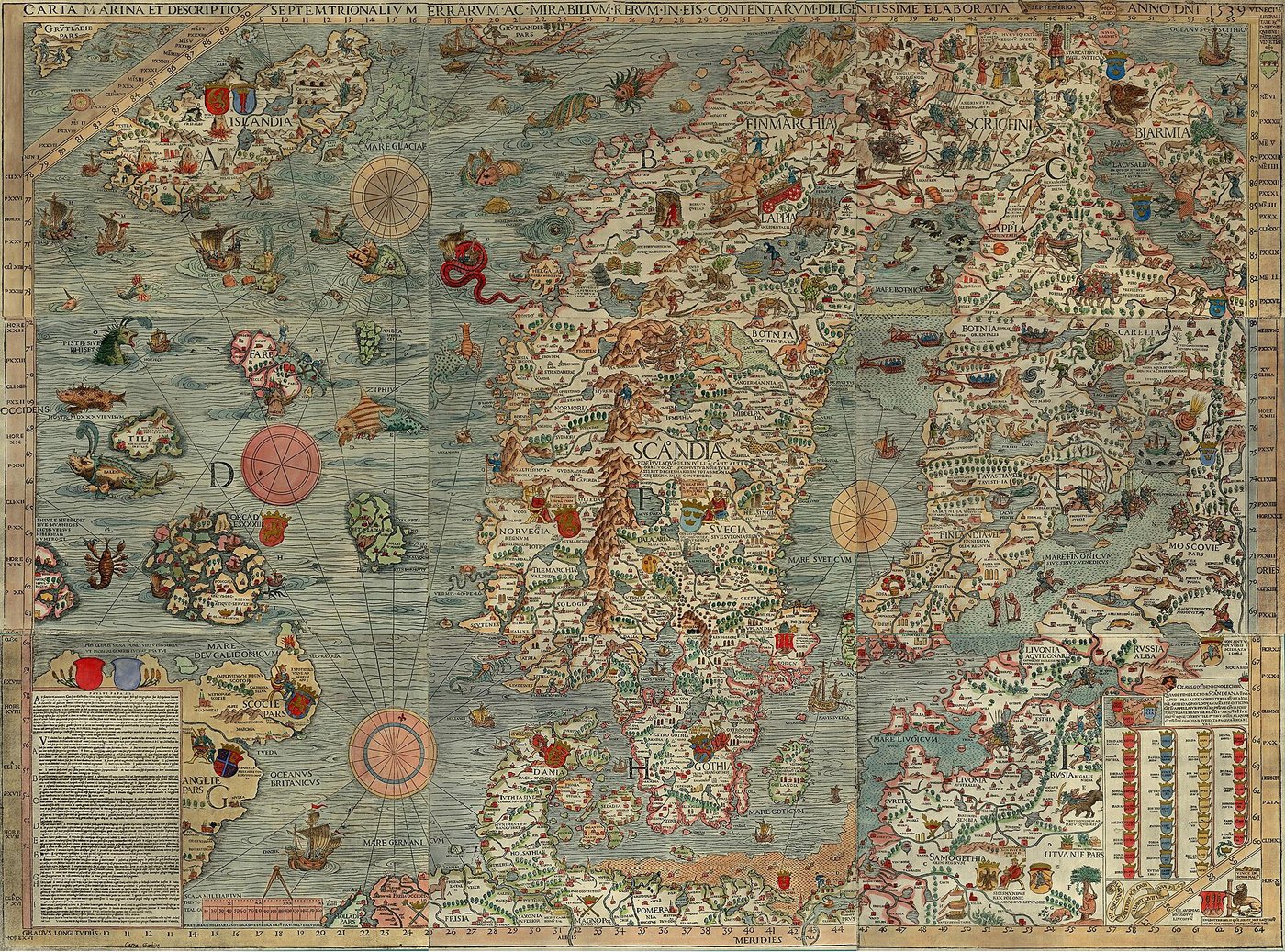
Frankish blades, silver coins, a splendid dress rebuilt from one grave, and Swedish runestones for men who died "in Finland": Viking Age Finland was anything but cut off. It still wasn't Scandinavia. This article tests what the finds from Luistari, Åland and Suontaka can bear, traces the trade routes, and shows why the sagas keep Finland, Kvenland and Karelia apart.
The question sounds simple, but three terms keep getting tangled. "Scandinavia" in the narrow sense means Denmark, Norway and Sweden. The "Nordic countries" add Finland and Iceland. "Fennoscandia" is a geographical label for the Scandinavian Peninsula, Finland and neighbouring parts of northwestern Russia. In today's usage, then, Finland is Nordic but not Scandinavian.
That only goes so far for the Viking Age, because no Finnish state existed, and no united people called itself Finnish. "Viking Age" is itself a problem. In their introduction to the 2014 volume Fibula, Fabula, Fact, Joonas Ahola and Frog point out that the term grew out of nineteenth-century Swedish Romanticism and Pan-Scandinavianism and became a period label almost by accident. The usual dates run from about 800 to 1050, and the period is defined by the expansion of Germanic-speaking groups from Scandinavia. For Finnish territory, the editors call these limits more arbitrary than accurate.
That leads to a useful distinction, one the volume also draws. One question asks what the period meant in Finland. The other asks whether there were Finnish Vikings. The first has plenty of answers; the second has almost none.
Some of the early mentions of Finland come from outsiders, and they aren't friendly. By the church of Söderby-Karl in Roslagen, Sweden, stood an eleventh-century runestone now catalogued as U 582. Reports on its fate differ: English Wikipedia says it has been lost since before 1830, while Runkartan lists it as destroyed. Its text is short:
Bjǫrn ok Ígulfríðr reistu stein eptir Ótrygg, son sinn. Hann var drepinn á Finnlandi.
"Bjǫrn and Ígulfríðr raised the stone in memory of Ótryggr, their son. He was killed in Finland."Runestone U 582, Söderby-Karl, Uppland, 11th century; normalised Old Norse as given on Wikipedia (Runic Text Database), my own translation
Who killed Ótryggr and what he was doing there, the stone doesn't say. Trade, raid, feud: nothing here lets us choose. A second stone, Gs 13 from Gävle, is just as terse but more exact about the place. Brúsi raised it for his brother Egill, who died in Tafeistaland, that is Tavastia, Finnish Häme, in the interior of southern Finland. A prayer for his soul marks Egill as a Christian. Another phrase is disputed; depending on the reading, Brúsi either led the land's levy or carried a standard.
Two stones, two names. That suggests people in central Sweden distinguished "Finland" from "Tavastia" in the eleventh century, though two inscriptions can't settle it. What "Finland" covered at the time isn't certain. Ahola and Frog also note that such inscriptions name places and offer almost nothing else. They show contact that ended in death, not conquest and not Swedish rule.
To see Finland from the inside, go to Eura in the southwest. The Luistari cemetery lies near Lake Pyhäjärvi. The cemetery counts over 1,300 graves, excavation ran from 1969 to 1992, and over 400 graves held artefacts. Of the excavated graves, 107 belong to the Merovingian period, around 300 to the Viking Age. Burial began in the late sixth century and ran into the Middle Ages, which researchers take to about the fourteenth century. Pirkko-Liisa Lehtosalo-Hilander, who uncovered Grave 56, laid the foundation for much of what has been written about the site since.
The burial rite alone makes a point. Inhumation graves in a cemetery used for centuries don't fit the textbook picture of ship graves and mounds. According to a review of current research, Finland also knew level cremation fields, which gave way to inhumation toward the end of the period, probably under Christian influence. Luistari, in other words, doesn't stand for all of Finland.
The cemetery's most famous grave was opened in the very first season, 1969. Grave 56 is regarded as the richest in metal finds at Luistari. It held a woman with jewellery, 34 glass beads, 11 silver coins and two silver pendants, along with well-preserved textile remains. The date varies by source: a radiocarbon measurement gave 940 to 1021, the 2025 isotope study places the grave in the phase 1000 to 1070, and others write "early eleventh century".
From these remains came the "Eura dress". A working group started in 1976 and finished the reconstruction in 1982; one scholarly article calls it the first scientific dress reconstruction in Finland. Its influence reached well beyond the museum, from reenactors around the world to President Tarja Halonen, who, according to a Finnish-language text in the University of Turku repository, wore a version at the 2001 Independence Day reception.
The reconstruction is less firm than its image suggests. The peplos, the strapped overdress, has lost its borders, so nobody can say whether it was tubular or open at the sides. Stray spirals only hint at a shawl or headdress. Needle-bound fragments were read as mittens, an idea later questioned. Because reindeer pelts are often linked to the Sámi in the literature, the article in Archaeological Textiles Review also asks whether the woman was Sámi. The authors themselves call that link highly questionable and leave the question open; no DNA analysis has been done. The dress is a well-argued proposal, and a proposal is what it remains. For comparison with other styles, see Viking Age clothing.
Two scientific studies have shifted the picture of Luistari in recent years. The first (2022) used stable isotopes to look at diet. People ate plenty of animal products and regularly consumed freshwater fish, probably from Pyhäjärvi. A clear marine signal is missing. Those buried here didn't live off the sea, even with the coast only about 40 kilometres away.
The second (2025) measured strontium and oxygen in 79 people. Strontium in tooth enamel reflects the geology of the area where a person spent their childhood. Four individuals, including the woman from Grave 56, fall above the local range, and one (Grave 41) falls below it. High values are common in southern Finland, the dress accessories from Grave 56 are Western Finnish, and the authors speak of mobility within Finland; they name no exact place of origin. The icon of Finnish Viking Age dress probably didn't grow up in Eura, then, but she wasn't a foreigner from overseas either.
The richly furnished woman in Grave 359 is a different case. Her values match people assigned to the Mälaren region of Sweden. "Possibly" remains the right word, because the strontium ranges of Eura and Mälaren overlap and oxygen didn't help much. Two results still stand out. Women show the largest deviations in certain phases, which the authors cautiously explain through marriage across group lines. And non-local women can't be picked out by clothing or jewellery, so anyone reading origin off a costume may be wrong. The study speaks of the "cosmopolitanism" of Luistari's people. That is an interpretation resting on a narrow sample, which the authors themselves call small for some phases.
Today the Åland Islands are an autonomous, Swedish-speaking region of Finland. For the Viking Age they can't simply be counted in. They lie about 36 kilometres from the Swedish mainland and about 70 from the Finnish one, and the archaeology points west.
In her 2018 paper on the Kvarnbo hall, Kristin Ilves describes rapid settlement around the middle of the first millennium, with most burial and settlement sites beginning around 600. Some 450 Late Iron Age burial sites are registered, with nearly 11,000 mounds. Scholars generally regard the material culture as "Swedish". At Kvarnbo in Saltvik, north of the church, traces emerged of a building around 45 by 15 metres, which Ilves cautiously calls a potential hall, the first of its kind known in Finland. A radiocarbon sample gave cal AD 650–870, and the finds run from the late sixth century to the end of the Viking Age.
At the same time Ilves questions the view of Åland as a mere political periphery of central Sweden. She describes the islands' Late Iron Age groups as culturally closer to one another than to their parent populations. So Åland fits no simple column: culturally Scandinavian, politically unclear, Finnish today. The coin finds add one more point. They are plentiful early in the Viking Age and stop around 1000 (Talvio, as reported in a review of the 2014 volume). The same review reports an economic collapse in the tenth century and gives shifting trade routes, piracy, Swedish power struggles and a receding coastline as causes; the introduction to Fibula, Fabula, Fact mentions a disruption of the eastern silver trade around the middle of the century. The picture isn't uniform: a 2023 pollen study finds renewed, more intensive farming at one lake on Åland from about the mid-tenth century.
Few finds show these ties as clearly as the swords. In his dissertation Marks of Fire, Value and Faith (2015), Mikko Moilanen recorded the material: 677 complete swords, blades and fragments, plus 197 separate hilt parts, with 62 of the sword items from Åland and 18 from ceded Karelia. Ferrous inlays appear on 140 blades or fragments, and another 11 are known from old radiographs and publications. The finds cluster clearly in the tenth century.
On Ulfberht blades specifically, the figures differ. Older catalogues based on Leppäaho's work of the 1960s give 12 to 14 for Finland, including Stalsberg's 14 in 2008. English Wikipedia credits Moilanen with 31; I haven't seen that passage in his work, and the overview can't firmly explain the gap either, though it suspects fragments play a part. Even the lower count makes Finland one of the important find regions.
What do these blades prove? A Frankish origin is the traditional assumption, and the names ULFBERHT and INGELRII are considered linguistically Frankish. Moilanen also stresses the variety of motifs, which suggests several makers, and considers local workshop traditions possible. A sword in a Häme grave doesn't prove a Viking, in any case. It proves that someone in Häme had access to expensive weapons and wanted to be, or was meant to be, buried with one.
In October 1968, workers laying a water pipe at Suontaka in Hattula (then Tyrväntö) hit a sword with a bronze hilt. Oiva Keskitalo excavated the grave. It held two oval brooches with wool remains below the shoulders, a costume regarded as feminine, and a hiltless blade with silver inlays at the left side of the pelvis. For decades this counted as a woman with two swords, and the National Museum of Finland displayed it from 1995 to 2016 as evidence of female leaders.
Ulla Moilanen and her team published a reassessment in 2021 (in print 2022, European Journal of Archaeology). The bronze-hilted sword, in the late Viking Age Urnes style, lay in the upper grave fill and was probably added later, possibly by the next generation. They consider a double burial unlikely. Two badly degraded femur fragments yielded very little DNA. Their model gives the XXY karyotype a probability of 99.75 per cent, but the authors stress that the data are extremely sparse and that the main uncertainty concerns the Y chromosome itself. Their wording stays careful accordingly: the person "possibly" had this condition and may have been respected as non-binary.
Two corrections belong here. First, with a radiocarbon date of 1040 to 1174 and artefact types of the late eleventh or early twelfth century, the grave is hardly Viking Age in the strict sense. Second, it doesn't belong among the shieldmaidens. Older readings did lean that way, but a weapon in a grave doesn't prove a fighter, and the study reads the find as the burial of a respected person, whose meaning we can only partly read.
The introduction to Fibula, Fabula, Fact mentions a major trade route along the Finnish coast. It led toward the Gulf of Finland and Staraya Ladoga, which the editors describe as a multicultural trading centre founded by 753 at the latest. From there the river routes of the eastern way ran south. According to the same authors, people from southwestern Finland also moved into the Ladoga region. The Norse name of the town, Aldeigja, very likely goes back to a Finnic water name, as our Ladoga article explains.
What travelled these routes? For Scandinavians, the authors name mainly furs and weapons, with silver from the Caliphate drawing them east. Coins are unevenly spread, though. Viking Age coins are clearly rarer on the Finnish mainland than in neighbouring areas, and most date to the end of the period; for silver hoarding elsewhere in the Baltic, see our article on silver hoards.
The far north offers a telling detail. In 1985 Tuukka Talvio described the Kuolajärvi (Salla) hoard from Lapland, the northernmost Finnish hoard of Viking Age type, buried no earlier than 1110. The Kuusamo hoard (no earlier than 1054) contained 107 Frisian coins among 396 German ones. Talvio thinks they reached Lapland from the east, through Karelia and northern Russia, and that the supply shifted toward Scandinavia around 1100. Lapland was therefore connected to routes eastward. Why the coins were used and who buried them can't be read from this.
Trade runs both ways, and that shows in the heart of Sweden. By 2010, Ingrid Gustin had counted nearly 40 dress items from southwestern Finland, or with Finnish influences, in the Mälaren region, 13 of them from Birka and 6 from Sigtuna, dating from the late ninth to the eleventh century. The commonest are penannular brooches with faceted and pegged knobs, along with round brooches. In Birka's Black Earth, Baltic Finnish pottery forms the second-largest group of imported ware.
The obvious reading would be traces of Finnish immigrants. Gustin's evidence argues otherwise: no grave holds more than one Finnish item, the burials follow local custom, and strontium values from 12 graves tentatively show at least 11 people growing up around Mälaren. She therefore links the brooches to gift giving and alliances. She describes Western Finnish elites as intermediaries in early eastern contacts; furs from Vakka-Suomi may have drawn groups from eastern Sweden, and, as a suggestion she reports, such contacts may have taught the Svear the way to Lake Ladoga. The pottery was probably made on the spot; whether by women trained in the Finnish tradition or Mälaren women who had learned the technique stays open.
The strongest argument against "Finland equals Scandinavia" is language. Finnish and its relatives are Uralic, not Germanic. Whether Scandinavian was spoken at all on the mainland at this time is uncertain, according to a review of the research; for Åland it seems more likely because of the material culture, which doesn't prove it. Contact did leave traces: the Finnish word for Sweden is still Ruotsi, which many scholars connect with an Old Norse root for rowers and the name of the Rus. That remains a reconstruction.
Then there are forms of its own: the Eura costume with its bronze spiral ornament, the pegged penannular brooches whose core area is Finland, the cremation fields, the pottery. People took what was useful or prestigious from their neighbours and passed things on in turn. According to the editors' summary, Sami Raninen and Anna Wessman point out that some Baltic cultures had a stronger Scandinavian presence and livelier maritime contacts than Finland. A review of the volume sums up their chapter as saying that Finland remained marginal to the Viking world. It was part of the network all the same.
The heat around this question comes from the nineteenth century. After 1809, when Finland passed from Sweden to Russia, the Viking Age became material for competing histories among Finnish and Swedish speakers. Only since the 1980s, as the introduction reports Sirpa Aalto's view, has research moved past that opposition.
Finland does appear in Icelandic tradition, but from far away and written down late. The thirteenth-century Egil's Saga tells of Faravid, king of Kvenland, harried by the Kirjálar (Karelians), and helped by Thorolf Kveldulfsson for a share of the plunder. The episode gets full treatment in our article on the Kvens. What matters here is another line in the same chapter, the list of lands east of Naumudal: "Jamtaland ok þá Helsingjaland ok þá Kvenland, þá Finnland, þá Kirjálaland". To the saga's author, Kvenland and Finland were two lands side by side. Anyone who simply equates Kvenland with Finland contradicts this very source. What the author pictured exactly we don't know, and the list proves nothing for the ninth or tenth century.
Then there's the trap in the word Finnar. In Norse sources it mostly means the Sámi, not the ancestors of today's Finns. A saga's "Finns" aren't automatically people from Eura.
Snorri Sturluson's Heimskringla supplies the most dramatic scene. The young Olaf Haraldsson lands in Finland, the inhabitants flee into the forest with their goods, he pushes inland to a valley called Herdaler, runs into an ambush on the way back, and barely escapes a storm at sea that the Finns are said to have conjured. English Wikipedia dates the events to around 1007/08; a verse by the skald Sigvat is quoted in support. The place is uncertain, with Hirdal in Inkoo among the suggestions. The sorcery belongs to the literary image of "Finns" and is no evidence of any event. From the east, the Primary Chronicle has a brief note under 1042 on a campaign by Prince Vladimir of Novgorod against the Yam'. Equating them with the Tavastians is common but uncertain; the chronicle's English editors placed them between Ladoga and the Northern Dvina.
Were there Finnish Vikings? That can't be firmly shown. No contemporary source calls people from Finland that, and "viking" described an activity, not a people. Armed elites with long-distance contacts certainly existed.
Did people in Finland speak Old Norse? On the mainland, mostly Finnic languages; whether Scandinavian was spoken there too is uncertain. On Åland the evidence leans toward Scandinavian, though I know of no written proof from the period.
Did Scandinavians rule Finland? There's no evidence for it from the Viking Age. The runestones and Olaf's saga tell of dangerous ventures rather than rule.
What makes Luistari special? Its long use, its large number of inhumation graves, and the well-preserved textiles behind Finland's first scientific dress reconstruction.
Where can the finds be seen? Many come from the collections of the National Museum of Finland in Helsinki. Ask there what is currently on show; the Suontaka grave, for instance, was displayed until 2016.

The Kvens · The Sámi in Norse Sources · The Vikings in the East – Varangians, the Rus & Byzantium · The Ulfberht sword.
All History & Finds articles →
Part of the Viking story was written on rivers, not at sea. The Seine, Loire, Somme, Meuse and Rhine carried …
Read more →In September 2020 the news went round the world: the largest DNA study of the Viking Age had shown that Vikings were …
Read more →The image of the Viking as a mere raider hides what really held the Norse world together: a far-reaching trade network …
Read more →There is one number that sobers up everyone approaching Norse arms and armour for the first time: from roughly two and …
Read more →