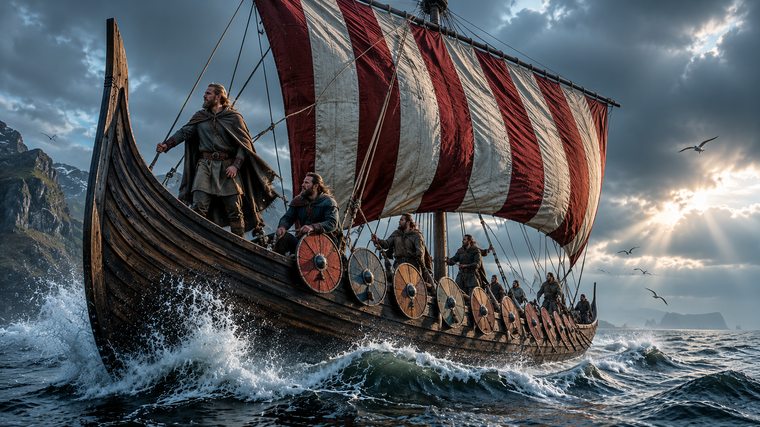
Not a single sail from the Viking Age survives. Yet it is often called the most labour-intensive part of the ship: a surface of wool that had to be spun, woven, sewn and sealed. How much work that was, who did it, and how we know, is documented very unevenly. This article sets the figures from reconstructions and calculation models side by side, says where they come from, and separates find, image, text and plain extrapolation.
Descriptions of Viking ships talk about planks, keel and rivets. The sail usually gets a subordinate clause, although it gave the ships their range. The Viking Ship Museum in Roskilde quotes the ship researcher Ole Crumlin-Pedersen as saying that the sail played a decisive role in the history of the Viking Age.
The difficulty is that the five Skuldelev ships, sunk as a barrier in the fjord near Roskilde and raised later, had no oars, sail or ropes on board. The museum itself says no sails have been found so far; only traces of the rig's fastenings suggest size and handling. The great Norwegian burial ships of Oseberg and Gokstad have left no usable sail either, as far as I could tell from the museum pages (more on one conflicting claim below).
Everything here therefore rests on four kinds of source that should be kept apart: images (stones, coins, the Bayeux Tapestry), traces on the ships (mast step, fittings, impressions), later surviving wool sails and replicas, and written sources that rarely describe in detail. On top come calculations that turn all this into numbers. The numbers look more precise than their foundation allows. On the ships themselves see our articles on longships and ship types.
Looking far back shows that the sail was not a given in the north. Around AD 98 the Roman author Tacitus, in the "Germania", describes the Suiones, a people associated with the Svear in Sweden, and found one trait of their ships worth reporting.
"They are not worked by sails, nor have they a row of oars attached to their sides; but, as on some rivers, the apparatus of rowing is unfixed, and shifted from side to side as circumstances require."Tacitus, Germania, ch. 44, on the ships of the Suiones; translation by A. J. Church and W. J. Brodribb (1877, public domain), read in an online reproduction and checked against the Latin ("nec velis ministrantur nec remos in ordinem lateribus adiungunt: solutum, ut in quibusdam fluminum, et mutabile, ut res poscit, hinc vel illinc remigium").
The sentence is short and can be read two ways: the boats had no sails, and they were paddled or rowed freely without fixed oar ports. Which ships Tacitus meant we do not know, and he wrote second-hand. As an indication that sails were not usual around the Baltic in his day, the passage still serves.
Research places the introduction of the sail in Scandinavia roughly at the threshold of the Viking Age. The textile archaeologist Lise Bender Jørgensen uses that phrase in her study "The Introduction of Sails to Scandinavia" (2012, N-TAG-TEN proceedings). She gives no exact year, at least not in the abstract I saw. The Gotland picture stones fit: early stones show rowing boats, later ones sailing ships (see our article on the picture stones).
The Nordic sail was a square sail, a cloth hung from a yard set across the mast. Its material was sheep's wool. Northern landrace sheep carry coarse long outer hair and fine undercoat, and the two can be spun separately. Our article on Viking Age weaving explains how the strong outer hair could be twisted into tear-resistant yarn for sails. Whether this applied to Viking Age ships is not shown by finds; it follows from later sails and from experiments.
For the weave there is one key source: "Square sails of wool" by Erik Andersen, published in 1995 in the Festschrift "Shipshape" for Ole Crumlin-Pedersen (pages 249–269, issued by the Viking Ship Museum in Roskilde). Andersen designed the sail and rigging of the "Havhingsten fra Glendalough" (Sea Stallion from Glendalough), the replica of Skuldelev 2. I did not have the essay in full; I saw only its reprint in the Norwegian Textile Letter of November 1995, through a summary by a retrieval tool. According to that, the following matters:
Mind the gap: these sails are centuries younger than the Vikings. They show what wool can do as sailcloth, not what was actually fitted in the tenth century. Andersen and the museum treat them as comparison and starting point for experiments.
How big were the sails? For the replicas there are figures; for the originals only estimates from mast step, hull shape and images. The museum gives the "Havhingsten", the Skuldelev 2 replica, a nearly square sail of 118 square metres, slightly wider than high. For Skuldelev 3, a small merchant ship of the 11th century, the sail width can be fixed precisely, writes the archaeologist Ole Thirup Kastholm on the museum site. A piece on the website medieval.eu gives Roskilde 6, the longest known Viking ship, a possible sail of "app. 200 m²"; that figure is a calculation, not a measurement.
A replica of the Oseberg ship carried a wool sail of about 90 square metres from traditional Nordic sheep, made by two weavers and several volunteers; one website puts the cost at about 1.3 million euros. I have this only second-hand and cannot confirm it. For smaller projects the report on Andersen's essay lists 56 square metres of cloth for the Skuldelev 5 replica ("Helge Ask") and 150 square metres for two boats of the Hitra project.
I found no areal weight, grams of cloth per square metre, in any source I could read, so I cannot give a reliable figure. A frequently repeated claim is attributed online to the Norwegian textile researcher Amy Lightfoot: roughly two tonnes of fleece for a 100-square-metre sail. That would be raw wool including losses in washing, combing and spinning, not the weight of the finished cloth. I have not seen it in Lightfoot's own words, so I pass it on only as "according to a citation".
Here lies the commonest error in popular accounts. It is often said that Erik Andersen calculated that a sail cost so many years of women's work. In the 1995 essay, as far as I know it through the reprint, I find no such calculation. It gives dimensions, weaves and one cost: a serviceable wool sail for the Skuldelev 5 replica could easily cost a million Danish kroner, counting wool collecting, spinning and weaving. No weaving times appear there. The widespread year counts come from others:
The uncertainty is part of the picture. "Labour years" means one person working full time; anyone speaking of "years per sail" often mixes sail, clothing and blankets, as Bender Jørgensen counts them. The figures are models. They depend on yarn fineness, spinning technique, loom width and how dense the cloth had to be. For comparison, the medieval.eu piece gives 24,000 to 28,000 working hours in a footnote for building the "Havhingsten". Set against the sail calculations, the sail with its clothing and blanket shares would be the larger item. That is a calculation result, not a finding.
The wool demand raises a question for farming: how many sheep did a sail take? These numbers are shaky too. According to the blog quoting Brown, more than 200 for a sail of about 93 square metres. The author Kassia St Clair reckons, according to an excerpt, with about 400 sheep to equip a typical ship with clothes, blankets and sails, and nearly two million for the whole fleet. I have not seen her book, only a paraphrase.
What can be held firmly is the idea behind it. Bender Jørgensen concludes from her calculations that the introduction of the sail must have changed agriculture: whoever needed sails needed more sheep, more pasture and more labour. The journalist Claire Eamer, in a Hakai Magazine piece, quotes Bender Jørgensen, according to the blog, as saying that sails must have greatly raised the demand for wool and grazing land. Whether this effect helped drive Viking expansion, as Lightfoot speculates, is a hypothesis, not a result. On the farming of the period see the article on Viking agriculture.
The find record is thin. From the Viking Age there are, according to the Roskilde museum pages, no sails. Where sailcloth remains turn up, they are medieval or later. According to the report on Lightfoot's work, a roughly 650-year-old sail was found stuffed between the rafters of a church ceiling as insulation, and she was asked to weave a replica. A piece on a medieval website also mentions sail remains from Trondenes church, found in 1986. I have not seen either at the primary source.
The author Kassia St Clair claims, according to a paraphrase, that pieces of a large red-and-white wool sail survive from the Gokstad ship. I cannot confirm that. I found nothing on it in the museum pages, and the claim comes from a popular book I know only through paraphrase. Anyone who wants to cite it should check the excavation reports on Gokstad. More on the find itself in the article on the Gokstad ship.
Why so little survives? Wool rots in damp ground, and sails were working objects that were repaired, cut up and reused. That is a plausible explanation, not evidence. One peculiarity is mentioned on medieval.eu: under the Gulathing law the sails of the leiðangr fleet, the royal levy, had to be stored in a church over winter. That would fit later sail remains turning up in churches. I have not read the law myself.
Because originals are missing, images carry great weight. The museum lists ship images on coins and picture stones, the Bayeux Tapestry, legal texts, sagas and skaldic verse, as well as aerodynamic calculations and experiments with traditional Nordic boats as sources for reconstruction. The picture stones of Gotland, a Swedish Baltic island, show strikingly many ships; more in our article on the Gotland picture stones.
On the stones the sails are wide and low, about twice as wide as high according to Kastholm's museum text. The reconstructions today are nearly square or taller than wide. Here an open question remains. The museum writes that it is unsettled whether the sails were tall and narrow like those of later Norwegian square-sail boats or low and wide as on the Gotland stones. Whether the carvers rendered the proportions faithfully or adapted them to the stone's shape cannot be shown clearly. The often gridded sail surfaces on the stones are also read differently: weave pattern, sewn-on reinforcing bands, or simply a pictorial convention. I know of no secure answer.
Experiments have defused the sailing question. According to the museum there is a necessary relation between sail width and height, hull shape and performance, and Viking ships demonstrably could beat to windward. The "Havhingsten" sailed well close to the wind on its voyage to Dublin; the weak point was the side rudder. That a wool sail was up to it was long doubted. Andersen's text names Svend Larsen as an early sceptic who is said to have argued in "Vikingernes hav" that wool sails could not tack. Trials with wool sails, for instance in 1985 on the Skuldelev 3 replica, speak against that.
Notable is what the "Havhingsten" crew chose: according to the medieval.eu piece, a modern cotton sail. The reason is not given there, and I will not guess it. The museum itself, by contrast, presents the weaver Anna Nørgaard, who wove a wool sail for another ship, the "Oselven".
The title promises "hidden women's work". To be fair: I found no source that explicitly says women wove the sails of the longships. What can be documented is the general situation. Spinning and weaving were in the Viking Age predominantly women's tasks; grave finds of spindle whorls and weaving tools in women's graves support that, even if linking sex and activity is not always certain in individual cases. More in the article on Viking Age weaving and on the women of Oseberg. Concluding from this that women made the sails is obvious, but it is an inference, not testimony.
Two things need separating. First, the research calculations (Bender Jørgensen, Lightfoot) assign the effort to spinning and weaving without reading a sex from any source. Second, the picture of the sail as a women's achievement rests on analogy and later evidence. The medieval.eu piece, for example, assumes that every oarsman had a woman in his household assigned for a year's work; the page calls this its own estimate. The idea that enslaved people might have woven sails is also discussed in connection with a 2016 Science piece; this is speculation the blog merely relays, and I have not seen the piece.
Where is the hidden part? It lies in historiography, not in a source: the sagas tell of ships, kings and crews, and say little about work on yarn and cloth. Noticing this means noticing a gap in the record, not proof of silencing. On the role of women overall see the article on women in the Viking Age.
What was a Viking sail made of? Woven sheep's wool, by present knowledge usually in twill, sealed with grease or tar. This rests on later sails and experiments.
How big was a sail? The Skuldelev 2 replica carries 118 square metres. For other ships there are calculated values, such as about 200 square metres for Roskilde 6; those are estimates.
How long did it take to make? Figures range from a few years for two weavers (Brown, second-hand) to many labour years for a warship with its outfit (Bender Jørgensen). There is no secure number.
Do Viking Age sails survive? According to the museum pages, no. There are later medieval and modern remains.
Did women weave the sails? They were probably involved in spinning and weaving; I found no source that names this explicitly for sails.

Viking Weaving · The longships · Viking Shipbuilding · The picture stones of Gotland · Who were the women in the Oseberg ship?.
All History & Finds articles →
Some peoples leave behind vast empires. Others leave behind a single sentence. The Segusiavi managed neither, but they …
Read more →Tacitus calls the Semnones the oldest and noblest people of the Suebi. Somewhere between the Elbe and the Oder, he …
Read more →Long before the Edda and the Viking Age, a Roman described a Germanic cult between the Elbe and the Oder: a wood that …
Read more →The Senones are the Celtic people who took Rome around 390 BC, all but the Capitol. Their leader Brennus is said to …
Read more →