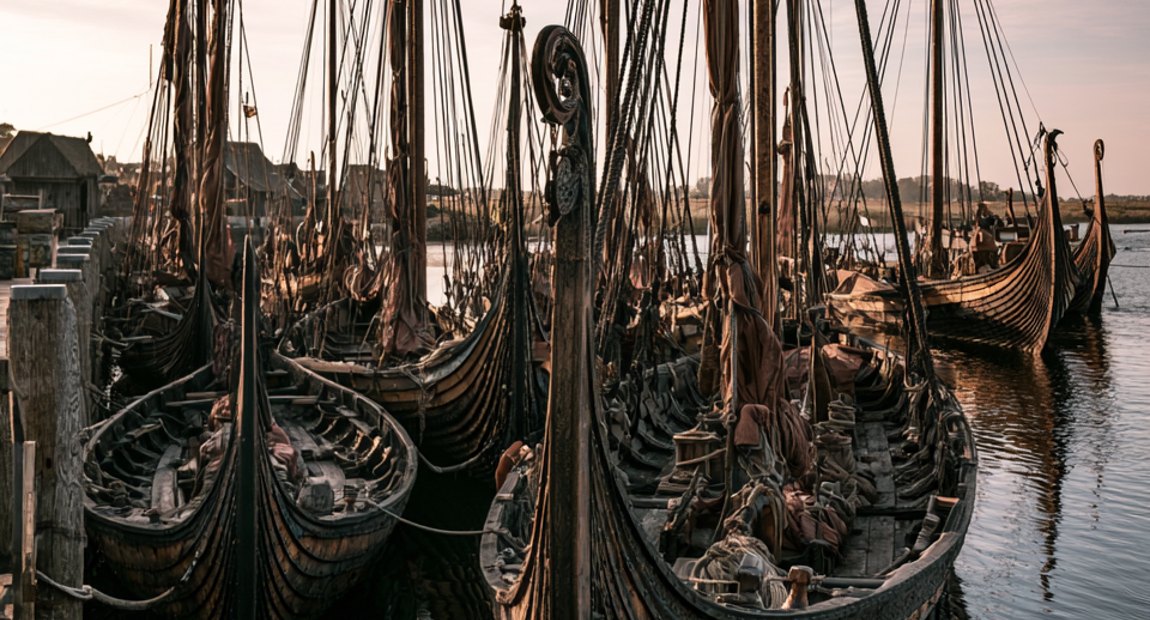
People have been building Viking ships and sending them out onto open water since 1893. Some voyages are well documented, others mainly well told. This article separates what the replicas actually demonstrate, what they merely suggest, and where the method honestly runs out.
A ship from the 9th or 11th century tells a museum visitor only so much about how it behaved at sea. Planks, nails and ribs lie in front of us, but wave action, wind load and hull fatigue cannot be read from a recovered find. The idea behind replicas is simple: build what the ground gave up, put a crew and a sail on it, and watch what happens. An archaeological hypothesis becomes a test setup.
That sounds more convincing than it is. A replica answers whether something was possible, rarely whether it was usual. And it answers only for the ship that was actually built, with the crew that was actually aboard. This article goes through the main projects and asks of each what can be supported. Where my sources are thin, the text says so, and the source list at the end separates what I read in full from what was only accessible through summaries.
Experimental archaeology means rebuilding historical techniques, buildings or tools according to the evidence and testing them under controlled conditions. Its value lies less in "this is how it was" than in "this cannot have been how it was". A ship that falls apart in a trial refutes a reconstruction. A ship that holds only shows that the reconstruction has not been refuted.
Then there is a problem that affects every voyage: the variables. Weather, route, sailcloth, ropes, tar and above all the crew differ from the original, and nobody knows the original values exactly. Anyone who puts 60 volunteers on a longship today has people aboard with life jackets, radios and a rescue plan, who trained for months beforehand. That is no criticism of the projects. It is a condition to keep in mind when reading the results.
The oldest of the well-known large-scale trials is more than 130 years behind us. The "Viking" was built in 1893 in Sandefjord, Norway, and is regarded as a copy of the Gokstad ship, which had been recovered in 1880 from a burial mound at Gokstad near Sandefjord. English Wikipedia names the shipowner Christen Christensen and Ole Wegger of the Framnæs Mekaniske Værksted yard as the builders; construction took place at the Rødsverven yard in Sandefjord. The captain was Magnus Andersen (1857–1938). Accounts of the crew differ: Wikipedia says 11, a society page says 11 were chosen from some 280 applicants, and another World's Fair page speaks of thirteen men.
The route ran from Bergen via Newfoundland to New York, up the Hudson, through the Erie Canal and into the Great Lakes. The final leg took the ship to Chicago, where, according to Wikipedia, it reached Jackson Park, the World's Fair grounds, on 12 July 1893; a second World's Fair page gives the same day. Wikipedia gives about 24 metres in length, 5.2 metres in beam and a speed of 10 knots, without saying whether that was top speed or cruising speed; the second page gives 78 feet (about 24 metres) and 11 knots as the highest speed recorded under sail. The same page lists departure from Bergen on 30 April, Newfoundland sighted on 27 May and arrival in New York on 17 June, so a good four weeks to Newfoundland; that is a single hobby-website source, not a primary one. I could not verify a total crossing time and do not give one.
What does this voyage show? That a ship built on the Gokstad model could cross the North Atlantic with a small crew and the seamanship of its day. What it does not show is that Vikings sailed the same way. The 1893 crew were experienced sailors of their own time, and Wikipedia calls the ship an "exact replica" of the Gokstad ship. How exact it was in detail, in rigging, fastenings or materials, I could not check. The word "exact" deserves caution for a ship of 1893.
The ship itself survived, if with uneven care. After the exposition it stood in Lincoln Park in Chicago, was restored in 1920 by a federation of Norwegian women's societies according to Wikipedia, was moved in 1994 and later housed under a canopy in Geneva, Illinois. Since 2012, again according to that page, the group Friends of the Viking Ship has looked after it.
The attention the 1893 "Viking" received owes much to its original. The Gokstad ship was recovered in 1880 and is among the best-preserved finds of the Viking Age. The Wikipedia page on Draken dates it to about AD 890 and gives its length as roughly 23 metres. It was a burial ship, and that is a point no replica debate should skip: a vessel used as a grave good need not have been built for the harshest seas, even though it evidently could sail. More on the find itself can be found on the page Gokstad ship.
The Oseberg finds belong to another category. Anyone looking for the differences between show ship, warship and cargo ship will find them under Viking ship types and in the overview Longships. For that question of categories, a replica is a weak tool, because it tests only the one specimen that was rebuilt.
The second great source for replicas is the five ships from Skuldelev in Roskilde Fjord. They were sunk in the 11th century as a barrier to block access to Roskilde. The National Museum carried out Denmark's first underwater investigation of the site in 1957–1959 and excavated the barrier inside a drained cofferdam in 1962: the pumps were switched on on 6 July 1962 and all ship parts were raised by 17 October 1962 (according to the Viking Ship Museum). The ships got a museum of their own in 1969; I did not find that year confirmed again in my sources. How the finds are to be classified is covered on the page Skuldelev.
One thing matters for everything that follows: only part of each ship survives. For Skuldelev 2, later rebuilt, the museum gives about 25 per cent of the original, assembled from some 1,800 fragments. The rest is reconstruction. That is no flaw of the project but the normal form of this work, and it has consequences: every figure for speed and seaworthiness applies to a ship that is three quarters well-reasoned assumption.
There is also a twist that often gets lost. Skuldelev 2 is not a Danish but an Irish ship. Tree-ring analysis dates the timber to a felling year around 1042, and the oaks come, according to the museum, from the area around Glendalough in County Wicklow; the ship was thus built near Dublin, in the Scandinavian shipbuilding tradition. How the attribution to Glendalough was reached, I have not checked myself, so I report the museum's statement. The replica's name, "Havhingsten fra Glendalough", the Sea Stallion from Glendalough, follows this origin.
The Viking Ship Museum in Roskilde built the replica in its own yard; Wikipedia gives the building years as 2000 to 2004, with the launch in 2004. The dimensions according to the museum: 29.30 metres long, 3.80 metres wide, draught 0.95 metres, weight 8.3 tonnes, displacement 25 tonnes, 112 square metres of sail, 60 oars. Wikipedia deviates, giving 120 square metres in the infobox and 112 in the text; I follow the museum.
The materials, according to the museum: about 150 stacked cubic metres of timber, 400 kilograms of iron, 3,000 metres of hemp rope and flax for the sail. A preview article of 2006 says more than 300 selected oaks were used, over 7,000 iron nails, rivets and spikes, plus ropes of lime bast and wood tar. The two accounts do not match without further work, if only because stacked cubic metres and trees are different units and because the preview does not mention hemp. I see no contradiction in that, but no proof of a particular fit-out either. Anyone interested in rigging and sailcloth should read the museum's project documentation in full, which I did not have.
For the general background of frames, clinker planking and choice of timber, see Viking shipbuilding.
The voyage was the centrepiece of the project. The ship left Roskilde on 1 July 2007 and reached Dublin on 14 August 2007; from 17 August 2007 to 29 May 2008 it was displayed at Collins Barracks, part of the National Museum of Ireland. The route crossed the North Sea, passed north of Scotland and ran down through the Irish Sea. According to the preview article, 65 volunteers from several countries were aboard. The stated aim was to test seaworthiness, speed and manoeuvrability under realistic conditions, and to find out whether a crew can live and work on such a small open vessel.
"The voyage is meant to test seaworthiness, speed and manoeuvrability under realistic conditions."Viking Ship Museum, Roskilde, preview article on the sailing project, 2006, paraphrased, own rendering (not a verbatim quotation)
The sentence is deliberately modest. It names hypotheses, not results. The museum documented the voyage, but the only page on it I could read in full is the preview article, and that naturally contains neither stage times nor observations on wind or hull behaviour. According to the museum, the 2008 return voyage went south through the English Channel and across the North Sea. How the ship performed on it I cannot report from my sources.
For the Sea Stallion's pace, the museum lists values under "Estimated performance": under sail an average of 6 to 8 knots and a maximum of 17 knots; under oars an average of 2.5 knots and a maximum of 4.2 knots. On the ship's own page these figures are labelled estimates. I could not establish whether they were measured during the sailing trials of 2005 to 2007, derived from calculation, or both, and the museum does not say on the page I read. Caution is therefore due when 17 knots is quoted as a proven peak.
A knot is one nautical mile per hour, or 1.852 kilometres per hour. Six to eight knots would thus be roughly 11 to 15 kilometres per hour. For a sailing ship of this size that is plausible, but a trip average over 45 days cannot be derived from it, because nobody knows how many days the ship lay at anchor or waited for wind. Here too: not the value itself but its origin decides what it is worth.
As a comparison with the original the number is of limited use. The 2007 crew were trained, the sails were new, and the hull had not swollen through decades in the water. A ship of the 11th century sailed under other conditions, and we cannot reconstruct them in detail.
A different case altogether is the "Draken Harald Hårfagre" from Haugesund. It was built from March 2010 by the company Viking Kings and launched on 5 June 2012. It was financed by the Norwegian businessman Sigurd Aase. Wikipedia gives 35 metres in length, about 8 metres in beam, 2.5 metres of draught and roughly 95.5 tonnes. There are 25 pairs of oars, with two rowers per oar; the sail area is about 260 square metres, and the ship also has a diesel engine. The crew is given as at least 100 under oars or 12 to 14 under sail.
Unlike the Viking and the Sea Stallion, Draken follows no single find. According to Wikipedia, the builders relied on traditional Norwegian boatbuilding and on descriptions in the sagas, and they scaled up the Gokstad ship to reach the dimensions that Snorri Sturluson mentions. The page records critical voices, among them the historian Eldar Heide, said to question the label "Viking ship" because saga descriptions have been regarded as inaccurate since the 1980s. Rikke Malmros is also reported as saying that skaldic poetry praises light, fast warships, which Draken does not match. I saw these statements only through Wikipedia and not in the scholars' own work, so read them as "according to Wikipedia". Several passages of that page also carry a note that a citation is missing.
The project's message is therefore a different one: Draken shows what a very large longship conceived from sagas might achieve, but it proves little about the Viking Age. That is no reason to belittle it. Its 2016 voyage is of interest as a feat of crew and seamanship. As evidence for Viking Age ships it is a poor witness.
Draken left Haugesund in April 2016; Wikipedia gives 26 April (elsewhere on the same page 24 April appears as the planned date), a Norwegian press article of 3 June 2016 gives 24 April. The exact date remains open. The plan led via the Shetland Islands, the Faroes, Iceland and Greenland to Newfoundland; the page gives 1 June 2016 as the landfall. The intention was to trace the route of the Norse voyages to America, about which you can read more under Vinland and Leif Eriksson. Later the ship was to call at the Great Lakes, New York and Mystic Seaport; which of these stops were actually reached, the page does not confirm. In July 2016 the US Coast Guard, according to Wikipedia, classed Draken as a commercial vessel needing a pilot under a law of 1960, at an estimated cost of 400,000 US dollars. On 4 August 2016 Viking Kings said Green Bay would be the last stop on the Great Lakes.
No speed values are given on the page, and I have read no source that offers reliable daily runs. What remains is a finding of feasibility: a modern ship in the shape of a longship, with modern navigation, communications and an engine aboard, crossed the North Atlantic. On how the Norse navigated, see Viking navigation.
Among the well-known replicas are also Ragnar Thorseth's "Saga Siglar" and the "Hjemkomst" of the American Robert Asp. Both pages were unavailable in my research, so I give neither dates nor routes nor results. Anyone meeting them in the literature should check whether a statement about a voyage comes from project documentation or from press reports.
The first limit is the gap in the original. For Skuldelev 2 about three quarters had to be supplied. Frame shape, joints and superstructure are reasoned assumptions drawn from other finds. If the ship sails well, one cannot know whether it does so because of the reconstruction or in spite of its mistakes. If it sails badly, the same holds.
The second limit is people. The crews of replicas are volunteers with life jackets, GPS and an escort boat in the background. They sail in summer, in a window chosen for the weather. Early medieval sailors went out in all seasons, though the sources show it hardly at all in detail, and so on their habits I can only say: this cannot be shown conclusively.
The third limit is the sample. One voyage is one data point. The Atlantic in May 2016 is not the Atlantic of any other year, and the North Sea in July 2007 says nothing about how the ship would have run in October. Repeatable tests exist only in the towing tank, where hull resistance can be measured but not fatigue in a seaway.
The fourth limit is selection. Nearly all replicas follow the most spectacular finds: Gokstad, Oseberg, Skuldelev. Ordinary vessels, small boats, ferries and fishing craft, rarely turn up as finds and even more rarely as replicas. That skews the picture, since the statistics of the experiments then stand for the exceptional. The hauling of ships overland, treated on the page Ships over land, is likewise a field where replicas answer questions only occasionally.
The fifth limit is dating. Tree-ring analysis gives the felling year of a tree, not the construction, the service or the sinking. For Skuldelev 2 the felling year lies around 1042 according to the museum; when the ship was sunk is not stated on these pages, and I do not guess. "Built no earlier than about 1042" is a better reading than "built in 1042", even if the gap between felling and building was often small for ships.
Despite these limits, replicas are no toy. They show practical things: how many people a ship of this size needs for the work aboard, which wearing parts of rope and sail cause trouble, and how a long, shallow hull reacts in a seaway. They also dispose of comfortable assumptions, such as the idea that such ships were mere river boats. A replica of about 29 metres that crosses the North Sea makes it implausible that this construction was unfit for open water. That is an argument, not proof, and it holds only for this construction under good management.
What they may not teach: what daily practice looked like in the 11th century, which routes were usual and how often ships were lost. That takes written sources and finds, not experiments. On this site you will find the evidence for trading places such as Hedeby and for show ships such as Oseberg.
What was the first large Viking ship replica? The 1893 "Viking" is the oldest large-scale trial known to me that I could verify. Whether there were earlier replicas, I did not check.
How fast did the Sea Stallion really sail? The museum lists an average of 6 to 8 knots under sail and a maximum of 17 knots as estimated performance. I had no measured stage values from the 2007 voyage.
Why is the ship called "from Glendalough"? According to the museum, the original was built around 1042 near Dublin from oaks of the Glendalough area in Wicklow.
Is Draken Harald Hårfagre a replica? Only in a wider sense. It follows no single find but traditional boatbuilding and saga descriptions, according to Wikipedia.
What can replicas not answer? How often, on which routes and in what weather Vikings actually sailed. There is no basis of comparison for that.

The longships · Viking Shipbuilding · The Skuldelev ships · The Gokstad Ship · The Oseberg ship & the two women.
All History & Finds articles →
In 2023 the news went round the world: Vikings had glass windows. Behind the headlines sits a specialist study of 61 …
Read more →"From the fury of the Northmen, deliver us, O Lord" is often presented as a cry from the Viking Age, and anyone who has …
Read more →In the summer of 789 Charlemagne led the only army of his reign that he personally took deep into Slavic territory …
Read more →In 1979, excavators on Kanonicza Street in Kraków uncovered something that surprised even specialists: 4,212 iron bars …
Read more →