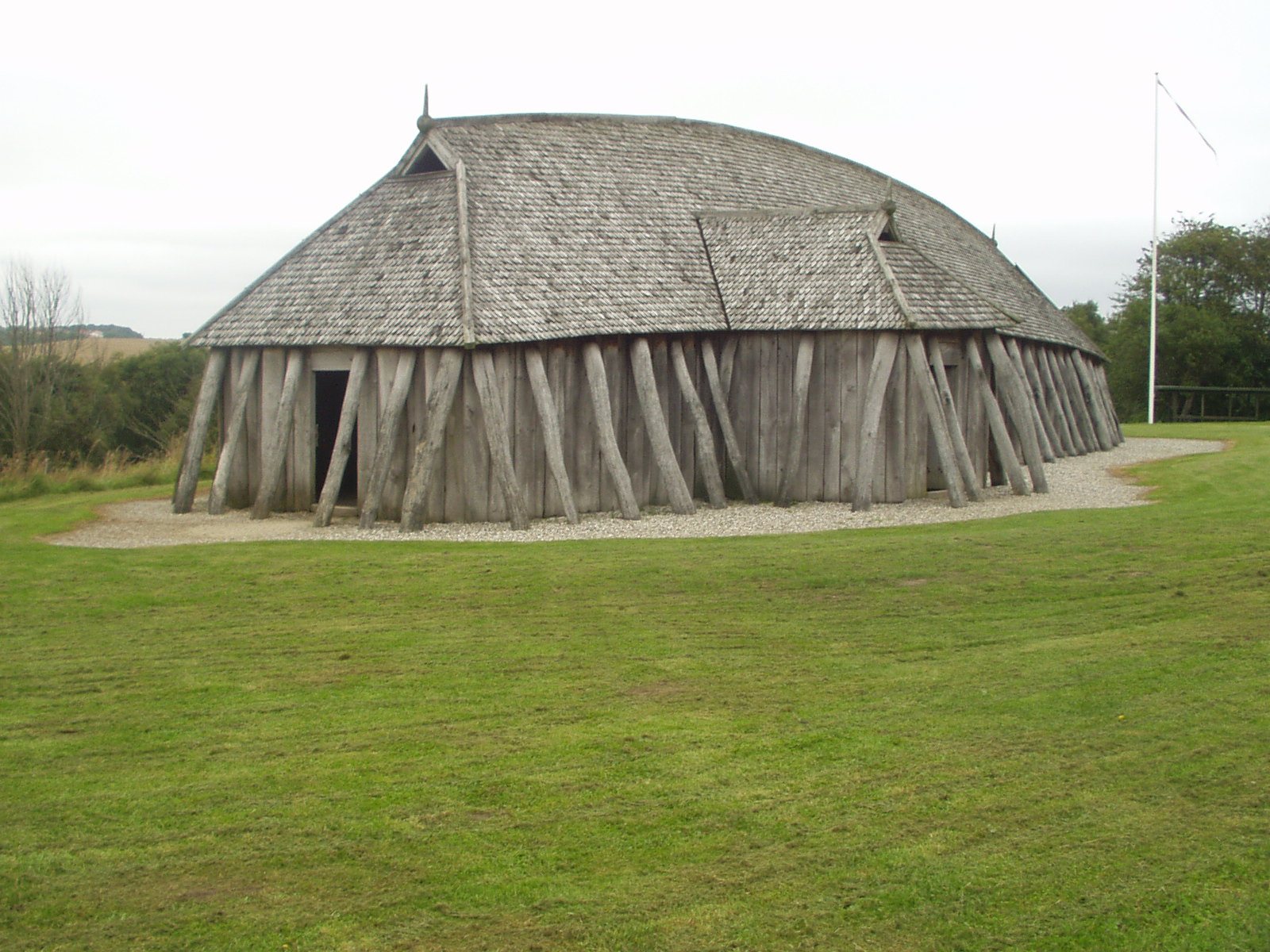
In 2023 the news went round the world: Vikings had glass windows. Behind the headlines sits a specialist study of 61 glass fragments from six sites, and it is better than its press. The chemistry and the find spots do suggest that flat glass reached the North before the wave of parish churches around 1100. But nobody has actually found a window. This article separates the shards from the reconstruction.
Probably yes, but few of them and only at the very top. It is secure that several Viking Age sites have produced fragments of flat glass, meaning thin, even panes and not drinking vessels. It is argued, though not conclusively proven, that much of this glass really was in use in the ninth to eleventh centuries. That the panes sat in the walls of halls and cult buildings remains an interpretation. No Scandinavian building securely dated before 1050 preserves a glazed window, and the postholes of a hall do not reveal where a wall opening was.
For the ordinary farmhouse little changes. The longhouse of a normal farm still took its light from the fire, the doors and the roof opening. Glass in the wall concerns, if anything, a narrow elite.
The study is called “Viking Age Windows” and appeared in the Danish Journal of Archaeology in September 2023. Its authors are Torben Sode, Mads Dengsø Jessen of the National Museum of Denmark and Bernard Gratuze of the Centre Ernest-Babelon laboratory in Orléans. The same three had already presented the subject in 2021 at the 22nd congress of the International Association for the History of Glass (AIHV), held virtually; the proceedings appeared in 2024.
Their starting point is a research habit. For about 25 years, excavations have turned up pane fragments in Viking Age layers. They were mostly written off as later contamination, because received opinion ties the regular glazed window in Denmark to the wave of parish churches around 1100. The three authors consider that a bias, so they tested the shards chemically.
The much-mentioned “Tissø find” is therefore no single sensation. Tissø is one of six sites, and not the largest by numbers.
The study analysed 61 samples. The figures below give first what the paper lists as finds, then how many pieces went to the lab.
The sample sizes are small. Sixty-one splinters carry the chemical side of the thesis, and the authors themselves say their numbers probably give only a partial picture. They could not sample Birka and Sorte Muld in full.
The method was LA-ICP-MS: a laser removes minute amounts of glass and a mass spectrometer measures major and trace elements, leaving the fragment practically intact. Three glass groups emerged:
From this the authors read two possible supply routes. The early trading places Birka and, in part, Hedeby show eastern fingerprints or the standard wood-ash glass. The aristocratic and cult sites of the south instead drew on a continental wood-ash-lime glass. Three glass smoothers from Tissø and Sorte Muld, tools for smoothing cloth, match the same group chemically, which to the authors could suggest a fairly centralised supply.
The analysis says nothing direct about how the glass travelled north. The paper itself speaks only of possible import paths for the raw material; as far as I could assess it, it does not discuss plunder at all. That contrast comes from the press: according to Euronews/AP the National Museum considers trade most likely, and Medievalists.net and Current World Archaeology report that theft from monasteries and churches was considered but rated less likely because the glass turns up at several sites. That fits the trading world of the Viking Age, but it is not proven for these shards.
This is the most sensitive part. Chemistry gives no year. The authors compare the recipes with a sequence built mainly on German finds (Wedepohl) and place the use of the panes between the beginning of the ninth and the end of the eleventh century. All they call certain for the wood-ash-lime glass is production before the thirteenth century. Recycled natron glass may also be much older than the moment it was used.
The second support is the sites themselves. As the authors present it, they end abruptly before about 1050, with hardly any finds afterwards. So how would late glass get into such layers? The argument has weight, but it depends on that ending holding for each site, and the paper, as far as I could assess it, states it as a general finding and not site by site. Hedeby, for one, is usually counted as lasting until its destructions of 1050 and 1066, and the authors' own date range runs to the end of the eleventh century.
Three individual cases are stronger. At Birka a large share of the fragments lay outside the gable of a timber building belonging to phase 7 and later, so the tenth century. Three Birka graves (Bj 124, Bj 348, Bj 557) held small pane splinters, which Holger Arbman read as possible amulets. And a note in the study reports 19 fragments from the recent excavations at Kaupang in Norway, five of them from undisturbed Viking Age layers. Those pieces have not yet been analysed.
“… he sent messengers to Gaul to fetch makers of glass, (more properly artificers,) who were at this time unknown in Britain, that they might glaze the windows of his church, with the cloisters and dining-rooms.”Bede, Lives of the Holy Abbots of Wearmouth and Jarrow, section on Benedict Biscop, translated by J. A. Giles (the Latin text was not consulted)
The idea would be implausible only if window glass had been a rarity across early medieval Europe. At major buildings it was not. Bede tells how Abbot Benedict Biscop fetched glassmakers from Gaul for his monastery at Wearmouth, which the study dates to 675. It also cites traces of glass production at Aachen on the site of the chapel and aula, window glass from Paderborn, workshops at the Italian monastery of San Vincenzo al Volturno and moulds for H-shaped lead cames from Saint-Denis. Cames are the profiles that join single panes into a surface.
Lords in southern Scandinavia knew this world. The authors compare Tissø in its Fugledegård phase (about 800–1050) with Carolingian manors. That explains why someone might want glass. It does not prove anyone installed it.
Two Danish planks provide the bridge to timber architecture. From the church at Dybe comes a stave plank, tree-ring dated to the last decade of the eleventh century, with a cut arch and grooves for a lead-framed window. Framlev near Aarhus has a similar plank from an earlier stave building, reused in the stone church of about 1100. Its opening measures about 85 × 35 centimetres, small nails remain in the groove and the window section was assembled with lead cames. Disturbed growth rings prevented tree-ring dating.
The planks demonstrate a technique: lead windows could be set into timber walls. To the authors this would have worked in any timber building. Both pieces, however, come from a church context, and Dybe stands at the very end of the Viking Age. The authors place Framlev's original building in the later Viking Age or very early Middle Ages, church or secular, without being able to decide. For a pagan hall of the ninth century both remain an analogy.
There are two pictures of size as well. For the cult buildings the authors speak of possibly one or more small windows, whereas Framlev shows a substantial opening. Looking out was probably not the point: according to press reports the researchers imagine smaller windows with a coloured inflow of light, and the paper also stresses coloured light in Carolingian palaces. That is an interpretation, resting on the green and brown tones of the shards.
Anyone looking for window glass from Ribe finds nothing in this study. It names the town as an early trading place and refers to the work of Barfod and colleagues (2022) on the glass workshops there, whose subject is raw materials and beads. No Ribe window glass is among the 61 samples. Separate articles here cover the coins and the bead makers.
That very fact raises an objection, one I am putting forward myself and not quoting from the study. Glass was reused as raw material, and at Tissø beads and bead waste lie alongside the panes. A splinter might therefore have arrived as scrap, ornament material or an amulet, with no window ever involved. The Birka graves may even show such a use. The authors counter that reuse for beads occurred at Hedeby and Birka, while the estates of Tissø, Strøby Toftegård, Sorte Muld and partly Uppåkra show only very limited evidence of it. The quantity at Birka also tells against my explanation, while the small numbers from Uppåkra or Strøby Toftegård do not rule it out.
The authors admit that the exact contexts are lacking. In what I could assess of the paper, neither a surviving window frame nor lead cames are named for the six sites before 1050; it documents cames for the Framlev window section and at Lilleborg on Bornholm, a castle of about 1190; Dybe shows only the grooves for them. The study gives no hall dimensions or window positions either. The main text describes cast, cylinder and crown glass only in general terms. It assigns the analysed pieces to none of these techniques and gives no pane thickness, though the supplement, which I did not see, may do so.
The magical reading, which credits glass in a window with protective or supernatural power as well, draws on the Birka graves and on hints in Old Norse literature, such as a “glass sky” (glerhiminn) and altar stones turned to glass, both according to Sode and colleagues. It remains an analogy across centuries.
What is the Old Norse word for “window”? Old Norse vindauga literally means “wind's eye”. The Cleasby-Vigfusson dictionary sets English window and Danish vindue beside it. It cites Grágás and Sturlunga saga, so law and saga texts, and says nothing about glass.
What did the panes look like? The Hedeby pieces are brown and light green. Nothing but small fragments survives, so the size of a single pane or a whole window remains open.
Was the glass made in the North? According to the study the raw material came from outside, by two possible routes. Whether finished panes were imported or formed locally from scrap glass does not emerge from my assessment.
Does this settle the matter? No. The study is a reasoned reassessment, and the authors themselves call for a wider examination of Scandinavian glass finds. The analysis of the Kaupang pieces is still to come. A targeted search turned up no published counter-study or specialist critique; that does not mean none exists.

The Viking Longhouse · Tisso · Hedeby · Birka – the trading hub · Viking Trade.
All History & Finds articles →
In the summer of 789 Charlemagne led the only army of his reign that he personally took deep into Slavic territory …
Read more →In 1979, excavators on Kanonicza Street in Kraków uncovered something that surprised even specialists: 4,212 iron bars …
Read more →The Vyatichi lived on the upper Oka and the Moskva, paid tribute first to the Khazars and then to Kiev, and resisted …
Read more →A river, a handful of chronicle lines, and a name that has outlived its tribe by more than a thousand years: the story …
Read more →