"From the fury of the Northmen, deliver us, O Lord" is often presented as a cry from the Viking Age, and anyone who has watched the series knows Ragnar Lodbrok's last words in the snake pit. But how many of these sentences can actually be found in a medieval manuscript? This article takes five famous quotations and the lines from films and series apart one by one, separates source, later tradition and modern attribution, and says openly where my research hit its limits. Whatever could not be verified is marked as "not attested".
The Viking Age (roughly 793 to 1066) was an era without a narrative tradition of its own on parchment. The Norse of the period wrote runes, mostly short inscriptions on stone, wood and metal: names, ownership marks, memorial formulas. Long texts, speeches, dialogues or first-person prayers virtually do not survive from the North in this period (the few long runic inscriptions, such as the Rök stone in Sweden, are exceptions rather than speeches). Skaldic praise poems were performed orally and written down only centuries later. The great narratives, sagas and Eddic poems, were mostly written down between the twelfth and fourteenth centuries, that is, generations after the events or after the end of the pagan faith. Accounts of raids come from the victims, usually clerics in England and the Frankish realm.
For quotations this means: what circulates online as "Viking wisdom" is either a line from a medieval poem, a sentence from a saga, a sentence by a Frankish or English chronicler about the Northmen, or a modern invention. The fourth group grows fastest. A saying that fits a picture of an axe and a ship gets shared a hundred times until nobody asks where it came from.
A note on method: I could consult only a limited number of sources for this article. Several primary texts (manuscript editions, Alcuin's letters in their wording) were not reachable. Where I saw only a summary or secondary literature, the text and the source list say so.
Three questions expose most misattributions. First: is there a citation with title, manuscript or edition, chapter or stanza? A line "from the sagas" without saying which saga and which chapter is worthless. Second: how long is the gap between the alleged speaker and the oldest written record? Between a Viking of the ninth century and a saga of the thirteenth lie about four centuries of oral and written transmission. Third: in what language and translation does the quotation exist? An English or German sentence that sounds like a translation but has no Old Norse original usually is not one.
A fourth distinction is standard in research: a quotation can be sourced and still not come from the person it is attributed to. When a saga lets a hero speak, it is a narrator putting words in his mouth. Direct speech in sagas is literary composition, not a transcript.
The Latin form is "A furore Normannorum libera nos, Domine". It appears in countless books and websites as a prayer of the Franks or English in the ninth century, often with the remark that it was said in churches. A source is almost never given.
What I was able to check: the site "The Viking Answer Lady" calls the formula "apocryphal", citing the Belgian historian Albert D'Haenens (Les Invasions Normandes en Belgique au IXe siècle, 1967). According to that page, no ninth-century text containing these words has ever been found. This is a secondary source; I have not read D'Haenens' book myself. The statement is clear enough, though, to treat the formula with caution.
The same page names as the nearest parallel a sentence from an antiphon for churches dedicated to Saint Vedastus (Vaast) or Saint Medardus: "de gente fera Normannica nos libera", roughly "deliver us from the wild race of the Normans". It cites Magnus Magnusson's Vikings! of 1980 and gives no date for the text. So I cannot say when this antiphon was written. That matters, because a prayer against the "Normans" could date from the ninth century but could just as well be later.
Result: the well-known formula "A furore Normannorum" is, in this wording, not attested as a ninth-century prayer in anything I could consult. That people in threatened regions prayed for protection from the Northmen is plausible. But a plausible prayer is not a sourced quotation. Anyone using it should write: "often quoted, not traceable in contemporary sources in this form". The article on the Viking prayer covers the other side, whether the Norse themselves knew such prayers.
One more point: the formula is in Latin, not Old Norse. It says nothing about what the Vikings said or thought, only about the fear of their victims, if it is genuine at all.
The testimony on the raid on Lindisfarne is different. The Anglo-Saxon Alcuin of York, then an adviser at the court of Charlemagne, wrote letters to Northumbria in 793. Two are confirmed for this round through a source collection (manchistorian.com, translators not named): one to King Æthelred of Northumbria, one to Higbald, bishop of Lindisfarne. I have not read the Latin.
According to that collection, the sentence that never before had such terror appeared in Britain stands in the letter to Æthelred. The letter to Higbald speaks of the heathens having poured out the blood of saints around the altar. English Wikipedia gives both without passage or translator; I therefore quote only in sense. Further details of the letters, such as the admonition that the monks' own sins might have provoked the punishment, I did not verify and leave out.
On the Anglo-Saxon Chronicle for 793: according to Wikipedia it mentions two omens, immense sheets of light in the air and fiery dragons in the sky. The date needs care: the chronicle entry itself, according to the source collection mentioned, gives "the sixth day before the ides of January", that is 8 January. Wikipedia gives 8 June 793 for the raid, evidently following other sources. Accounts differ here; how scholarship explains the discrepancy I did not check in this round. I did not consult the public-domain nineteenth-century translations (Ingram, Giles), so no verbatim quotation follows.
What matters for interpretation: Alcuin's letter is a genuine contemporary voice. But it is the voice of a cleric who sees divine judgement in the catastrophe. What the attackers said, what they thought, where exactly they came from, he does not tell us. More on the raid in the article on Lindisfarne.
Ragnar Lodbrok, whose byline loðbrók is usually rendered "hairy breeches" or "leather trousers" (the meaning is not clear-cut, according to Wikipedia), is a figure between history and legend. Who he was, and whether the saga figure goes back to one or several historical persons, is disputed in research and treated at length in the article on Ragnar Lodbrok. For the question of quotations something else counts: his last words stand in two different traditions.
The first is Ragnars saga loðbrókar, a medieval prose narrative in which Ragnar is captured by King Ælla in England and thrown into a snake pit. The second is the Krákumál, also called the "Lay of Kráka" or Ragnar's death song, a poem that lets Ragnar speak in the face of death. For its origin I have only secondary statements: English Wikipedia dates the poem to the twelfth century and suspects the Scottish islands; vikingr.org says the consensus is that it was first written in the twelfth century, preserved in manuscripts of the thirteenth and seventeenth. The two agree on the period but not in every detail, and nothing here rests on reading the primary text.
The gap is what matters. Ragnar, if he existed in this form, is a figure of the ninth century. The poem was composed centuries later at the earliest. There is therefore no secure link between the words spoken there and what a man in the ninth century really said. The saga also uses motifs that appear in other tales of a hero's death. That is why research speaks of a literary death scene rather than a report.
The sentence in the form often read today (I have seen the wording in no edition; the line is given here in sense only) runs roughly: "How the piglets would grunt if they knew how the boar fares." The meaning: if Ragnar's sons, the "piglets", knew the plight of their father, the "boar", they would act, namely take revenge. The boar as a fierce animal is a familiar image in Norse poetry; I did not check it for this particular line.
What I found in this round is less than one might expect. The English Wikipedia page on the Krákumál does not contain the line; it reproduces only the first stanza and notes that the poem inspired Ragnar's last words in the television series Vikings. The English translation on vikingr.org, according to my query, also contains no reference to piglets or boar. I could not see an Old Norse stanza with exact verse numbering, so I do not write one here. In the follow-up check I also went through the English Wikipedia pages "Tale of Ragnar Lodbrok" and "Ragnar Lodbrok"; the line is not there either. Whether it occurs in the saga, in the Krákumál or in both I cannot say. My earlier guess that it belongs to the saga only was pure recollection and is not substantiated.
What does this mean for the fact check? Two things can be said honestly. First, that the tradition of Ragnar's death includes a remark about boar and piglets is the common view, but in this research I cannot pin it to a stanza or chapter. Second, whether he "really" said it is not a question that can be answered, because the scene is late narrative material. Anyone quoting the line should cite: "Ragnars saga loðbrókar (thirteenth century?), death scene", and mark the dating of the saga as open.
According to Wikipedia, Saxo Grammaticus (around 1200) also tells of Ragnar's death in the snake pit. Whether and in what form the piglet image occurs there I could not check, because the public-domain English edition by Elton could not be read through the retrieval tools. All that can be said is that death in the snake pit was a fixed narrative tradition existing in several versions. There is no single "authentic" version. On the sons, see Ragnar's sons.
The counterpart to the doubtful sayings is a verse firmly anchored in a medieval manuscript: stanzas 76 and 77 of the Hávamál ("Sayings of the High One"), a poem of the Poetic Edda preserved in the Codex Regius from around 1270. In Old Norse, in the normalised spelling used on our page about the Hávamál sayings:
Deyr fé, deyja frændr, deyr sjalfr it sama; en orðstírr deyr aldregi hveim er sér góðan getr.
Deyr fé, deyja frændr, deyr sjalfr it sama; ek veit einn at aldri deyr: dómr um dauðan hvern.
"Cattle die, kinsmen die, you yourself will die likewise. But the fame of the dead never dies for the one who earns a good one. – One thing I know that never dies: the verdict on each dead person."
Hávamál, stanzas 76–77, Codex Regius (c. 1270), normalised text; English rendering our own
Here manuscript, stanza and language are clear, though stanza counts can be shifted by one depending on the edition (on voluspa.org, for instance, the stanza "Cattle die … a noble name will never die" carries the number 77 in the English version). The Old Norse wording of both stanzas matches what is printed there. Note, though, that the poem is a collection of life rules delivered by a speaker in Odin's name, not the words of a historical Viking. Its date of composition is discussed in research; individual stanzas can be older than the record. How old stanzas 76 and 77 are cannot be established with certainty. And one more thing: "orðstírr" literally means "word-glory", that is, what people say about the dead. The modern translation "fame" catches the core but not all of it.
On the place of the Edda see Edda, and on its compiler Snorri Sturluson. Whether the stanza's view of death fits the belief in Valhalla is discussed in Viking ideas of death.
The film lines that circulate as "Viking wisdom" form a group of their own. Their wording is protected by copyright, so I do not quote them here but describe how to classify them.
One example that series do pick up real sources is Ragnar's farewell scene in Vikings. According to the Wikipedia page on the Krákumál, the poem inspired those last words. That does not mean the series' words reproduce the poem, only that the writers took up the idea of including a death song. Whether any single sentence of the scene rests word for word on a stanza, I have not compared.
Much else comes from scripts that use words like "Valhalla" and "Odin" to create atmosphere. Such lines belong to fiction and are not sources. That is legitimate as long as nobody passes them off as evidence. On the series itself and its accuracy see Vikings: fact check and Viking films.
In this round I did not verify individual film or series quotations with season, episode and speaker. Anyone wanting to use one should look up episode, writer and speaker and state in the text that it comes from a series.
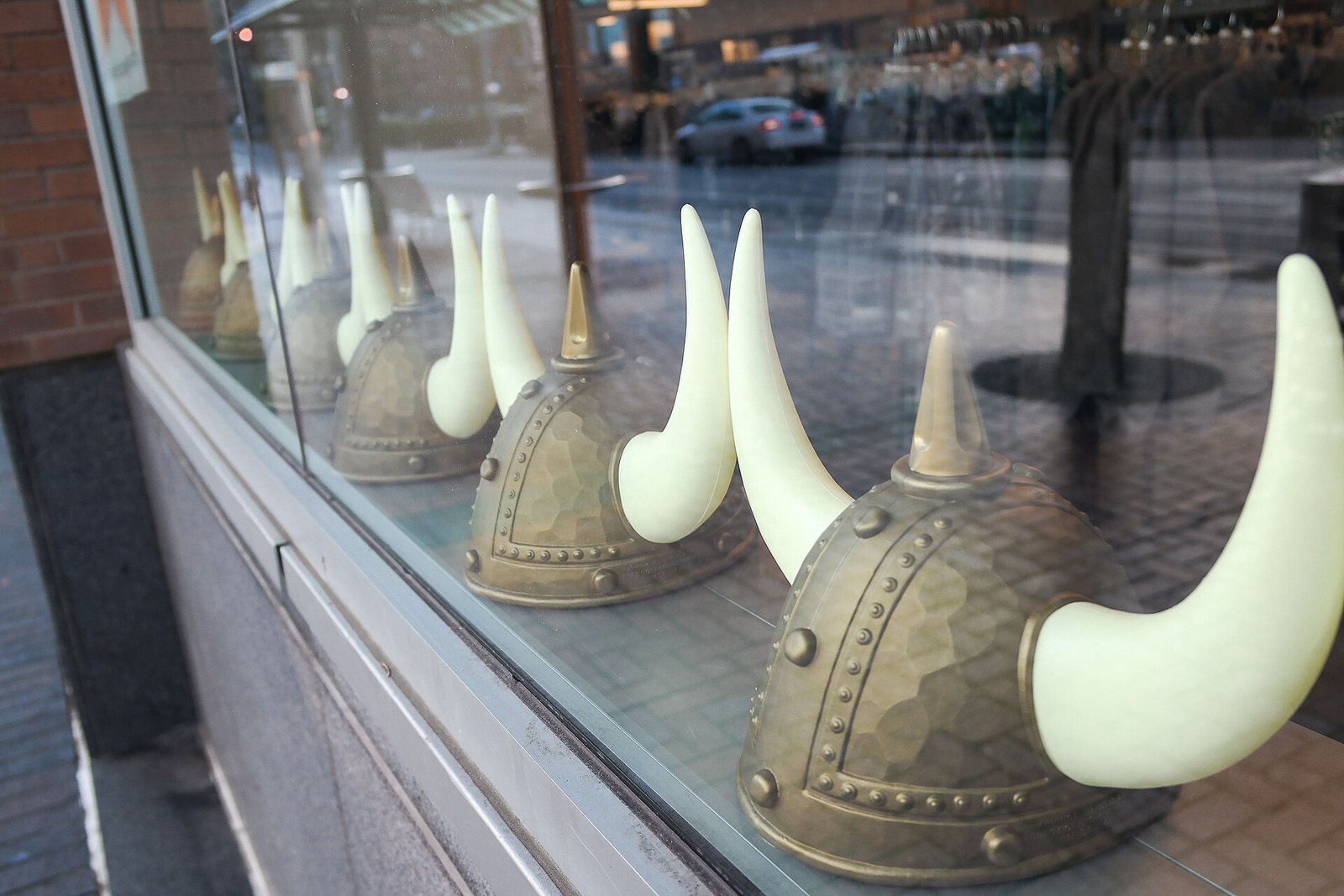
The examples yield several features that make a quotation suspect. It sounds modern, with words like "motivation", "success" or "mindset" that had no counterpart in Old Norse poetry. It names no source. It is attributed to a man who demonstrably left nothing in writing. Every web post gives it a different wording. And it sits on a picture with a horned helmet, which according to current research was not an everyday helmet (see Viking helmets).
A reliable remedy is to look along the chain: who wrote it down first? For Alcuin it is a letter by a contemporary. For the Hávamál, a manuscript. For the piglets, a late narrative work. For "A furore Normannorum", according to what I found, no such chain is visible.
Research separates three groups of sources: archaeology and runic inscriptions (contemporary, but sparse), foreign accounts by clerics and chroniclers (close in time, but partisan), and Norse literature of the High Middle Ages (rich, but late). A "Viking quotation" in the strict sense, a sentence spoken by a man of the Viking Age and written down soon afterwards, is therefore extremely rare. Genuinely contemporary are almost only runic inscriptions, and these are short: A freely worded example line such as "Thorgisl raised this stone for his brother" captures their typical tone (the example is invented, not a real inscription). More on inscriptions in the article on runes.
The most famous Viking sayings are in truth sayings about Vikings, written down by those who feared them or by descendants who idealised them. That does not diminish their value, but it changes what they prove: they show how people in the Middle Ages and today imagine the Vikings, not how the Vikings themselves spoke.
Look for the wording in an edition. For the Edda, public-domain translations such as Karl Simrock's (nineteenth century) are suitable; compare the stanza number there. For sagas, sites such as heimskringla.no offer the Old Norse text. For letters and annals, the editions of the Monumenta Germaniae Historica are recommended. Never rely on the first search-engine hit, because many pages copy each other.
If you find nothing, say so. "Not traceable in the sources I could consult" is an honest sentence.
Are there genuine Viking quotations? Contemporary ones almost only on rune stones, and those are short. Longer sayings come from poetry and sagas written down centuries later.
Is "A furore Normannorum" a real prayer? In this form it is, according to what I found, not attested in the ninth century. Similar pleas are possible but not documented in this wording.
Who wrote down Ragnar's last words? They appear in the saga and in the Krákumál, both medieval and much younger than Ragnar's time. Which line stands in which text I have not finally checked.
Which Viking quotation is best sourced? Hávamál stanzas 76 and 77, because manuscript and text are fixed (stanza numbering varies by edition). They are, however, poetry and not a Viking's own mouth.
May film lines be used as Viking quotations? Only with a note that the source is a film or series. As historical statements they do not work, and their wording is protected.
Hávamál sayings · Ragnar Lodbrok · Ragnar's sons · Lindisfarne · Viking prayer · Vikings series fact check · Edda · Prejudices about Vikings

Hávamál – Sayings of the High One · Ragnar Lodbrok · The Lindisfarne Raid of 793 · The Vikings series fact-check · What contemporaries thought of the Vikings.
All History & Finds articles →
In the summer of 789 Charlemagne led the only army of his reign that he personally took deep into Slavic territory …
Read more →In 1979, excavators on Kanonicza Street in Kraków uncovered something that surprised even specialists: 4,212 iron bars …
Read more →The Vyatichi lived on the upper Oka and the Moskva, paid tribute first to the Khazars and then to Kiev, and resisted …
Read more →A river, a handful of chronicle lines, and a name that has outlived its tribe by more than a thousand years: the story …
Read more →