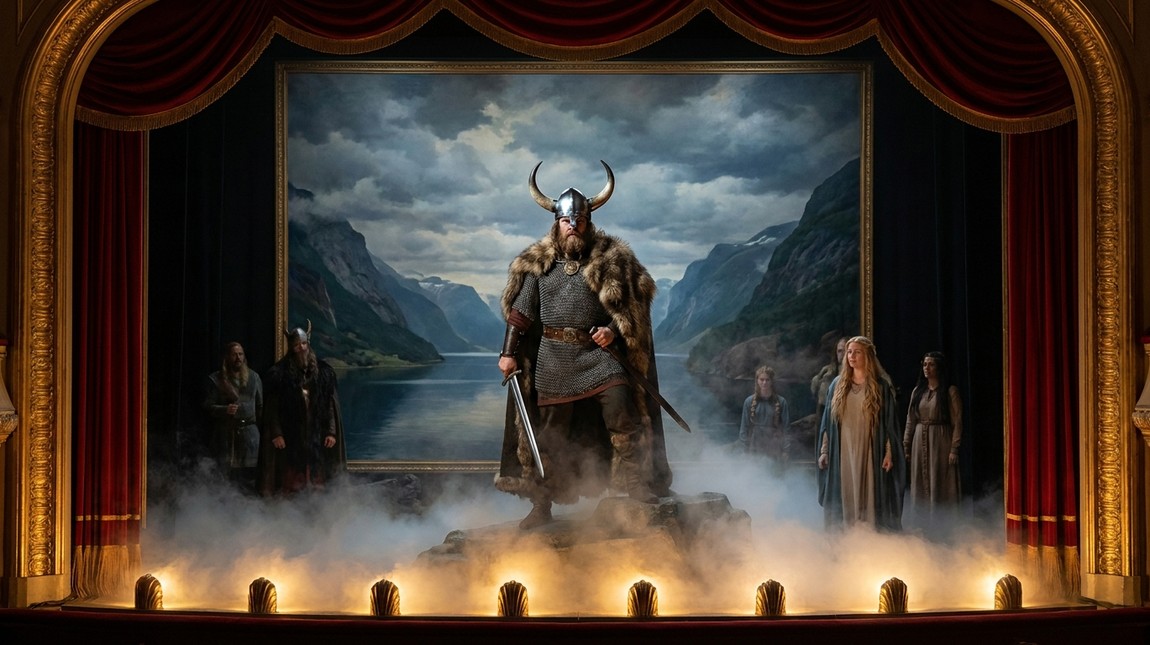
Few periods of European history have been shaped by cinema as much as the Viking Age. Most people meet their first Vikings not in a museum but on a screen. This guide sorts the best-known films and series not by how entertaining they are, but by five checkable criteria: clothing and equipment, ships, religion, chronology and characters. Where a verdict rests on finds and written sources, I say so. Where it is my interpretation, it is marked as such. For titles that already have their own fact check on this site, I point you there rather than repeating everything.
Lists of Viking films usually judge by taste. The question we are asked most often is a different one: “Is that how it was?” The answer is rarely a plain yes or no. A film can get its woollen fabrics exactly right and still squeeze three generations into a single lifetime.
So this text separates the layers. For each title it asks what is shown, what it can be compared with, and how solid that comparison is. A film that is historically far off can still be a great film. Valhalla Rising (2009), for example, is closer to a poem about violence and faith than to a history film.
Clothing and equipment. The evidence here is comparatively good. Textiles from graves at Birka, Hedeby or Oseberg, brooches, weapons and the Gotland picture stones allow fairly precise statements. The basic materials were wool and linen, often dyed. The only largely complete helmet from the Viking Age comes from Gjermundbu in Norway, and it has no horns. More in Viking clothing, What did Vikings look like? and Helmets of the North.
Ships. Hard evidence exists here too: the Oseberg and Gokstad ships, the Skuldelev wrecks from Roskilde, and many replicas that have been sailed. They let us check whether a film ship is clinker-built, carries a square sail and has a plausible size. Carved dragon heads are trickier: texts and images know them, surviving examples are rare. See Viking longships.
Religion. This is the most delicate criterion. Almost everything we read about gods, cult and afterlife was written down by Christians, often two or three centuries after the events: Snorri Sturluson around 1220, Saxo Grammaticus around 1200, Adam of Bremen around 1075. A film that shows rituals is almost always filling gaps. The question is whether it uses material from the sources or free invention.
Chronology. This is the easiest to check. By the usual definition the Viking Age runs roughly from 793, the raid on Lindisfarne, to 1066.
Characters. Is a figure historical, legendary or invented? Ragnar Lodbrok is a saga figure whose relationship to real people of the ninth century is unresolved. Uhtred in The Last Kingdom is a novelist’s creation. Thorkell in Vinland Saga, by contrast, has a historical model.
I use three levels, which can differ from criterion to criterion: close to the evidence (what is shown can be supported by finds or near-contemporary sources), loosely based (there is a source, but a late one, or it is heavily altered) and free (no basis, or deliberate invention). The overall assessment for each title is marked as interpretation.
Richard Fleischer’s The Vikings reached cinemas in 1958, with Kirk Douglas as Einar, Tony Curtis as Eric, Janet Leigh as Morgana and Ernest Borgnine as Ragnar. It was based on Edison Marshall’s 1951 novel The Viking, loosely drawn from the Ragnar sagas. Aella’s castle is the real Fort-la-Latte in Brittany, a late medieval fortress.
Clothing and equipment: free to loosely based. The film works with furs, leather vests and helmets to 1950s taste. Ships: loosely based; the longships look broadly right. Religion: loosely based. A seeress warns of Odin’s curse, and Ragnar wants to die sword in hand to reach Valhalla. The idea that death in battle opens the way to Valhalla comes from later literature and is far less clear-cut there than it seems here; see Valhalla. Chronology and characters: loosely based. Ragnar dies in Aella’s wolf pit, a variation on the saga scene in which Ragnar ends in Ælla’s snake pit. The saga itself is a thirteenth-century text, not a chronicle; more in Ragnar Lodbrok.
Assessment (interpretation): This film is the template for almost every later screen Viking. It tells an adventure with saga motifs, not a history of the Viking Age.
John McTiernan’s The 13th Warrior opened in August 1999, with Antonio Banderas as the Arab envoy Ahmad ibn Fadlan and Vladimir Kulich as Buliwyf. It is based on Michael Crichton’s 1976 novel Eaters of the Dead, which fuses two texts: the travel account of the historical Ibn Fadlan and the Old English epic Beowulf. Buliwyf is recognisably Beowulf, and the Wendol take Grendel’s role. After weak test screenings Crichton directed reshoots; financially the film was a heavy loss.
Characters: this is the interesting core. Ibn Fadlan was real. In 921 and 922 he travelled on behalf of the caliph al-Muqtadir from Baghdad to the Volga Bulghars and described traders there whom he calls Rus. What the film makes of this is invented: Ibn Fadlan does not travel to Scandinavia with Northmen, and he does not fight bear-like cannibals there. Religion and equipment: loosely based. The ship cremation the film shows early on goes back to Ibn Fadlan’s account of a Rus chieftain’s funeral, one of the most quoted passages in Arabic writing about the North. The dead king is called Hygelak, a name from Beowulf. One difference in detail: in Ibn Fadlan the ship is burned on land on a wooden frame; in the film it drifts out onto the water in flames. Ibn Fadlan also notes that each man carried an axe, sword and knife. Chronology: free. Beowulf is set in the sixth century, Ibn Fadlan travelled in the tenth, some 400 years apart.
Assessment (interpretation): A film that uses a genuine source as its frame and introduced many viewers to the name Ibn Fadlan. We cover the account itself in Ibn Fadlan: the account of the Rus on the Volga, including a section on the film.
Two adaptations are widely known: Beowulf & Grendel (2005), directed by the Icelandic-Canadian filmmaker Sturla Gunnarsson, starring Gerard Butler and shot in Iceland, and Robert Zemeckis’s Beowulf (2007), animated with performance capture from a script by Neil Gaiman and Roger Avary, with Ray Winstone, Anthony Hopkins and Angelina Jolie.
The key point: Beowulf is not a Viking story. The epic survives in Old English in a single manuscript from around the year 1000. Its plot, however, is set among Danes and Geats of the sixth century. The Geatish king Hygelac, Beowulf’s uncle, probably corresponds to a king whose raid into Frankish territory Gregory of Tours records for around 520. The matching archaeology is therefore the Vendel period, with its splendid helmets known from Valsgärde or Anglo-Saxon Sutton Hoo.
Chronology: anyone who equips Beowulf with longships, dragon prows and Viking helmets moves him by two or three centuries. Religion: the poem itself was composed by a Christian poet telling of pagan ancestors. Assessment (interpretation): both films are literary adaptations with a great deal of freedom. Neither works as a picture of the Viking Age, because both are about a different period.
The Norwegian film Ofelaš (international title Pathfinder), written and directed by Nils Gaup in 1987, is in Northern Sámi and set around the year 1000 in Finnmark. Its raiders are the Chudes, figures from Sámi tradition, not Vikings in the strict sense. The film was nominated for the Academy Award for Best Foreign Language Film in 1988. The American remake Pathfinder (2007), directed by Marcus Nispel and starring Karl Urban, moves the story to North America and turns it into a fight against giant Northmen.
Clothing and equipment: free. The warriors of the 2007 film wear oversized armour and masks closer to fantasy monsters. Chronology and characters: loosely based. That Norse people reached North America around the year 1000 is archaeologically secure thanks to L’Anse aux Meadows in Newfoundland. The Vinland sagas also tell of fights with locals they call Skrælings. An invasion like the one in the film is not recorded; the sagas describe small groups that left again after a few years. See Thorfinn Karlsefni.
Nicolas Winding Refn’s Valhalla Rising (Venice, 2009), with Mads Mikkelsen as a mute, one-eyed fighter, takes a different route. Shot entirely in Scotland, it follows Christian Norsemen bound for the Holy Land who land on an unknown coast in the fog. The film leaves the date open; the crusade points to after 1096. Norwegian crusaders are attested, notably King Sigurd Magnusson, called Jórsalafari (“Jerusalem-farer”), whose expedition falls between 1107 and 1111. Assessment (interpretation): Valhalla Rising is a film about the end of a world in which old and new religion collide. Its look is spare and plausible, its storytelling symbolic, not a history lesson.
Michael Hirst’s Vikings premiered on History in March 2013 and ended after six seasons; the final episodes were released at the end of 2020, and Canadian television aired them until March 2021. The sequel series Vikings: Valhalla, created by Jeb Stuart, ran on Netflix from 2022 to 2024, three seasons of eight episodes each, and opens with the St Brice’s Day massacre of 1002, more than a century after the events of the original.
Both series have their own detailed reviews here: the Vikings fact check and the Vikings: Valhalla check.
Clothing and equipment: free to loosely based. Both series use a look built on dark leather, studs and shaved temples. Ships: loosely based; the basic shape of the ships is right. Religion: free. Hirst himself said he had to take liberties because so little is known about the period. The temple at Uppsala, for example, appears as a stave building, a type known only from the Christian period. Chronology: free. Vikings puts figures side by side who are generations apart, such as Ragnar and Rollo, who only becomes tangible in Normandy in 911. Valhalla compresses events from 1002 to the middle of the eleventh century. Characters: mixed. Ragnar and Lagertha are saga figures, King Ecbert, Aelle and Alfred are historical kings, Athelstan is invented. In Valhalla, Leif Erikson, Freydís, Harald Sigurdsson, Cnut and Emma are historical, but their meetings are largely not.
Assessment (interpretation): Vikings has brought more people to the Viking Age than any book, but it is a drama built on saga material, not a historical panorama. It comes closest to history where it portrays the Great Army of 865, which the Anglo-Saxon Chronicle also knows; see Ragnar’s sons.
The Last Kingdom is based on Bernard Cornwell’s Saxon Stories. The first two seasons aired on BBC Two in 2015 and 2017, seasons three to five on Netflix until 2022, 46 episodes in all. The film Seven Kings Must Die followed in 2023. The hero, Uhtred of Bebbanburg, is fictional. His name was later borne by several lords of Bamburgh, notably Uhtred the Bold, who lived about a century after the story.
Chronology: loosely based to close to the evidence. The framework is surprisingly sound: the Great Army’s attacks on Northumbria and East Anglia, the death of King Edmund in 869, Alfred’s retreat to the marshes of Athelney, the victory at Edington in 878, the division of the country, later Æthelflæd’s rule in Mercia. All of this comes from the Anglo-Saxon Chronicle and Asser’s Life of Alfred; more in Alfred the Great. Characters: mixed. Alfred, Guthrum, Ubba, Æthelflæd and Edward are historical; many of the series’ Danes, such as Ragnar the Fearless, are invented. Clothing, ships: loosely based. It too reaches for a lot of dark leather.
Assessment (interpretation): For a rough sense of the Viking wars in England this series serves better than most, as long as it is clear that the hero and his deeds are invented. A dedicated review appears as The Last Kingdom fact check.
Robert Eggers made The Northman from a script he co-wrote with the Icelandic author Sjón. It reached cinemas in April 2022, with Alexander Skarsgård as Amleth, alongside Nicole Kidman, Anya Taylor-Joy, Ethan Hawke, Willem Dafoe and Björk. Its advisers included the archaeologist Neil Price, the folklorist Terry Gunnell and the literary scholar Jóhanna Katrín Friðriksdóttir. The story begins in the year 895 and leads through the land of the Rus to Iceland and into the crater of Hekla.
Characters: loosely based. Amleth comes from the Gesta Danorum of Saxo Grammaticus, written around 1200, and is the same legendary figure who later became Shakespeare’s Hamlet. In Saxo the story takes place in Jutland, not Iceland. Clothing and equipment: close to the evidence. Fabrics, cuts, jewellery and weapons are clearly modelled on finds; the costume and props are among the most careful the genre has seen. Religion: loosely based. The film shows rituals, seeresses, a wolf-warrior rite and valkyries. Much of this draws on motifs from sagas, the Eddas and research on wolf warriors and seiðr, condensed into scenes that are not recorded in this form anywhere. Chronology: close to the evidence. The late ninth century, with raids in the East and the settlement of Iceland, fits the time frame.
Assessment (interpretation): Among feature films, The Northman is probably the current benchmark for material culture. A detailed review follows in The Northman fact check.
Vinland Saga began as a manga by Makoto Yukimura, launched in 2005 and concluded in July 2025 with chapter 220 after some twenty years. The anime has two seasons of 24 episodes each: 2019 by Wit Studio, 2023 by MAPPA. The story starts in the early eleventh century and runs through the Danish conquest of England under Sweyn Forkbeard and Cnut.
Characters: mixed. Thorfinn is modelled on Thorfinn Karlsefni, who according to the Vinland sagas led a settlement voyage to North America; his youth as a revenge-driven warrior is invented. Thorkell has a historical model in Thorkell the Tall, a Danish commander who fought in England from 1009 and later changed sides; tradition also links him to the Jomsvikings. Cnut is the later king of England, Denmark and Norway; see Cnut the Great. Askeladd is invented; his name comes from Norwegian folk tales. Chronology: loosely based to close to the evidence. The main lines of the years 1013 to 1016 are right. Clothing, ships: loosely based, but careful for an animated work.
Assessment (interpretation): A work about violence and its cost that uses a historical framework to tell it. More in the Vinland Saga fact check and in Thorfinn Karlsefni.
Some titles do not want to be historical at all. Norsemen, originally Vikingane, ran from 2016 to 2020 on the Norwegian broadcaster NRK and internationally on Netflix, three seasons of six episodes each. Every scene was shot twice, in Norwegian and in English. The comedy is set around 790 in a fictional village and works by transplanting modern office and relationship problems into the Viking Age.
How to Train Your Dragon (2010, directed by Chris Sanders and Dean DeBlois, based on Cressida Cowell’s books; remade in live action in 2025) uses horned helmets quite deliberately as a mark of a fantasy world. Ragnarok (Netflix, 2020 to 2023, three seasons, created by Adam Price) moves gods and giants into a fictional present-day town in western Norway called Edda. And Marvel’s Thor films from 2011 onwards invent a mythology of their own, in which Loki, for example, is Thor’s adopted brother; see our Marvel Thor fact check. For games there are separate reviews of Assassin’s Creed Valhalla and God of War.
Assessment (interpretation): measuring these titles against finds would be unfair. The useful question is which images they plant in our heads. Today the horned helmet survives mainly through animated films and merchandise; see The horned helmet myth.
The Netflix series Barbarians (2020 and 2022, two seasons) often appears in lists of Viking titles, but it does not belong there. It tells of Arminius and the battle of the Teutoburg Forest in AD 9, some 800 years before Lindisfarne. Reviewers praised the Latin dialogue; archaeologists criticised the dark-forest imagery and errors in clothing and diet. Why “Germanic peoples” and “Vikings” are two different things is explained in Germanic peoples and Vikings: the difference.
Across the genre the same images keep coming back. A longer list of clichés is in Typically Viking?.
Almost every title has its heroes talk of fame after death. That idea does have an old basis, but in the sources it sounds more sober than in the cinema. The best-known passage is in the Hávamál, the Sayings of the High One in the Poetic Edda:
Cattle die, and kinsmen die,
And so one dies one’s self;
But a noble name will never die,
If good renown one gets.Hávamál (stanza numbering varies by edition: 77 in the online Bellows text used here, 75 in Simrock); Poetic Edda, translated by Henry Adams Bellows, 1923 (public domain)
There is no Valhalla here, no sword in the hand. The stanza is about a good reputation among the living. Cinema has often turned it into a death wish.
Which Viking film is the most historically accurate? An overall score would mislead. For clothing and equipment The Northman is currently regarded as particularly careful; for the course of events in England, The Last Kingdom stays comparatively close to the sources. Both invent their heroes or their heroes’ deeds.
Is The 13th Warrior a true story? No. Ibn Fadlan is a historical person and his account of 922 exists, but the film freely combines it with Beowulf. Ibn Fadlan never went to Scandinavia.
Did Ragnar Lodbrok really exist? That cannot be clearly established. There are ninth-century leaders with similar names, but the Ragnar we know comes from sagas and Saxo, texts of the twelfth and thirteenth centuries.
Why do Vikings in films so often wear horned helmets? Because the image took hold in nineteenth-century art and opera and has since served as an instantly recognisable sign. Animated films use it on purpose.
Is Beowulf a Viking story? Not strictly. The epic was written down around 1000 but is set in the sixth century, in the Vendel period before the Viking Age.

The Vikings series fact-check · "Vikings: Valhalla" Fact-Checked · The Last Kingdom fact-check · The Northman fact-check · Typically Viking?.
The famous "Viking prayer" – "Lo, there do I see my father …" – is not a prayer handed down from the Vikings. It was …
Read more →Few images of the Viking Age disturb like the “blood eagle”: the victim’s ribs supposedly severed from the spine and …
Read more →To some an ancient Germanic sun-sanctuary, to others a Christian place of pilgrimage – the Externsteine in the …
Read more →