The famous "Viking prayer" – "Lo, there do I see my father …" – is not a prayer handed down from the Vikings. It was written for the 1999 film The 13th Warrior. Even so, it is shared as an ancient text, engraved on headstones and tattooed onto skin. Its genuine core lies in an Arabic travel account from the year 922, and there the speaker is no warrior before battle but a young enslaved woman moments before her death. Here is what is real, what was invented, and which genuine Norse verses you can use instead.
Ask around for a "Viking verse for a headstone" and sooner or later someone will offer this line: "Lo, there do I see my father." The words turn up at funerals, in farewell posts for friends who have died, on forearms and shoulder blades, on slate plaques and urns. Almost always they come with a label like "ancient Viking prayer" or "the Vikings' prayer for Valhalla".
It is easy to see why. The text has a rhythm that sticks, and it promises that the dead are waiting for us. Anyone who has lost someone is looking for exactly that kind of comfort.
The trouble is the label. The prayer is roughly twenty-five years old, not a thousand, and its story runs from a Hollywood studio, through a bestseller of the 1970s, back to the banks of the Volga in the year 922.
At the end of August 1999 The 13th Warrior opened in cinemas, with Antonio Banderas as the Arab envoy Aḥmad ibn Faḍlān. A cultivated courtier from Baghdad is pressed into a band of twelve Norsemen following their leader Buliwyf north, where a mysterious people, the "Wendol", are terrorising a king's hall. The outsider is the thirteenth warrior a seeress has demanded.
Before the final battle the mortally wounded Buliwyf stands before his men one last time, and the warriors speak the lines that later travelled the world as the "Viking prayer". It opens with "Lo, there do I see my father" and repeats the same formula: mother, sisters and brothers, then the whole line of ancestors back to the beginning. At the close the ancestors call the speaker to take his place among them in the halls of Valhalla, where the brave live forever. We deliberately do not quote the film text in full; it is protected by copyright.
The scene packs in everything audiences associate with Vikings: courage in the face of death, comradeship, ancestors, Valhalla. But it was written for the screen. No Viking Age text and no medieval Norse manuscript contains this prayer.
The film had a rocky birth. Shooting began in the summer of 1997 under director John McTiernan, then known for Die Hard and The Hunt for Red October. The working title was the same as the novel's: Eaters of the Dead.
Test screenings went badly. Michael Crichton, the author of the source novel, then took charge himself. There were reshoots, which by consistent accounts Crichton directed without screen credit, a new edit, a new ending and a new score: Jerry Goldsmith replaced Graeme Revell as composer. The title became The 13th Warrior, and the release slipped by more than a year.
Commercially the film flopped. The budget was originally set at around 85 million dollars, and total costs with reshoots and marketing are reported to have been considerably higher. Worldwide it took about 61.7 million dollars.
The source appeared in 1976: Eaters of the Dead, subtitled as the manuscript of Ibn Faḍlān relating his experiences with the Northmen in AD 922. Crichton dressed the book up as a scholarly edition, complete with introduction, footnotes, commentary on supposed manuscripts and a bibliography in which real and invented titles sit side by side.
The construction is clever. The opening chapters really do follow Ibn Faḍlān's account: the journey, the meeting with the Northmen, their customs, the chieftain's funeral. Then the story swerves into fiction and retells, at its heart, the Old English epic Beowulf, set in Scandinavia, in which a hero frees a king's hall from a monster. Beowulf becomes Buliwyf; Grendel and his mother become an entire tribe of cave-dwellers.
In his afterword Crichton explains how it began. An acquaintance had listed Beowulf in a lecture among the great bores of literature. Crichton disagreed and set out to show that the story could grip readers if it was told as an eyewitness report. For that he needed an eyewitness, and he found one in Ibn Faḍlān.
Ibn Faḍlān was a real person. In June 921 he left Baghdad as secretary of an embassy from the Abbasid caliph al-Muqtadir. The destination was the ruler of the Volga Bulgars, who had asked for religious instruction and help in building a fortress. In May 922 the embassy reached the middle Volga. There Ibn Faḍlān met traders he calls ar-Rūsiyya, the Rus. Most scholars take them to be chiefly Scandinavians who traded furs, slaves and silver along the great rivers of eastern Europe. More about them in our article on the Rus in the East.
His report is known as the Risāla, the "epistle". For a long time only excerpts were known, quoted by the geographer Yāqūt in his great geographical dictionary in the 13th century. In 1923 the scholar Ahmed Zeki Validi Togan found a 13th-century manuscript in the library of the Imam Reza shrine in Mashhad, Iran, containing a much fuller text. Togan published it in Leipzig in 1939 with a German translation. All modern editions rest on this manuscript.
One thing matters for reading it: Ibn Faḍlān writes as a devout Muslim and court official, for readers in Baghdad. He is curious, often disgusted, sometimes admiring. He did not understand the language and relied on an interpreter, so everything he reports has already been translated and interpreted. More on the man himself in our article on Ibn Faḍlān.
The longest and most famous passage about the Rus describes how a man of rank was buried. We summarise it soberly, in our own words.
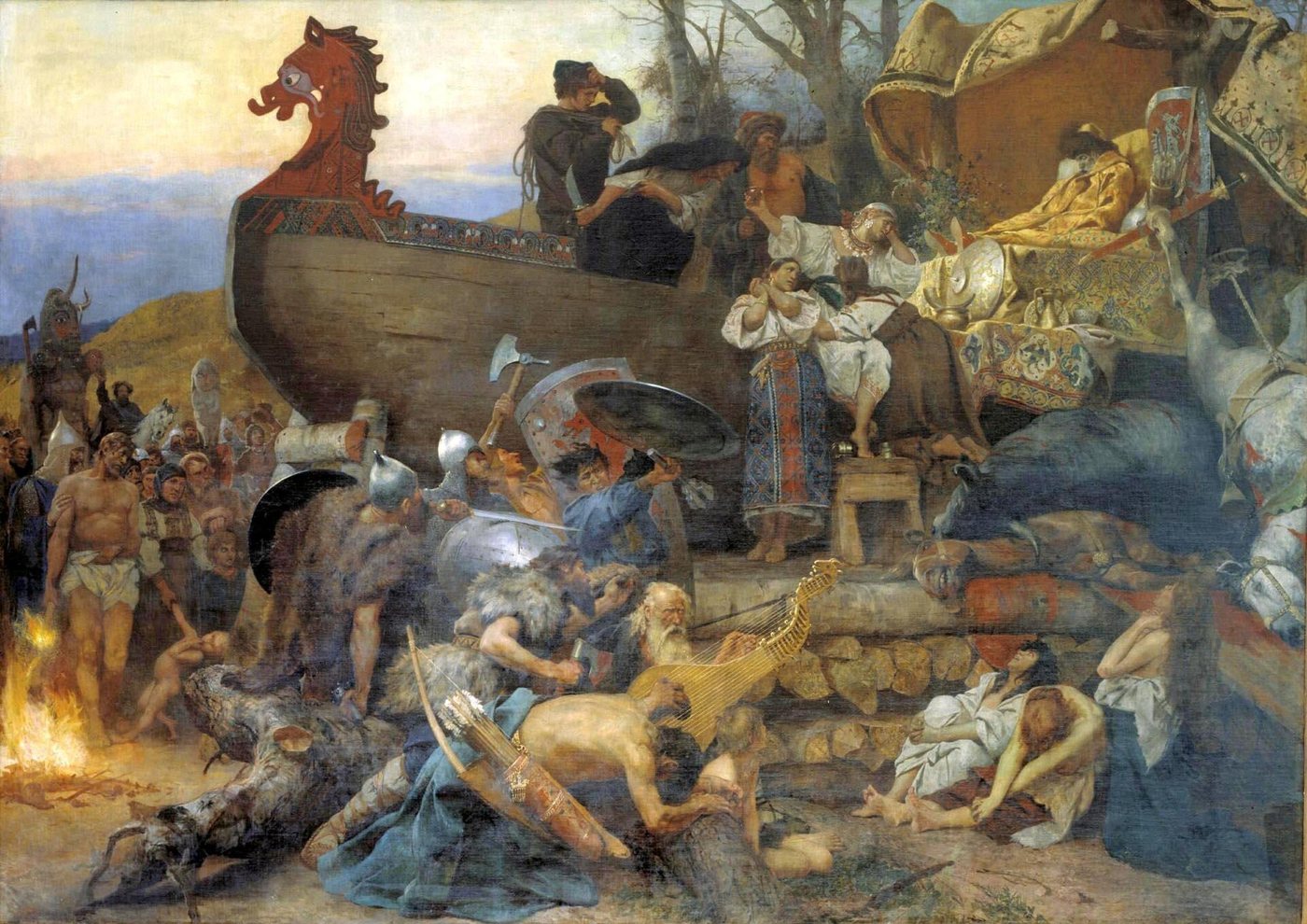
First the dead man was laid in a temporary, roofed grave for ten days while his clothes were cut and sewn. His wealth was divided into three parts: one for his family, one for his burial clothes, one for the intoxicating drink consumed during those days. His slave women and servants were asked who would die with him. A young woman volunteered. From then on she was watched and waited on; she drank and sang as if at a feast.
On the day of the burning the dead man's ship was hauled ashore and set on a wooden scaffold. An old woman whom Ibn Faḍlān calls the "Angel of Death" directed the ceremony. The body was dressed in fine clothes and laid in a tent on the ship, surrounded by drink, food, weapons and animal offerings: a dog, horses, cattle, a cockerel and a hen.
Then comes the scene that matters here. The young woman was led to a structure that looked like a door frame and lifted above it three times. Ibn Faḍlān had her words translated. In paraphrase: the first time she saw her father and mother. The second time she saw all her dead kinsfolk sitting together. The third time she saw her master sitting in Paradise; Paradise was beautiful and green, men and young servants were with him, and he was calling her, so they should take her to him.
She was then taken onto the ship. What follows Ibn Faḍlān describes without softening: sexual acts by the men as part of the ritual, an intoxicating drink, and finally her killing by the old woman and several men while others beat their shields so that her cries could not be heard. The dead man's closest kinsman then set fire to the ship. Within a short time everything was ash. A round mound was raised over it and a post set up bearing the dead man's name.
One detail is often overlooked. A man of the Rus is said to have told Ibn Faḍlān, through the interpreter, that the Arabs were fools: they put their loved ones in the earth to be eaten by worms, whereas the Rus burned theirs so that they entered Paradise at once. Again the Arabic word is Paradise, not Valhalla. You can read the full passage in our reading edition of the account.
Genuine is the sequence of visions: father and mother first, then the dead kinsfolk, then the master in the otherworld. Genuine is the threefold structure, the repeated "behold, I see" – the film's "Lo" – and the idea that the dead call the living to them.
Invented are the sisters and brothers, the line of ancestors back to the beginning and, above all, Valhalla with the brave who live forever. Ibn Faḍlān has "Paradise", the word of a Muslim scholar who heard the speech through an interpreter and put it into his own terms. Whether the young woman was thinking of anything we would call Valhalla, we cannot know.
Completely reversed is the situation. In the film a free warrior speaks a proud prayer before battle. In the source an unfree young woman speaks, after days of intoxicating drink, moments before her ritual killing. What sounds like heroism in the cinema is, in the original, the testimony of a human sacrifice. What life looked like for unfree people in this world is the subject of our article on slavery among the Vikings.
That leaves the question of whether the account itself can be trusted. Scholars take it seriously but read it with care. He was an eyewitness, but he wrote for an audience that expected the exotic. Some details may be misunderstood or sharpened.
There is a second uncertainty: exactly who the Rus on the Volga were is not fully settled. Much points to Scandinavians, but they had lived for generations among Slavic, Finnic and Turkic neighbours. Their customs need not match what was usual in Norway or Sweden. Ibn Faḍlān describes one funeral, in one place, at one time. Not a universal Viking rite.
Still, there are finds that fit parts of Ibn Faḍlān's description. Ship and boat burials are well attested in Scandinavia, both cremations and inhumations. Animal offerings in graves – horses, dogs, cattle, poultry – are among the commonest finds. Our article on boat burial gives an overview.
More on this and other finds from the island in our article on the Norse on the Isle of Man. Similar questions arise at Flakstad in Lofoten, northern Norway, where beheaded individuals lay alongside other dead. Isotope analysis showed that the beheaded had eaten a different diet, with more fish, and DNA suggested they were probably not related to their grave companions on the maternal line. Elise Naumann and her colleagues cautiously interpreted them as unfree people who went into the grave with their masters.
And then there is Oseberg in Norway, the most splendid ship burial of all, built in 834. Two women lay in the ship, one considerably older than the other. Once the younger was taken for a servant sent along with her mistress; today that is open, and the two may well have been of equal standing. We describe the find in our article on the Oseberg ship and its two women. Other cemeteries, Birka among them, also have double burials whose meaning remains open.
The honest verdict of archaeology: human sacrifice at funerals very probably did happen in the North, but rarely, and mainly for the very highest-ranking dead. A fixed ritual for everyone cannot be read from it.
The road from the cinema to the headstone ran through the internet. In the years after the film's release the text spread through forums and later social media, usually without any mention of the film. With every share its origin grew hazier. "Prayer from The 13th Warrior" became "Viking prayer", then "Old Norse prayer", sometimes even "prayer from the Edda".
Today you meet it in very different settings: as a tattoo, often next to runes or a valknut; in death notices and on memorial stones; at funerals where comradeship and courage are meant to take centre stage; in farewell videos and songs. There are no reliable figures, but a single search shows how far the text has spread. On runes and skin, see Were the Vikings tattooed?
To learn how people in the North spoke about death themselves, you have to turn to other texts. Most were written down in 13th-century Iceland, after the conversion, but they often preserve older ideas. They do not show a single, unified afterlife.
Valhalla is Odin's hall, which according to the Eddic poems receives a share of those who fall in battle. But in the poem Grímnismál Freyja also chooses half of the slain each day for her dwelling, Fólkvangr. Those who die of sickness or old age go, according to Snorri Sturluson, to Hel, the realm of the dead. The sagas also know of the dead living on inside hills: in Eyrbyggja saga a shepherd sees the hill Helgafell open and a dead man being welcomed into a cheerful company inside. How these ideas fit together is explained in our article Valhalla, Hel, Fólkvangr: where did the dead go?
The most famous lines about death are in the Hávamál, the "Sayings of the High One". Stanzas 76 and 77, in our own translation:
Cattle die, kinsmen die, you yourself will die. But fame never dies for the one who earns a good name. […] One thing I know that never dies: the judgement on each of the dead.Hávamál 76–77, our own translation
This is not about a reunion in the afterlife but about what remains: a person's reputation, the memory of the living. You can read the original alongside a translation in our bilingual Hávamál.
The Völuspá, the "Prophecy of the Seeress", paints a very different picture. After the end of the world the seeress sees a hall standing, fairer than the sun, thatched with gold, at Gimlé. There, roughly, the faithful shall dwell and enjoy delight all their days. Whether this image owes something to Christianity is debated. More in our article on the Völuspá.
Yes, but not in the way we use the word today. Fixed prayers recited by heart, like the Lord's Prayer, hardly survive from the pre-Christian North. What we do have are invocations, formulas and blessings, mostly embedded in poetry, plus accounts of toasts at sacrificial feasts – to Odin, and to Njörd and Freyr for a good year and peace.
The finest example is in the Eddic poem Sigrdrífumál. The valkyrie Sigrdrífa wakes from an enchanted sleep, and the first thing she does is greet the world. In our own translation:
Hail, day! Hail, sons of day! Hail, night, and your daughter! Look on us with kindly eyes and give victory to us who sit here. Hail, gods! Hail, goddesses! Hail, rich and nourishing earth! Give the two of us speech and wisdom, and healing hands while we live.Sigrdrífumál 3–4, our own translation
These verses are often called the only genuine "heathen prayer" in the Norse tradition. They were written down in the 13th century, though the core is probably older. You can read them in our reading edition of the Sigrdrífumál. The tone is striking: no glorious death, just a plea for wisdom and health.
For people who turn to the old Norse religion today, the question of the right farewell words is a practical one. In Iceland the Ásatrúarfélagið has been officially recognised as a religious community since 1973. Its priests, the goðar, may conduct naming ceremonies, weddings and funerals. Norway, Denmark and other countries also have recognised or organised communities.
Such ceremonies are usually simple. Verses from the Edda are spoken, often from the Hávamál, and sometimes a toast is raised to the dead, very much in the spirit of remembrance. Many groups make a point of working from genuine sources rather than film quotations. If you want to know how modern heathens are organised, see our article Ásatrú today.
Of course. A text does not need to be a thousand years old to comfort people or give them courage.
We just think you should know where the words come from. On a memorial stone or in a eulogy, "after the film The 13th Warrior" is more honest than "ancient Viking prayer". And if you want the real thing, the genuine sources hold verses that move just as deeply.
A few suggestions, all in our own translation and free to use:
The last line is not a quotation but follows the pattern found on hundreds of Scandinavian runestones: someone raises a stone "after" a person who has died. If you would like a verse like this on slate or stone, our page on memorial plaques has examples and advice on spelling.
Is the Viking prayer "Lo, there do I see my father" real? No. The text comes from the 1999 film The 13th Warrior. It borrows motifs from Ibn Faḍlān's account of 922 but appears in no Old Norse source.
Who spoke the original words? In Ibn Faḍlān's account a young enslaved woman speaks them during a Rus funeral on the Volga, shortly before she is killed. She sees her father and mother, her dead kinsfolk and her master in Paradise.
Does Ibn Faḍlān mention Valhalla? No. The Arabic text says "Paradise", a word chosen by Ibn Faḍlān or his interpreter. Valhalla was added for the film.
Is there a genuine Viking prayer? The closest is the invocation in Sigrdrífumál, stanzas 3–4, written down in the 13th century. Fixed prayers in the Christian sense do not survive from the Viking Age.
What genuine Norse verse suits a headstone? Hávamál 76 is a favourite: fame never dies for the one who earns a good name. The simple runestone formula "raised this stone in memory of …" is authentic too.
For courage. For remembrance. For legends that live on.

Ibn Fadlan & the Rus · Valhalla · Boat burial – the burning ship · Hávamál – Sayings of the High One · Beliefs about Death · The Vikings series fact-check.
Few images from the Viking Age are as disturbing as the „blood eagle": a ritual killing in which the victim's ribs were …
Read more →To some an ancient Germanic sun-sanctuary, to others a Christian place of pilgrimage – the Externsteine in the …
Read more →When thick flakes fall, people in many regions still say: „Frau Holle is shaking her beds." A harmless children’s …
Read more →
