When The Northman reached cinemas in April 2022, it came with a bold promise: one of the most accurate Viking films ever made. Robert Eggers and his co-writer Sjón did work closely with specialists, among them the archaeologist Neil Price. But accuracy means something different in this film than in a history book. The plot follows a legend that Saxo Grammaticus wrote down around 1200, while the images blend archaeological finds with scenes from Icelandic sagas, an Arabic travel account and plain invention. This article takes the key scenes one by one and separates what is attested, what comes from late texts and what the cinema added.
The Northman is the third feature by the American director Robert Eggers, after The Witch and The Lighthouse. He wrote the screenplay with the Icelandic author Sjón, also known as a lyricist for Björk. After preview screenings in March 2022 and openings in Scandinavia from 13 April, the film was released in Germany on 21 April and in the United States on 22 April 2022. Its budget is usually given as 70 to 90 million US dollars; figures vary between sources.
Alexander Skarsgård plays Amleth, Ethan Hawke his father Aurvandill, Claes Bang the uncle Fjölnir, Nicole Kidman the mother Gudrún, Anya Taylor-Joy the enslaved Olga, Willem Dafoe the fool Heimir and Björk a seeress. Most of the shooting did not take place in Iceland but in Northern Ireland, with additional footage from Donegal and Iceland.
Three historical consultants are named: the archaeologist Neil Price of Uppsala University, the folklorist Terry Gunnell of the University of Iceland and the historian Jóhanna Katrín Friðriksdóttir. Price stresses that the material culture was researched most thoroughly. Where sources are silent, as with many rituals, the team invented deliberately, but in keeping with the world. The film does not try to show what happened around 900, but how people might have experienced a world in which gods and revenants are as real as sheep.
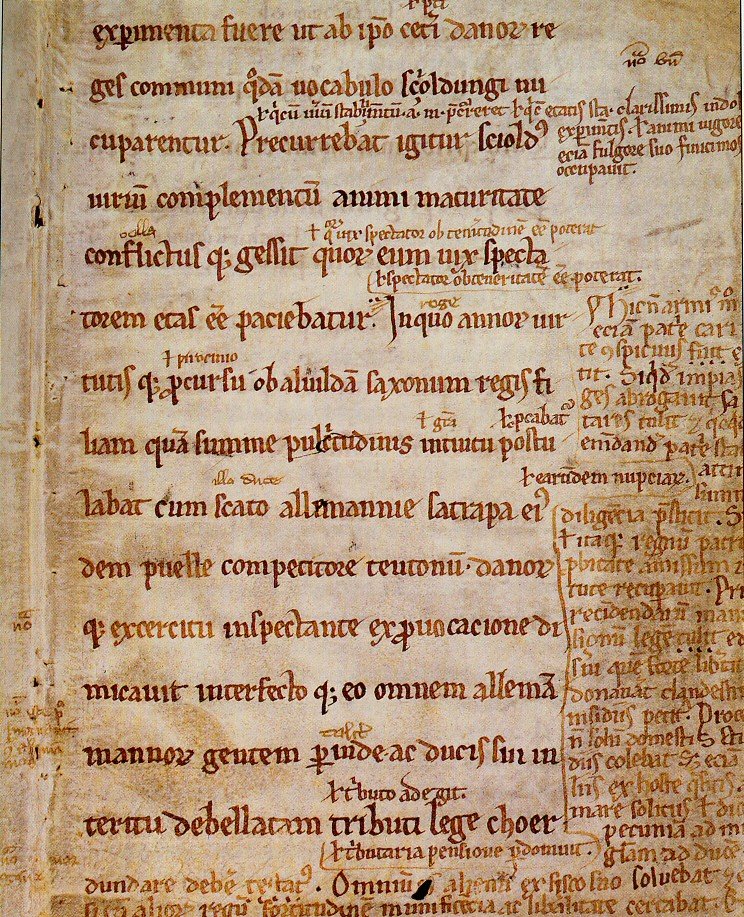
The core story comes from the Gesta Danorum, the "Deeds of the Danes", written in Latin around 1200 by Saxo Grammaticus in the circle of Archbishop Absalon of Lund. Amleth appears in Book III, and his story continues into Book IV. Saxo places it in a distant pagan past of Denmark, long before the Viking Age and without a date. No historical Amleth is attested anywhere else. This is legend, not chronicle.
In Saxo, the brothers Horwendil and Feng govern Jutland for the Danish king Rorik. Horwendil wins fame and Rorik's daughter Gerutha as his wife; their son is Amleth. Feng murders his brother out of envy and marries the widow. Amleth survives by playing the fool.
"So he chose to feign dulness, and pretend an utter lack of wits. […] He used at times to sit over the fire, and, raking up the embers with his hands, to fashion wooden crooks, and harden them in the fire, shaping at their tips certain barbs, to make them hold more tightly to their fastenings. When asked what he was about, he said that he was preparing sharp javelins to avenge his father."
Saxo Grammaticus, Gesta Danorum, Book III (the Amleth story), translated by Oliver Elton, 1894 (public domain; the obvious slip "be" for "he" in the digital transcription has been corrected)
Feng sets traps, including an eavesdropper in the mother's chamber and a journey to Britain with a letter ordering Amleth's death. Amleth swaps the letter and returns during his own funeral feast. He gets the guests drunk, pins the wall hangings over the sleepers with his crooks and burns the hall, then kills Feng with Feng's own sword.
In Book IV Amleth becomes king, also marries the Scottish queen Hermutrude and falls in battle against Wiglek. Saxo's hero dies in a battle in Jutland, not in a volcano, and his mother helps him in the end. The story closely resembles Livy's Lucius Junius Brutus, who also played the fool to survive a tyrant. How much of Saxo's Amleth is Norse tradition and how much learned embellishment cannot be settled with certainty.
That "Amleth" sounds like "Hamlet" is no accident. Saxo's work was printed in 1514, François de Belleforest retold the story in his Histoires tragiques in 1570, and from there it reached England. Shakespeare's Hamlet, written around 1600, kept the fratricide, the marriage to the widow, the feigned madness, the eavesdropper and the swapped letter, but turned the cunning avenger into a brooder.
The name was also known in the North. Snorri Sturluson quotes a verse by the poet Snæbjörn that calls the sea "Amlóði's mill". That shows a figure called Amlóði existed, not that his story matched Saxo's. The Icelandic Ambáles saga dates only from the early modern period.
Eggers and Sjón skip Shakespeare and go back to Saxo. Their Amleth does not doubt. He is a man fixed on a single task from childhood: revenge. This puts him closer to Saxo and to the Icelandic sagas, where blood vengeance appears as a duty, than to the stage prince.
The film keeps Saxo's pattern but changes almost every detail. Horwendil becomes Aurvandill, a clever choice: in Snorri's Edda, Aurvandill is a mythical figure whose frozen toe Thor throws into the sky as a star, and linguists regard the two as forms of the same name. Fjölnir is a byname of Odin in the Edda, and Gudrún is familiar from the Eddic Nibelung poems.
The story begins in 895 on the fictional island of Hrafnsey, "Raven Island". Fjölnir later loses his realm to King Harald of Norway and becomes a sheep farmer in Iceland. This picks up a saga motif: the settlement of Iceland from about 870 is often explained there as flight from Harald Fairhair. Many historians doubt that this was the main reason, but as a narrative motif it is well attested. More on this in the article on the Icelanders.
The biggest change concerns the mother. In Saxo, Gerutha helps her son. In the film, Gudrún reveals that she wanted Aurvandill dead herself, because she had once been captured and forced into marriage. This is the screenplay's invention, and it undercuts the duty of vengeance that defines Amleth's life. Olga is also absent from Saxo. Her name fits, though: "Olga" is the East Slavic form of the Norse name Helga.
Also new is the prophecy of a "Maiden-King". The proud maiden-queen, Old Norse meykóngr, comes from late medieval Icelandic romances and is not attested for the period around 900.
Two scenes shape the film's image of warriors. In the first, the fool Heimir leads young Amleth and his father into an underground sanctuary, where both crawl on all fours and howl like dogs or wolves. In the second, grown warriors in wolf and bear skins work themselves into a frenzy around a fire before raiding a village.
The warrior scene has real points of contact. The word berserker probably means "bear-shirt", while the úlfheðnar are the "wolf-skins". A praise poem for King Harald Fairhair, the Haraldskvæði from around 900, describes berserkers roaring and wolf-skins howling at the battle of Hafrsfjord. In the 13th century Snorri Sturluson wrote in Ynglinga saga that Odin's men went into battle without mail, wild as dogs or wolves, biting their shields, strong as bears. In pictures, the pressed bronze plates from Torslunda on Öland, dating from the 6th or 7th century, show a figure in a wolf skin beside a dancing man in a horned helmet. The film has clearly restaged this pair.
This evidence points to warrior groups who identified with bear and wolf. No source describes a ritual before a raid; the fireside scene is a plausible elaboration. For the initiation with Heimir there is, according to the archaeologist Christopher Nichols, no archaeological or written parallel. It is the writers' invention.
The intoxicating drink calls for caution. Fly agaric mushrooms feature in the film, and popular culture often treats them as the cause of berserk rage. The idea goes back to an 18th-century Swedish scholar; no Old Norse source mentions mushrooms.
The raid takes place in the East, in a land the film calls Garðaríki. That is the Old Norse name for the realm of the Rus, though it appears only in high medieval texts. In the 9th and 10th centuries the Rus were a ruling and trading elite of Scandinavian origin along the rivers of Eastern Europe; see the article on the Kievan Rus.
Human trafficking is well documented here. The geographer Ibn Rusta wrote in the early 10th century that the Rus raided the Slavs by ship, took them captive and sold them to the Khazars and the Volga Bulgars. The many thousands of Arabic silver coins in Scandinavian finds fit this picture. The film does not show the raid as an adventure, but as a manhunt for a market.
At the end a building burns with people locked inside. No specific source records such a scene. Burning enemies in their house, Old Norse brenna, is a fixed motif, though: Njáls saga tells how Njáll burns in his farmstead with his family, and Saxo's Amleth also sets the hall alight. The film moves a feud motif into a raid. Whether Vikings in the East acted like this cannot be clearly established.
After the raid, Amleth meets a seeress in a sanctuary, played by Björk, who reminds him of his oath and foretells that his fate is bound to a Maiden-King. Plot summaries place the scene in a temple of the Slavic god Svetovit. I have not been able to verify the name of the statue independently.
The seeress herself is well attested. The völva read fate and the future. In the Saga of Erik the Red, written down in the 13th century, a seeress named Þorbjörg arrives at a farm in Greenland wearing a blue cloak and catskin gloves and foretells the end of a famine. Women's graves with iron staffs, as at Fyrkat in Denmark, are often interpreted as burials of seeresses. Their technique was called seiðr.
The temple is the problem. Svantevit was the god of the West Slavic Rani on Rügen. His temple at Arkona was described, of all people, by Saxo in Book XIV, in the context of the Danish conquest of 1168. For the East Slavs, the Russian Primary Chronicle names other gods, above all Perun. No source supports a Svantevit sanctuary in the East around 900. The scene compresses cultures and centuries into a single image.
To reach his uncle, Amleth has himself shipped to Iceland as a slave among captured Slavs. The film takes slavery more seriously than most Viking films: the unfree are chained, beaten, raped and sacrificed.
Unfree people, Old Norse þrælar, were everywhere, Iceland included. The sagas and the Book of Settlements name many slaves with Irish or Scottish names, and genetic studies suggest a high share of settler women from Ireland and Scotland. How many were taken by force cannot be quantified. The character Halldóra, described in the film as a Pict, fits this. The direction of trade is unusual, however: the main flows ran east and south to the markets of the Islamic world. That Rus traders sold Slavs as far as Iceland is not attested. More in the article on Viking slavery.
The funeral of Fjölnir's son Thórir is disturbing: Gunnar beheads a horse, and in the background a singing woman is stabbed so that she may follow the dead man. The model is the account of Ibn Fadlan of a Rus funeral on the Volga in 922. There an enslaved woman agrees to die with her master, is strangled and stabbed by an old woman he calls the "Angel of Death". Horses are sacrificed too, though in his account they are cut to pieces.
Ibn Fadlan was an eyewitness, but an outsider who understood through interpreters. He describes Rus on the Volga, not farmers in Iceland. Graves with a second, violently killed person are known from Scandinavia and the British Isles, but they are rare. Horse sacrifices are common in Icelandic graves. Both have a basis; their combination on an Icelandic farm is cinema.
In Iceland Amleth takes part in a brutal ball game in which players fight with bats over a hard ball. In the film it turns deadly: when a player threatens young Gunnar, Amleth steps in and kills him. The game has a real model, knattleikr, covered in detail in the article on glíma and knattleikr.
Knattleikr is mentioned in several Icelandic sagas, including Egils saga, Gísla saga, Grettis saga and Eyrbyggja saga. It was played with a stick the sagas simply call tré, "wood", and a ball hard enough to cause injury. Several passages mention ice or frozen ground, and games were often held at large gatherings in autumn and winter. Quarrels, blood and occasional killings almost belong to the game in the sagas: in Egils saga the young Egill kills his opponent with an axe after losing.
No one knows the rules; all modern rules are reconstructions. Reviews describe the film's match as one in which the unfree play for their masters' entertainment. I know of no source for this; in the sagas free men play at social gatherings. The escalation into a fight to the death is not entirely foreign, though: the sagas mostly tell of knattleikr when a feud grows out of it.
With the help of a sorcerer, Amleth speaks with the severed head of the dead fool Heimir. The head tells him where a special sword lies, called "Draugr", which can be drawn only at night or at the Gates of Hel. Amleth enters a burial mound and fights its undead occupant for the weapon.
Almost every element has a literary counterpart. A speaking head recalls Mímir, whose severed head Odin, according to Ynglinga saga, preserved with herbs and consulted for advice. The fight in the mound is a classic saga motif. In Grettis saga, Grettir breaks into the mound of old Kárr, wrestles with the dead man and brings out treasure and a sword. In Hrómundar saga Gripssonar the hero wins the sword Mistilteinn in a similar way. The undead who live on in their graves are called haugbúi, "mound-dweller", or draugr in the sagas, and the film uses both terms.
The sword's conditions also have models. Sköfnungr, said to have been taken from the mound of the legendary king Hrólfr kraki, was not to be drawn near a woman, according to Laxdæla saga, nor was the sun to shine on its hilt. Such taboos are literary motifs. With gold, garnets and a pommel ring, the film's weapon resembles, in Nichols' view, Vendel-period swords of the 6th to 8th centuries rather than Viking ones. That may be deliberate: a sword from an old grave ought to be older than its finders. More in the article on the Viking sword.
The climax is a duel between Amleth and Fjölnir at the edge of an erupting volcano that the film calls the "Gates of Hel". Plot summaries identify it with Hekla. Both men die, and a valkyrie carries Amleth away on a flying horse, up to Valhalla.
Valkyries are well attested in the Edda. The name means "chooser of the slain", and in the Helgi poems they ride armed through the air and over the sea. Winged horses are unknown in Norse tradition; they owe more to Pegasus and Romantic opera. That the fallen go to Odin matches the Edda, though how widespread the belief was is debated. Many of the dead went to Hel, others to Freyja or into their mound.
Hekla is where things get difficult. Its first recorded eruption took place in 1104, and geological evidence suggests it had been dormant for at least about 250 years before. A Hekla eruption in the early 10th century is therefore not attested, though other Icelandic eruptions are, such as Eldgjá in the 930s. The idea of Hekla as the mouth of hell first appears in church texts of the 12th century and survived into the early modern period. It is Christian. Hel in Old Norse tradition was a realm of the dead beneath the earth, not a place of fire.
Material culture is the film's strongest point. Christopher Nichols, an archaeologist trained at Uppsala, notes that the production avoids the Ringerike and Urnes art styles, which appeared only around 1000. The seeress's oval brooches are typical women's jewellery of the period. The horned headdress of a cult figure quotes the Torslunda plates, not a war helmet; horned Viking war helmets have never been found. See the article on the horned helmet myth.
Some details are especially careful. Because Iceland never had wolves, it is an Arctic fox that shows Amleth the way there, not a wolf. The seeress lives at the margin of the settlement, as is typical for people skilled in magic in the sagas. The horses draw criticism: the animals on screen are much larger than the rather small horses known from Viking Age graves. The location of Hrafnsey is left deliberately vague.
Departures mostly serve effect: the warriors are almost always angry and cruel. Peter Konieczny of Medievalists.net remarked that the Saxo original is less violent and more complex than the film.
Is The Northman an adaptation of Hamlet? Not directly. The film goes back to Saxo Grammaticus, whose Amleth story dates from around 1200 and later, via Belleforest, served as a source for Shakespeare. Many typical Hamlet elements are missing, and others come from Icelandic sagas.
Where was the film shot? Mostly in Northern Ireland, including County Antrim, with additional footage in Donegal and Iceland. According to production details, the volcano scenes were shot in a quarry near Belfast.
Who were the historical advisers? The archaeologist Neil Price, the folklorist Terry Gunnell and the historian Jóhanna Katrín Friðriksdóttir. Price stresses that clothing, objects and living conditions were researched most thoroughly.
Was knattleikr real? Yes, the ball game is mentioned in several Icelandic sagas. Exactly how it was played is unknown, because no rules survive.
Where does the scene with the killed slave woman come from? It clearly follows the account of the Arab envoy Ibn Fadlan of a Rus funeral on the Volga in 922. The film moves it to Iceland.

Saxo Grammaticus · Berserkers · The Voelva · The Ulfheðnar · The Vikings series fact-check.
In an Old English poem from the 9th century, two words sit in the same line: éarendel and middangeard. A young student …
Read more →The Vegvísir and the Helm of Awe (Ægishjálmur) are Icelandic magical staves, or galdrastafir, recorded in early modern …
Read more →The series „Vikings" brought the Viking Age to a whole generation – and along the way it compressed, condensed and …
Read more →The series opens with something that really happened: the St Brice's Day massacre of 1002. It ends with men one of whom …
Read more →