To Alcuin they were God's punishment. To Ibn Fadlan they were the filthiest of God's creatures, with the most perfect bodies he had ever seen. To Miskawayh they were a nation that knew no defeat, and to the court historian of their own descendants they were heathens from whom God meant to make something better. All were talking about people from the same cultural world, and almost none let them speak for themselves. This article sets ten voices side by side, from an English scholar at the Frankish court to a Greek historian in Constantinople, and asks what each reveals about the people described and about himself. In several places it also has to say which wording it knows only at second hand.
Prejudice about Vikings was not invented in the nineteenth century. The basic patterns are already in the period's own texts, only they do not fit together. Someone writing in a monastery saw heathens. Someone writing at a caliph's court saw foreigners whose bodies and habits he measured against his own rules of purity. Someone writing in Constantinople saw Scythians, because ancient literature kept that word ready for peoples from the north. And someone writing for a Norman duke had to turn yesterday's heathen into today's founding father.
The names alone show this. "Viking" was not the usual collective term in any of these sources; what the word really covers is set out in What does "Viking" mean?. The Franks mostly wrote Nordmanni or Dani, the Irish gennti (heathens) and gaill (foreigners), and Arabic and Greek authors spoke of the Rus. That last word brings a caveat for the entire East: the Rus of the ninth and tenth centuries had a Norse-influenced elite but lived among an increasingly Slavic population. Calling them simply "Vikings" oversimplifies, and the later the text, the more it does.
One more thing is missing: the reply. Scandinavia itself has left runic inscriptions and skaldic poetry from this period, but no extended answer to Alcuin or Ibn Fadlan. Everything below is the view from outside. It says something about the Northmen and usually more about the writers.
Alcuin of York, a Northumbrian scholar in Charlemagne's close circle since the 780s, responded to the raid on Lindisfarne with letters to king and bishop. They are the closest witnesses we have to the event. To King Æthelred he wrote, in Dorothy Whitelock's English, "never before has such terror appeared in Britain" as now from a pagan race. He pictures the church of St Cuthbert spattered with the blood of priests and stripped of its ornaments. The letter does not name Lindisfarne at all, only the saint's church.
About the attackers themselves we learn almost nothing. No origin, no number, no leader, no customs. They are simply a pagan people, and for Alcuin that covers what matters. His energy goes to his readers. Since the days of King Ælfwald, he says, fornication, adultery and incest have flooded the land. To the bishop of Lindisfarne he wrote in another letter that this is either the beginning of greater tribulation or else the sins of the inhabitants have called it upon them.
The most revealing sentence comes almost in passing in the letter to the king: consider your trimming of beard and hair, in which you wished to resemble the pagans. Alcuin does not say explicitly who these pagans are; the usual reading takes them to be Scandinavians. If so, Northumbrians knew the Northmen well enough before the raid to copy their haircuts. The image of a bolt from the blue cracks, and in the text of the man who painted it most effectively. More on this in Viking hairstyles.
Alcuin's pattern holds for centuries: the attackers are the instrument, and the real speech is addressed to one's own community. That does not make the horror invented. But the frame is a sermon, not a police report.
Annals are yearbooks recording what the writer thought worth noting for each year. In the Frankish realm they often sound more sober about the Northmen than any letter does. There is a political reason: for Frankish rulers, Northmen were not only enemies but also negotiating partners, allies and vassals.
For 845, the Annals of St-Bertin supply month, number of ships and payment, as our article on Paris 845 sets out: 120 ships on the Seine and 7,000 pounds for their departure. The Annals of Xanten name a leader, Reginheri, and tell of his end, so the voices differ with distance and interest. For 839 the same annals report envoys who called themselves Rhos and turned out, at the court of Louis the Pious, to be Sueones, Swedes.
The matter-of-fact tone is clearest with men like Rorik of Dorestad, a Danish warlord who held parts of Frisia as a vassal of Frankish rulers. The same writers treat him now as a threat, now as a treaty partner. A chronicler like Prudentius, who wrote part of the Annals of St-Bertin, denounces some of the bargains a king struck with the Danes, so that the sharpest criticism lands on the Christian ruler who deals with them. I saw the 845 entry only in excerpt; 839 and the point about Prudentius come from our neighbouring articles, unchecked against the annals.
Ermentarius, a monk of the community of St Philibert of Noirmoutier at the mouth of the Loire, died in the mid-860s. His work on the translations and miracles of the saint contains the most quoted lament of the Viking Age, the preface to Book II, begun around 862. The gist, here from a summary because I have not seen the Latin wording: the sons of Louis the Pious are at odds, law is abandoned, watch over the coasts is given up, and so the number of ships and the countless host of Northmen grow. Bordeaux, Périgueux, Saintes, Limoges, Angoulême and Toulouse are taken, Angers, Tours and Orléans ruined. It ends with the prophet's words from Jeremiah 1:14 about disaster breaking out of the north.
It reads like a situation report and has often been used as one since the nineteenth century. Against that, Christian Harding questioned the monks' flight narrative as such in his University of St Andrews thesis (2010). Further objections I know only from our knowledge database and could not read in his text: the cities named fell over some eighteen years, while the text sounds like a single collapse. The interpretation is theological, with the blame resting on quarrelling Christians, a Carolingian commonplace also treated by Simon Coupland in his essay on the rod of God's wrath. The work also seeks patrons, as Harding shows for Abbot Hilduin. And the monks, seemingly in panicked flight, had according to Harding travelled between the island and Déas on the mainland since at least 819, probably 814, before moving there for good in 836.
The raids remain real, the monks did leave their island, and from 843 Northmen used Noirmoutier as a base. The tone, though, is a petitioner's.
The Irish annals are the tersest witnesses. "The burning of Rechru by the heathens, and Scí was overwhelmed and laid waste," says the Annals of Ulster for 795; Scí is Skye. That is all. For 821 they note that heathens plundered Étar, today's Howth near Dublin, and carried off many women. The recurrence of slave-raiding in these entries is among the hardest evidence on Viking slavery, and the word "prejudice" fits it badly.
The comparison sits in the same columns. For 817 the Annals of Ulster report a battle between the monastic communities of Taghmon and Ferns with a reported four hundred dead; for 833, attacks by Irish rulers on Kildare, Clonmacnoise and Durrow, in the same tone as that year's heathen notices. Were the Vikings dirty and brutal? lays this out. Anyone who extracts only the heathen entries gets a different picture from the one the annalist handed down.
The words shift too. At first gennti, "heathens", predominates; later gaill, "foreigners", and Lochlannaigh, people from Lochlann, come to the fore. The category moves once Northmen sit permanently in Dublin and other bases and make pacts with Irish kings; Vikings in Ireland gives the detail. The lurid images arrive only in retrospect: the Cogadh Gáedhel re Gallaibh, "The War of the Irish against the Foreigners", dates from around 1100 and probably served the prestige of Brian Boru's descendants. For the ninth century it is hardly a factual report; for attitudes around 1100 it is very rich.
Two centuries after Alcuin, an English archbishop applies the same pattern with greater force. Wulfstan II, archbishop of York, who died in 1023, called himself Lupus, "wolf". His Sermo Lupi ad Anglos was composed between 1010 and 1016 and survives in several versions; the longer one is dated to 1014, the time of the Danish advance under Svein Forkbeard. The Danes appear as divine punishment, as the Saxons did for the Britons in Gildas. But the list of sins concerns the English: betrayal of one's lord, broken oaths, the selling of fellow countrymen.
A scene often quoted has two or three seamen driving whole droves of Christians from sea to sea. I read it in a modern English translation, not in the Old English. It fits the sermon's logic: the enemy's superiority is an indictment of the attacked, not an army statistic. The slave trade in this text is also notable. Wulfstan accuses his own countrymen: brother sells brother to foreigners. A business now often linked with the Northmen alone stands here as an English sin.
Ahmad ibn Fadlan travelled in 921/922 as a member of an embassy from the caliph in Baghdad to the Volga Bulgars and met Rus traders there. That makes him the one witness in this series who saw his subjects without a war in view. His verdict falls into two halves. He had never seen more perfect bodies, he writes in substance, tall as palm trees, blond, ruddy. And right beside that: they are the filthiest of God's creatures.
The charge rests on concrete observation, above all the washbasin passed from man to man each morning, into which each spits and blows his nose. For a Muslim whose ritual purity depended on running water, this was an abomination. And Ibn Fadlan is hard on other peoples along his route as well, such as the Oghuz and Bashkirs. The Rus get nothing reserved for them alone.
The limits of this witness are covered in our article on Ibn Fadlan: he did not speak the language, an interpreter stood in between, and James Montgomery points out that some interpretations may rest on misunderstanding. These are traders in one place in one year, not "the Vikings".
The counter-image comes from the same language world. The scholar Ibn Miskawayh describes in his chronicle the capture of the town of Bardhaʿa, in today's Azerbaijan, by a Rus fleet in 943. He asks how these people must be judged as a military force.
"They are a mighty nation with vast frames and great courage. They know not defeat, nor does any of them turn his back till he slay or be slain."Ibn Miskawayh, Tajarib al-umam, on the capture of Bardhaʿa; translated by D. S. Margoliouth, The Eclipse of the ʿAbbasid Caliphate, vol. 5, read in the excerpt on Cambridge Core
He has details too. They fight on foot, with spear and shield, wear a sword, a lance and a dagger-like weapon, and also carry tools: axe, saw, hammer. The defenders, he writes, misjudged the attackers' strength, and not an hour passed before the fierce onslaught. Above all, he has the Rus make a declaration to the inhabitants: there is no dispute about religion, they desire only sovereignty, they will treat the population well and expect loyalty. The conquest appears as a political event, not a holy war.
The later chronicler Ibn al-Athīr, partly drawing on Miskawayh according to his translator William Watson, carries the story to its end. At first they were "good in their conduct". After attacks by the townspeople they killed many and, by his figure, took some ten thousand captive, demanded ransom and massacred those who could not pay; only the sensible among them, the text says, kept to the bargain. In the end disease wore down the force, which the author blames on eating too much fruit, and we read in passing that the Rus buried their dead with their weapons. So the source is neither eulogy nor atrocity tale but holds both. The figure, like all round chroniclers' numbers, needs caution.
Leo the Deacon wrote a history in Greek in the late tenth century that covers Emperor John Tzimiskes' campaign against Prince Sviatoslav of Kiev on the Danube in 971. Of the standard English translation by Alice-Mary Talbot and Denis Sullivan I could read the introduction, and of the Rus chapters only an English excerpt from Book IX, 6–8.
Leo wrote in deliberately classical language. A writer like this reaches for old words for foreigners too: he calls the Rus Tauroscythians, a name leading back to the Black Sea of ancient authors. Some scholars therefore read his Rus passages, according to the abstract of a recent article, as "ethnographic excursuses" and heroic short stories with an epic background, rather than plain records.
The most lurid images stand in this frame (IX.6 and IX.8): at night the Rus gather and burn their dead, kill captives, men and women, over them, drown suckling infants and chickens in the Danube as offerings, and drive swords into themselves rather than surrender. Leo himself introduces their never surrendering with "it is said", and brings in Achilles nearby. Whether this is observation, hearsay or learned embroidery cannot be clearly established.
Beside them stands the famous description of Sviatoslav (Book IX, chapter 11): medium height, bright eyes, shaved head with one lock, an earring with a carbuncle and two pearls, recognisable only by clean clothing. I have not seen the wording; this comes from a secondary paraphrase, and his rowing among his men only from our hairstyles article. With the Kievan Rus of this generation, however, the question remains how much of it is still Scandinavian and how much steppe or Slavic.
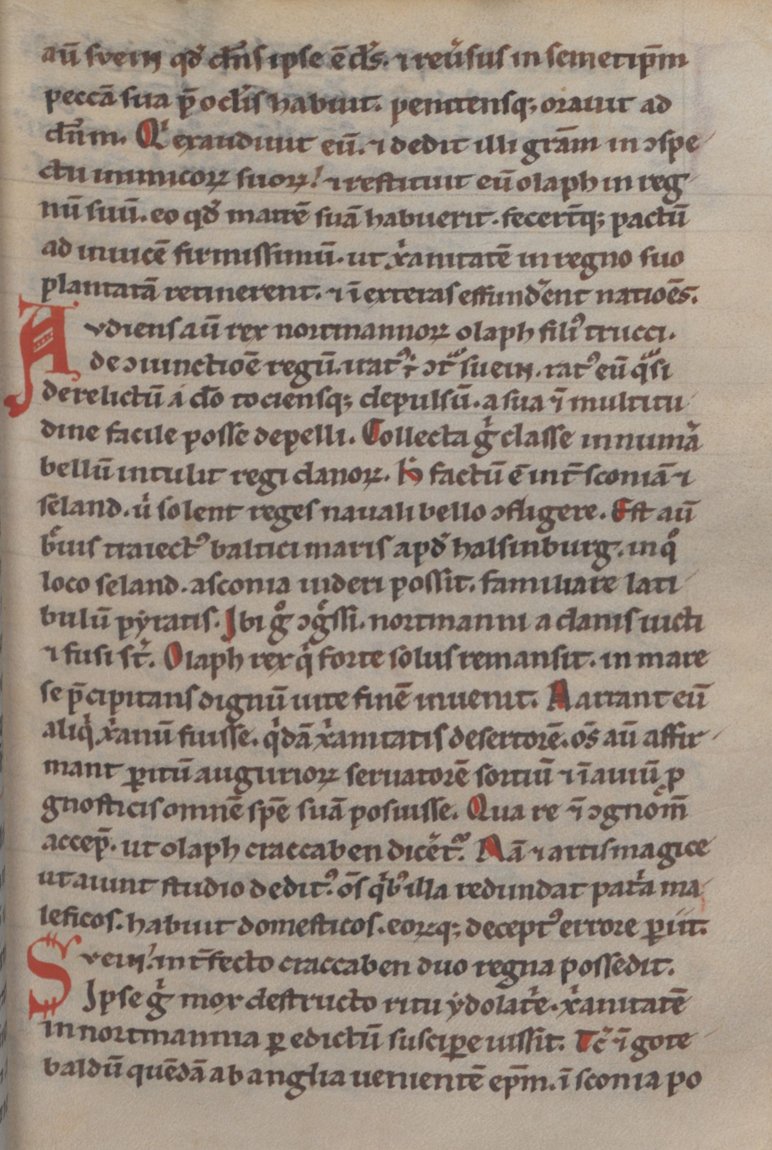
Around 1075 Adam, master of the cathedral school in Bremen, wrote his history of the archbishopric of Hamburg-Bremen and in its fourth book described the North. He never saw Uppsala. His is the view of a churchman whose diocese claims the northern mission. Our article on Adam calls it a view from outside onto the North. His pictures of heathens, above all the sacrificial feast at Uppsala with nine heads of every male creature, are among the most influential ideas we have. Tellingly, scholars doubt precisely its human sacrifices; Hultgård, according to our database, did not count them as part of the public feasts.
At the same time, Adam distinguishes more precisely than many later writers. Of Zealand he writes that much gold lies there, gathered by piracy, and then: these pirates, whom they call Wichingi and our people Ascomanni, pay tribute to the Danish king. Yet they often turned this licence on their own people and sold captives from among themselves to comrades or barbarians. For Adam, then, "Vikings" are a group of robbers, not the nation. That does not make him impartial, but it shows that the blanket image of all Northmen plundering does not come from this text.
The most surprising case comes from Dudo of Saint-Quentin, a Frankish canon who came to the Norman court in the late tenth century and, by his dedicatory letter, received the commission from Duke Richard I. Completion is usually placed around 1015, by some as late as 1026. Dudo is no contemporary of the first raids. He writes for the great-grandson's generation, and one would expect whitewash.
Instead he opens with an unflattering national portrait. His Scandinavians, called "Dacians" after learned fashion, live without restraint, take many women, father countless children and send the surplus abroad by lot to win kingdoms by fighting. Wildness here is not the charge but the premise of the story. The darker the starting point, the brighter the conversion: Rollo appears as a chosen heathen to whom God shows the Christian future in a dream, the dukes as a dynasty called to their role. More in our article on Rollo.
Where Dudo can be tested against closer sources such as Flodoard, he fares poorly; scenes like the foot-kiss at the grant of land cannot be verified. His text is therefore a very good source for how a court around 1015 wished to be seen.
Set side by side, the voices produce no average but a pattern. Western clerics measure by faith and sin, annalists by event and treaty, the envoy from Baghdad by purity and body, the chronicler of the caliphal world by power and fighting strength, the Byzantine by ancient models, the man from Bremen by mission, the Norman court writer by the size of the later rise. Hardly any of this is simply false, and little is neutral. The violence, the taking of people and the tributes are well attested by independent sources. The character traits made out of them change with the standpoint. Ibn Fadlan's Rus, perfectly built and filthy at once, are the clearest example. A later English chronicle attributed to "John of Wallingford", written only in the thirteenth century, even charges the Danes with the opposite, too much grooming. That too says more about reputation than daily life; Typically Viking? puts it in context.
Did contemporaries use the word "Viking"? Rarely, and not as the name of a people. The sources write Nordmanni, Dani, heathens, foreigners or Rus. Adam of Bremen knows Wichingi as a term for a group of pirates.
Were the monks' laments exaggerated? The raids are real, and slave-taking is widely attested. Exaggeration lies more in frame and tone: many laments are sermon or petition. They do not tell us how great the damage exactly was.
Who came closest to the Northmen? Of the authors named here, Ibn Fadlan above all met them in person, and even he through an interpreter. Dudo and Adam worked through courts and informants.
Are the Rus Vikings at all? In part. The elite had Norse roots, as the 839 report supports, but the tenth century especially must be expected to show strong mixing. For Sviatoslav in 971 the label is particularly problematic.
Is there a reply from the Northmen? None at first hand in prose. Runestones and skaldic verse speak of their own deeds, and the sagas were written down much later and follow their own interests.
Ibn Fadlan and the Rus on the Volga · Adam of Bremen · Were the Vikings dirty and brutal? · Typically Viking? · Lindisfarne 793 · What does "Viking" mean? · Vikings in Ireland · Rollo

Ibn Fadlan & the Rus · Adam of Bremen · Were Vikings more brutal than others? · Typically Viking? · Did Vikings catch babies on spears? One sentence and what it can bear.
All History & Finds articles →
Say "Viking" and most people picture a sword – yet the majority of warriors in the Viking Age never owned one. Spear …
Read more →The Wagrians lived farther northwest than any other Slavic tribe, in eastern Holstein between the Kiel fjord, the …
Read more →While some Norsemen sailed west, others rowed, poled and hauled their boats east: past Ladoga and Novgorod to the …
Read more →The Warni are one of those tribes that surface in the sources again and again over five centuries and still cannot be …
Read more →