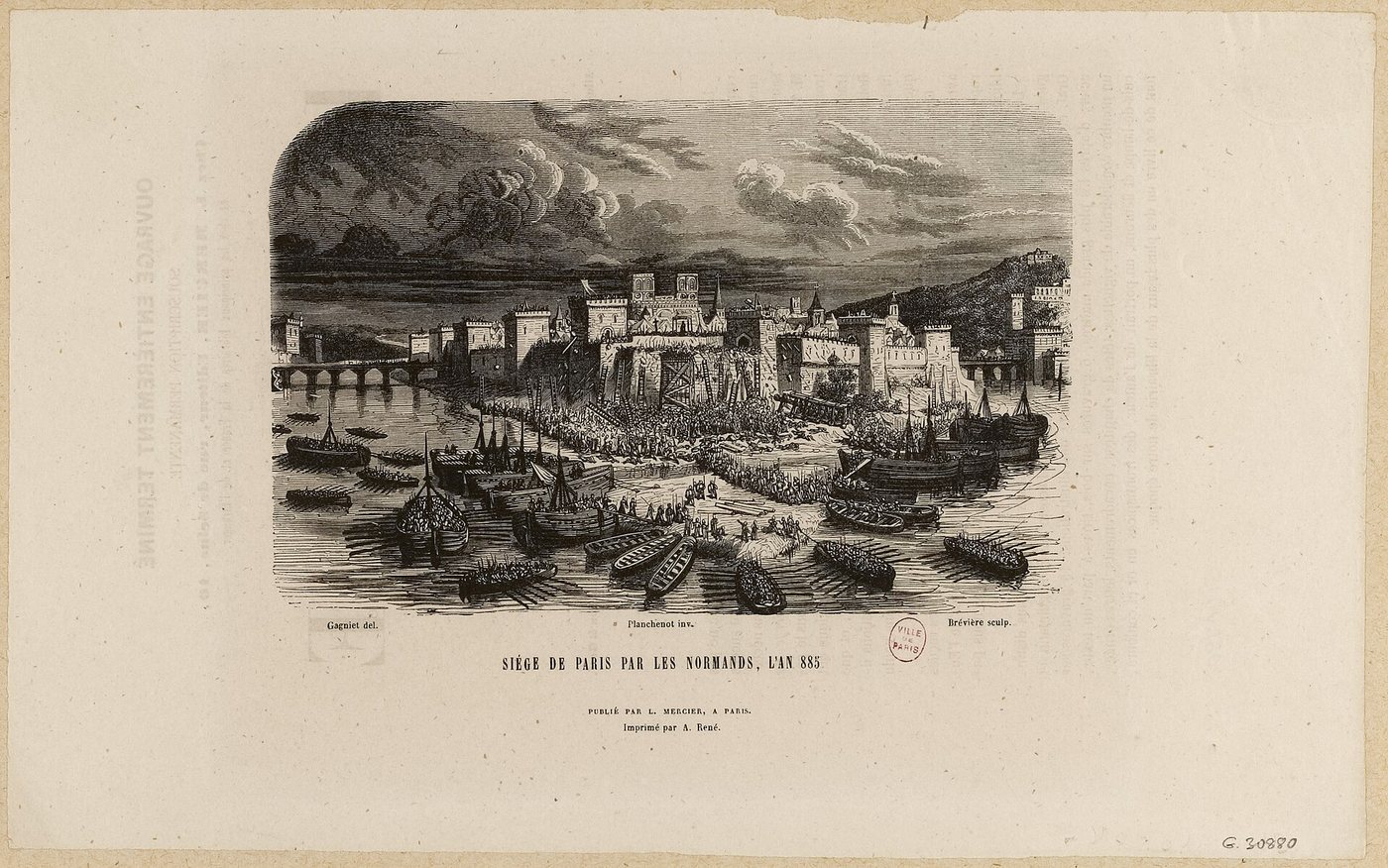
In March 845, 120 ships sailed up the Seine. By Easter their leader stood in Paris, and King Charles the Bald bought his departure for 7,000 pounds. On that much the reports nearly agree. Beyond it they part ways: the best-known source names no leader at all, the hanged prisoners do not appear in the annal passages I could check, and the most colourful account comes from monks who had fled before any of it happened. This article sets the voices side by side and separates what each can bear.
No contemporary Scandinavian word survives about Paris in 845. Everything comes from the Frankish world, and nearly all of it from clergy. Six voices matter here. The Annals of St-Bertin, written at this stage by Prudentius, supply the frame: month, number of ships, payment. The Annals of Xanten, written far from the Seine, know a name and how the man ended. The Annals of Fontenelle, from the monastery of Saint-Wandrille on the lower Seine, also name the leader and give an exact date. The Annals of Fulda watch from the East Frankish kingdom and care mainly about what happened afterwards in Saxony.
Two voices of a different kind join them. The monks of Saint-Germain-des-Prés recorded in their miracle stories how their saint punished the intruders. And Rimbert, biographer of the missionary Ansgar, mentions a Raginarius in whom some recognise the same man. Annals are terse yearly notes; miracle stories are advertising for a saint. Blend them and you get the gripping but unreliable version told today.
One limitation up front: I could not reach the Latin editions in full, except for the Fontenelle entry, which Christian Cooijmans published in Latin and English in 2022. Otherwise I rely on older English translations and on the 2002 study by the Danish historian Niels Lund, which quotes and compares the passages in Danish. Where I only have handbook knowledge at second hand, the text says so.
The core is in Prudentius. In March, the Annals of St-Bertin say, 120 ships of the Northmen sailed up the Seine to Paris, laying waste both banks and meeting no opposition. The old English version by Ogg (1907) has them reach Paris "without meeting any resistance", first on one bank, then on the other. That ease is the point of the entry, and it probably carries a reproach.
The miracle stories add a stop: Rouen was taken before the fleet reached Paris. They also mention a camp at Chalevanne, which Lund places just west of Paris. How crews could row so far inland is covered in the articles on longships and on the Vikings in France. What matters here is the figure itself: 120 ships is an annalist's statement, not a count. Nothing more can be said for it.
You will often read that the fleet carried more than 5,000 men. English Wikipedia traces that number to a popular book by Martina Sprague (2007). It does not appear in the annal passages I could see. It looks like a calculation, ships multiplied by an assumed crew. That cannot be clearly documented, so it should not be treated as a source statement.
Charles the Bald was not on firm ground in 845. The Annals of Xanten report for the previous year that Pepin of Aquitaine routed Charles's army. In 844 the three royal brothers, Lothar, Louis and Charles, also met at Diedenhofen and parted peacefully. So there was calm among the brothers, but Charles still had open fronts inside his own kingdom. The article Why the Vikings succeeded traces how such situations played out militarily in later years.
In her 2014 study Danielle Turner sees internal conflict as the reason rulers failed to recognise the outside threat in time. That is a modern reading and it fits the evidence. It is not proof of what Charles actually knew in spring 845. The sources are silent on whether anyone warned of the fleet at all.
No scene is told more eagerly than this one: Charles splits his small army between the two banks to protect the abbey of Saint-Denis. The Northmen defeat one division, take 111 prisoners and hang them on an island in the Seine, in full view of the remaining Franks.
This is exactly where the evidence thins. According to English Wikipedia, the modern version goes back to Gwyn Jones's A History of the Vikings and George Kohn's Dictionary of Wars, both surveys. As far as I could see the passage in translation, the Annals of St-Bertin say only that Charles meant to resist and realised his men could not win. I did not find the scene in Xanten or Fulda either, and Lund does not mention it in his study. I could not locate the Latin passage that gives the figure 111. So the episode stands here as a tradition of the secondary literature, with a primary source I have not checked.
The interpretation is weaker still. That the execution honoured Odin is a modern attribution, which English Wikipedia rests on Kohn. None of the texts I could consult speaks of a sacrifice. Deterrence, revenge, ritual or all three at once: it remains guesswork. What scholars otherwise assemble on Germanic sacrifice and the cult of Odin is no evidence for this particular day.
The date survives with surprising precision. The Annals of Fontenelle have Ragneri dux Nortmannorum, the leader of the Northmen, arrive at Paris with his fleet and enter the city on holy Easter Eve, 28 March (5. Kalend. Aprilis). The calendar checks out: Easter 845 fell on 29 March. Many accounts simply say Easter Sunday. One day's difference is small, but it shows how details slip in the retelling. Prudentius says nothing about Easter; in Ogg's translation the feast does not occur anywhere in the entry.
Was it a siege? English writing likes "the Siege of Paris". According to the miracle stories the Northmen entered an empty city, and the annals describe no fighting over walls. The monks of Saint-Germain had loaded their treasures and relics into boats and withdrawn to Combs-la-Ville. They left behind an abbey with the tomb of a saint who, per Lund, had died in 576. "Capture and plunder" fits the record better than "siege".
How severe the damage was can only be roughly stated. The Annals of Xanten lament that the cloisters of most of the saints were destroyed and many Christians carried off. That comes from a distant author in an accusing tone. The monks of Saint-Germain, for their part, report with pride that they had wine for a whole year after the raiders left, and read that as their saint's grace too. Taken literally, the two statements sit badly together.
The figure is in Prudentius, and hardly anyone doubts it. For 7,000 pounds Charles bought the Northmen off from going further and persuaded them to turn back. The translations differ in small ways. Ogg writes "7,000 livres" with no metal. In Nelson's modern translation, as reproduced in the version available to me, the silver stands in square brackets, an editorial addition. Lund's Danish has "7000 pund sølv". Xanten speaks vaguely of many thousand pounds of gold and silver, Fulda of a handsome sum raised by Charles and the people of the land. That is a telling nuance: on this account the king did not pay alone.
Converted into metal, a Carolingian pound taken at 367.1 grams, the value English Wikipedia uses, gives about 2.57 tonnes. The weight of the ninth-century pound is itself an estimate, so this indicates only the order of magnitude. How long collecting it took is uncertain: I found "two months" only in a popular account, not in the sources.
It is often said that this marks the start of Danegeld, the term English history uses for payments to Danish armies. Turner notes soberly that the siege has kept the reputation of being the first example. The word belongs to later English usage and fits only loosely; more in the article on Danegeld and Maldon. Opinions differed already at the time. Xanten puts the payment down to Charles's indolence, Prudentius to the recognition that his men could not win. One act, two verdicts, both from clergy on the Frankish side.
The payment did not end the expedition. According to Prudentius the Northmen went back down the Seine and plundered the coastal regions. Then comes a puzzling sentence: after sacking a certain monastery, they were struck by God's judgment, "either blinded by darkness or smitten with madness". Lund gives this in Danish, and I translate from there. The annalist does not name the monastery.
The Annals of Fulda tell the return differently. After the payment the Northmen fought three engagements in Frisia, losing the first and winning the other two, and also plundered a fortress in Saxony called Hamburg, returning "not unpunished". Xanten knows of another group in Frisia, of whom more than twelve thousand are said to have fallen. Such figures are hardly to be taken literally, and whether this was the same fleet remains open. That misfortune struck the Northmen after they left Paris, all these texts agree. What it consisted of, each tells differently.
Precision is the only help here, because many accounts go wrong at this point. It is repeatedly claimed that the Annals of St-Bertin name Reginherus or Ragnar as leader. The popular survey in the World History Encyclopedia, for example, has them call him Reginfred or Reginherus. In the passages I have seen, Prudentius does not: neither Ogg's old translation nor Lund's quotations nor English Wikipedia's account find a name there. The entry does name a ruler, King Horik, but not the leader on the Seine.
Others have the name. The Annals of Xanten write Reginheri, the Annals of Fontenelle Ragneri (Regner in Lund's Danish). The Saint-Germain miracle stories also know him as head of the Paris expedition, and Cooijmans adds the Translatio Sancti Germani and the Miracula Sancti Richarii. The Annals of Fulda do not name him in Lund's quotations. That gives two annal collections and several monastic texts for the name. The man himself is therefore well attested. His career is not.
"Thereafter the robbers were afflicted by a terrible pestilence, during which the chief sinner among them, by the name of Reginheri, who had plundered the Christians and the holy places, was struck down by the hand of God."Annals of Xanten, entry for 845, trans. James Harvey Robinson, Readings in European History (1904)
Xanten continues: the survivors cast lots to learn from which of their gods they should seek safety. The lots fell badly. A Christian prisoner advised them to cast before the God of the Christians, and now the lot fell happily. Their king "Rorik" and all his people fasted for fourteen days, the plague ceased, and the Christians were sent home. The royal name is striking, and Lund marks it "sic". Whether Horik is meant or someone else, such as the later attested Rorik of Dorestad, cannot be clearly established. The word "pestilence", incidentally, is Robinson's; the Latin ingenti clade that Lund cites means, at first, only "in a great disaster".
A translatio is an account of moving relics, in this case those of Saint Germanus. More than one such text arose at Saint-Germain-des-Prés around these events. The MMP database of the Austrian Academy of Sciences lists anonymous Miracula Sancti Germani Parisiensis in Normannorum adventu facta from the ninth century (MGH, SS 15/1, ed. Georg Waitz, pp. 10–16). The monk Aimoin, who was already there before 845, wrote his own miracle collection around 874. I have not seen the often-cited Translatio S. Germani in an edition, and I could not check against the Latin which scene belongs to which version. I follow Lund's summary, which draws on the Danish translation by Niels Skyum-Nielsen (Vikingerne i Paris, 1967).
The story is drastic. In the abbey the intruders cut beams, for their ships as Aimoin explains, and three fall to their deaths. Lund doubts that explanation, since Viking ships were built of fresh wood and seasoned timber was too hard to work. One strikes a marble column with his sword, and his hand withers around the hilt. Thirteen notches in the column are still shown, the text says. On a second entry a dense fog fills the abbey, terror and bloody flux seize the men and many die, while no Christian captive falls ill. They then ask Charles for leave to depart. Only in Aimoin, Lund notes, do they receive the tribute first.
Then the scene shifts to Denmark. Regner shows King Horik his gold and silver. Horik does not believe him, so Regner produces a beam from Saint-Germain and a bar from a Paris city gate. Only Saint Germanus resisted him, he says, and is then struck by the invisible saint. He lies in bed for three days, has a golden statue made for the saint, swells up and bursts. Horik, fearing for his life, has the survivors beheaded and orders the Christians in his realm sent home with honour.
The monks were present at none of these scenes, and they do not hide it. They turn their absence into authentication: envoys of Louis the German brought the story back from Denmark, and four years later a Saxon count named Kobbo testified at the abbey that he had seen the man with the withered hand standing before Horik. Such chains of witnesses belong to the genre, because a miracle needs guarantors. They show that news of the raid travelled through diplomatic contacts. They do not prove that a hand withered.
The text is still usable. It supplies details the saint gained nothing from: the monks' flight, the route via Rouen. Its punchline, Regner's death and Germanus's punishment, is exactly what it sets out to prove, and deserves the greatest caution.
Lund goes a step further. His thesis: the nameless monastery in Prudentius is not Saint-Germain, as often assumed, but Hamburg, the last stop of the retreat, which the Annals of Fulda also name as a fortress in Saxony. The monks of Saint-Germain, he says, "usurped" the divine punishment for their saint. On this view Horik did not attack Hamburg himself. Lund rejects the usual view that the Danish king struck the town in 845 on the grammar of the entry: not Horik but the Saxons, after their victory over his Elbe fleet, captured a Slav town.
For that fleet Prudentius gives 600 ships. Lund quotes the sentence in the original: Nortmannorum rex Horicus sexcentas naves per Albim fluvium in Germaniam adversus Hludovicum dirigit, "Horik, king of the Northmen, sends 600 ships up the Elbe into Germany against Louis". The Saxons beat them. Horik then sent envoys to Louis the German, offering to free all captives and return the plunder as far as lay in his power. For Lund the likeliest reason is that Horik had to repair relations with Louis after the defeat. The climbdown would then be politics, not remorse. That too is an interpretation, though a well-argued one, and it has the merit of working without a miracle.
A name is not yet an identity. Reginheri, Ragneri, Regner and Raginarius are forms of a name that other men of the period also bore, and the image of the saga hero hangs on quite different texts: we know the figure of Ragnar Lothbrok from stories written down centuries later. English Wikipedia says it is "often assumed" that Reginheri is his historical core, says too that historians dispute the identification, and reports that attempts to tie the saga hero firmly to any historical person have failed, mainly over irreconcilable chronology. The arguments can be tested without relying on authority.
In favour there is little beyond the name and the period: a Ragnar in the mid-ninth century who takes plunder and lives on in reports. Against it stands the ending. According to Xanten and the miracle stories the man from Paris dies in 845 under divine punishment far from England. The legend has Ragnar die in Ælla's snake pit, and his supposed sons appear in England only from 865. That gap can be bridged at a pinch, but it has to be explained, and the name alone does not explain it.
The other candidates do not help much. English Wikipedia, following Peter Sawyer, cites a Ragnar to whom Charles granted land at Torhout in Flanders around 841 and who lost it again. It calls Rimbert's Raginarius "probably" the same man as Reginheri. I cannot check these links against the sources themselves. Rory McTurk's specialist work on Ragnarr and the Irish annals I have met only as titles, so I do not reproduce its arguments. How the television series treats the figure is covered in the Vikings series fact check.
Forty years later Northmen stood on the Seine again, and this time it really was a long siege. The two events share little but the place: in 885/86 Paris fought for months with fortified bridges, and the monk Abbo of Saint-Germain, from the same abbey again, described it in a poem. The course of events is in the article on the Vikings in France. It is no comparison for 845 and certainly no template. Anyone who puts bridges, towers and Count Odo into the story of 845 is merging two generations.
Did the Vikings actually enter Paris in 845? Yes, according to the Annals of Fontenelle and the miracle stories. Prudentius has them reach Paris and then describes the buy-off.
Which annals name Reginheri? The Annals of Xanten in this form, the Annals of Fontenelle as Ragneri. The Annals of St-Bertin report the expedition but do not name him.
Were the 7,000 pounds in silver? That cannot be clearly established. The translations of St-Bertin differ here, and Xanten speaks of gold and silver.
What did Reginheri die of? According to Xanten, "the hand of God" during a great disaster; according to the miracle stories, Germanus in Denmark. No medical diagnosis can be drawn from that.
Was Paris 845 the same as the siege of 885/86? No. They are two events forty years apart, with very different courses.

Ragnar Lodbrok · The Vikings in France – from the Seine Estuary to Normandy · Why were the Vikings so successful? · Viking Trade · Ansgar.
All History & Finds articles →
The Parisii lived on the middle Seine and gave their name to a world city. What we know about them comes from a handful …
Read more →When a find comes out of the ground, the archaeologist faces one plain question: how old is it, and where does it …
Read more →The Petrocorii lived in south-western Gaul between the Dordogne and the Vézère, in today's Périgord. Caesar lists them …
Read more →The Pictones lived in western Gaul between the Loire and the Atlantic, in what became Poitou. Caesar names them in 56 …
Read more →