Anyone who thinks the Vikings were invincible should read the ninth-century annals. There they lose on the Dordogne, near Chartres, at Saucourt, on the Dyle and at Edington, and still the Franks and Anglo-Saxons cannot get rid of them for decades. Their success lay less in battle itself than in deciding whether, where and when a battle happened at all. This article covers the strategy and politics behind that: surprise, ships, camps, civil wars and tribute. And it uses the defeats to show where the model reached its limits.
"Militarily successful" suggests battles won. For the century from about 790 to 900 no such scoreboard can be drawn up, because nobody kept count and nearly all the reports come from the side under attack. What can be shown is something else. Armies from Scandinavia plundered monasteries and towns far inland, repeatedly extracted thousands of pounds of silver from West Francia, deposed and installed kings in England, and in the end kept land in East Anglia, Northumbria and on the lower Seine. Measured against their means, that was an enormous return.
These armies had no clearly better equipment than their opponents. Frankish swords were so sought after that capitularies, the royal decrees, had to ban their export, as the article on the Carolingian military system explains. How warriors formed up in combat belongs to the article on the shield wall. In a 1999 paper Simon Coupland rates tribute as "far more effective" than victory in battle: a beaten Viking army was often not finished, whereas a paid one was often gone.
"The Vikings" had no shared strategy. There was no general staff and no plan for Europe, only shifting forces under their own leaders who sometimes combined and sometimes fought each other. The article on lið, hirð and leiðangr explains how such groups formed. Strategy here means recurring patterns that we recognise in hindsight. Whether those involved saw them that way no source tells us, because no accounts of their own survive from this period.
The raid on Lindisfarne in 793 still shapes the idea that the Northmen came out of nowhere. For the first generation that may have been true in some coastal places. By the 830s it no longer was. The Franks knew the fleets would come. According to the University of Cambridge's overview they had ordered a coastal defence system under Charlemagne around 810, and it actually repelled attacks in 820. In the 830s it gave way under repeated blows.
So surprise did not mean nobody expected Vikings. It meant nobody knew on which of hundreds of kilometres of coast and riverbank they would appear, or in which week. The defender had to be everywhere, the attacker in one place. The idea that Vikings were uniquely cunning is part of their bad press: Coupland showed in 2003 that the stereotypes of cruel, crafty, oversized Northmen hold a grain of truth but are exaggerated even in some ninth-century sources, and that Carolingian parallels for treachery are easy to find.
Then there was winter. A levy of free landholders and their men could only stay in the field for a limited time, and supply and fodder set hard limits. An army that wintered in enemy country could strike when the other side was not expecting war and its men were at home.
It is often said that Vikings deliberately exploited Christian holidays. Three cases come up again and again. On St John's Day, 24 June 843, a fleet is said to have attacked Nantes while crowds were in town for the feast, and Bishop Gohard died. The near-contemporary Annals of St-Bertin report the attack and the bishop's death but give neither day nor feast. St John's Day and the Mass appear only in later texts, among them the eleventh-century Chronicle of Nantes. At Easter 845 a fleet stood before Paris. And early in 878 the army descended on Chippenham:
"Hér hine bestæl se here on midne winter ofer twelftan niht to Cippanhamme." – "In this year the army stole away in midwinter, after Twelfth Night, to Chippenham."Anglo-Saxon Chronicle, s.a. 878; Old English wording as cited in Bosworth-Toller, entry Cippan-ham; my own translation
That sentence is more exact than many retellings. It says "bestæl", the army stole away, and "ofer", after Twelfth Night, so not on the feast night itself. Nothing in the Chronicle points to a drunken banquet at King Alfred's table. What the sentence does secure is the season: midwinter, when nobody expected a campaign.
The logic of the feast-day theory is simple. On holidays people, church treasure and often market goods crowded into one place, and people were themselves loot for slave traders. Against it stands a problem with the sources. Clerics dated by the church year anyway, and the calendar was thick with saints' days. An attack easily falls on or beside some feast, and a chronicler likes to say so because it makes the outrage worse. I know of no count comparing raids on feast days with all the others. That individual leaders chose holidays on purpose is quite possible. As a general rule it cannot be clearly proven.
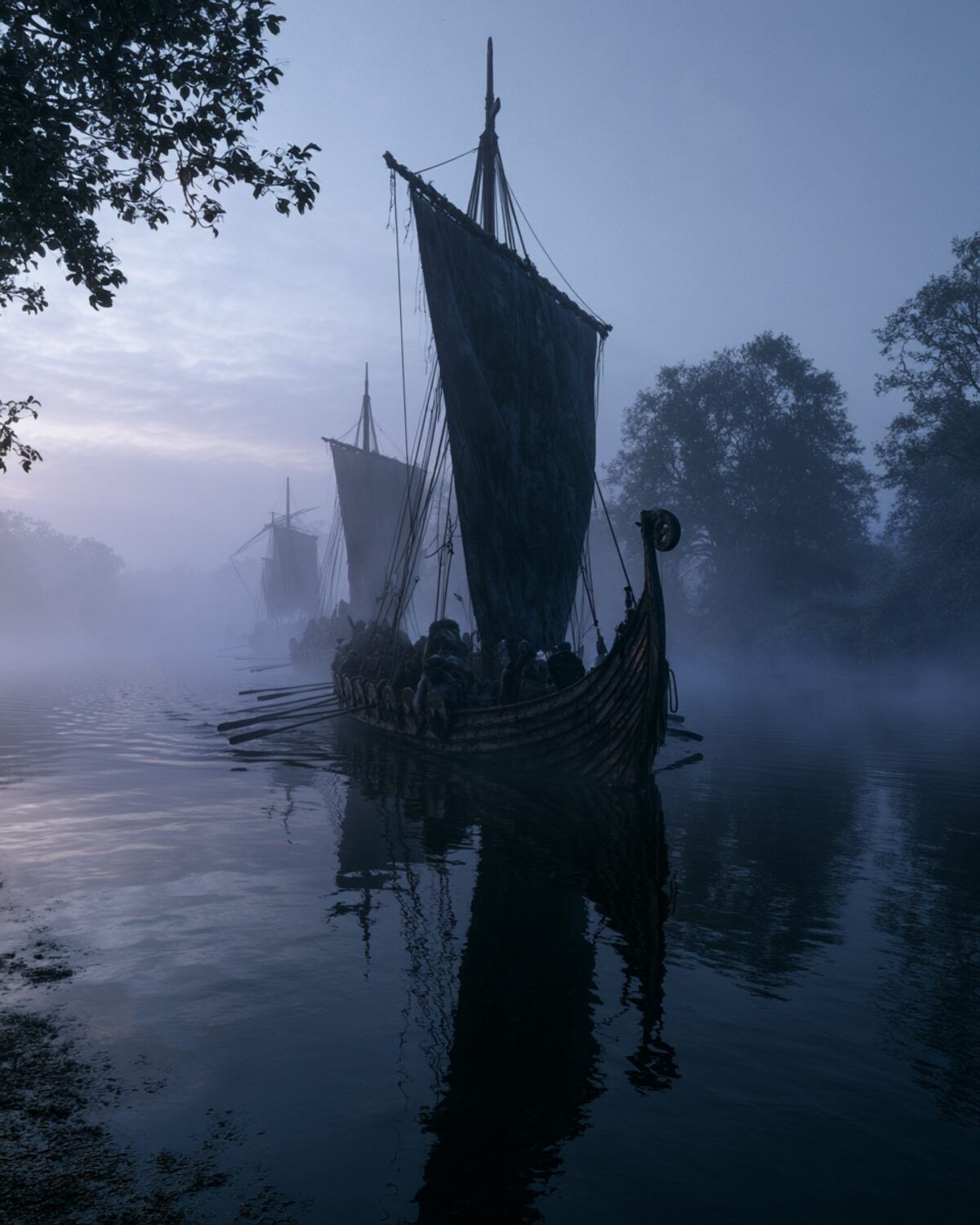
Construction and draught are covered in the article on longships. What matters strategically is what followed from them. The Annals of St-Bertin record 120 ships sailing up the Seine to Paris in March 845. A fleet combined three things that no land army of the time had together: it carried its supplies and loot, it moved on rivers faster than most levies on foot, and it offered a way out at any moment.
That way out is easy to underrate. A lost battle on land could end a Carolingian campaign. For a fleet it often meant no more than changing rivers. This explains the puzzle Coupland raises: in the 860s the Aquitanians won a whole string of victories without lastingly restraining the Northmen based there. The Annals of St-Vaast lament under 882, in substance, that the Franks had won but that the fight had done nothing to subdue the Northmen.
Ships alone were not enough. From the 860s many of these armies fought far from water. The Anglo-Saxon Chronicle notes that the Great Army got horses in East Anglia, and Dawn Hadley and Julian Richards show how it crossed the kingdoms rapidly by old Roman roads and rivers. More on that in the article on Viking horses. The strength lay in the combination: the fleet for range and fallback, horses for the thrust inland. The Old English word "rædehere", mounted army, which the Chronicle uses under 891, fits this.
The finds show how much the armies relied on boats. In 2018 Hadley and Richards cite clench bolts from the camps of Torksey, Repton and Aldwark (their 2016 report still said none had been found at Torksey), and all three sat where major river and road routes met.
The decisive change of the ninth century was overwintering. In his 2023 survey of research Gareth Williams gives the stages: Ireland in the late 830s and early 840s, with camps at Dublin and Annagassan in 841; Francia for the first time in 843; England on Thanet in 850/51. The Chronicle marks that year specifically: for the first time the heathens stayed over winter. Williams stresses two points that correct the image of a brief seasonal quarter. The camps were almost always reachable by ship. And the armies of the later ninth century usually arrived one winter and stayed until the next, often close to a full year.
That changed the war. Whoever sat in the country did not have to start afresh each spring. He could strip the surrounding land, hold captives and negotiate with kings for months. At Torksey on the Trent, the winter camp of 872/73, Hadley and Richards found hack-silver, cut dirhams, ingots, more than 350 weights and 289 lead gaming pieces across some 55 hectares, along with traces of metalworking. Their survey found no defensive ditch; river, bluff and marsh made the place almost an island. They reckon with several thousand people, an order of magnitude and not a count. The reasons for overwintering and the question of Asselt or Elsloo are in the article on winter camps on the Rhine, the English side under The Great Army.
A camp could even hold off a large opponent. In 882 Emperor Charles III besieged the camp on the Meuse, probably at Asselt, for twelve days according to the Bavarian continuation of the Annals of Fulda, and then made a treaty instead of taking it. How it came to that is told in 881: when the Vikings stood before Aachen.
Around 840 the Frankish empire was the strongest power in the Latin West. Then Louis the Pious died, and his sons Lothar, Louis the German and Charles the Bald fought over the inheritance. The chronology is striking. In May 841 Rouen was raided, in June 841 the brothers fought at Fontenoy, the same year Lothar granted the island of Walcheren in the Scheldt estuary to the Dane Harald, and in 843 the Treaty of Verdun divided the empire. Prudentius of Troyes, who continued the Annals of St-Bertin, sharply denounced the grant to a "demon-worshipper". The article on Harald Klak untangles the case, since the Harald of 841 is probably a different man from the convert of 826.
No source says that the civil wars "summoned" the Vikings. Raids had begun earlier, and the causes in the North did not lie in Aachen. The narrower claim is secure: division and feuding robbed the empire of the ability to concentrate its forces, and created factions that could use Norse warriors as partners.
Coupland documents this in a concrete case. In 858 numerous West Frankish magnates defected to Louis the German, who had invaded his brother's kingdom. As late as 859 Charles could not rely on his own army. For precisely that reason he turned to another tool: he hired the Somme fleet under Weland to attack the Seine Vikings' camp on the island of Oissel. Coupland explains why West Francia was hit more often than the other kingdoms by its longer coastline and its wealth, and explicitly also by its political divisions.
After the death of Charles the Bald in 877 came a rapid succession of short-lived kings, and the armies of the later century turned from England to the Continent shortly after Alfred's victory at Edington. The articles The Great Army on the Continent and Vikings in France trace this. Scholars see in it one reason for the choice of target; no leader ever stated it.
England repeated the picture on a smaller scale, only without a common ruler. Northumbria was fighting over its throne when the Great Army took York in November 866. Only then did the rivals Osberht and Ælla join forces, attack in March 867, and both die. Mercia called in help from Wessex in 868 and then made peace. Hadley and Richards sum up that the army deposed or killed at least three Anglo-Saxon kings and replaced them with its own appointees. Ceolwulf in Mercia is the best known of those men.
In Brittany and on the Loire the fronts ran across every camp. The Breton Salomon hired Northmen, and in 862 Robert the Strong agreed to pay another group 6,000 pounds of silver to fight him. Four years later, in 866, Northmen allied with Bretons marched against Robert, who fell at Brissarthe; Hastein is regarded as their leader. Whether Salomon himself was there cannot be shown. The Chronicle of Nantes, a later text, even claims Count Lambert led the fleet to Nantes in 843. That remains an accusation made in hindsight, but it shows how natural such alliances seemed; more under Vikings in Brittany.
The Northmen were never united either, and their opponents used that. Björn, based on Oissel, commended himself to Charles the Bald in 858 before the king attacked the island. Others could be bought against their own kind. Rorik held Frisia for the Carolingians over decades.
The figures Simon Coupland assembles for the reign of Charles the Bald are impressive: 7,000 pounds of silver in 845, 5,000 pounds for Weland in 861, 6,000 pounds promised by Robert the Strong in 862, 4,000 pounds in 866, 5,000 pounds in 877. The 7,000 pounds of 845 would come to about 2.5 tonnes at an assumed pound of some 367 grams; the actual weight of the pound of that time is a matter of conversion. The means came from taxes on peasant holdings and merchants and from church treasure. On top came local ransoms, for the monastery of St-Wandrille in 841 for instance, and the buying back of individual captives.
The popular version runs: pay up and you feed the wolf. Lucien Musset argued this in scholarship, and it echoes in this site's article on France. Coupland firmly disagrees in his 1999 study. Raids, he says, vastly outnumbered tributes, no reliable ninth-century source reports Vikings demanding money on their own initiative, the initiative came from the Frankish side, and the paid fleets left the kingdom. For 866 and 877 he concedes that their later movements are unknown and only assumes they kept their word. His verdict: in military terms payment was essentially successful. So interpretations differ, and Coupland's is limited to Charles's reign. England around 1000 poses the question differently, as Danegeld and Maldon shows.
Tribute was a strategic solution for the Vikings too. A leader had to pay his followers and hold his fleet together. Silver weighed out by a king came without risk. Whoever got it could sail home with a profit or ask for land. And a king who paid was no coward: in 859 Charles spent the money deliberately to steer two armies against each other and save his own position at home.
The business was not risk-free. Weland's army then attacked Meaux, was trapped at Isles-les-Villenoy in 862, and had to leave the Seine.
The list of documented defeats is long. Coupland names victories over Vikings on the Dordogne in 848 and near Chartres in 856. On 3 August 881 Louis III beat an army at Saucourt-en-Vimeu; you need not believe the high death tolls in the sources, but you can believe the victory. Paris held out in 885/86, though money changed hands again at the end. In 911 Rollo failed before Chartres. In al-Andalus the emirate of Córdoba built a fleet after the attack on Seville in 844, and Björn's later voyage ended with heavy losses according to an uncertain report. In Ireland the Northmen were driven out of Dublin in 902.
The year 891 is especially instructive. On 26 June a Viking army beat a Frankish levy on the Geul near Maastricht, and Archbishop Sunderold of Mainz fell. In the autumn King Arnulf attacked the fortified camp on the Dyle near Leuven, made his horsemen dismount and stormed it on foot. The Annals of Fulda report the deaths of the kings Sigfrid and Godfrid and sixteen captured standards. There are no reliable casualty figures, and the claim that the riverbed was choked with corpses is victor's rhetoric. The Anglo-Saxon Chronicle notes that Arnulf fought the mounted army before the ships came. An army without its fleet behind it was vulnerable. It was not destroyed, though. It wintered again near Leuven, in 892 a force went once more as far as Bonn, then hunger drove the men away, and an army with some 250 ships landed in Kent. That these were the same men is likely but cannot be proven in every case. The effect was probably confined to the Rhineland, since things went on along the Loire and Oise.
One of these defeats even ended as a gain for the loser: shortly after his setback at Chartres, Rollo received land on the lower Seine, as the article on Rollo describes.
Edington shows the limit of the model most clearly. After the winter strike on Chippenham, Alfred withdrew with few men into the marshes of Athelney, built a stronghold there, and in May called out the men of Somerset, Wiltshire and Hampshire at Egbert's Stone. He then beat Guthrum's army at Edington and besieged it in its base for about two weeks, until it gave hostages and swore oaths. Guthrum was baptised at Aller.
So the surprise at Chippenham had worked and still was not enough. Alfred had a realm that could still respond after the shock, and the ability to bring together a levy from several shires at the decisive moment. Yet this defeat was no end either. Guthrum went on to rule as a Christian king in East Anglia, and from 880 his army shared out the land there, as the articles on Guthrum and Alfred the Great show. The loser still got a kingdom.
The model rested on two conditions, and opponents attacked both: free passage and the lack of fixed strongpoints. From 862 Charles the Bald had fortifications built at Pîtres on the Seine, he ordered fortified river bridges, and in the Edict of Pîtres of 864 he banned the sale of weapons and horses to the Northmen, with death as the penalty for horses. That such a ban was needed suggests it happened. No network of blocked rivers came of it, however: Coupland reckons with only one or two actually fortified bridges, probably Pont-de-l'Arche and Les Ponts-de-Cé.
In Wessex the system went deeper. Alfred's fortified places, the burhs, spread the defence across the land, and in the 890s a Danish fleet was lost in the River Lea after the river was blocked. The model did not end in one great battle; it grew more expensive over decades.
A footnote on the ring forts. Fyrkat is sometimes listed among Viking defeats. That is wrong. Fyrkat in Jutland is a Danish ring fortress, now placed around 980 under Harald Bluetooth, long after the campaigns discussed here. It burned down around 1000, with no traces of fighting found. I know of no battle at Fyrkat. It rather shows that a Scandinavian king, too, eventually built fixed strongpoints; more under Trelleborg and the ring forts.
Why were the Vikings so successful? Above all because they could choose where to fight. Ships and later horses gave them reach, camps gave them endurance, and quarrelling enemies made deals and tribute possible. Superior weapons or fighting power cannot be derived from the sources.
Were Vikings superior to the Franks in combat? That cannot be shown. The Franks won several times, for example in 848, 856, 881 and 891. Frankish armies also lost, as in 845, 866 and on the Geul in 891.
What role did the Frankish civil wars play? They made it harder to concentrate forces and turned Northmen into allies of individual factions, as with Lothar in 841. No source says they caused the raids, which had begun earlier.
Did ransom payments help? According to Coupland, for Charles the Bald they did: the paid fleets left the realm, though he cannot show for every case that they stayed away. In general the question stays disputed.
Was the Dyle in 891 the end of the Viking Age on the Continent? No. The army moved on and probably went to England in 892, but raids on the Loire, Seine and Oise continued, and in 911 Rollo received land on the Seine.
The Great Army in England · The Great Army on the Continent · The Carolingian military system · The shield wall · Lið, hirð and leiðangr · Winter camps on the Rhine · Danegeld and Maldon · Longships

How did Vikings really fight on the battlefield? Following the evidence from poem to saga to skeleton · The Great Heathen Army · Lið, Hird & Leiðangr · The Carolingian Military System · The longships.
All History & Finds articles →
“Viking” sounds like the name of a people, but it did not start out as one. In Old Norse, a víkingr was a man who went …
Read more →Two early medieval peoples called themselves Croats — one on the Adriatic coast, one deep inland between the Vistula …
Read more →Westphalia is a regional name everyone knows and a tribal name hardly anyone can explain. The Westphalians, Latin …
Read more →"Visigoths" sounds like a people that crossed the Danube in 376 and perished in Spain 335 years later. The sources tell …
Read more →