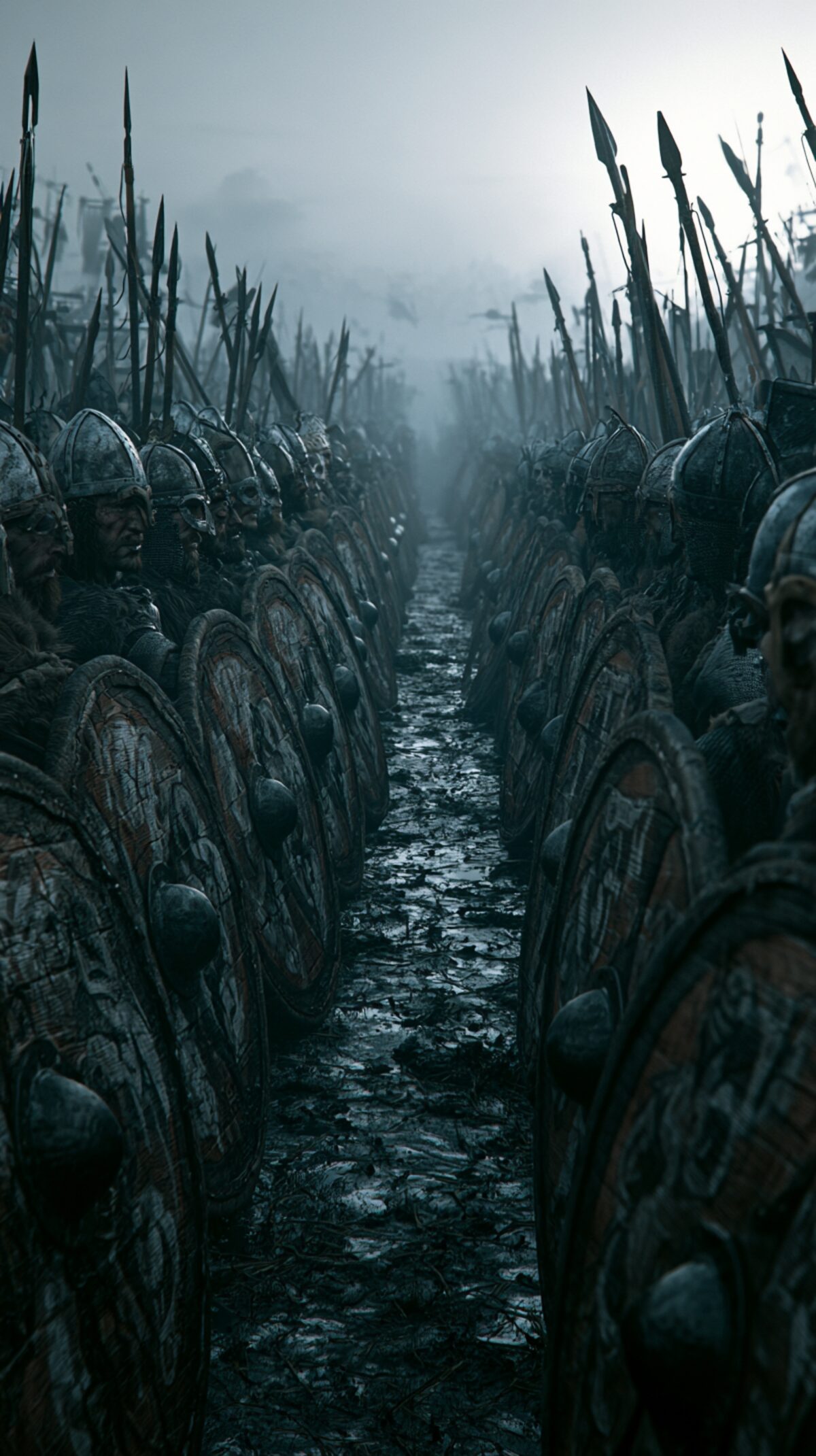
No combat manual survives from the Viking Age. No Scandinavian of the ninth or tenth century wrote down how deep a battle line stood or when the archers loosed. What we have are the writings of their enemies, praise poems, sagas from later centuries and bones with cut marks. This article stays with the fighting itself, and of each familiar image, from the shield line through the swine array to the berserker, it asks: who says so, when was it written down, and what does the find show?
Describing how Vikings fought runs into a witness problem: the men in the ranks did not write. Runestones may record that someone fell, but not in what formation. That leaves four kinds of evidence, each with its own weakness.
The first comes from the other side: Frankish annals, the Anglo-Saxon Chronicle, monks and bishops, close in time but partisan and rarely interested in technique. The second is skaldic verse, the courtly praise poetry of Norse professional poets. Some stanzas were composed by men who were present, yet they survive only as quotations in younger sagas, and they aim to glorify. The third is the kings' sagas and Saxo Grammaticus, writing around 1200 and later, often two centuries after the events. The fourth does not speak at all: weapons, shields, ships and skeletons.
The finds show what a man held, not who stood beside him. The sagas name formations, but they write from another time. So this text follows the witnesses rather than an ideal battle sequence. Strategy and politics stay outside the frame; the subject is the hours in which men actually fought.
The rare case of an observer who actually watched is Abbo of Saint-Germain. The monk lived through the siege of Paris in 885/886 and wrote a Latin epic about it, the Bella Parisiacae urbis. He is valuable because he was close, and treacherous because of his deliberately obscure vocabulary and his celebration of Saint Germanus as the city's true saviour. His 700 ships and 30,000 to 40,000 men are regarded by scholars as gross exaggeration; Carroll Gillmor reckoned on 200 to 300 ships and 5,000 to 8,000 men, which also remains an estimate.
The attackers strike at the bridge tower “with slingstones and fill it with arrows” (feriunt fundis acriter complentque sagittis, Book I), and missiles fly from both sides. The defenders pour down oil, wax and pitch. Abbo also tells of fire ships sent against the bridge, which by his account run aground through the saint's intervention. The soberer Annals of Saint-Vaast confirm the building of machines and the attempt to set fires (machinas construunt, ignem supponunt).
Modern overviews add rams and mining; I have read Abbo's Latin only in excerpts. Paris still shows one thing: the same men people like to imagine purely as a raiding party could conduct a months-long and technically demanding attack on a fortification. They could not take the city; in autumn 886 Emperor Charles III arrived with an army and bought their departure with a promise of silver. More in the article on the Great Army on the Continent.
The most famous picture of a field battle comes from the Old English poem on Maldon, 991. It survives incomplete, praises the loyalty of Byrhtnoth's retinue and was composed on the losing side. The Chronicle for the same year records little beyond the ealdorman's death. So the poem is no eyewitness protocol. It does show what an English poet of the time took for granted, and in this order:
“he mid bordum het / wyrcan þone wihagan, and þæt werod healdan / fæste wið feondum. […] bogan wæron bysige, bord ord onfeng.”
In English: “He ordered them to build the war-hedge with their shields and the troop to hold firm against the foe. […] Bows were busy, shield met spear-point.”The Battle of Maldon, lines 101–103 and 110, Old English text; my translation and abridgement
The Old English word behind the “war-hedge” is wihagan. It evokes dense thicket, not masonry, and alongside it the poem uses scyldburh, “shield-fort”. Both are images. Neither they nor the poem reveal how many ranks stood behind one another or how much room a man had. The sequence is informative, though: first spears and arrows, then close combat. And when Godric rides off on his fallen lord's horse, the poem has the warrior Offa complain that the host has been split and the shield-fort broken (scyldburh tobrocen). The line breaks because men believe their leader is fleeing, not because a manoeuvre tears it open.
An older English voice speaks of Ashdown, 871. Asser, Alfred the Great's biographer, wrote some twenty years later and wants his king to shine. He has Alfred charge uphill against the pagans “like a wild boar” while his brother is still hearing Mass, and he names the closed array of both armies, Danes and English alike, with the Latin word testudo, the Roman “tortoise” (chapters 37–38). That is learned Latin, but it shows a dense, ordered array on both sides, as far as Asser can be taken at his word here. The Brunanburh poem of 937 similarly speaks of the bordweall, the board-wall. There is a separate article on the background to Maldon.
The two battles of 1066 are often cited as textbook shield-wall cases. In both it pays to look closely at who says what. Hastings is not a Viking battle. An English army fought a Norman-French one. It still belongs here, because English infantry with shields and axes came from the same North Sea world as Scandinavian fighters, and Harold Godwinson's army had faced them only weeks before. The accounts, above all William of Poitiers and the Bayeux Tapestry, come from the winning side: a dense line on the ridge fends off the horsemen for hours and thins only when men leave it to pursue those falling back. See Hastings 1066.
Stamford Bridge is the reverse case. There, on 25 September 1066, a Scandinavian army under Harald Hardrada really did stand, but the famous description comes only from Snorri Sturluson. He has Harald form a long, thin line whose wings are bent back until they make a ring; the front rank plants spear shafts in the ground so the points reach the riders' chests. Yet it stands in a saga written some 160 years after the battle, in which English horsemen attack and pretend to withdraw, a pattern strongly reminiscent of Hastings. That Snorri or his sources blended the year's two battles is a common interpretation, not a proof. The Anglo-Saxon Chronicle reports chiefly the surprise and the outcome (more under Stamford Bridge). For tactics this means: the elaborate ring is saga, while the dense infantry line is well attested.
Shield construction and the English and Norse terms are covered at length in the articles on the shield wall and the Viking shield. What is firm: Old Norse skjaldborg and Old English bordweall, scyldburh and wihagan name a closed front of shields. The shield itself is superbly documented, from the 64 examples in the Gokstad ship, about 94 centimetres across, to the piece found at Trelleborg in 2008. Rolf Warming re-examined the Gokstad fragments in 2023 and argues they were covered with thin rawhide and built for fighting, not merely as grave goods.
This find gives the strongest argument against the film image of overlapping shields. A round shield does not sit on the forearm; it is held at a central fist grip behind the boss, which makes it mobile. Wedging it tightly into a neighbour's shield robs it of exactly that strength. So modern experimental archaeologists suspect a closed but not rigid line that tightens at contact and opens again for fencing. That too is reconstruction. I know of no contemporary written source that describes overlapping or rules it out, and the frequently quoted figure of about a metre per man is an estimate from trials.
Ask the graves rather than the poets, and the picture shifts from axe to spear. It is the most common weapon in Viking Age weapon graves, joined by the shield and less often by sword and axe; mail and helmets remained costly and rare. That suits a way of fighting in which men stab and throw from a line. Grave goods also reflect rank and custom, though, not just tactics (more on the Viking spear).
In western accounts men mostly fought on foot, even though horses mattered for mobility. The Anglo-Saxon Chronicle already reports for the winter of 865/866 (the year reckoning varies) that the Great Army was provided with horses in East Anglia. At Maldon Byrhtnoth has his men drive their horses away before they take position. Those who rode evidently dismounted to fight, as far as the sources allow a statement (see Viking horses). Norman-style trained cavalry is not attested for Scandinavian armies of this period in my sources.
No tactical image of the Viking Age is described as exactly as the svínfylking, the “swine array”: a point of one or two men, ranks of growing size behind, archers inside, several wedges side by side. No Viking Age source says this in such detail. The references lead back to a surprising family tree.
At its root stands a Roman author. Tacitus writes tersely in the Germania (chapter 6): acies per cuneos componitur, the battle line is formed of wedges. In the next chapter he explains that no chance assembly forms such a body, but familiae et propinquitates, families and kin. Whether cuneus here means a pointed shape or a compact division cannot be settled from the passage. Then comes the detail that makes the matter interesting. The late Roman military writer Vegetius, in the third book of his handbook (III.19), defines the cuneus as a body of infantry narrower in front and wider behind, and adds: Quam rem milites nominant caput porcinum. The soldiers call this the pig's head.
Some eight centuries before the Icelandic manuscripts, then, the same image already exists. Direct borrowing into the sagas has not been demonstrated, and such animal names could have arisen more than once, but learned transmission remains possible.
In the Norse texts the wedge then acquires a god's label. In the eddic Reginsmál (in a thirteenth-century manuscript) Odin, in the guise of Hnikarr, advises young Sigurd on a wedge-shaped array. In Saxo Grammaticus around 1200 Odin teaches the art to the legendary king Hadding, complete with a scheme (Book I): the first rank has two men, the second four, the third eight, and each further rank doubles the one before; slingers and archers go to the ends of the wings. In the tradition around the battle of Bråvalla he passes the art to Harald Wartooth, only to betray him in the end. Frederick York Powell summed this up in the introduction to Elton's 1894 Saxo translation: Woden invented the wedge array, “the terrible column with wedge head which could cleave the stoutest line”. Bråvalla is legend about a battle before the Viking Age. Dictionaries attest the word svínfylking itself chiefly from late saga literature, from texts of the thirteenth and fourteenth centuries.
The numerical scheme itself, then, is already Saxo's. Nineteenth-century books such as Paul Du Chaillu's The Viking Age of 1889 and Richard Burton's Book of the Sword later popularised the image. That Viking armies of the ninth or tenth century actually formed a geometric swine array on command cannot be shown. As the article on Germanic warfare also shows, a gap of centuries separates the ancient word from the saga motif.
The film Viking seldom carries a bow; the finds tell otherwise. Arrowheads are among the common iron finds, the complete yew bow from the harbour of Hedeby measures about 191 centimetres, and the Irish bow from Ballinderry about 185. Construction and range are covered under bow and arrow. Three tactical points matter.
First, in combat the bow appears mainly as the weapon of the opening exchange and of bombardment. Abbo's arrows at Paris belong here, as do Maldon's busy bows. The evidence from Salme on Saaremaa, around 750 and so just before the Viking Age proper, is especially striking: the two ship graves held more than ninety arrowheads, along with dead men bearing cut wounds. Second, Norwegian Gulathing law requires for the fleet levy one bow with 24 arrows per rowing bench. So the bow was planned equipment, though the text of the law is high medieval, and how far it fits conditions around 1000 is disputed. Third, nothing points to specialised archer units. Bowmen inside the wedge are a late embellishment; even Saxo's Odin places them at the ends of the wings.
The sagas delight in individual marksmen. The most famous scene is set at Svolder: Einarr Þambarskelfir is shooting, an arrow breaks his bow, and when the king asks what broke, he answers, “Norway, king, from thy hands.” That is storytelling; Saxo knows the same tale but has Einarr aim at King Sveinn rather than Jarl Eiríkr. At Hastings, by contrast, the accounts set many Norman archers against very few English ones.
Nimble longships circling and ramming each other are not attested. In bays and river mouths, leaders laid their ships side by side, tied the stems together and so created a platform on which men fought as on land. This is among the best evidence for Scandinavian tactics, because it does not stand in the sagas alone.
The key text is a stanza by the skald Sigvatr Þórðarson on the battle of Nesjar in 1016, in which he took part. Snorri quotes it; in Samuel Laing's 1844 translation it reads: “Earl Svein his ships of war pushed on, / And lashed their stout stems one to one.” The escape route is attested the same way: the earl has the ties and finally the stems cut in order to get away. The poet was there, but his verses too survive only in later texts.
The kings' sagas supply the rest. At Svolder in the year 1000 Olaf Tryggvason lashes eleven ships together, with the Ormrinn langi, the “Long Serpent”, in the middle. At the battle of Niså in 1062, according to Snorri, both sides, Harald Hardrada and Sveinn Estridsson alike, bind their ships together through the middle of their fleets. Modern accounts name two advantages: all the men stay free to fight, and a superior force can make less use of its numbers.
The price is immobility, so in the sagas the free wings often decide matters. Jarl Eiríkr attacks the end of the line at Svolder and clears ship after ship, and at Niså Jarl Hákon Ívarsson leaves his ships unbound and attacks the loose Danish ships from the wing. “Clearing” means killing the enemy on board or driving him into the water; the sources do not speak of deliberate sinking. Whoever lost could only cut the ropes or jump overboard.
Here too the details wobble. The site of Svolder is unknown to this day, Oddr Snorrason evidently modelled his review-of-the-ships scene on a Carolingian precedent, and the battle of Hjörungavágr, treated in the article on the Jomsvikings, is half legendary in its saga form. The length of the Ormrinn langi is an extrapolation from a saga figure; the longest longships known from archaeology, Skuldelev 2 and Roskilde 6, measure about 30 and about 36 to 37 metres. More under longships and Olaf Tryggvason.
Berserkers have their own article; here only the tactical question. Were they an elite force charging ahead of the line? The oldest trace is the praise poem Haraldskvæði on the battle of Hafrsfjord in the late ninth century, which mentions howling ulfhednar and roaring berserkers, and whose verses survive only in thirteenth-century kings' sagas. Snorri later places these men in the fore part of the king's ship, the rausn between stem and mid-hold, in his saga of Harald Fairhair (chapter 9). That is where boarding begins, but the passage describes a ship's crew, not a fight, and it stands in a late saga.
The famous description in the Ynglinga saga (chapter 6), of men without mail who bite their shields like dogs and whom neither fire nor iron can harm, concerns Odin's warriors in mythical prehistory. After that, berserkers appear in the Sagas of Icelanders mostly as troublemakers and duellists extorting farmers, not as a battle formation. I know of no contemporary Frankish or English chronicle describing a berserker unit in combat. The fly agaric theory comes from Samuel Ödmann in 1784 and has no northern evidence; Karsten Fatur's henbane suggestion of 2019 is likewise a hypothesis. For an organised shock troop, the proof is missing.
Skeletons are the only witnesses without an agenda, but they too rarely speak for open combat. Osteoarchaeology distinguishes healed wounds from perimortem ones, inflicted around the time of death. Blows from behind or above and a lack of defence injuries on the forearms point rather to execution or flight than to fighting face to face.
This very criterion separates the great sites. The mass grave at Ridgeway Hill near Weymouth held 54 skeletons and 51 skulls of Scandinavian men from around 970 to 1025. They were decapitated, so they are victims of an execution, not battle dead. At St John's College in Oxford lay some 35 to 37 young men with multiple stab and cut injuries; a link to the St Brice's Day massacre of 1002 is unproven. Repton, with the grave of a man with a Thor's hammer and a heavy blow to the left thigh, belongs to the winter camp of the Great Army, but the great bone deposit there was reburied and may include people who did not die by weapons.
Two individual cases come closer to the fight. According to Per Holck's 2009 re-examination, the man in the Gokstad ship carries blows on both legs, including a cut on the inside of the right thigh bone and a cut about 4 centimetres long on the left shin near the knee. That may fit strikes below the shield rim; one man allows no more. And the dead of Salme show cuts, stabs and blows to the skull, along with the arrowheads mentioned. That find is older than the Viking raids, however.
Large battlefield statistics only come from the late Middle Ages: for Visby in 1361 Bo Ingelmark counted 456 cases of cutting wounds and 126 of arrow or crossbow hits among 1,185 dead, with most injuries on the lower body, which is explained by the protection of the shield. I could not check an exact figure for the often-cited predominance of left-side wounds against the original report. Applying that to the Viking Age remains analogy. A 2024 comparative study in the Journal of Anthropological Archaeology reports, according to its press release, 33 per cent of skeletons with healed and 37 per cent with lethal injuries for Norway, and about 6 per cent violent deaths for Denmark, nearly all by execution. I could not consult the study itself or its sample sizes. Healed wounds also suggest care: whoever survived such a blow was probably looked after. One saga scene on this is set after Stiklestad.
One pattern runs through all the witnesses: the more detailed a description is, the later it was usually written down.
Was there a fixed Viking battle order? None has come down to us. The sources show a dense infantry line, often with the leader and his banner in the middle according to the sagas. Depth, spacing and commands are unknown.
Is the svinfylking invented? Not the word, which is attested in sagas. But the motif has a literary family tree with Tacitus, Vegetius and Odin. Its use in a specific Viking Age battle cannot be demonstrated.
Why did Vikings tie their ships together? To turn a fleet into a fighting platform, free all the men for combat and protect the flanks. The skaldic stanza on Nesjar 1016 counts as especially strong evidence; the details come from the kings' sagas.
Did Vikings fight on horseback? In western sources they used horses mainly for movement and fought on foot. Exceptions cannot be ruled out, but they are not the typical picture.
Do skeletons show how people fought? Only to a limited extent. They show wounds and often the direction of blows but nothing about formations. Many well-known finds also document executions rather than battles.

Why were the Vikings so successful in war? Ships, camps, quarrelling enemies and a good many lost battles · The shield wall · The Viking Shield · Berserkers · Warfare.
All History & Finds articles →
If the axe was the weapon of the common man, the sword was its opposite: costly, rare, inherited and often given its …
Read more →Fifteen silk textiles in the Oseberg ship, tens of thousands of dirhams in northern soil, a Buddha from the Swat Valley …
Read more →The Viking Age is often told as a world of free farmers and proud warriors. That is half the truth. Beneath the free …
Read more →A runestone in central Jutland was raised by a queen in memory of her mother. She writes in Norse runes and calls …
Read more →