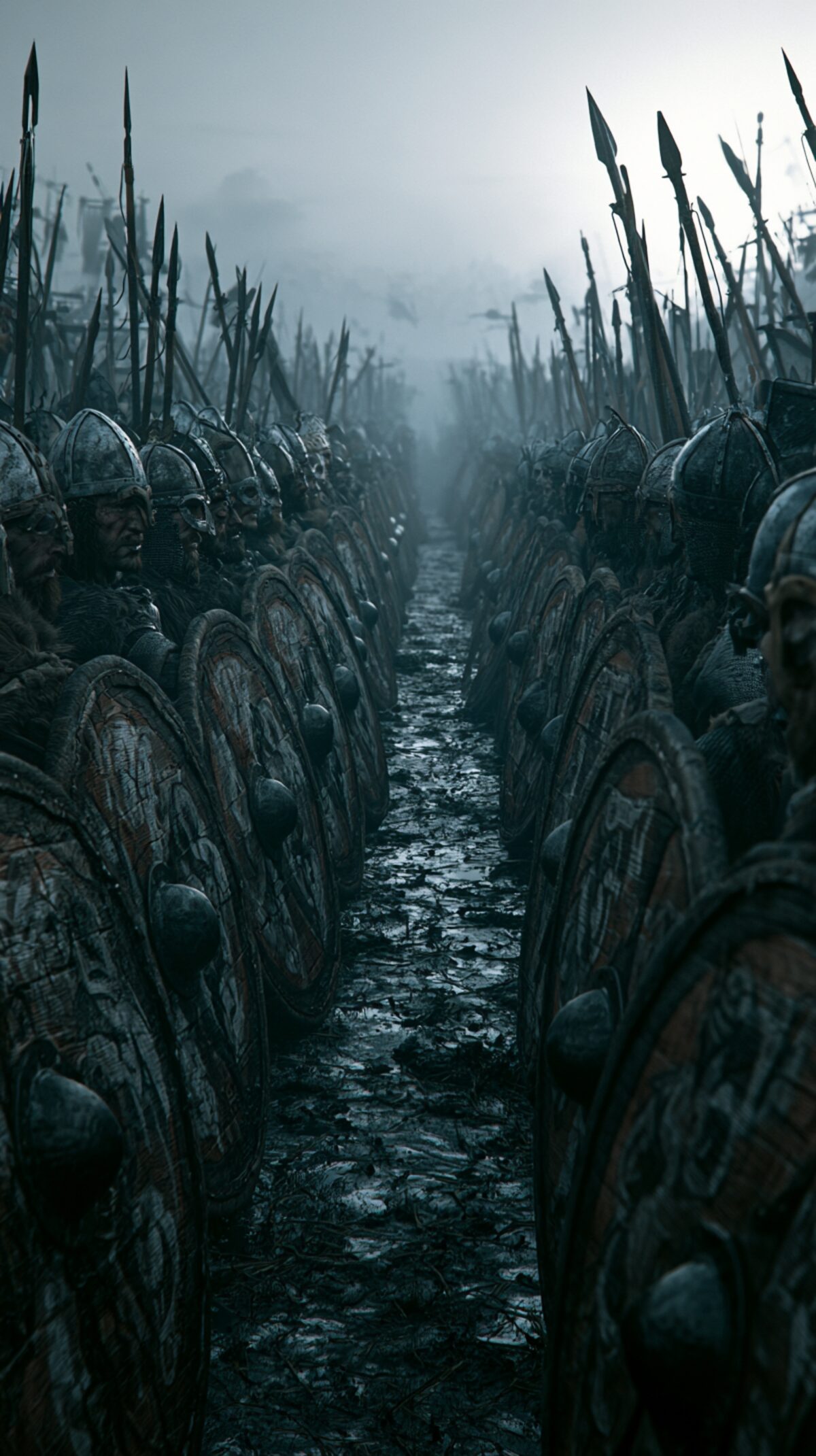
In 937 King Æthelstan and his younger brother Edmund defeated an alliance of the Viking king Olaf Guthfrithsson of Dublin, Constantine II of Scotland and Owain of Strathclyde. An Old English praise poem hails the victory as the greatest slaughter since Angles and Saxons first came to the island. Irish annals confirm the battle, Welsh annals give it two words, and an Icelandic saga retells it three centuries later in quite another way. Where Brunanburh lay is still not settled. This article sets the witnesses side by side, weighs Bromborough on the Wirral against some forty other proposals, follows Olaf's return after Æthelstan's death and asks how much the label "birth of England" can bear – with an eye on the film "The Last Kingdom: Seven Kings Must Die".
Brunanburh is among the best-known and worst-documented battles of early medieval England. What is secure is the year 937, the names of the leaders and the result: the West Saxons and Mercians under Æthelstan and Edmund won, the allies from Dublin, Scotland and Strathclyde fled. Even the month is unknown.
The place is less certain still: whether Brunanburh, Brunandun, Weondun, Brune, a plain called "Othlyn" and the heath of Vínheiðr in Egil's saga all mean one spot has occupied scholars for over a century.
Two terms first. The Anglo-Saxon Chronicle is a set of year-by-year records in Old English, begun at the West Saxon court in the late ninth century and preserved in several manuscripts; the oldest is called the A text. A jarl (Old English eorl) is a high-ranking lord below a king. Strathclyde was a Celtic-speaking kingdom in what is now south-west Scotland.
Æthelstan was a grandson of Alfred the Great and the son of Edward the Elder by his first partner, Ecgwynn. After Edward's death in 924 he was accepted in Mercia and crowned in 925; his half-brother Ælfweard died shortly after their father, in circumstances nobody records.
The key to 937 lies in York. Scandinavian kings had ruled there since the late ninth century (see Jórvík). When King Sihtric died in 927, a year after marrying Æthelstan's sister, Æthelstan took York. Sihtric's kinsman Guthfrith, king of Dublin, tried to take the throne and was driven off. He was the father of Olaf, who thus had a family claim to York.
On 12 July 927, according to the D version of the Chronicle, several rulers met Æthelstan at Eamont near Penrith and acknowledged his overlordship: Hywel of the West Welsh, Constantine of the Scots, an Owain whom the Chronicle calls king of Gwent, and Ealdred of Bamburgh. William of Malmesbury turns him into an Owain of the Cumbrians, so the sources disagree here.
Seven years later, in 934, Æthelstan marched into Scotland with a land army and a fleet and ravaged much of the country. No contemporary source gives the reason; the campaign showed the northern rulers they could not face him alone.
Olaf Guthfrithsson, in Irish Amlaíb mac Gofraid, belonged to the Uí Ímair, the "descendants of Ívarr", who had ruled Dublin and at times York since the ninth century. Equating that Ímar with the Ivar whom later sagas call the Boneless is common but unproven. Olaf succeeded his father in Dublin in 934. Earlier in 937 he removed the Viking king of Limerick at Lough Ree, which left his back free. Norse Dublin's beginnings are covered under Olaf the White (from 853), not to be confused with Olaf Guthfrithsson.
Constantine II, Gaelic Causantín mac Áeda, had ruled the kingdom of Alba since about 900, longer than any ruler of his day. That this old opponent of the Vikings now allied with Dublin shows how far Æthelstan had shifted the fronts. John of Worcester in the twelfth century calls him Olaf's father-in-law; no contemporary source confirms the marriage. Constantine survived, abdicated around 943 and died in 952, according to Scottish tradition as a monk at St Andrews.
Of Owain of Strathclyde we know least; no source records his fate. For the alliance's wider world see the Gall-Goídil and on the Vikings in Ireland, Scotland and the Isles.
The Welsh kings, Hywel Dda above all, stayed away, although the Welsh prophetic poem "Armes Prydein" calls for a grand alliance against the English. Its date is disputed, so as evidence for 937 it needs caution.
The chief witness is a praise song: under 937 the Chronicle carries a poem of 73 lines in Old English alliterative verse. As the A manuscript already contains it in the tenth century, it was composed at the latest a few decades after the battle.
The poem opens by saying that Æthelstan, "lord of nobles, ring-giver of men", and his brother Edmund won lifelong glory at Brunanburh and split the bordweal, the wall of boards, with the edges of their swords. (see shield wall). Then come the fighting from sunrise to sunset, the pursuit and the dead.
Five young kings, it says, lay on the field, "put to sleep by swords", together with seven of Olaf's jarls and countless men of the host, seamen and Scots. The "chief of the Northmen" was driven with a small band to the prow of his ship and saved his life on the fallow flood. The "old", "grey-haired warrior" Constantine also fled north to his homeland; he had no cause to boast, for he left his son on the field of slaughter, wounded, "young in battle". The Northmen went in their nailed ships over Dinges mere and deep water back to Dublin, ashamed.
Towards the end the beasts of battle appear, raven, eagle and wolf, a motif traced in the article on the raven in the North. Then comes the close that has shaped readings of the battle ever since:
"… never yet was greater slaughter on this island of people felled before this by the edges of swords, as books tell us, old learned men, since from the east hither Angles and Saxons came up over the broad seas, sought out Britain, proud war-smiths overcame the Welsh, earls eager for glory won the land."
"The Battle of Brunanburh", Anglo-Saxon Chronicle s.a. 937, lines 65–73; my own translation from the Old English text (CLASP database edition, Oxford)
These lines measure the victory by a story of origins: the English appear as heirs of the conquerors who came over the sea. It is no battle report, but it shows how the court wished the victory to be understood – and it stays precise: Olaf and Constantine survive.
Alfred Tennyson's English version of 1880 is a free poetic rendering, not a close translation.
Sources from the other side show that Brunanburh is no West Saxon invention. The Annals of Ulster, kept year by year in Ireland, record under 937 a great, lamentable and horrible battle between Saxons and Northmen. Several thousand Northmen fell, beyond counting, but their king Amlaíb escaped with a few companions; many Saxons fell on the other side, yet Æthelstan, king of the Saxons, won a great victory. They name no place but confirm, from Olaf's own world, the outcome and the heavy losses.
The Annals of Clonmacnoise, surviving only in an English translation of 1627, name the "plaines of othlyn", 34,800 dead and several fallen leaders, among them Constantine's son Ceallach. None of this can be checked independently.
The Welsh Annales Cambriae note under 937 only "bellum Brune", the battle of Brune, which independently confirms the name element Brun-.
The nobleman Æthelweard wrote a Latin chronicle around 980. He calls the place Brunandun – dun means hill – and speaks of a "great war". After this victory, he writes, the fields of Britain were joined into one, peace reigned everywhere, and no hostile fleet came again. It is the earliest reading of the battle as a turning point; I have not read the Latin text in full.
In the twelfth century monks at Durham, Worcester and Malmesbury tell the story at greater length; whether their additions come from lost sources or from embellishment can rarely be decided.
Texts written at Durham and attributed to Symeon of Durham call the place Weondun or Wendun and add that it was also called Et Brunnanwerc. They give Olaf a fleet of 615 ships and have him fight together with Scots and Cumbrians. No contemporary source supports the figure.
John of Worcester describes Olaf as "king of many islands", urged on by his father-in-law Constantine, and has him sail into the mouth of the Humber with a strong fleet. This sentence underpins the Yorkshire theories; critics see it as the chronicler's inference.
William of Malmesbury, writing around 1125, is the most colourful: Æthelstan deliberately let Olaf advance deep into the country. Olaf crept into the English camp disguised as a minstrel. And Æthelstan's sword fell from its scabbard during the battle and was back in his hand after a prayer to St Aldhelm. These are Malmesbury legends – Æthelstan is buried there – and the report that his cousins Ælfwine and Æthelwine fell comes from the same house. William also claims that Constantine was killed in the battle. That is wrong.
The Icelandic Egil's saga, written c. 1220–1240, has its own version. It belongs to the sagas of Icelanders, prose narratives between memory and literature. According to the saga, Egill Skallagrímsson and his brother Þórólfr entered Æthelstan's pay with their men. Chapters 51 to 55 then tell of a battle against a king Óláfr, whom the saga calls Óláfr rauði, "the Red", and makes king of Scotland: Scottish on his father's side, Danish on his mother's.
Æthelstan has a battlefield offered to his opponent on the heath of Vínheiðr by Vínuskógar and has the field marked out with hazel poles; in Old Norse hasla völl, "to enclose the field with hazel", a custom for appointed battles. Two jarls called Hringr and Aðils, lords in Bretland, change sides, Þórólfr kills Hringr and later falls himself, and Æthelstan gives Egill two chests full of silver for his brother.
Most historians equate Vínheiðr with Brunanburh, because date, enemy and victor broadly match. It is not proven, and there are good reasons for doubt. The king has a different name, Dublin is missing, and the story puts Egill at its centre. Sarah Foot, author of the standard biography of Æthelstan, considers the saga unreliable on this point.
More than forty sites have been proposed. Most specialists now favour Bromborough on the Wirral peninsula between the Dee and Mersey estuaries.
The strongest argument is the name. The place-name scholars Paul Cavill and Stephen Harding, both at the University of Nottingham, read Brunanburh as "Bruna's fortification", with a personal name as its first element, and the early records of Bromborough as a continuation of exactly that form. By their count three of the four English place-names containing Bruna lie on the Wirral. Their book "Finding the Battle of Brunanburh" appeared at the end of 2025.
A second argument comes from the poem: the fugitives sail over Dinges mere to Dublin. Cavill, Harding and the Viking scholar Judith Jesch have proposed reading this as a "mere" or water by the Thing, an assembly place (see the Thing). On the Wirral lies Thingwall, whose name records just such an assembly site. The Wirral had been settled by Norsemen since Ingimund, expelled from Dublin, arrived around 902 according to Irish tradition – an obvious target for a Dublin king. Michael Deakin countered in 2022 that Dinges mere is more likely a poetic word for the sea, and that the name Brunanburh could derive from Old English brūn, "brown", rather than from a personal name.
In the 2010s the volunteer group Wirral Archaeology surveyed fields near Bromborough with metal detectors. Michael Livingston, editor of a "Casebook" on the battle (2011) and author of "Never Greater Slaughter" (2021), describes finds he saw in 2019: bent arrowheads of a type used by Vikings from Ireland before 950, a zoomorphic strap end, an Arab silver dirham and metalworking debris that the group assigns to a tenth-century camp. The findspot is kept secret. Livingston himself then called this premature. A full publication of the finds is not known to me; Cavill and Harding describe ongoing isotope analyses of the metal.
Livingston's book treats the case as settled. Steven Walton found the thesis convincing but the archaeology not yet sufficiently confirmed; Thomas Williams disputed the claim that the question was solved. A fair summary: Bromborough is the best-supported candidate, not a proven one.
Burnswark near Lockerbie in Dumfriesshire, a prominent hill with an Iron Age fort and Roman camps, was proposed by George Neilson as early as 1899 and later argued afresh by Kevin Halloran. For it speak location and name; against it, no medieval record of the name Brunanburh and the long way to the Dublin fleet.
The historian and broadcaster Michael Wood has argued for sites in South Yorkshire over decades, first Brinsworth with nearby Tinsley Wood near Rotherham, later the area of Burghwallis and Went Hill in Barnsdale. Cavill replied in 2023 in the journal "English Studies": northern English sources show strikingly little interest in the battle, and Went Hill as Weondun does not convince.
Andrew Breeze proposed Lanchester in County Durham, others Burnley, Heysham, Barton-upon-Humber or Bourn in Cambridgeshire. None of these places has produced finds that could be linked to 937.
The poem's list of losses is brief and concrete – five young kings, seven of Olaf's jarls, Constantine's son, a countless host – and gives no names. Whether "young kings" means reigning rulers or royal sons is open; given the many petty kings of Ireland and Scotland, five is not implausible.
According to the Annals of Ulster the victors also suffered heavy losses. No contemporary source gives army sizes. The 615 ships of the Durham tradition and the 34,800 dead of Clonmacnoise are late figures of unknown origin. Modern estimates rest on models and are left aside here.
The Annals of Ulster report briefly under 938 that Amlaíb son of Gofraid was in Dublin again.
Æthelstan died at Gloucester on 27 October 939 and was buried at Malmesbury. Even the Irish annals honour him in their obituary. He was succeeded by Edmund, his fellow victor at Brunanburh, then about eighteen years old.
Olaf returned at once and became king in York, while his brother Blácaire held Dublin. According to the Durham tradition, he and Edmund faced each other at Leicester until the archbishops Wulfstan of York and Oda of Canterbury brokered a settlement that left Olaf large parts of the north Midlands. Coins naming Anlaf survive from York and are attributed to Olaf Guthfrithsson, some showing a raven. He died in 941, according to Scottish tradition after a raid on Tyninghame.
In 942 Edmund recovered the so-called Five Boroughs, the fortified towns of Leicester, Lincoln, Nottingham, Stamford and Derby. The struggle for York went on, with Olaf Sihtricsson, called Cuarán, and later with Eric Bloodaxe. Only in 954, after Eric's expulsion and death, did Scandinavian kingship in York end for good. For the wider frame see the Danelaw and the Vikings in England.
Brunanburh thus broke a dangerous alliance and brought Æthelstan peace in the north, but it removed neither Dublin nor the Uí Ímair claim to York. Alex Woolf speaks of a pyrrhic victory, Alfred Smyth of the greatest single battle in Anglo-Saxon history before Hastings, though one whose consequences have been overstated.
Livingston's book carries the phrase "birth of England" in its subtitle. It has a real core: the poem celebrates the victory as a continuation of the Anglo-Saxon settlement, and Æthelweard around 980 reads it as the moment the fields of Britain became one. Æthelstan used titles such as rex totius Britanniae, "king of all Britain", in charters and on coins.
Against the phrase stands the course of events. Two years after the victory a Dublin king held York again, and the north came permanently under the southern crown only in 954. Livingston himself places the beginning at Eamont in 927 and sees Brunanburh as its test.
There is also a problem of terms. The texts of the time speak mainly of peoples – West Saxons, Mercians, Anglo-Saxons – and hardly of a country. What won in 937 was an alliance of West Saxons and Mercians under a king who saw himself as ruler of all the English.
The film "Seven Kings Must Die" was released on Netflix on 14 April 2023 (directed by Edward Bazalgette, written by Martha Hillier) and concludes the series based on Bernard Cornwell's novels. Harry Gilby plays Æthelstan, Alexander Dreymon the fictional hero Uhtred of Bebbanburg, Pekka Strang the Viking king Anlaf. More in the "The Last Kingdom" fact check.
Some things are broadly right. Anlaf builds an alliance with Constantine and Owain, the meeting of kings and the submissions of the 920s are echoed, Constantine loses a son, and Anlaf escapes. According to Michael McComb's analysis for the World History Encyclopedia, the film follows the majority view that places the battle on the Wirral.
Much is invented or shifted. Uhtred is fictional; the real lord of Bamburgh submitted in 927. In the film Æthelstan kills his half-brother Ælfweard; the sources say only that Ælfweard died in 924 shortly after his father. The adviser Ingilmundr merely borrows the name of the Ingimund who came to the Wirral around 902; a love affair of Æthelstan's is not attested. Hywel Dda, at Æthelstan's side in the film, did not fight there as far as we know. The hidden cavalry charge from the woods that turns the battle in the film is found in no source; the poem mentions mounted troops only in the pursuit. And where Uhtred fights in the film, history puts Edmund, then about sixteen, whom the poem names as joint victor.
When was the Battle of Brunanburh? In 937. The Chronicle and the Irish and Welsh annals agree; month and day are unrecorded.
Who fought whom at Brunanburh? King Æthelstan and his brother Edmund with West Saxons and Mercians against Olaf Guthfrithsson of Dublin, Constantine II of Scotland and Owain of Strathclyde. The Welsh stayed away.
Where was Brunanburh? It has not been finally settled. Most specialists regard Bromborough on the Wirral peninsula as the most likely site; alternatives include Burnswark, sites in South Yorkshire and Lanchester.
Is the battle in Egil's saga the same as Brunanburh? Probably, but not certainly. The saga names the heath of Vínheiðr and a king Óláfr rauði of Scotland. It is not a reliable source for details.
What happened to Olaf Guthfrithsson after the battle? He escaped to Dublin, was king there again in 938 and took York after Æthelstan's death in 939. He died in 941.

The Last Kingdom fact-check · The Norse of Jórvík · The shield wall · Egill Skallagrímsson · The Vikings in England – from Lindisfarne to 1066.
All History & Finds articles →
When people hear „Viking fortress“, many picture a grey stone castle with battlements and a drawbridge. But the …
Read more →The Burgundians (Latin Burgundiones) lived on the Rhine in the early fifth century, were beaten in 436 by Aetius and …
Read more →The Buri are one of those peoples who only flash up in ancient writing: a sentence in Tacitus, a mushroom sent as a …
Read more →