Three times Irish sources declare the foreigners finished: in 902, in 980 and in the memory of 1014. Three times that proves wrong. Anyone trying to understand the Vikings in Ireland has to read the annals line by line and distrust them at the same time. This overview runs from the terse note for 795 through the ship camps of 841 and the expulsion of 902 to the great fleet of 914, then on to the towns, the loanwords and a question that long sat awkwardly: how much of the violence against Irish churches came from the Irish themselves?
The Viking Age in Ireland opens not with a story but with half a sentence.
“The burning of Rechru by heathens, and Skye [on another reading: a shrine] smashed and stripped bare.”Annals of Ulster, U795.3; Irish text from the Corpus of Electronic Texts (Mac Airt/Mac Niocaill edition): “Loscadh Rechrainne o geinntib & Sci do choscradh & do lomradh”; the reading “scri” from the online edition “Vikings in Irish Chronicles” (DIAS); my own translation
First, where was Rechru? The candidates are Rathlin off the Antrim coast and Lambay north of Dublin. The place-name scholar Gillian Fellows-Jensen discusses the raid of 795 under Lambay, an Irish teaching platform prefers Rathlin, and Clare Downham in 2017 names both without deciding. This cannot be settled, because the annals give no location.
Second, what was smashed? The Mac Airt and Mac Niocaill edition reads “Sci”, understood as the Hebridean island of Skye (its translation just prints “Scí”; I have not seen the index). The online edition from the Dublin Institute for Advanced Studies reads “scri” and translates “shrine”. In favour of the shrine, the Annals of the Four Masters at the same point speak of Rechru’s shrines. One reading gives the entry a second target across the North Channel, the other gives us the first recorded grab at a reliquary. The Annals of Inisfallen list different targets for the same year: Iona (Í Choluim Chille), Inis Muiredaig and Inis Bó Finne. Nothing in these passages says the fleets were the same ones that struck Lindisfarne in 793.
The year is less firm than it looks. The Annals of Ulster carry the note 794 here, and the edition files the entry under U795. The Annals of the Four Masters place the same burning under 790, the Annals of Clonmacnoise under 792.
The Annals of Ulster are a year-by-year chronicle whose surviving form dates only from the late fifteenth century, written by Ruaidhrí Ó Luinín for Cathal Óg Mac Maghnusa on an island in Lough Erne. Their early section rests on older exemplars kept in monasteries. For the ninth century we hold no eyewitness, but probably a copy of near-contemporary notes.
Monks record what concerns monks: dead abbots, burned churches, harvests. A raid on a farm leaves no line. If the entries name mainly churches as victims, this tells us first who was writing, and only then who was hit.
The vocabulary is loaded and imprecise too. No annalist says “Viking”. The words are gennti (heathens), gaill (foreigners) and later labels such as Norsemen or dark foreigners. What exactly lies behind the “dark” groups, who appear as dark heathens as early as 851 and again with Ragnall in 917, is disputed. The old equation with Danes survives in modern Irish vocabulary, but that proves nothing for the ninth century.
Later texts tell far more colourful stories. The Cogadh Gáedhel re Gallaibh, the “War of the Irish against the Foreigners”, was written around 1100, probably for Muircheartach Ua Briain, a descendant of Brian Boru. In her 2023 thesis, Ann Caroline Humphrey treats it as dynastic propaganda that hardly serves as a factual account of the ninth and tenth centuries but reveals much about Gaelic attitudes around 1100.
Until the 830s the entries mostly concern coasts and offshore islands. For 798 the Annals of Ulster report the burning of Inis Pátraic, the seizure of the local cattle tribute and the breaking of Do-Chonna’s shrine, plus large raids in Ireland and in Alba, meaning Scotland. For 824 they record the plundering of Bangor, the destruction of its oratory and an attack on the relics of Saint Comgall. In the same year the heathens carried off Étgal of Skellig, a cleric from the rock in the Atlantic. He soon died of hunger and thirst.
Étgal’s case shows what was often at stake. Raiders came for people. Under 821 we read that heathens plundered Étar, today’s Howth, and led a great many women into captivity. In his 2025 book Vikings in Early Medieval Ireland, Colmán Etchingham argues, according to the publisher’s summary, that captives rather than metalwork or bullion were the main aim of church raids, destined for ransom or sale. Churches paid because people, cattle and stores gathered there. Emer Purcell likewise describes them as economic and craft centres.
Clare Downham discussed slavery in History Ireland in 2009. She places Ireland within the wide Viking trading network but also warns that the sources reveal more about the emotions aroused by abductions than about their commercial scale. How much slaves really mattered to the Irish ports remains unclear, she says.
In 837 the scale shifts. Sixty ships each now lie on the Boyne and the Liffey, and the foreigners plunder the plains of Liffey and Brega, with their churches, forts and dwellings. Sixty may be a round figure, but the direction is clear: rivers carry the boats inland. The same annal also corrects any picture of helpless victims: the men of Brega rout foreigners at Deoninne and kill 120 Norsemen, and in a separate entry the leader Saxolb falls to the Cianacht.
Then the foreigners stay. Under 841 the annalist notes that heathens are still on Lough Neagh. In the same year he names a ship camp, a longphort, at Linn Duachaill, from which the people and churches of Tethba are plundered, and a second at Duiblinn, from which Leinster and the Uí Néill suffer. The very next annal remarks that the heathens are still at Duiblinn. That little word “still” is the real news: they are wintering.
Duiblinn is the seed of later Dublin. It has its own article, so only this here: it is not established that the camp of 841 became a town without a break.
The Irish word joins long (ship) and port (place, camp). It sounds like a clear type of site. In 2004 the archaeologist Michael Gibbons urged caution: the meaning shifts across the texts, Irish kings set up longphuirt too, Máel Sechnaill in 858 for one, and by the fourteenth century the word can mean a fortified lordly residence. Gibbons would rather not use it as an archaeological term at all. Purcell counters that places like Woodstown and Annagassan confirm a recognisable type, as Eamonn Kelly has argued.
At Linns near Annagassan in County Louth, three test trenches were opened in 2010. Mark Clinton’s report lists a ditch about five metres wide and three deep with the remains of a bank, cobbled surfaces, clinker nails and roves from work on ships, metalworking waste, two pieces of hack silver and a lead weight. The radiocarbon dates were then still to come. In 2011 the heritage press quoted the archaeologist Eamonn Kelly as saying they conclusively showed an early Viking Age site; I have not seen the measurements themselves. Purcell treats the site as the Linn Duachaill of the annals. At Woodstown on the Suir, ship nails, hack silver, weapons and a richly furnished grave came to light. At Dunrally in County Laois a D-shaped enclosure of about 350 by 150 metres has been linked with a camp in the annals.
These places share a waterside position and a mix of war and craft. Our piece on hack silver explains how payment by weight worked.
After 841 nothing resembles a triumphal march. The leader Tuirgéis, camped on Lough Ree in 845, falls into the hands of King Máel Sechnaill and is drowned in Lough Owel. Beyond that camp with its raids and this end, the Annals of Ulster say nothing of him; the embroidered legend belongs to later tales. Under 848 he reports four Irish victories in a single year, at Forrach, Sciath Nechtain, Dísert Do-Chonna and Dún Maíle Tuile. The figures for the dead run from 200 to 1,200, and nobody should mistake them for a count. Jarl Tomrair, tanist (designated successor) of the king of Lochlann, dies in the fighting.
From the 850s fixed leaders appear, above all Amlaíb and Ímar, who have their own articles: Olaf the White and Ivar the Boneless. At Ímar’s death in 873 the annalist calls him king of the Norsemen of all Ireland and Britain. Alongside them stand the puzzling Gall-Goídil, whose very name signals a mixture.
The alliances are revealing, and they sit in the terse annals, not just in late sagas. In 859 Amlaíb, Ímar and Cerball, the Irish king of Osraige, march together into Mide. In 862 Áed son of Niall, who became king that same year, plunders Mide, probably alongside foreign kings: the translation puts a question mark at “with”. And in 863 foreigners search the “caves” of Achad Aldai, Knowth and Dowth in the Boyne valley, meaning ancient mounds, something the annalist says had never been done before. With them: Lorcán son of Cathal, king of Mide.
In 866 Áed clears out all the foreigners’ strongholds in the north, taking heads, flocks and herds: alliance and destruction probably four years apart. In 869 the blow falls on Armagh: Amlaíb burns the monastery, and the entry speaks of a thousand people carried off or killed. No single front of Ireland against Scandinavia explains such lines.
Read the annal for 833 as a whole. Heathens plunder Clondalkin and burn Druim Inasclainn. Meanwhile Cellach son of Bran defeats the community of Kildare in a battle inside its own monastery, and many die. And Feidlimid, king of Cashel, has members of the community of Clonmacnoise put to death, burns their church lands and treats those of Durrow likewise, up to the church door. The same year thus holds two Irish assaults on monasteries next to two short notes on heathen plundering. That is not the whole picture: the annal also has an Irish victory over foreigners and a ruler killed “at the ships”.
833 is no isolated case. In 842 Comán, abbot of Linn Duachaill, dies wounded and burned by heathens and Irish, as the entry expressly says. In 850 Cináed son of Conaing, king of the Cianacht, rises against Máel Sechnaill with foreign support. He sacks the island in Lough Gabor and burns the oratory of Treóit with seventy people inside.
The archaeologist A. T. Lucas pursued this trail systematically early on. According to Liz FitzPatrick he counted 309 plunderings of church sites between 600 and 1163. About half were the work of the Irish, and in 19 cases Irish and Norse fought together. FitzPatrick also shows that violence was part of monastic life from the seventh century: monasteries waged war on each other and abbots took up arms for their overlords. I have not read Lucas himself; the figures are as she presents them. They count entries, not deaths, and rest on annals that leave much out.
None of this makes the raids harmless. Etchingham, according to his publisher, sees church raiding as a core Viking activity, moving from random attacks to politically targeted ones, with 1014 as a turning point. In her 2025 review Clare Downham points to further raids from 1019 to 1037, to Scattery Island in 1101 and to the seizure of the Shrine of Columba in 1127. Nor was slavery an import. According to Downham it already existed in Ireland, fed by war, debt and famine, and Irish kings later took captives as war booty themselves.
In 902 comes a strong sentence. The heathens were driven from Ireland, and the annalist immediately specifies: from the fortress of Áth Cliath. The victors were no national army but two regional rulers: Máel Finnia son of Flannacán with the men of Brega, and Cerball son of Muiricán with the Leinstermen. The foreigners abandoned many of their ships and escaped half dead. According to Fellows-Jensen they first took refuge on Ireland’s Eye, an islet off Howth.
For a long time 902 served as a neat line between a ninth and a tenth century of Vikings in Ireland. Archaeology has softened that line. Purcell points to Georgina Scally’s excavation in Parliament Street and Linzi Simpson’s site at Temple Bar West: neither shows a break in occupation between 902 and 917. Michael Kenny read the Lough Ennell hoard as a sign of a group remaining in Dublin, perhaps traders and townspeople under Irish overlordship. That remains a conjecture. The political break was real, an empty town is not attested.
Twelve years later another terse line appears in the annals: a great new fleet of the heathens on Loch dá Chaech, the estuary at Waterford. The entry does not say where it came from. In the same annal Ragnall, a grandson of Ímar, destroys the fleet of Barid son of Oitir in a sea battle off Man. The Norse of the Irish Sea evidently also fought each other.
In 917 Ímar’s grandsons reach their goal. Sitriuc lands with his fleet at Cenn Fuait on the Leinster coast, Ragnall moves with a second against the foreigners on Loch dá Chaech. The high king Niall Glúndub leads an army of the Uí Néill into Munster and camps there for twenty nights facing the heathens. At Cenn Fuait the Leinstermen go down before Sitriuc; the entry gives five hundred dead or somewhat more, among them their king Ugaire. That year he enters Áth Cliath. In 919 Niall himself falls in battle before Dublin. In 921 Gothfrith, another grandson of Ímar, takes over the town.
That year also brings perhaps the most surprising entry of the period. When Gothfrith attacks Armagh on 10 November, his army, according to the annals, spares the prayer houses with their Céli Dé (followers of an ascetic reform movement) and their sick, and also the monastery, apart from a few houses burned by accident. The country around is plundered anyway.
From now on the entries change. Next to plunderers we meet labels such as the foreigners of Áth Cliath: people tied to a place. Dublin in 917 and Waterford with the fleet of 914 count as fixed points, and both have their own articles: Dublin and Waterford. For Limerick the annals name in 922 a fleet from Luimnech under the son of Ailche, which sails Lough Ree and relieves Clonmacnoise of gold, silver and other treasure. For Wexford and Cork I know of no similarly clear founding line, and I did not check them for this overview.
According to Fellows-Jensen they had a larger hinterland that had to feed them, attested in Icelandic as Dyflinnar skíri. The silver finds point further still: seven of ten crannógs, artificial lake islands, with silver hoards of the tenth and eleventh centuries lie in the Westmeath area according to Graham-Campbell and Sheehan, which Purcell reads as confirming Kenny’s thesis of regular trade between the southern Uí Néill and Dublin. The gold hoard from Hare Island in Lough Ree, about five kilograms and according to Purcell the largest ever found in Ireland, may date to the ninth century, according to a personal communication from John Sheehan to Purcell.
Were these ports Ireland’s first towns? That depends on what one calls a town. Large church settlements were economic centres before them, but craft quarters with plots, a harbour and later a mint are most densely attested at these coastal sites. How the inhabitants changed over time is the subject of our article on the Ostmen, which carries the story on to the arrival of the Anglo-Normans around 1170.
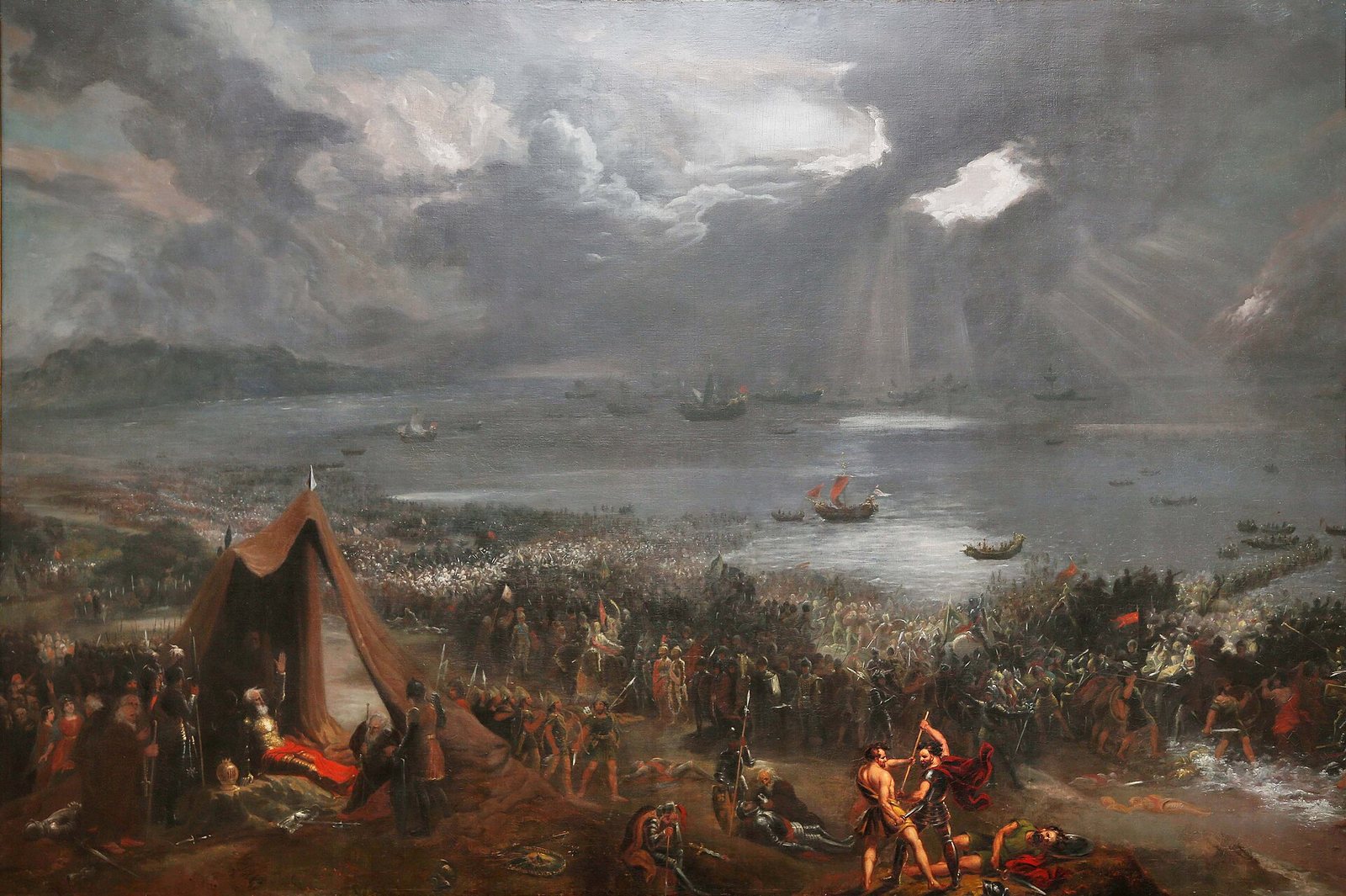
The entry for 1014 tells of a campaign by Brian and Máel Sechnaill against Áth Cliath, against Leinstermen and Dubliners, with a similar number of Scandinavians from overseas. Irishmen stand on both sides. Brian falls, as does his son Murchad, and on the other side Máel Mórda, king of Leinster. For the place-name Clontarf and the formula of a war of liberation you must look elsewhere. Our article on the Battle of Clontarf has the details. Already in 980, after Máel Sechnaill’s victory at Tara, the annalist writes that the power of the foreigners has been driven out of Ireland. Dublin carried on regardless, after 902, after 980 and after 1014.
A teaching list from Cambridge’s Department of Anglo-Saxon, Norse and Celtic gives 56 Middle Irish loanwords from Old Norse. Many belong to the sea: bát from bátr (boat), accaire from akkeri (anchor), stiúir from stýri (rudder), cnairr from knörr (ship). Others come from trade and rule: pinginn from penningr, punt from pund, íarla from jarl.
How many there are depends on the count. In a 2014 Lund thesis Robert Farren arrives at 67 probable direct loans in modern Irish, against the usual figure of under 50, and denies that most concern seafaring. A loanword proves contact, not how many people spoke both languages.
Place-names give a similar picture. Fellows-Jensen observes that surviving Norse names cluster on the east and south coasts on islands and headlands, which is to say on seafarers’ landmarks: Carlingford (fjord of the old hags, probably after three peaks), Wicklow, Waterford, Howth (from “head”), Lambay (lamb island), Leixlip (salmon leap). The meaning of Waterford is not certain: ram or weather. Nick Maxwell argued in History Ireland in 2020 that the usual thirty or so names badly understate the true number, as many hide inside Irish and English names. That is a recent thesis, not an accepted count.
When did the Vikings come to Ireland? The first raid recorded in the annals stands under 795, though the year varies between annals. Earlier voyages cannot be excluded, but they are not attested.
Were the Vikings in Ireland Norwegians or Danes? The annals speak of heathens, foreigners and Norsemen, as well as groups labelled fair and dark. They allow no clean sorting into modern nations, especially as mixed groups appear already in the ninth century.
What does longphort mean? Literally something like ship camp. The word denotes fortified bases by the water, but already in the ninth century Irish camps as well. Whether it marks a fixed archaeological type is disputed.
Did the Vikings found Dublin? They set up a camp in 841 beside a place that already had an Irish name. The later town grew after 917 under their kings. The details belong to the separate Dublin article.
Did the Irish raid monasteries as well? Yes, the same annals say so. Under 833, for instance, they name Feidlimid of Cashel as the attacker of Clonmacnoise and Durrow.
The Ostmen: Viking towns in Ireland
The Battle of Clontarf, 1014
The Gall-Goídil
Olaf the White
Ivar the Boneless
Vikings in Ireland, Scotland and the Isles
Slavery among the Vikings
Hack silver
Silver hoards

The Ostmen · The Battle of Clontarf 1014 · The Gall-Goídil.
All History & Finds articles →
The Vikings did not come only in summer. In the late ninth century a Danish army settled into fortified winter camps on …
Read more →The same men who raided the North Sea and the Channel also turned up off Lisbon, Seville and Algeciras, perhaps off the …
Read more →If your roots are European, you almost certainly descend from people who lived in Viking Age Scandinavia. Not because …
Read more →We remember the Vikings as raiders and coastal pirates – yet their greatest achievement was a quiet one: they crossed …
Read more →