Waterford celebrated its 1,100th birthday in 2014 and names a Viking called Ragnall as its founder. Read the annals word for word and you find only a new fleet on an estuary, with no leader and no town. The earliest firmly dated timbers I can find in the excavation reports from the town itself are about 150 years younger, a rich Viking site lies a few kilometres upriver, and the famous round tower on the quay dates from after the Vikings. This article sets the evidence side by side, from the annals of 914 to 918 to a brooch lost in a pit around 1100.
Under the year 914 the Annals of Ulster, the key Irish year-by-year chronicle of the period, carry one short sentence: a great new fleet of the heathens on Loch dá Chaech. That was the estuary of the Suir and Barrow, today's Waterford Harbour. The entry just before it reports a sea battle off Man in which "Ragnall grandson of Ímar" destroyed one Barid son of Oitir. The two notes sit side by side, and nothing connects them. Neither mentions a town, a founding or a founder.
The formula "Ragnall founded Waterford in 914" is therefore an inference from several entries. The written sources speak of fleets and warriors, the ground speaks of houses and streets, and a century and a half lies between them.
The wider story of the Norse in Ireland is told in our article on the Ostmen of Dublin, Waterford and Limerick.
Waterford is one of the few Irish cities whose English name comes straight from Old Norse. It has nothing to do with water or a ford, despite the sound. The form scholars give is Veðrafjǫrðr, and its second half is clear enough: fjord. The first half is disputed. Old Norse veðr can mean a ram or wether, and it can also mean weather. Hence "ram fjord" or "wether fjord" and "weather fjord", which some take as a windy place and others as a harbour sheltered from storms. This cannot be settled with certainty.
The Irish name Port Láirge is usually read as "Lárag's port". Nobody knows who Lárag was, and a rival explanation sees the river bend as shaped like a thigh (Irish lárag).
For 914: the new fleet on Loch dá Chaech. For 915: a great and frequent increase in the heathens arriving there, with the laity and clergy of Mumu, or Munster, plundered. For 917: Sitriuc, grandson of Ímar, lands with his fleet at Cenn Fuait in Leinster, while Ragnall, also grandson of Ímar, "with his second fleet moved against the foreigners of Loch dá Chaech". That is the wording of the English translation in the Mac Airt and Mac Niocaill edition; I have not checked the Irish myself. The same year Ragnall, now "king of the dark foreigners", brings reinforcements to his people in Munster against the Irish king Niall son of Aed.
For 918 comes the sentence that makes the link: "The foreigners of Loch dá Chaech, i.e. Ragnall, king of the dark foreigners, and the two jarls, Oitir and Gragabai" leave Ireland and move against the men of Scotland. They fight on the bank of the Tyne, and Oitir and Gragabai fall.
So by 918 at the latest Ragnall belongs firmly with the people on the estuary, and in 917 he appears there with a fleet. The Ulster entry on the fleet of 914 does not name him. It is often said that he led that fleet from the start, but I did not find this in the wording of the Annals of Ulster. I have not checked other annals on this. According to English Wikipedia, the later propaganda tract Cogad Gáedel re Gallaib shows Ottir and Ragnall together with a base at Waterford Harbour; I have not read the text.
What happens in 918 is just as striking: the leading men leave. Ragnall then established himself at York, and the Annals of Ulster report his death under 921, calling him king of the fair and the dark foreigners. On this evidence the supposed founder spent a few years at most on the Suir. His ancestry is thin too. The annals never name his father, and the popular phrase "grandson of Ivar the Boneless" assumes that the Irish Ímar and the Ivar of the sagas are the same person.
Until 2003 archaeology knew no early Viking material from the city of Waterford. Then came the bypass. Testing along the route began in 2002, and in spring 2003 archaeologists cut 29 test trenches in two fields and hit about 600 features under the topsoil. A geophysical survey in July 2003 showed the outline of an enclosure on the south bank of the Suir, in the townland of Woodstown. Its position is given in different ways: Richard O'Brien and Ian Russell say about 6 kilometres south-west of the city in their preliminary report, while the Irish Times says about 9 kilometres upstream.
The core is a C-shaped enclosure, about 200 metres long and 100 wide, with a ditch about 2.5 metres wide and as deep, and an internal bank. Features run for about 500 metres along the river. According to press reports the site covers some 4.5 hectares, of which only about 5 per cent has been excavated.
The finds speak of trade and craft. Of more than 5,300 items, 208 belong to a class that stands out at once: lead weights for balance scales, clustering at about 11 and 22 grams. Add about 30 pieces of hacked silver (the preliminary report counts 36 pieces of silver), one complete ingot of 22 grams, molten silver debris and a fragment of a Kufic coin from the Arab world (Ryan's review gives two coins, southern Iraq about 740 and Samarkand early 10th century). Someone here was weighing and melting silver: the economy of hacksilver. For comparison, the preliminary report gives fewer than ten lead weights from late Viking Waterford.
About 22 metres outside the ditch lay a warrior grave, probably under a low cairn. The acidic soil had dissolved the skeleton. What remained was a broken sword, shield boss, spearhead, battle axe, ring pin and a perforated whetstone. The sword hilt gives only a rough date, from the mid-9th to the mid-11th century.
A caveat: 89 per cent of the finds come from topsoil, the layer churned by ploughing. Siobhán McNamara, who presented the finds, says explicitly that for many pieces one cannot tell whether they are Viking or Irish. These figures come from the 2004 reports. I have not read the 2014 monograph by Ian Russell and Maurice Hurley.
This is where the usual story of Waterford's "forerunner" gets difficult. The enclosure is older than the Vikings: a charcoal-rich layer in the ditch gave radiocarbon dates from the early 5th to the mid-6th century, and a furnace dates to the early 5th to early 7th century. Glass, amber and ivory beads belong to these early phases, not to the Norse. In the view of O'Brien and Russell the Vikings refortified an existing Irish site, probably after 850. Some objects, such as a possible book clasp and mounts from house shrines, led McNamara to ask whether a monastery stood here earlier or whether this was loot and tribute. She herself calls the idea speculative.
On the end, the statements conflict. The 2004 report, using the radiocarbon dates then available, gives abandonment around the mid-11th century, which would mean a long overlap with the town. Later statements put it much earlier: James Eogan wrote in the Irish Times in 2014 of abandonment by the early 10th century at the latest, Michael Ryan's 2015 review of the monograph summarises occupation as the later 9th and earlier 10th centuries, and the site's conservation plan gives 850 to 950. Follow-up work in 2007 also found a building of the 9th to 10th century which Ian Russell reads as a workshop rather than a dwelling, with crucibles and traces of glass working.
O'Brien and Russell left the question open at the time. Did the people of Woodstown move to the later town site, or did the fleets of the early 10th century trigger the town's founding and Woodstown's decline? They recommended looking for 9th-century traces around Reginald's Tower. Ryan now writes that Woodstown was occupied when a substantial settlement around the tower began to thrive. I found no 9th-century excavation evidence from the town in the reports available to me.
The Irish word longphort in the annals of the 9th century refers to a permanent Norse camp. Woodstown is often called one. James Eogan, senior archaeologist at the Irish roads authority, counted it among them in the Irish Times in 2014, and the Viking Ship Museum in Roskilde has a piece under that title. The 2004 preliminary report, by contrast, does not use the word for Woodstown at all and speaks cautiously of a Viking occupation that refortified an older enclosure.
The equation is therefore an interpretation. More on how such sites were built can be found in our article on Viking camps.
The roads authority chose another route in January 2005, and the minister ordered the site protected in May 2005.
The city authority renewed a run-down central quarter and had it excavated first. Between 1986 and 1992 the team around city archaeologist Maurice Hurley and Orla Scully opened about 6,000 square metres, according to the Irish Times, almost a fifth of the old Viking town. Some 3,000 square metres at Arundel Square were dug section by section in 1990 while the shopping centre and underground car park moved in behind them.
The results appeared in 1997 in a volume of 935 pages, edited by Hurley, Scully and Sarah McCutcheon. Its title, Late Viking Age and Medieval Waterford, is carefully chosen. I could not consult the volume itself. What follows comes from the excavators' short reports in the Irish database Excavations.ie, written during the work and provisional.
On Peter Street and Olaf Street the team uncovered, in 1988, the remains of 18 houses on seven properties. Floors were usually trampled clay with a central hearth, and walls were of wattle or staves. Two years later Arundel Square added full ground plans of the 11th and 12th centuries: three-aisled houses along the street, smaller ones behind, with paths and property boundaries between them. The earliest levels of Peter Street had a well-paved surface linked to 11th-century structures.
Alongside these stands a striking local form: buildings sunk partly into the ground. One on Peter Street was dug about 1.5 metres into the subsoil, with walls of vertical ash staves and an entrance through a corridor lined with stone. A timber from its door jamb was dated by dendrochronology, the study of tree rings, at Queen's University Belfast to about 1083. More such buildings lay on Olaf Street, one with stone steps. The short report does not say what they were for.
At Bakehouse Lane the excavators cut through the town defences. The ditch was up to 3 metres deep and 8 wide, with a bank up to 6 metres wide behind it, faced by a stone wall 1.8 metres wide and surviving up to 1.5 metres high. Timbers from the base of the ditch gave dates around 1070 to 1080. This is the hardest fixed point for the Viking-age town: by then at the latest it was worth such effort to enclose a defined area. Whether the stone wall is as old as the ditch timbers is not clear from the short report. The ditch was filled in during the 12th century.
This date changes how the town's history reads. In the reports I have read, everything urban-looking in Waterford comes after the battle of Clontarf in 1014, which popular accounts treat as the end of the Vikings in Ireland. That does not mean nothing existed earlier. It means the town becomes archaeologically tangible precisely in the following decades.
The Church provides the written counterpart. In 1096 the town became a bishopric, and its first bishop Malchus, in Irish Máel Ísu Ua hAinmere, formerly a monk of Winchester, was consecrated in late December 1096 by Anselm, Archbishop of Canterbury. English Wikipedia gives the 27th, a Waterford Treasures text the 28th.
The most famous single object from the excavation came from a pit on Peter Street. The Waterford Kite Brooch takes its name from its shape, measuring just 39 by 27 millimetres and weighing 20.6 grams. It is hollow-cast in silver, decorated with gold filigree, impressed gold foil and niello, a black metal-sulphide inlay, with studs of amethyst-coloured glass. The hinge and part of the pin survive.
Its date is given with varying precision: around 1100 in the museum text, around 1090 in the notes on its 2014 postage stamp and from Éamonn McEneaney on local radio. The find context does not allow a date to the year. The museum calls it the finest of thirteen brooches of this shape found in Ireland and the finest secular metalwork of the early 12th century in the country. That is the verdict of the institution displaying it.
The classification is more interesting. It is not a "Viking brooch" in the narrow sense. The museum sees native Irish tradition with English, continental and Scandinavian influences, and points to St Patrick's bell shrine and the Lismore crozier group. According to the museum, the Virgin in the Book of Kells wears the same shape. Who commissioned it is unknown, though probably a layperson. It shows the taste of an urban population that can no longer be neatly sorted into Norse or Irish. For Scandinavian forms, see our article on Viking jewellery.
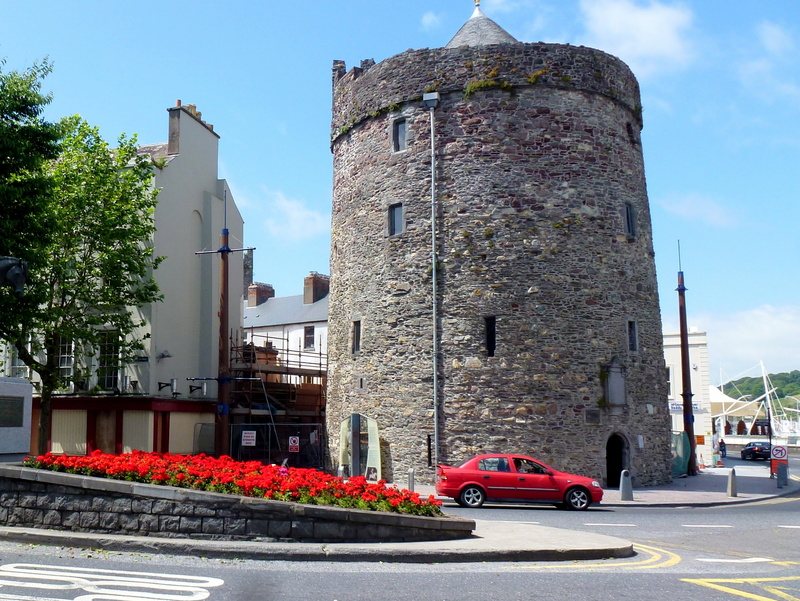
On the quay stands the round tower that appears in every photograph of Waterford and today houses the Viking museum. On all the evidence, the Vikings did not build it.
The decisive source is Ben Murtagh's excavation inside the tower in 1997. His short report assigns the lower two storeys to about 1200 and the upper part to the late Middle Ages, and it distinguishes ten phases up to the 20th century. It lists no building remains from before 1200.
Other statements differ. A date of 1253 to 1280 proposed by J. S. Carroll in 1984 is known to me only through English Wikipedia, and the museum gives the same span without a reference. The Ask About Ireland portal says broadly 13th to 15th century. So the figures vary, but all of them lead to the period after the conquest of 1170.
And the name? Giraldus Cambrensis speaks of a "Reginald's tower" for 1170. So there was a predecessor, but whether it stood on the same spot is not secure. The museum itself suspects a first tower somewhat further from the river. Which Ragnall the name refers to is also open. Several rulers of that name are possible, the grandson of Ímar of the early 10th century as well as Ragnall Mac Gilla Muire, captured in 1170.
According to the museum it later served as a mint from 1463 to 1483, as a position against Perkin Warbeck in 1495 and as a house of correction from 1819 to 1861. It opened as a museum in 1954, or 1955 according to Murtagh's report.
We know the town's fall mainly from Giraldus Cambrensis, Gerald of Wales, whose Expugnatio Hibernica is written from the conquerors' side. An advance party under Raymond le Gros had, says Gerald, set out about 1 May and dug in at Dundunolf, usually identified with Baginbun. Richard de Clare, known as Strongbow, landed according to Gerald on 23 August 1170, the eve of St Bartholomew, with about 1,200 men. The attack was beaten back twice. Then Raymond noticed a small timber house hanging on a post outside the wall. He sent armed men to cut down the post, and the house fell and took a great piece of wall with it. The attackers broke in and slaughtered the townspeople in the streets.
"The two Sytaracs being taken in the tower called Reginald's tower, were put to the sword, but Reginald and Machlachelin of Ophelan, being also taken prisoners in the same place, their lives were spared through the intervention of Dermitius […]"Giraldus Cambrensis, Expugnatio Hibernica I.16, public-domain English translation by Thomas Forester (Bohn's Antiquarian Library, ed. Thomas Wright)
The Dermitius of the quotation is Diarmait Mac Murchada, the exiled king of Leinster who had brought the Normans into the country. While still in the town he gave Strongbow his daughter Eva, in Irish Aoife, in marriage, as their treaty had provided. The army then moved on to Dublin, as told in the Ostmen article.
The sources disagree about the fate of the captured Ragnall, and that is typical of the whole tradition. Gerald lets him live. Roger of Howden has him submit later to Henry II. In an inquiry of 1311, however, jurors stated that the English had hanged him and some of his followers. I know these three versions only from the summary in the English Wikipedia article, not from the texts themselves. The present museum text also differs: citing Gerald, it says Strongbow imprisoned King Sitric and his son in the tower, whereas Gerald's text in Forester's translation has two men named Sytarac put to the sword and does not speak of father and son.
When was Waterford founded? 914 is the usual date, and the city marked its anniversary on that basis in 2014. It rests on an annal note about a fleet. The earliest firmly dated timbers I found in the excavation reports are from the 1070s.
Did the Vikings build Reginald's Tower? Not the present tower, on the excavation evidence. Its lower storeys date to around 1200. Giraldus Cambrensis mentions an earlier tower of that name for 1170.
What is Woodstown? A site on the Suir a few kilometres upriver from the city, discovered in 2003 during work on the bypass. The Norse refortified an older Irish enclosure there, used roughly 850 to 950 on recent statements, and the road route was moved.
What does Veðrafjörðr mean? The second part means fjord. The first may mean ram or wether, perhaps weather. It cannot be settled with certainty.
Where can I see the Kite Brooch? Heritage Ireland, the state heritage site, lists a kite brooch among the pieces in Reginald's Tower, the older museum text names the Waterford Museum of Treasures. Ask before visiting.
The Ostmen of Dublin, Waterford and Limerick, Clontarf 1014, Jorvik and the Viking kingdom of York, Ivar the Boneless, Viking camps, Hacksilver, Viking jewellery, The Isle of Man.

Vikings in Ireland: two centuries of raids, alliances and towns · Viking Dublin: how a ship camp at the Black Pool became a town · The Ostmen · The Battle of Clontarf 1014 · The Vikings in Ireland, Scotland & the Isles.
All History & Finds articles →
Two early medieval peoples called themselves Croats — one on the Adriatic coast, one deep inland between the Vistula …
Read more →Westphalia is a regional name everyone knows and a tribal name hardly anyone can explain. The Westphalians, Latin …
Read more →"Visigoths" sounds like a people that crossed the Danube in 376 and perished in Spain 335 years later. The sources tell …
Read more →A name that outlasted three decades of war: Widukind was the most famous leader of Saxon resistance against …
Read more →