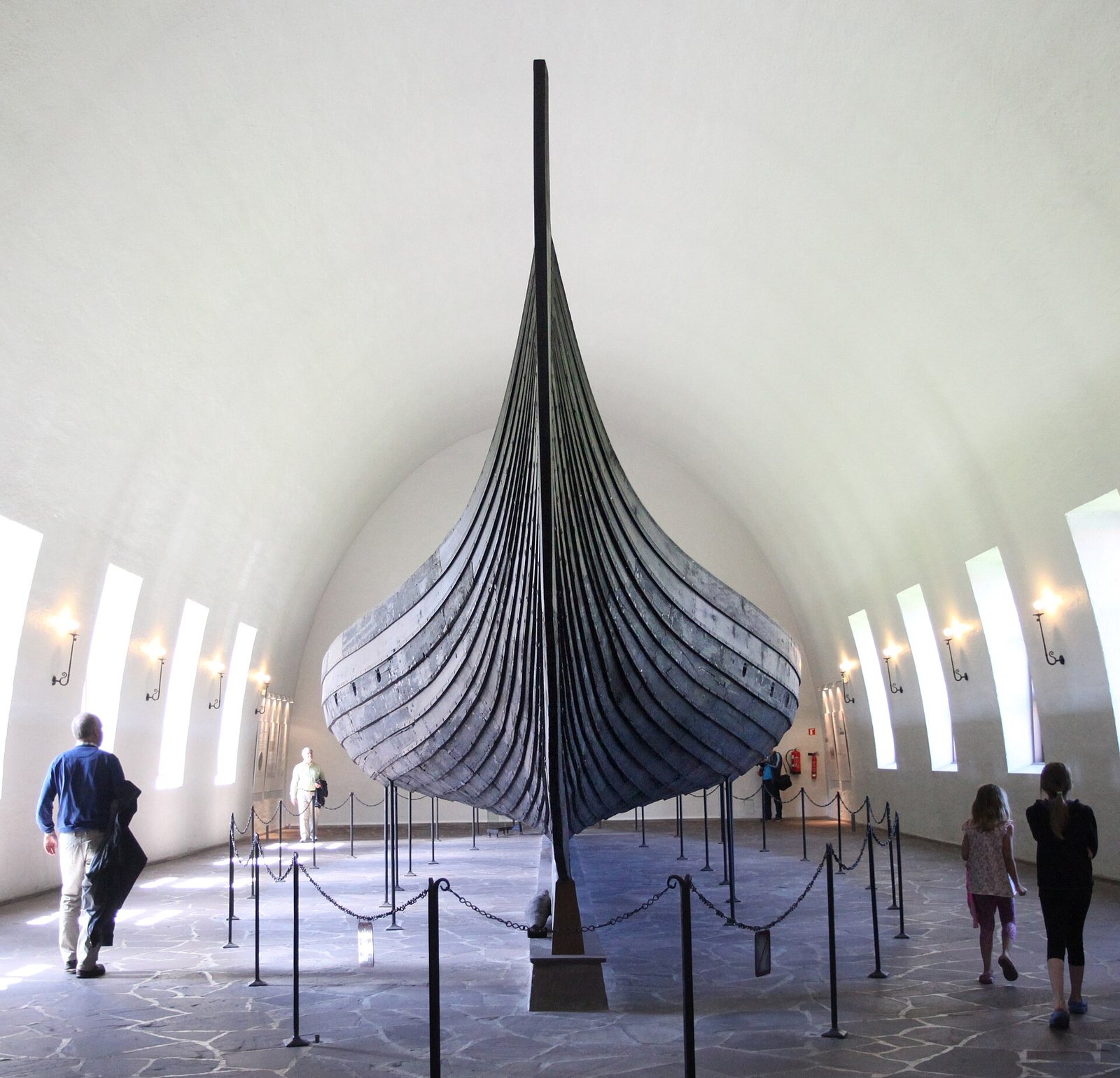
In autumn 2018 a radar image from beneath a field near Halden showed the outline of a ship. Three years later the first excavation of a Norwegian ship burial in over a century had finished, and it looked nothing like Oseberg or Gokstad. The wood had almost vanished, the hull survives as an imprint in the soil, and some 1,400 corroded rivets have to become a ship again inside a computer. This article follows how a drainage application turned into a research project, sets the competing dates side by side, asks what was really found next to Jellhaugen, and marks where specialists still give only provisional answers.
It began with paperwork rather than a research question. In 2017 the farmer at Gjellestad applied to improve the drainage of his field. The farm lies on Viksletta, a lowland near Halden in south-east Norway, and the field borders one of the country's largest burial mounds. So the regional heritage authority, Østfold County, had to find out what lay in the ground, ideally without digging.
That brought in the Norwegian Institute for Cultural Heritage Research (NIKU) with a motorised ground-penetrating radar. The device sends radar waves into the soil and records what bounces back, so ditches, pits and stone layers appear as patterns in a data image before anyone lifts a spade. Surveys took place in April and August 2018 and in January 2019. In autumn 2018 the news travelled worldwide.
A local tradition, recorded for the 1950s, held that a “King Jell” lay buried with his ship inside the great mound. It proves nothing, since it names the wrong mound and its age cannot be established. There is also a hint from the nineteenth century: when mounds were removed from the Gjellestad field, a small boat and skeletal remains were reportedly found. That material is lost. Whether it has anything to do with the big ship cannot be clearly established.
The first publication appeared in Antiquity in 2020, by Gustavsen, Per Erik Gjesvold, Sigrid Mannsåker Gundersen, Alois Hinterleitner, Nau and Knut Paasche. It lists the ship as M13: an elliptical anomaly about 19 metres long and 5 metres wide, at a depth of roughly 0.3 to 1.4 metres. Within it runs a linear trace of about 9 metres, possibly the keel. They extrapolated an original length of around 22 metres.
The survey also recorded ten small mound remains and two large ones of about 28 and 30 metres. With the ship that makes 13 mounds, not 13 in addition to the ship, as some reports had it. Then there are longhouse plans, among them H3, 38 metres long and about 7 wide, which the authors interpret as a hall.
A radar image delivers only shapes, though, neither a construction date nor the condition of the wood. That is why Riksantikvaren, the national heritage directorate, funded a verification project in 2019.
To understand the site, start with the mound next door. Jellhaugen is regarded as the second-largest burial mound in Scandinavia; in eastern Norway only Raknehaugen in Romerike is larger. Its dimensions vary by source. Store norske leksikon gives about 85 by 70 metres at the base and some 9 metres in height, the 2024 research volume about 80 metres across and 13 metres high. There is a concrete reason for that: in 1989 the mound was heavily reshaped with a bulldozer, and what it looked like in the Iron Age is hard to say.
Only the investigations of 1968 and 1969 showed that people had built it, around a rock outcrop. At the bottom lay a cairn with charcoal, which Store norske leksikon describes as a simple cremation burial. A radiocarbon sample from it falls, depending on the source, between 426 and 598 or between 330 and 660 AD. That is coarse but enough for one clear statement: the core of the mound is markedly older than the ship. It does not prove the place was in continuous use.
Why would people around 800 bury a ship exactly here? The Antiquity authors suggest the builders were tying themselves to an existing power structure. Knut Paasche reads ship mounds in general as political messages, a language expressing power over a landscape. That is interpretation: no inscription or text states this motive for Gjellestad.
The 2019 test fell to the Museum of Cultural History at the University of Oslo under Christian Løchsen Rødsrud, which kept a dig diary. On 26 August the ploughsoil came off in ten-centimetre layers and was sieved. A day later two rows of ship rivets appeared less than 30 centimetres below the surface, with no trace of wood.
On 29 August plank impressions became visible, too soft to lift. On 2 September spade marks confirmed a robbers' pit. On 5 September came the keel, well preserved according to the diary. The visible 25 centimetres measured about 4.5 centimetres wide and 11 deep, far narrower than on other Viking ships. Samples were taken, and the trenches were packed with clay to make them airtight again.
Wood survives in the ground mainly where oxygen cannot reach it. Oseberg and Gokstad owe their condition to dense packing in clay and turf. At Gjellestad several modern interventions compounded one another. In the nineteenth century, according to written hints in the 1870s, mounds were removed from the field, apparently including the one over the ship; decades of ploughing sliced off bow, stern and upper strakes. In the 1950s or 1960s, sources differ here, a drainage ditch was cut across the ship. It split the remains in two, lowered the groundwater and let air in. National Geographic adds hotter, drier weather as a factor.
The results of the samples came in January 2020. The museum put it bluntly: the fungal attack would eat inward year after year. Museum texts speak of fungi, while the introduction to the 2024 research volume refers to “soft rot bacteria”. In wood science soft rot is normally attributed to fungi. I could not find the precisely identified organism in the texts available to me.
That overturned the first decision: in 2018 the plan had been to leave the ship in the ground. In May 2020 the government pledged about 1.5 million US dollars, subject to parliament.
Minister Sveinung Rotevatn broke ground on 26 June 2020 and work started on 29 June. The plan allowed about five months: first sieving the topsoil, then, under a tent, the southern bow section, and last the stern and presumed burial chamber amidships.
It took much longer. Fieldwork ended only in autumn 2021, and in October the imprint was covered, first with perforated plastic and fibre cloth, then sand. In spring 2022 the spot received a low mound planted with grass and flowers. That probably explains the label “excavation 2020 to 2022”: the research volume dates the dig itself to 2020–21, restoring the surface ran into 2022, and in 2022 and 2023 a further project surveyed the surroundings.
What remained sounds like little. Planks once about 2.5 centimetres thick are now 1 to 2 millimetres, compressed by many tonnes of earth. Impressions of the lowest eight or nine strakes were visible. Rødsrud put it simply: the ship could not be lifted. So the team turned to the rivets, the iron fastenings that hold overlapping planks together in clinker construction (more in our article on Viking shipbuilding).
Figures for their number differ, from over 1,300 at Science Norway through almost 1,400 at the museum to over 1,500 in the trade magazine Teknisk Ukeblad (2025). The rivets are so poorly preserved that they would fall apart if picked out. So each was measured and lifted with its block of soil.
In the lab the blocks are repeatedly soaked in tetraethyl orthosilicate, which reacts with moisture to form silica and turns them almost as hard as stone. Archaeologist Justin Kimball then scans them by CT, several hours each. In 2023 the team averaged around nine rivets a day; Rødsrud told National Geographic the puzzle would be “like Tetris”. The keel meanwhile sits in polyethylene glycol (PEG), a waxy substance that replaces the water in wood cells. In 2023 Rødsrud expected a complete digital model within a year; the December 2025 report still mentions no finished model.
Only the starting point is firm: the keel timber was felled after 732. Dendrochronology, dating by tree rings, gives an exact felling year only if the outer wood under the bark survives. Here it does not, so all that remains is a minimum date. The museum first derived a burial between the late eighth and early tenth centuries.
Research has since narrowed that by different routes without reaching a single year:
These figures do not exclude one another, but they measure different things: the felling of a tree, the building of a ship, the burial. A ship can sail for years or decades before going underground. Gjellestad belongs to the early Viking Age, close to Oseberg, whose burial tree rings date to 834, and before the Gokstad burial at the end of the ninth century. Whether it predates Oseberg stays open; Bandlien considers it possible that it belongs to the second generation of such rulers' graves in southern Norway. The published record gives no more. I know of no final peer-reviewed publication of the excavation itself.
According to Paasche the surviving hull measures about 19.3 by 4 metres, other reports give just under 19.5 by 4.5. Rødsrud adds one to two metres for the ploughed-away stems, and Paasche arrives at about 20 to 21 metres. For comparison, Oseberg measured 21.5 metres, Gokstad about 23.
The keel is the interesting part, with some nine metres lifted in pieces, the longest nearly six metres, because it could fill a gap. In 2020 the Antiquity authors still considered the ship likely to have sailed, based on length and breadth. The narrow keel then fed the opposite idea: a rowing ship, built when the sail was only just establishing itself in the North. National Geographic reported in 2023 that reinforcements for a mast were lacking. Rødsrud warned that a mast cannot be ruled out until the reconstruction is complete. Jan Bill, curator at the Viking Ship Museum, offered another thought: mast and sail might have been taken out before the burial, since wool sails were precious.
Whether Gjellestad is a transitional type therefore stays open. The keel timber also reminded the team of Oseberg and Gokstad, which points to construction on Norway's west or south-west coast: likely, not proven. The reddish floor timbers, probably conifer rather than the oak of most Viking ships, might instead point to Møre or Trøndelag; they are probably unfit for tree-ring dating. For an overview, see Viking ship types.
About 8,000 finds are registered, very many of them fragments of iron or copper alloy. Reports name amber and glass beads, some with gold foil, among them a group of six white, one amber and three segmented beads, probably a bracelet or necklace; a broken whetstone, perhaps from Eidsborg in Telemark; a shard from a glass beaker; wood layers with iron fittings, probably from a chest; and remains of a comb. The two largest beads measure almost 5 centimetres, and one is said to be the largest amber bead in the museum's holdings (on the material, see amber). Another object in a soil block was still unidentified in 2021: a second large bead or a spindle whorl. Two axes are reported. Of one, unusually large and heavy, only the rust imprint remained; robbers probably took it. The other, a lump of rust under the ship, is discussed as a wedge, an offering, part of the ceremony or a robber's tool.
Then there are the animal remains: 25 horse teeth and 560 fragments from hoofed animals, horse or cattle, lay in the disturbed chamber, plus ten fragments certainly from cattle; large bones in the undisturbed area beside it are assigned to horses. The team suspects head and body were laid out separately, as at Oseberg and Gokstad (see sacred horses). There is also a bone from the tail fin of a nine-foot (about 2.7 metre) Atlantic halibut, reported by Archaeology magazine. The magazine reads it as a trace of feasting.
So who lay here? Headlines like to answer “king” or “queen”, and the honest answer is unsatisfying: it cannot be clearly established. The museum assumed only that someone of high rank was buried, possibly more than one person. According to the finds report in Science Norway (December 2021), burnt bones of an adult human lay directly outside the chamber's north wall, with the comb remains in the same area, perhaps belonging to that person. They could be a later burial, a simultaneous one, or bones from another grave that arrived with the mound material. Dating was meant to settle this; I have found no result. No unburnt bones survive from the chamber: the main burial was probably not cremated and has decayed. Teknisk Ukeblad says flatly in 2025 that the few bones found are from horse; the more specific 2021 report contradicts that. Woman or man? Weapons and jewellery help little in a robbed grave, and no sex is attested.
Perhaps the most important results come neither from wood nor metal but from the earth around them. According to reports on the soil analyses, people cleared grass and topsoil from a round area before bringing in the ship, possibly from a nearby stream. A ditch bounded the space, a ramp led to the hull, and a deposit of blue-grey clay lay at the bow. The hull rested in a hollow dug to fit it, with a timber burial chamber amidships.
Then came the mound, built of turves set like bricks. They are compressed today to layers of under an inch, yet the grass inside gives away a season: harvest time. The mound may therefore have been raised in late summer or early autumn.
Gjellestad thus suggests that a ship burial was a process over time rather than a single act; excavation archaeologist Camilla Cecilie Wenn called the site “a stage” in 2020. Neil Price of Uppsala University, not involved in the project, describes such burials as more than a static ceremony, a space where the living engaged with the dead. How long the ship stood open has not been published. National Geographic speaks of weeks or months; it remains a guess.
No written source covers any of this. The only explicit theory of the Nordic mound custom dates from the thirteenth century, by an Icelander writing four centuries later:
As to funeral rites, the earliest age is called the Age of Burning; because all the dead were consumed by fire, and over their ashes were raised standing stones. But after Frey was buried under a cairn at Upsala, many chiefs raised cairns, as commonly as stones, to the memory of their relatives.Snorri Sturluson, Heimskringla, Preface (c. 1230), tr. Samuel Laing (1844)
Snorri's tidy sequence from burning to mounds is a scholar's construction, not an archaeological finding. Gjellestad illustrates that well: an old mound with a cremation at its core stands beside a younger ship burial, and neither rules out the other. See also boat burial.
The grave was opened long before any farmer levelled it. A tunnel runs from the west side to the middle of the ship. According to Rødsrud no gold or silver is left.
When this happened has not been directly dated, as far as I can see. The Antiquity authors argue by analogy: similar intrusions into other ship burials around the Oslofjord appear to date to the mid-tenth century. Jan Bill and Aoife Daly (Antiquity 2012) link the plundering of Oseberg and Gokstad to the rule of the Danish king Harald Bluetooth over Norway. For Gjellestad that is a transfer, not an observation.
The title of the Antiquity paper calls Gjellestad a newly discovered “central place”. That technical term covers sites where political, religious and economic functions came together, such as Gudme, Uppåkra or Lejre. The media of 2020 made it an ensemble of ship, “feast hall” and “temple”; the authors are more careful. Building H2, with its few postholes, reminds them of a cult building from Uppåkra and was probably not meant for living in, but they call two separate four-post structures perhaps more probable. Radar alone cannot securely identify a cult building.
Later measurements bring an important qualification. In 2019 twenty samples from postholes and other features were radiocarbon dated. They place the largest longhouse between the fifth and second centuries BC, another around the turn of the era, and two buildings in the fifth to sixth centuries AD. The volume does not say explicitly whether the largest house is “hall” H3, and the authors urge caution because the samples mostly come from posthole fills. If it is the same building, the popular scene of a death ship beside a feast hall would need correcting: around a millennium would lie between them. At least some of the houses are far older than the ship, and the same paper says the mounds have not yet been dated. In 2021 NIKU also reported, without a date, a radar-detected longhouse of 60 by 15 metres north of the ship.
The site remains significant all the same: 67 known prehistoric burial sites on Viksletta, a rare gold pendant, probably fourth century, and from the neighbouring farm Hjelmungen weights, coins and precious metal, which Paasche links to trade and a possible harbour. But no trading site like Heimdalsjordet near Gokstad has been found, writes Bjørn Bandlien.
Bandlien's paper carries the fine title “Gjellestad – a loser in Viking-Age Viken?”. He sees one of several chieftaincies around the Oslofjord, in the border zone between Vingulmǫrk and Ranrike, probably with a local harbour and market. In the late ninth and early tenth centuries, other rulers gained more from long-distance trade and alliances with the kings of Denmark and south-west Norway. Gjellestad stayed a link to the local population. This also adjusts the picture of a solitary power in Vestfold.
The story does not end in a museum. The rest of the hull still lies at Gjellestad under sand. Science Norway described it in 2024 as butter-soft; county archaeologist Gundersen stresses that it still retains a recognisable ship shape. Rødsrud estimated at most ten years from October 2021 to secure the traces, and called that a guess. A protective building with controlled climate and a visitor centre are planned. Against that stand high costs and quick clay in the field, a soil that can suddenly lose its strength. In December 2025, Teknisk Ukeblad reports, the museum was still working with Halden and the county on a visitor centre, and Riksantikvaren was considering World Heritage inclusion. I have found nothing newer.
Where is the Gjellestad ship? On Gjellestad farm in Halden municipality, Østfold, south-east Norway, immediately beside Jellhaugen. A visitor centre is planned.
When was it excavated? Test trenches were dug in August and September 2019, and the main excavation ran from June 2020 to autumn 2021. The ground was restored in spring 2022.
Why excavate it at all if digging destroys it? Because samples from 2019 showed the remaining wood was quickly being lost to fungal or rot attack. Waiting would have meant losing the information.
Can I see the ship in a museum? There will be no ship like those in Oslo. The conserved keel and individual finds are to feature in the new Museum of the Viking Age, and the team plans a digital reconstruction from the rivet scans. Rødsrud named a full-scale reconstruction as the aim, according to Teknisk Ukeblad; whether digital or built is left open there.

The Gokstad Ship · The Oseberg ship & the two women · Boat burial – the burning ship · The longships · The People of Vestfold.
All History & Finds articles →
Exactly one line about the Golensizi survives: a name and a number in a Latin list from the 9th century. An unknown …
Read more →One entry in a short Latin list, barely a handful of words, earned the Goplans a fixed place in the early history of …
Read more →Gorm the Old is the first king of Denmark whose existence is proven by a monument of his own: in the mid-10th century …
Read more →