One entry in a short Latin list, barely a handful of words, earned the Goplans a fixed place in the early history of Poland: 400 strongholds or more, the highest number the text gives for anyone. What lies behind it, a powerful tribe, a name for something else entirely, or simply an inflated figure, is still debated. Only the entry itself is certain, along with a landscape in which water, salt and ramparts played their part.
Lake Gopło is a long, narrow glacial channel lake in Kuyavia, a landscape in central Poland between the Vistula and the Warta. Its waters drain through the Noteć (German Netze) towards the Warta and the Oder. The town of Kruszwica lies at its northern end. A small correction is due right away: placing the Goplans in "Greater Poland" is only half right. Kuyavia is a historical region of its own, bordering Greater Poland; the allocation of the Gopło area varies in the literature, and that very blurriness is part of the subject.
The name Goplans is a modern scholarly form. It derives from a single medieval name form: Glopeani. The word stands in a text known as the Bavarian Geographer, a terse list of Slavic and other peoples north of the Danube, preserved in manuscript Clm 560 of the Bavarian State Library in Munich. Its author is unknown. For many groups it states how many civitates they have. The Latin word literally means "citizenries" or "cities"; in the context of this list it usually means fortified places or settlement districts. How exactly the author understood the term, we do not know.
The form Glopeani is generally connected with Lake Gopło. That is a plausible equation, nothing more: the source says neither where the Glopeani lived nor what they knew of the lake. That scholars shaped the name "Goplans" from it is an inference from similarity of sound. Whether the people ever called themselves that remains open.
The decisive entry reads, in sense: Glopeani, in which 400 civitates or more. The Latin original has a Roman numeral, CCCC, plus the phrase "aut eo amplius". For comparison: the Lendizi get 98, the Velunzani 70, the Opolini, whose name is linked with the Opolans, get 20, and the Milzane and the Lunsizi 30 each. The Goplans stand far ahead of everyone.
Glopeani: in this territory there are 400 civitates or more.Bavarian Geographer, manuscript Clm 560; paraphrase in my own words of the Latin entry, not a verbatim quotation
That is exactly why caution is needed. A stronghold in the early Middle Ages was often a ring rampart of timber and earth that served a kin group or a cluster of hamlets as a refuge. Four hundred such works in a manageable area would be a find without parallel. Scholars therefore regard the number as exaggerated, imprecisely transmitted, or meant differently from how it reads today. The author may have counted settlements, farmsteads or administrative districts; he may also have taken figures from informants who were more likely to inflate the worth of their tribe than to shrink it. All of this is interpretation. What is certain is only that the number stands in the source.
The dating of the text is also disputed. Bernhard Bischoff, one of the foremost manuscript experts of the twentieth century, attributed it to a monk active at Reichenau between the 830s and the 850s. The Russian historian Aleksandr Nazarenko proposed the 870s instead, when Saint Methodius is believed to have stayed at Reichenau. Henryk Łowmiański in turn suspected that the list consists of two parts written at different times. Anyone who cites "the year 845", as is often read, is therefore choosing one of several possibilities.
From written source to archaeology the path is short, but the link is weak. On the shore of Gopło lies the hillfort of Mietlica, in the municipality of Kruszwica, an early medieval ring rampart of timber, earth and clay that projects into the lake from a high bank. Excavations in 1977 and 1978 recorded dwellings and working structures, animal bones from domestic and wild species, fish bones, pottery, glass fragments, spindle whorls (small weights for hand spindles), arrowheads and iron finds. Aerial photographs additionally drew attention to outer fortifications to the south and southwest. Use is dated roughly to the 9th and 10th centuries.
Polish literature therefore regards Mietlica as the most important tribal hillfort of the area and often calls it the main seat of the Goplans. That is an interpretation resting on the date and size of the site, not on a name tag. The site shows that a fortified centre existed at Gopło in the 9th century, not that it was the centre of a tribe called Goplans.
Kruszwica itself was settled earlier than its town history might suggest: traces of occupation go back to the 6th century. A large fortress complex of the 8th or 9th century has not been found there, however. The main stronghold, dated dendrochronologically, that is by reading the tree rings of the timbers used in its construction, is placed according to Polish literature only in the years 975 to 999, a figure that should be checked against the excavation publications before citing. If it is correct, the rise of Kruszwica falls clearly in the age of the early Piasts and not in the epoch of the Bavarian Geographer. The same applies to Gniezno: there the tree rings of the hillfort timbers give a felling date around 940/941. That is the time of Mieszko's immediate forebears, not that of a legendary prehistory.
Added to this is the lake's surroundings, described as economically significant: around Gopło there was salt production and there were trading places, and the Kruszwica area lay on routes where, as regional literature describes it, Byzantine, Roman and Scandinavian influences met. That should be read with care: finds of imported objects prove exchange, not a form of rule.
Here the real argument begins. The older line sees the Goplans as a tribe of their own that ruled the land around the lake in the 9th century, perhaps even over the Polans with their centre at Gniezno. Some authors link this with the tradition of Popiel and read the Piast takeover as an uprising of the Polans against Goplan overlordship. This construction is attractive but highly speculative.
The Polish historian Gerard Labuda countered that a unit with 400 strongholds does not vanish without a trace. Behind it, he reasoned, a larger federation must be hidden; in other words, Goplans and Glopeani were really the Polans or a part of them. A further argument against a distinct Goplan culture comes from place-name studies: in the name stock of Kuyavia no tangible traces of the tribal name have survived. More recent excavations moreover suggest that the settlement area around Mietlica was part of a larger tribal territory, possibly with a cult site on Lech Hill, a hypothesis advanced mainly by Polish archaeologists and marked here as such.
A third group of scholars even doubts the localization. Depending on how the tribal lists are read, the Glopeani have also been sought in Pomerelia, in Greater Poland or in Masovia. Anyone thinking of the Pomeranians, the Vistulans and the Kashubians recognizes the pattern: for almost all the western and southern Baltic peoples, tribal names drawn from a few lines of text have to be laboriously pinned to the map.
Most Poles associate Kruszwica with a legend: Popiel, a cruel ruler, is eaten by mice. It does not belong to the time of the Goplans but to the historiography of the high and late Middle Ages, and one must carefully separate who tells what.
Gallus Anonymus, author of the oldest surviving Polish chronicle, wrote in the early 12th century, some 250 to 300 years after the Bavarian Geographer. In his account Popiel rules in Gniezno. Two mysterious guests, refused a place at his feast, go instead to the peasant Piast, whose provisions multiply miraculously. Popiel is driven out, and in the tradition mice make his life miserable. Piast's son Siemowit, says Gallus, becomes ruler, followed later by Lestek, Siemomysł and Mieszko I. Kruszwica is not named by Gallus in this connection according to the usual account; that should be checked against the text itself before citing.
The murder by mice is elaborated only later. Vincent Kadłubek, Bishop of Kraków, raised the story to a gothic horror around 1200: Popiel II is said to have poisoned twenty uncles and left their bodies unburied, and from them came the mice that devoured him and his family in a high tower. The Greater Poland Chronicle (Kronika wielkopolska) of the late Middle Ages moves the event to Kruszwica and knows the Mouse Tower version; later chroniclers such as Jan Długosz in the 15th century added details, for instance a German princess as wife. The dating of Kadłubek and of the Kronika wielkopolska is secure only in broad terms; specialist literature is authoritative here.
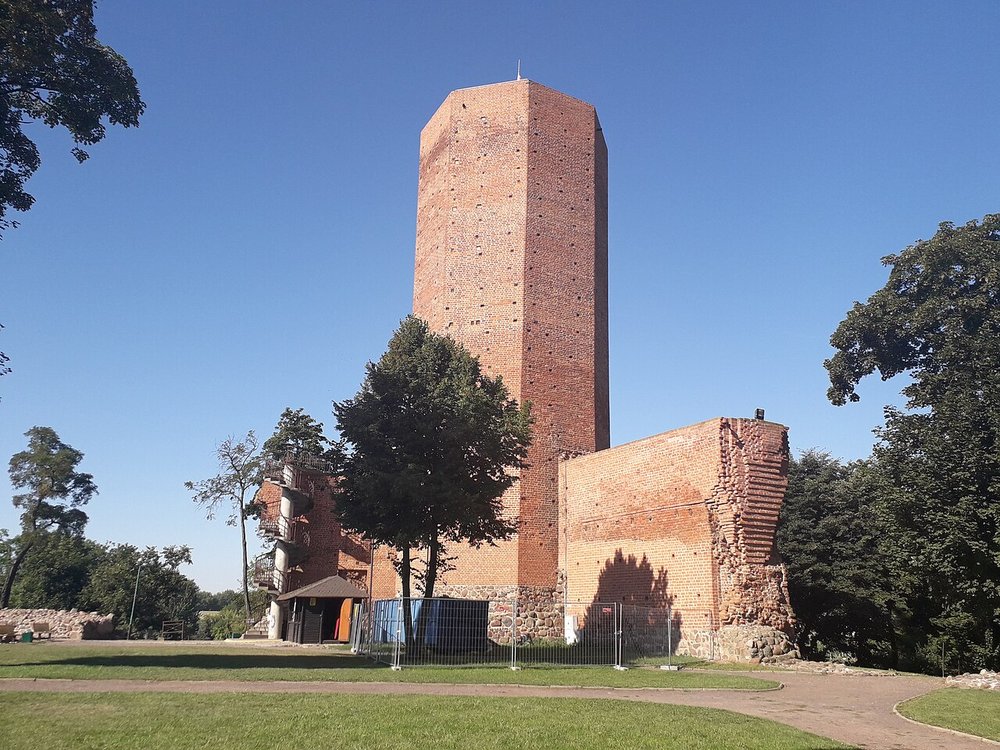
The tower one visits today in Kruszwica as the "Mouse Tower" (Mysia Wieża) has nothing to do with the legend. It is a brick structure of the 14th century, built under Casimir the Great, thus about 500 years after Popiel's supposed time. It stands on the shore of Gopło and shapes the townscape; that Popiel died there is an attribution from the age of the chronicles, not an archaeological finding.
Whether Popiel was a real figure is answered cautiously by scholarship. Some historians consider a predecessor of the Piasts possible, whose rule was co-determined by popular assemblies; others see the whole tradition as a migratory tale meant to create dynastic legitimacy. Dendrochronology does not make matters easier: Gniezno as a fortified seat of power arises, by current dating, only around 940, whereas Popiel would have had to rule in the late 9th century if the legend's chronology holds.
The link with the Goplans is thus a modern bridge: whoever settles Popiel at Lake Gopło makes him ruler of the Glopeani. The sources do not do that. It is an explanation that joins two separate traditions, the tribal list of the 9th century and the Piast legend of the 12th and 13th centuries, and it has had adherents and critics to this day.
The case shows how thin the source base for early medieval Poland is. For the period before Mieszko I, that is before the later 10th century, there is little beyond this list, scattered reports from the Frankish realm and the Piast tale written down afterwards. A tribe can look like a kingdom in a text and appear in the ground as a network of small settlements. Anyone using the name Goplans is working with a designation that comes from scholarship.
Among the West Slavic groups described on these pages, the Goplans stand beside the Sorbs, the Rani, the Lubusz and the Slensane as a name that fills the map of the 9th century but carries little narrative. That is exactly their appeal: one can name the limit of knowledge without embellishing the rest.

The Polans · The Lendians · The Pomeranians · The Vistulans · The Kashubians.
All History & Finds articles →
Somewhere a story must begin. For the kingdom of Denmark this beginning is a man named Gorm – Gorm the Old, the first …
Read more →In July 1999 a metal detector on a farm near Othem gave a signal, then flashed "overload", then switched itself off …
Read more →Few stones shaped early-medieval prestige craft the way deep-red garnet did. Sliced wafer-thin and set into golden …
Read more →