Oslo celebrated its 900th birthday in 1950 and its 1,000th in 2000. Count backwards and the two founding dates sit half a century apart. That is no slip of arithmetic but the whole problem: the saga names a king and, by later reckoning, a date around 1050; archaeology produced graves that seemed older; and the newest measurements have made those graves younger again. Meanwhile the city houses the world's most famous group of Viking ships, none of which has anything to do with the place. This article sets the evidence side by side, limits included.
In 1950 Oslo marked 900 years of existence. The basis was Snorri Sturluson, and the round figure, as John McNicol notes in the 2024 volume Det gamle Oslo 1000–1624, conveniently matched the completion of the city hall. In 2000 the same city held a millennium. This time it pointed to excavated finds and to scepticism about the medieval texts; Erik Schia had even proposed a foundation under the Danish king Harald Bluetooth in the 970s. Middelalderparken, the ruin park in the Gamlebyen district (the "Old Town"), was laid out for that anniversary, according to the city of Oslo.
Both celebrations assume that a town has a birthday. Recent scholarship doubts precisely that. Ask about Viking Age Oslo and you run into three different things that are often run together: a farm with an old name, a church with a graveyard, and a king who turned the spot into his base. This article keeps them apart. For the ruler himself, his years in Byzantium and his death in England, see the article on Harald Hardrada; the subject here is the place.
The founding notice is short and appears in passing, at the start of a war story. Harald sails from Oslo to Jutland, plunders, and gets trapped in the Limfjord. The town is merely the point of departure:
"King Harald had built a merchant town in the East at Oslo, where he often resided; for there was good supply from the extensive cultivated district wide around. There also he had a convenient station to defend the country against the Danes, or to make an attack upon Denmark, which he was in the custom of doing often, although he kept no great force on foot."Heimskringla, Saga of Harald Hardrade, chapter "King Harald's Foray in Denmark", translated by Samuel Laing (1844)
Three things stand out. The passage gives no year. The often-quoted 1048 comes, says the Store norske leksikon (the Norwegian national encyclopaedia), from the nineteenth-century historian Peter Andreas Munch, not from Snorri, and "around 1050" is a modern rounding. Second, the text speaks of a merchant town that Harald "had built". Whether that means a new foundation or the expansion of an existing place, the sentence does not say. Third, it explains the choice: supplies from the hinterland and proximity to the Danish enemy. That reads like logistics rather than urban vision.
Heimskringla was written in Iceland; McNicol places it in the 1220s, others around 1230, so some 170 years after the events. Even the attribution to Snorri Sturluson has no medieval support: according to Lena Rohrbach in the same volume it goes back to early modern editions, and the oldest manuscript remains are a single fragment from about 1260. I still write "Snorri", as most scholars do, with that caveat. For Harald's era the work leans heavily on the older compilation Morkinskinna. How much of the Oslo passage was already shaped there, I have not checked against the text.
Earlier witnesses help little. The seafarer Ohthere names Skiringssal at the end of the ninth century, not Oslo. Adam of Bremen mentions a Wig in the eleventh century, which might be Tønsberg or Oslo; that cannot be settled. In McNicol's series of sources, Oslo appears only with Orderic Vitalis around 1135, in a list of five Norwegian towns to which a correction adds Tønsberg, a good eighty years after Harald.
Norwegian scholars set out three models early on, which McNicol traces. Munch in 1847 thought of beach markets where seasonal trade gradually became permanent. Gustav Storm backed the opposing view in the late nineteenth century: kings found towns. Edvard Bull, in the history of Kristiania, expressly denied that Harald Hardrada founded Oslo and stressed the church with its fixed bishoprics instead.
More names followed. Schia, advocate of the Bluetooth thesis, read Oslo in 1991 as a Danish military base from before the year 1000. Arnved Nedkvitne and Per G. Norseng found in the same year that the material did not support a pagan long-distance trading place, and proposed Olaf Tryggvason as founder of the first St Clement's. Knut Helle thought of Olaf the Holy. Four kings, then, each with arguments, and all resting on the same graves.
St Clement's Church (Klemens- or Clemenskirken in Norwegian) is now a ruin in Middelalderparken, named after a saint associated with seafarers. Gerhard Fischer found graves under its choir in 1920. The decisive excavation was led by Ole Egil Eide in 1970–71, prompted by a planned road: in just 20 square metres beneath the ruin he uncovered, says McNicol, 143 graves in seven layers; I could not check the figure against Eide's report. Two fields differed markedly in alignment from the stone church. From this he concluded that they were older and belonged to a wooden predecessor.
Then Eide did the sums. He assumed that on average at least 15 years passed before a new burial was made in the same spot; seven layers thus gave a minimum duration. The age of the oldest graves therefore depended on when the stone church was built: 1020 to 1040 if around 1120, 980 to 1000 if around 1080. His conclusion was that Oslo must be older than Harald. These numbers took on a life of their own. Travel guides and even the history page of Oslo's public transport company still give 980 to 1030 and a "Christian community before the year 1000".
The model has a weak point. In the 2024 volume, Øystein Ekroll and Morten Stige place the stone church in the 1130s or 1140s, well after both of Eide's assumptions. Continue his own method and the oldest grave moves later. That is my reasoning, not a statement by the authors.
Radiocarbon dating (C14) measures the decay of carbon in organic material; the result then has to be converted, "calibrated", into calendar years. Eide's measurements from the early 1970s yielded values such as 960 ± 70 for a skeleton from grave 136. In 2007 Nordeide and Gulliksen had samples re-examined. The calibrated result for the same grave: 980 to 1160. Grave 145 falls between 1020 and 1210. A point near the millennium had become a span of more than a century.
Nordeide and Gulliksen conclude that little or no urban activity can be shown before the year 1000; the graveyard was probably established between 1000 and 1050, and a start as early as 1000 itself is unlikely. I know their paper only through McNicol's account. In 2019 Elise Naumann and her colleagues dated four further skeletons. The oldest span, for a woman of about 60, runs from 943 to 1024; two more begin only in 1025 and 1028, and the fourth belongs to the later Middle Ages. There is a further caveat: people who ate plenty of fish took in old carbon from the sea, which can make a skeleton look older than it is.
The 2024 volume does not fully agree with itself. McNicol concludes that Oslo arose as a dense settlement after 1000 and considers a mission station a possible beginning. Ekroll and Stige speak of graves reaching back "to the beginning of the eleventh century" yet estimate the first church at about 1000. The Store norske leksikon also says "about 1000". Petter B. Molaug writes in an abstract that the first urban remains date from the first half of the eleventh century. The differences are small, but for the question "before or after Olaf the Holy?" they decide everything. The material does not permit a date to the decade.
The graves allow a second question. Naumann's team examined 20 people from the oldest phases of the graveyard for isotopes, chemical signatures in teeth and bone that reveal diet and origin. Their paper in Archaeometry explicitly tests the common assumption that royal power called Oslo into being. The finding is striking: most grew up locally and ate a fairly steady diet from childhood to old age, quite unlike the dynamic pattern the authors associate with Viking Age populations.
The number of incomers is reported differently within the 2024 volume. McNicol has two of the 20 plus one unclear analysis; Iversen has 17 from the surrounding regions and "two or three foreigners" who probably traded. The picture holds either way, though a sample of 20 from Iversen's 998 graves at the church cannot speak for the whole population: the first inhabitants were apparently people from the neighbourhood, not settlers brought in by a king.
Frode Iversen opens his chapter "Oslo før Oslo" with the name. Oslo was first a farm at the mouth of the Alna, at the head of the bay. The element -ló means a low-lying meadow by water. Iversen explains the first element most probably from Old Norse áss, a god, giving "plain of the gods". Others also consider "meadow at the foot of a hill" possible. All that is firm is that the old explanation "mouth of the Lo" does not hold. The farm probably belonged to the old holdings of Aker, a crown estate, and lay in Vingulmark, the densely settled land on the east and north of the fjord.
On the find maps, this landscape is by no means empty. Iversen counts some ninety Viking Age finds in the so-called Osloherred, the district around the later town, a third of them secure graves. Many are swords, for example from St Mark's Church, Ullevålsveien and near the city hall. In 1844 a hoard with half a kilo of silver turned up at Teisen: seven arm rings, a bar, hacksilver and Arabic dirhams, the youngest coin from 919. The archaeologist Zanette Glørstad has put the known Viking Age graves in Oslo overall at about 60, most found around 1900 by construction workers; the figures evidently refer to differently defined areas. In 2022 a cremation grave with a shield boss, a sickle and horse tack came to light at Holmen in the west of the city, provisionally dated by a brooch to after about 850.
What is missing is a large pagan town cemetery of the kind older Scandinavian towns have. Iversen reads this as a sign that the place was Christian from the start, though he also notes a larger eighth- to tenth-century burial ground north of Gamle Aker church, which weakens the argument. Oslo was thus farmland with sword-bearers, silver and distant contacts, but no Viking trading place in the style of Kaupang. It may have been an assembly place; Iversen suspects so, but this cannot be directly shown.
The latest twist dates from spring 2026. Beneath the ruins of Oslo's royal manor, Oluf Olsen uncovered a round earthen mound and ditch in the early 1960s. It contained a small coin hoard; German and English issues dated to about 1040–1060, according to the Norwegian local history wiki. The mound was taken for a motte, a castle mound, and the coins for proof of Harald's foundation.
According to a statement from the Norwegian Institute for Cultural Heritage Research (NIKU) in April 2026, Michael Derrick and Knut Paasche see it differently. The ditch is only about half a metre deep, the mound small for a motte, and such structures are unknown in eleventh-century Scandinavia. The coins lay in a pit dug into the mound from above, so it must be older. The 2023 excavation produced 717 nails and nail fragments, among them 91 intact clinker nails of the type boatbuilders use to join overlapping planks. Olsen's diaries mention large quantities of further nails, most of them thrown away. Derrick arrives at over 1,100.
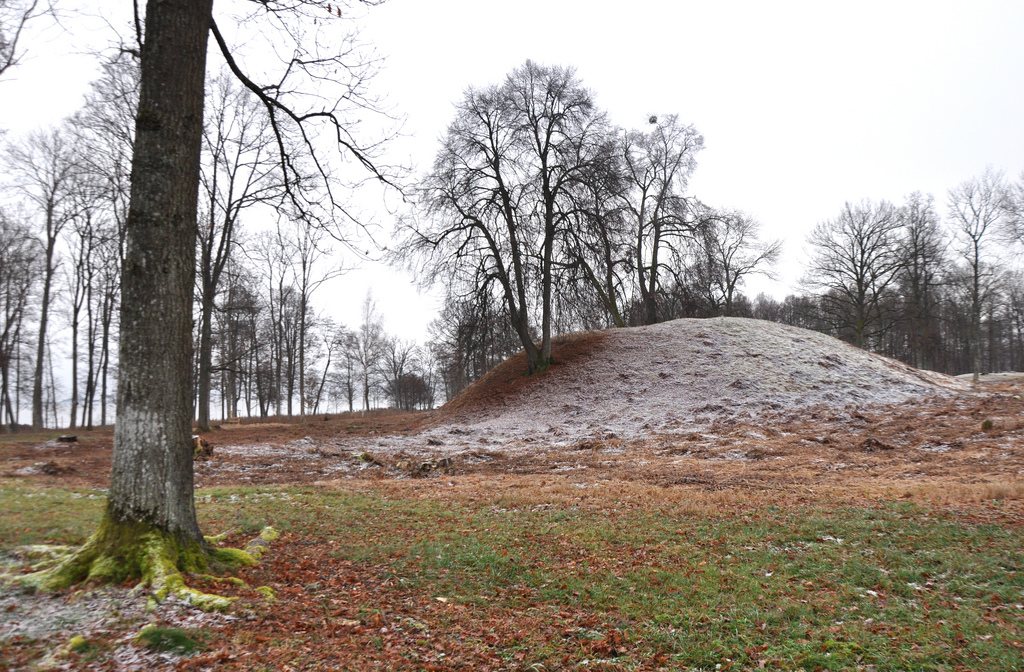
Radiocarbon dates place the mound probably at the end of the ninth or start of the tenth century. The interpretation: a boat burial under a mound about 25 metres across, on a headland, visible far out on the fjord. No bones were found, and the boat itself is inferred only from its nails. I know the finding only from the institute's statement; I could not consult the scholarly publication, and the 2024 volume still treats the question of fortification as open. If the reading is right, the royal manor sat down on the grave of an older elite. For Derrick this shows that the eleventh-century town arose where powerful people already were.
A good deal, just not a foundation. Under the stone St Mary's Church, begun only in the 1130s or 1140s, Håkon Christie found posts of an older wooden church in the 1960s. Ekroll and Stige tentatively link them to a royal manor church of Harald's around 1050 (they were never scientifically dated, and the church may be older), and date the residence on the Øra headland from his time, "perhaps longer". Ole-Albert Rønning Nordby and Hans Jacob Orning read the manor as largely a symbolic display of power, because it was not fortified, and point to signs that Harald took up Byzantine models. Their comparison of the Alna's mouth with the Golden Horn, however, is an attractive claim by Løyte (2010), not a finding. The same programme includes, as these authors put it, the first large-scale minting in the country.
Iversen shifts the founding debate with one sentence: Harald's achievement was perhaps to establish Oslo as a separate urban jurisdiction. This too cannot be proven; it is a suggestion that fits the evidence.
To see why the king sat here, look at the map. The land around the Oslofjord, called Viken ("the bay"), was contested. Already the Royal Frankish Annals report for 813 that Danish kings marched with an army to Westarfolda, an outlying region of their realm whose princes and people refused to submit. That is, as the article on Vestfold explains, the western shore of the fjord. In the 970s and 980s, according to Iversen, Danish kings again controlled the region, with Harald Bluetooth at their head. A base at the head of the fjord, as the saga describes it, thus lay in a zone with a long tradition of Danish rule.
The comparison with the west side teaches something else. Vestfold has the great ship graves and, in Kaupang, an early urban site permanently settled from about 800 to 930, and so long abandoned when the graveyard at Oslo began. I know of no direct line from Vestfold to Oslo. Iversen treats the two as neighbours, and Kaupang does not appear in his chapter at all. The idea that the centre "migrated" from the outer to the inner fjord is a modern shortcut as well: Tønsberg in Vestfold also appears in Orderic, by correction. On the bishopric the sources differ: the Store norske leksikon makes Oslo a see already under Olaf Kyrre, while Iversen reckons with a move from Tønsberg to Oslo only in the early twelfth century.
This explains the most common confusion. Say "Vikings in Oslo" today and people think of Bygdøy, the peninsula west of the centre. Yet none of the three great ships was found there or in the city. The Tune ship was dug up in 1867 on Rolvsøy near Fredrikstad, on the east side of the fjord in Østfold. The Gokstad ship followed in 1880 at Sandar near Sandefjord, and the Oseberg ship in 1904 at Slagen near Tønsberg (discovered 1903), both in Vestfold. According to the Store norske leksikon, Oseberg was buried around 834, Gokstad is about 50 years younger, and Tune dates from about 910.
They ended up in the capital for institutional reasons: the university took charge of the finds, and at first they stood in a wooden building in the university garden in Kristiania. The house on Bygdøy by Arnstein Arneberg, the outcome of a 1914 competition, opened in 1926 with the Oseberg wing; Gokstad and Tune followed in 1932. A side note: in the Viking Age, says Iversen, the sea stood four to five metres higher and Bygdøy was an island. The ships rest on land that was surrounded by water when they were built, a long way from their graves.
Oslo's own boat grave, if that is what it was, survives differently: as nails in the soil. In Østfold, a NIKU team made the Gjellestad ship visible with ground-penetrating radar, likewise with no surviving mound above ground.
The Viking Ship Museum (Vikingskipshuset) has been closed for rebuilding since 2021. It is becoming the University of Oslo's Museum of the Viking Age (Vikingtidsmuseet). The ships moved into the new extension: Oseberg in September 2025, and last the Tune ship in February 2026, on the longest route, according to the engineering magazine Teknisk Ukeblad. Opening is planned for November 2027; a museum presentation from January 2026 says "late 2027" and jokes about 2028.
To see early Oslo itself, head for Gamlebyen. In the area of the medieval town lie the ruins of St Clement's, St Mary's and the royal manor, while Minneparken and the area around Oslo ladegård add St Hallvard's Cathedral and the bishop's seat. What is visible, though, is the stone building of the high Middle Ages, not the timber phases of 1000 or 1050. After the fire of 1624 Christian IV had the town rebuilt across the bay by Akershus, and the old one largely became farmland.
When was Oslo founded? No founding date can be proven. The graveyard at St Clement's probably began in the early eleventh century, Snorri names Harald Hardrada without a year, and 1048 is a modern calculation.
Were there Vikings in Oslo? Yes, in the sense that Viking Age people lived and were buried around the Oslo farm. A town of that period has not so far been shown there.
Where do the ships on Bygdøy come from? Oseberg from Slagen and Gokstad from Sandar in Vestfold, Tune from Rolvsøy in Østfold. None was found in Oslo.
Can I see the ships at the moment? No. The building has been closed since 2021, and the new museum is planned to open in November 2027. That date may shift.
What was found under the royal manor? A round mound with over 1,100 nails and dates around 900. NIKU reads it as a boat grave; human remains are missing, and I could not yet check the scholarly publication.
Harald Hardrada · Vestfold · Kaupang · Oseberg · The Gokstad ship · The Gjellestad ship · Boat burial · Snorri Sturluson

The People of Vestfold · Harald Hardrada · Kaupang · The Gokstad Ship · The Oseberg ship & the two women.
All History & Finds articles →
When we picture Vikings, we usually see longships off English monastery coasts and sails over the North Sea. But an …
Read more →If you know the Viking Age only as a string of raids on monastery coasts, you have not seen the Baltic. Between …
Read more →On screen, nearly every Viking wears leather, studs and fur. In the museum, the entire age offers one nearly complete …
Read more →Swords and axes get the glory, yet the most common piece of kit in the North was round, wooden and surprisingly thin …
Read more →