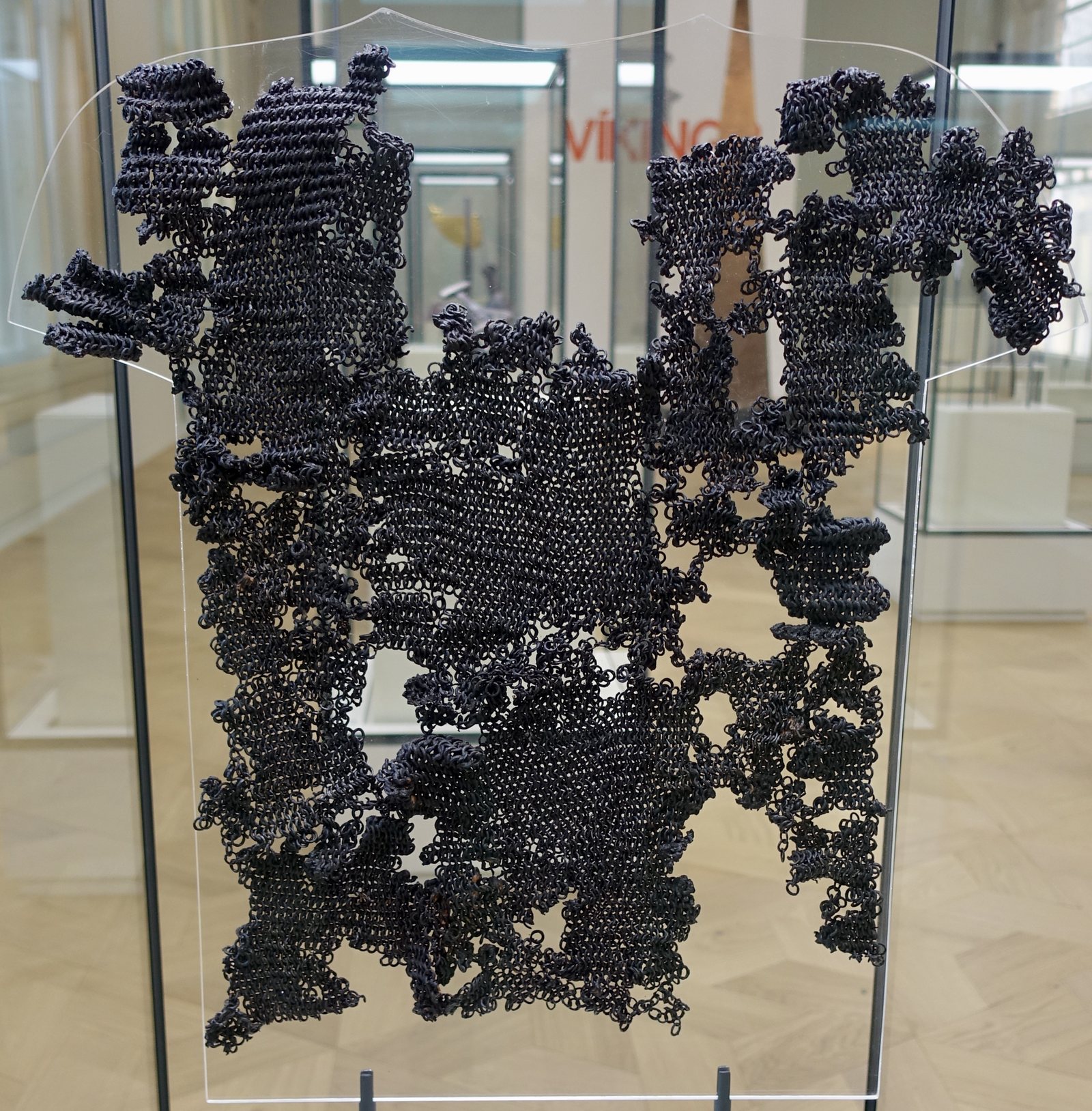
On screen, nearly every Viking wears leather, studs and fur. In the museum, the entire age offers one nearly complete mail shirt. Between those two pictures sits a question that can be answered: who wore what? This article sorts the equipment by people rather than by object. It sets three witnesses side by side – the ground, the law and the story – and shows where they agree and where they part. What emerges is sober: shield and everyday clothes for the many, helmet and byrnie for the few, lamellar as a special case, and a leather cuirass for which the evidence is missing.
Ask about “Viking armour” and most people expect a list of kit. The individual pieces have their own articles here: the mail shirt and its technique, the helmets and their catalogue of finds, the Gjermundbu helmet as a case of its own. This text asks something else. How was protection distributed, and how much did a man carry on his body according to rank, wealth and origin?
Three kinds of witness can help, and each has its own flaw. The ground shows what went into a grave or got lost, not what was in use. Legal texts show what someone ought to own, not what he had, and the Norwegian ones were written down after the Viking Age. Sagas and chronicles speak vividly of byrnies and helmets, but the key voice, Snorri Sturluson, wrote in the 13th century, about two hundred years after the events that matter here. A claim stands best where at least two of these witnesses say the same thing independently.
Denmark’s Nationalmuseet puts it briefly. One helmet survives from the Viking Age, from a Norwegian warrior’s grave at Gjermundbu, and the same grave held the period’s only complete suit of mail. From Denmark the museum knows helmet fragments, among them brow ridges. Outside Scandinavia the Yarm helmet from England is often named, but according to our helmet article its Viking Age date is disputed. Vegard Vike, a conservator at the Museum of Cultural History in Oslo, told Science Norway that helmet and mail are almost unique among thousands of Scandinavian weapon graves.
It does not follow automatically that hardly anyone owned armour. The Nationalmuseet itself points out a bias: there was, it says, no tradition of placing helmets in graves, and they were not sacrificed as spears and swords were. Yet it also considers it possible that relatively few Vikings wore a helmet at all. A find pattern like this limits what can be claimed. It yields no percentage, and any figure such as “one warrior in ten wore mail” would be invented.
Birka shows how much depends on where you look. Of more than 1,100 excavated burials there, only 75 contain any offensive weapon, according to Price and colleagues (2019). The same paper describes the so-called Garrison, a hall near the hillfort, with “dozens” of rare pieces of mail and lamellar armour. The cemetery is largely silent; the settlement evidence is not. Body armour turns up where people used and lost it, not where they were laid to rest. More on the site is in our article on Birka.
The second voice sounds quite different. The Older Law of the Gulating, the provincial law of western Norway, is placed in the 11th or 12th century. According to the summaries available to me, among them a specialist volume on swords from Telemark, it requires (chapter 309) every free man to have at least an axe or a sword, plus spear and shield. I could not consult the law’s wording for this article. The list is still revealing for what it leaves out: neither helmet nor byrnie belongs to the required kit. Only later changes of the 12th and 13th centuries are said to demand helmet, mail, shield, spear and sword from the wealthy farmer or burgher; I also know this only at second hand.
A law describes a minimum, not reality. For our question the direction is enough. Whoever organised the levy – the leidang, the farmers’ ship service – evidently did not expect an ordinary man to carry metal on his body. That fits the picture from the ground without depending on it.
This produces the main character of the story, and he is unspectacular. The round shield was the protection everyone had, and in the shield wall it protected more than its bearer. For the many, the answer to the armour question probably reads: everyday clothes of wool and linen, plus a shield. According to the summary on English Wikipedia, Hjardar and Vike likewise hold that the average fighter fought in ordinary clothing. This cannot be proven directly, since clothing does not mark a man as a combatant. It is the most probable conclusion from the three witnesses.
A look across the North Sea sharpens the picture, because English scribes left lists. Under the year 1008, the Anglo-Saxon Chronicle reports that King Æthelred ordered ships built all over England. A man holding 310 hides was to provide a vessel, and a man with eight hides “a helmet and breastplate”, as the old English translation has it. The byrnie, the mail shirt, is probably meant; I have not checked the Old English wording on this. So every eight hides of land – the hide was a unit for assessing landholding – came to one helmet and byrnie. The old translation speaks of individual holders; more recent accounts read the passage as an assessment, one ship per 300 or 310 hides.
The law code of the Dane Cnut, who ruled England from 1016, is more precise still. His second code (II Cnut 71) sets out the heriot, the payment due to a lord when a follower died. An earl owes four helmets and four mailcoats, plus swords, spears, shields and horses. A king’s thegn, a noble follower of the king himself, owes one helmet and one mailcoat. The median thegn gives a horse with its trappings and “his weapons”, or money. Helmet and byrnie are not named for him, but the law does not say what “his weapons” include either. So the ladder ends less clearly than it first appears. One will shows this: a man named Ketel set aside helmet, mailcoat, horse, harness, sword and spear as his heriot between 1052 and 1066. S. Pracy (2025) considers this a plausible median thegn’s payment, assuming that helmet, mail, sword and spear are the “weapons” in question. Other wills differ: Ælfhelm’s heriot names neither helmet nor mailcoat.
These are English conditions, not Scandinavian ones, and the law has its own rates for thegns “among the Danes”: four pounds for a king’s thegn with jurisdiction, two pounds for one of lower position, and for one closer to the king two horses, a sword, two spears, two shields and 50 mancuses of gold. Helmet and byrnie are absent there. The value of the comparison lies elsewhere. It shows one route by which armour stayed in circulation: from the dead man to his lord; what the lord then did with it, the law does not say. That something similar applied in the North is not attested. It would, however, be a plausible explanation for why such costly pieces rarely ended up in the ground. For Cnut’s realm, see our article on Cnut the Great.
Sagas show the top rung most clearly because kings stand at their centre. In his saga of Olaf the Saint (chapter 225 in Laing’s numbering), Snorri lists the king’s equipment before the battle of Stiklestad in 1030: a gold-mounted helmet, a white shield with a gold cross, a lance, the sword Hneiter and a strong coat of ring-mail. He tells the battle itself in a way that exposes the limits of that protection. Olaf takes an axe wound to the leg, and Thorir Hund drives a spear in under his mail-coat and into his belly (chapter 240).
With Harald Hardrada the byrnie almost becomes a person. Snorri calls it Emma, says it reached nearly to the middle of his leg and that it was so strong no weapon ever pierced it (chapter 94). That a mail shirt has a name says something about its rank in the telling. The invulnerability belongs to the telling too, for Harald dies all the same, struck by an arrow in the windpipe (chapter 96).
Passages like these do not document any particular man’s equipment. Snorri also knows of twenty English riders whose horses were clothed in armour, and his account of cavalry at Stamford Bridge in particular is treated as unreliable in specialist discussion. What the passages show is the idea of his own day: the byrnie belongs to the king and his closest circle.
The most revealing scene on this subject is set in 1066. The weather was uncommonly fine and the sun hot, Snorri writes (chapter 90), so the men laid aside their armour and went ashore with only shields, helmets and spears, swords at their belts, many with arrows and bows too. Then the English army arrives unexpectedly. In a verse by the skald Arnor that Snorri quotes, the king falls without helmet, armour or shield (chapter 96). The rearguard under Eystein Orri comes running from the ships, all in armour and utterly exhausted, and in the end they throw off their ring-mail (chapter 97). Details of the battle are in our article on Stamford Bridge.
Whether it happened exactly so cannot be clearly established; according to our article on the battle, the English tradition does not confirm the armour episode. The revealing part is the narrative logic, even if it dates only from the 13th century. The author assumes that an army on the march treats the byrnie separately and that it hardly suits a forced run. Armour appears here as gear for a planned fight, not as permanent dress. The film image of a warrior rowing, roaming villages and sitting in the longhouse in his cuirass finds no support in this passage.
The order of what stays is worth noting as well. In Snorri’s prose, helmet and shield go ashore and the byrnie does not; Arnor’s verse only partly fits this. The prose assumes that the mail shirt is what a man parts with first.
Among the Rus, the Scandinavian-influenced groups on the eastern European river routes, the equipment looks different at first. The archaeologist Frans-Arne Stylegar, as reported by Science Norway, calls helmets and mail “characteristic items – if few in numbers” in rich male graves of 10th-century Kievan Rus, for example at Gnezdovo, Chernihiv and Kyiv. He proposes that the man from Gjermundbu may himself have served in a Rus ruler’s retinue. This remains a hypothesis: for certainty his colleague Christian Løchsen Rødsrud asks for DNA analysis or finds with organic material, and in a cremation grave, Science Norway notes, such tests are largely impossible.
The Arabic writers fit this only in part. Ibn Fadlan notes of the Rus on the Volga around 921/922 that each man has an axe, a sword and a knife. That passage says nothing of armour. Ibn al-Athīr, partly after Miskawayh, writes of the Rus at Bardha’a that they fight with spear and shield and wear the sword in a sheath. In the excerpts available to me neither mentions body armour, though that proves little. A traveller describes what strikes him, and silence is no inventory.
Lamellar armour consists of many small metal plates laced together in rows. It is the only type of armour besides mail for which there are material traces at all in Viking Age Sweden. The main find comes from the Garrison at Birka. Figures differ: Tomáš Vlasatý, citing Niklas Stjerna (2004), gives about 720 lamellae, with the largest connected piece made of twelve, and 267 analysable plates in eight types. English Wikipedia, citing Olausson (2001), says over 30. I have not read Stjerna’s paper myself. The date agrees across accounts: the first half of the 10th century.
Where the pieces came from is widely regarded as clear: the steppe nomad world, with the closest parallel at Balyk-Sook in the Altai. Who had them at Birka and why remains open. According to Vlasatý, Stjerna does not see such items as military or practical gear. Timothy Dawson, in the same account, accepts only three of the eight types as lamellae at all, finds too few even for half a chest piece, and reads the find as scrap metal. Vlasatý disagrees on this point because Dawson did not take the Snäckgärde graves into account.
Those graves were opened in 1826 near Visby on Gotland. The finds are lost; only the description by the priest Nils Johan Ekdahl remains. Grave 2 had “some pieces of armour on the chest”, grave 4 “several scales of armour”, each with an axe. That these were lamellar is an inference from the wording and from analogies, not something that can be checked today.
Further east the matter was more familiar, though not the rule there either. For the Rus, Vlasatý, following Kirpichnikov, lists few lamellar finds from the 9th to 11th centuries and about 270 only for the 11th to 13th; until the second half of the 13th century, mail fragments are said to be about four times as common. Vlasatý also observes that in today’s re-enactment scene lamellar sometimes makes up more than half of all armour. That is his impression, not a survey, but the distance from the find record is striking. More on the scene is under Viking re-enactment.
The texts offer two trails that people like to read as evidence for lamellar. The word spangabrynja, roughly “clasp-byrnie”, appears in Icelandic writing. In the Grænlendinga þáttr, the tale of the Greenlanders, one Símon receives, according to the Hurstwic compilation, an old spangabrynja as compensation for a slain kinsman and throws it to the ground as junk. What exactly the word means cannot be clearly established. The texts also come from the High Middle Ages and may describe the equipment of their own time. For the 10th century they are of limited use.
The second trail is Gerald of Wales. In his Expugnatio Hibernica he describes the Norwegians and islanders who attacked Dublin with sixty ships in 1171 as dressed all in iron “in the Danish fashion”, some in long loricae, others in iron plates skilfully sewn together. I know the Latin wording only from a specialist discussion on the myArmoury forum, where the reading stays open: scale, plate or lamellar. Gerald also writes about a century after the end of the Viking Age and sees foreigners through the lens of his own time. For what Norsemen wore around 900, this is no testimony.
That leaves the garment that dominates the screen: the jerkin of thick, studded leather. Here I have found not a single find, neither an armoured shirt nor a cuirass, and the overviews I could consult name none. It would be wrong to claim this is more than a preservation problem: leather decays in many soils. So the absence of finds does not mean that no man ever went into battle in a stout leather garment. It means that nobody can show one and that as standard equipment it is pure conjecture. Surviving Viking Age leather, including shoes, scabbards and belts, is covered in our article on leatherworking; cloaks and tunics are under Viking clothing.
The most famous text passage does not support the myth at all. Snorri reports that Thorir Hund traded with the Sami, and mentions twelve reindeer-skin coats he had made. This is how he tells it:
He had twelve large coats of reindeer-skin made for him, with so much Lapland witchcraft that no weapon could cut or pierce them any more than if they were armour of ring-mail, nor so much.Snorri Sturluson, Heimskringla, Saga of Olaf Haraldson, ch. 204 (Laing’s numbering), public-domain English translation, read at wisdomlib.org
At Stiklestad, Snorri goes on, Olaf strikes him across the shoulders, the sword will not cut, and something like dust flies from the skin (chapter 240). So the coat protects through magic, and so wondrously that it earns its own story. Its yardstick is the byrnie. Had leather cuirasses been everyday gear, the tale would be hard to understand. That does not make it evidence for real protective fur; the motif is a wonder story.
The most sensible candidate for middle-rank protection would be a thick textile layer of the kind known from other periods. Before and after the Viking Age padded garments are attested according to the Hurstwic compilation; for the Viking Age there is neither a find nor a mention in the stories. English Wikipedia, without a specific citation, names quilted cloth as a possible option for lower-status warriors, and Projekt Forlǫg likewise states that there is no archaeological evidence and one must speculate. That is a guess, not a result. Textile rarely survives, so silence proves little either way. The quilted re-enactment shirt is therefore an understandable reconstruction, not a secure find.
So why the leather on screen? I cannot document a history of this costume’s origin and do not wish to invent one. The factual reason for the gap is plain: between the farmer in a wool tunic and the king in ring-mail, the record offers nothing visible, and a costume has to show something. Our articles on Viking films and the Vikings series follow this up in detail. Anyone looking for a picture of the normal case should imagine a man in wool with shield and spear, a better-off man with helmet and sword, and the ring-mail mainly around rulers and the wealthy. At the size of these groups, knowledge ends.
What did an average Viking wear in battle? Most probably everyday clothes and a round shield, with spear and axe. Scholars infer this from finds and legal texts; direct evidence is hardly possible.
Did Vikings have leather armour? I know of no find. As leather preserves badly, isolated use cannot be ruled out entirely, but as standard equipment it is unattested.
How rare was mail? Scandinavia has yielded one nearly complete piece, plus small fragments such as those at Birka. Grave customs also distort the pattern, so there is no exact ratio.
Did Vikings wear lamellar? Individuals perhaps. The main find from Birka is regarded as a steppe import, its use is disputed, and Dawson even takes it for scrap.
Did King Harald wear his byrnie at Stamford Bridge? According to Snorri, no: the armour stayed at the ships because of the heat. That comes from the 13th-century saga, not the English chronicle, and cannot be independently confirmed.
The mail shirt: technique and value · Viking helmets: the catalogue of finds · The Gjermundbu helmet · Viking weapons overview · The Viking shield · The shield wall · Illerup Ådal: weapons before the Viking Age · Stamford Bridge 1066

The Mail Shirt · Helmets of the North · Illerup Ådal · How did Vikings really fight? · Weapon Lore.
All History & Finds articles →
Swords and axes get the glory, yet the most common piece of kit in the North was round, wooden and surprisingly thin …
Read more →No combat manual survives from the Viking Age. No Scandinavian of the ninth or tenth century wrote down how deep a …
Read more →If the axe was the weapon of the common man, the sword was its opposite: costly, rare, inherited and often given its …
Read more →Fifteen silk textiles in the Oseberg ship, tens of thousands of dirhams in northern soil, a Buddha from the Swat Valley …
Read more →