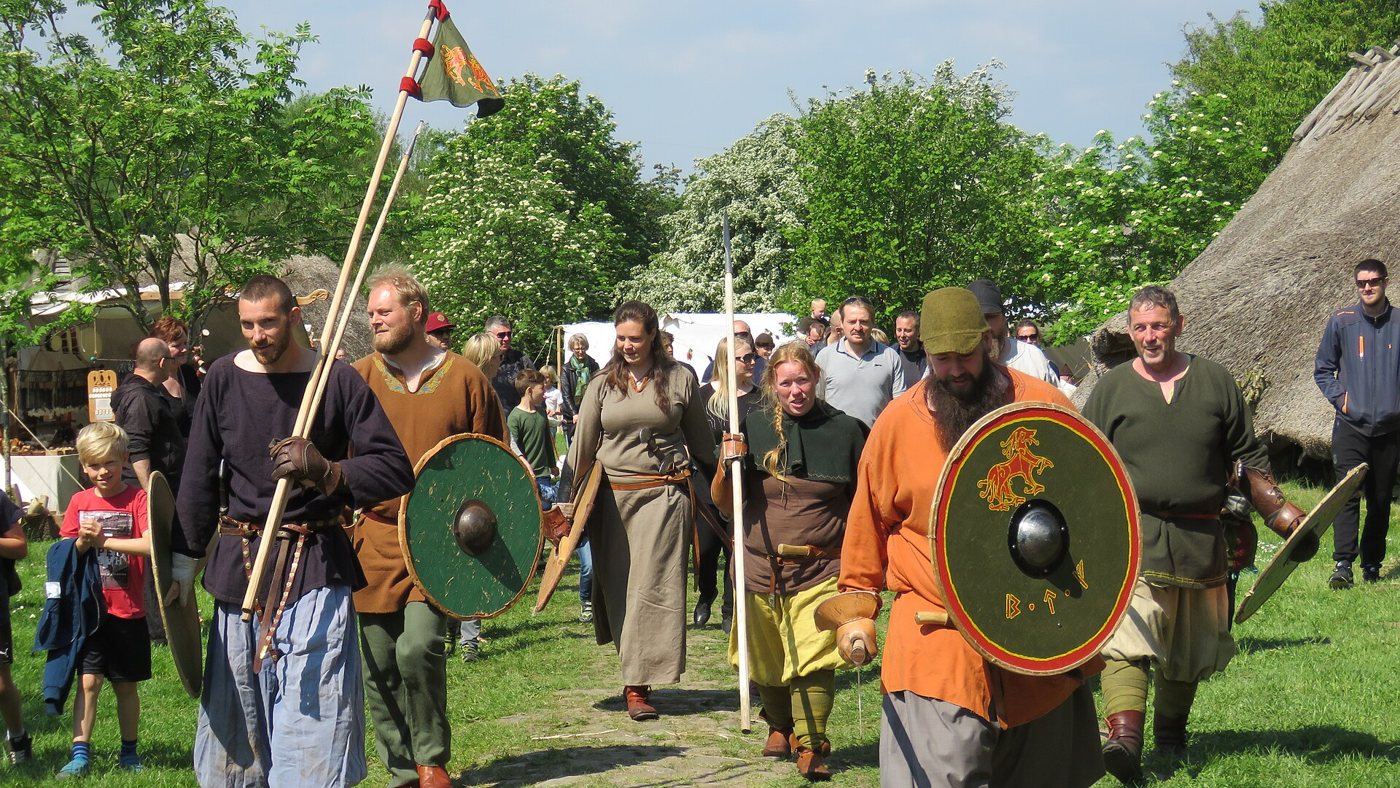
In July 2007 the crew of a replica longship sits off the Norwegian coast for eight hours waiting for an easterly. It never comes, a moderate gale is forecast instead, and what may be the Roskilde Viking Ship Museum's most ambitious experiment ends up on the end of a towline. The skipper remarks that a volunteer crew cannot afford to be as patient as the Vikings. That is the subject of this article: where do replicas, camps and costume produce real knowledge, where do they only produce a good feeling, and which line can nobody cross?
At a summer festival you see wool, smoke and shields, and you call all of it reenactment. Three overlapping activities sit behind that word.
Reenactment means acting something out again. It has no agreed definition; the Polish archaeologist Leszek Gardeła works with a broad one from the historian Michał Bogacki: the visual presentation of past life by people in costume, using replicas or original objects. Living history is broader still. Jay Anderson gave the field an early framework in his 1984 book Time Machines, defining it as the attempt to simulate life in another time. German-language scholars often use the two words interchangeably, the historian Juliane Tomann notes.
Experimental archaeology, by contrast, is a research method. It starts with a question, sets up a test, measures, documents and repeats. Fell a tree with a replica axe in front of an audience and you are giving a demonstration. Compare the marks in the wood systematically with a find and publish the result, and you are running an experiment.
The urge to play Viking is older than any society. The Viking Ship Museum in Roskilde lists the early motives for replicas: national image, tourism, fellowship, later political causes too.
The most famous early case is the Viking, a copy of the Gokstad ship built for the Chicago World's Fair. According to the museum she sailed from Bergen to Newfoundland in 27 days in 1893, 3,900 nautical miles, without using her oars. That showed what such a hull can take, not how Vikings travelled.
In 1950 a replica cost lives. The Swedish Ormen Friske, a Gokstad copy, was lost in a storm in the German Bight off Heligoland on 22 June 1950, and all 15 people aboard died. Accounts of the cause differ. The archaeologist Rune Edberg considers the early press accusations against ship and crew largely overdone, though he names a deficiency in the frames. On his account, US aircraft were bombing Heligoland that day. The museum sums this up as follows: she drifted into the practice area, probably capsized while taking evasive action, then went aground. Edberg himself writes that there is no evidence of a direct hit and thinks it likely she was smashed on Heligoland's underwater rocks or in the surf. The sequence of events cannot be established with certainty.
In 1964 the ethnologist Hans-Ole Hansen founded a centre for experimental archaeology at Lejre in Denmark, today's Sagnlandet Lejre. With the five Skuldelev replicas launched at Roskilde between 1984 and 2004, the scholarly question moved to first place, by the museum's own account, with documentation and publication built into the project.
Serious Viking reenactment began in England in the 1970s, according to Gardeła. The oldest group is the Norse Film and Pageant Society, founded in 1971 and now called The Vikings. The name gives away its origin: film and pageantry. According to Wikipedia it grew out of a film club and now has over 1,500 members; I could not check that figure independently.
In 1985 York added a festival born of a very practical problem. The Jorvik Viking Centre had opened in April 1984, visitor numbers fell in early 1985, and the idea was to draw people to the city during the February half-term. So says the organiser.
In Eastern Europe, Wolin marks a turning point. Gardeła and the article by Filipowiak, Bogacki and Kokora both date the first Viking festival there, organised by Danes, to 1993; only that article's summary says 1992 (more in our article on the Wolin festival). Participant numbers differ: Gardeła cites as many as 500 reenactors, Filipowiak and his co-authors several dozen. In 1988 Philip Burthem and others had founded Jomsborgelag, which later became The Jomsvikings, a group focused on combat with blunt steel weapons. They staged the battles at Wolin.
Gardeła's account of the Polish beginnings is unromantic. The early groups were mostly young men drawn to weapons and shaped by films and comics. Clothing and everyday objects were an afterthought, and some wore army boots wrapped in animal skins. Demand for replicas then created markets, internet forums followed in the late 1990s, and permanent villages from the early 2000s.
I am not aware of an equally solid overview for Germany. For the start of the Schleswig Viking Days, for instance, both 1986 and 2009 are in circulation.
Gunter Schöbel, director of the Unteruhldingen lake-dwelling museum, draws a clear boundary in the Routledge Handbook of Reenactment Studies. Experimental archaeology aims at verifiable knowledge. Reenactment and living history aim at experience, education and history as lived. They foster insight but, in his formulation, provide no new knowledge unless participants really work experimentally and document it.
A useful ladder is one Schöbel traces to Peter Kelterborn and the museum network EXARC, though I did not find it in Kelterborn's 2005 article published by EXARC: emotional experience, teaching and learning techniques, demonstration, replication, the true experiment, the report. Reenactment, Schöbel says, covers the first three rungs. An evening by the fire in wet wool can be powerful. As evidence of how someone felt in the tenth century, it is worthless.
Tomann names the heart of the problem. For historians, authenticity depends on whether a statement stands up to the sources, which hold a right of veto. In reenactment, critics object, the staging often just confirms what the participants already believed.
Havhingsten fra Glendalough, the Sea Stallion from Glendalough, shows what an experiment looks like and where it meets its limits. Construction and route are covered in our article on the Skuldelev ships.
About a quarter of the original, Skuldelev 2, survives according to the museum; a 2007 museum news item says about 20 per cent. The rudder, mast, sail and rigging are missing and were supplied from other finds and earlier replicas. The museum therefore says plainly that she is no exact copy and, in a research note, calls her a hypothesis to be tested.
That meant a programme of measurements on speed, manoeuvrability and rowing, plus the log and diaries kept by foremen, nurse and cook. The crew followed models from Nordic texts of the eleventh and twelfth centuries. On a 2006 trial the hull moved too much in strong wind, so the team added a thick longitudinal plank and fixed some floorboards. According to the museum's 2008 report the ship then coped with winds up to 23 m/s and swells of three to five metres. Rowing against the wind worked only in calm water; in moderate swell she managed one to one and a half knots.
And the compromises? Life jackets are compulsory, life rafts and modern navigation come along, and the project description puts crew safety above the experiment. According to Smithsonian, two crew members needed treatment for hypothermia in the first days, and there was hardly any rest. The archaeologist Anton Englert inferred "amphibious" behaviour, meaning frequent landings. That is a plausible reading, not proof: modern bodies and modern habits are not those of eleventh-century crews.
The tow from Eigersund to Kirkwall is therefore the most revealing episode. The museum reported that waiting for a fair wind could have taken weeks, and volunteers have fixed days for joining and leaving the ship. The research plan allowed for a tow in such cases. Even so, the scene makes the point: time is the one thing you cannot replicate.
At the ring fortress of Trelleborg near Slagelse stands a building that says more about research than about the Viking Age. The excavator Poul Nørlund and the architect C. G. Schultz began reconstructing a longhouse in 1941–42. The National Museum of Denmark describes it as possibly the world's first scientifically based reconstruction of a prehistoric building, and in the same breath says it has proved incorrect in some respects. The best-known example is in our Trelleborg article: the surrounding gallery, now widely regarded as outdated.
Post holes give you a ground plan, not a roof structure. Whoever builds on them must interpret everything above ground, and that interpretation then stands for decades as a solid building. The museum itself says the house still gives a good overall impression.
Today Trelleborg presents itself as a place of experimental work. The museum lists tests on indoor climate in the longhouse, on food storage and cultivation, on the making and use of weapons, and several reconstructions of the Trelleborg shield. It counts "modern-day Vikings" among its sources of knowledge and announces projects on warrior life and on rebuilding a section of the fortress. The first has run as a doctoral project since 2023; I found nothing on the status of the second. In November 2024 the network Experimental Archaeology in Denmark met there, and the EXARC review stresses that failed experiments teach something too. That is the difference from a show, which is not allowed to fail.
The richest observations come from an unassuming report. Ribe VikingeCenter, founded in 1992 and by its own description not a museum but a non-profit open-air centre with 25 buildings and about 1,000 volunteers a year, published Halls, Houses and Huts by Bo Ejstrud and others with the University of Southern Denmark in 2014.
Some findings: the Danish field archaeologists' rule of thumb that an oak post lasts about 30 years in the ground is called into question. Posts on the south and west sides rotted faster than those to the north and east. The larger the eaves, the less the rot. On one house, thatch reportedly lasts up to five years less on the south side than on the north. No excavation can supply such figures.
Of the roughly 5,000 shingles on the great hall, only about 400 were shaped with an axe and the rest were sawn; one worker makes about seven a day by hand. The sawn ones now show visible warping; the report does not say this of the axe-shaped ones.
The authors' candour is just as striking. They call their houses replicas rather than reconstructions, because buildings known only from post holes cannot be restored. They report that the hall was too dark and later received small windows, noting the assumption that houses of the period had small, widely spaced windows. And they record that rotten staves in a byre were repaired with concrete and an iron plate, which breaks their own rule but saves running costs and stays out of visitors' sight. The centre also divides its grounds into dated zones, from the market of about 710–750 to the farm of about 980. Instead of a single "Viking Age" there are recognisable time slices. For building methods and ground plans, see our article on the longhouse.
It also works the other way round. A 2024 article by Ulla Moilanen and Jenni Sahramaa in the journal Time and Mind describes what wearing clothes reveals: fit, warmth, freedom of movement, whether a dress allows nursing. Reenactors objected, for instance, that a brooch position on the breasts proposed by the textile researcher Annika Larsson would be uncomfortable to wear. That is only half an argument, since fashion has rarely been comfortable in other periods either, but nobody would have raised the question at a desk.
Gardeła makes the same observation about Poland: the most knowledgeable people are often craftspeople who read the academic literature and work experimentally, but rarely publish. The Ribe authors likewise note that much knowledge built up at the centre had never before been written down.
The limit is clearest on the battlefield. The rules of The Vikings allow only the body and the upper legs as target; head and neck are off limits, and anyone who strikes there must immediately drop as if dead. Sharp weapons are banned, helmets and padded gloves compulsory.
That is sensible, and it changes everything. If the head cannot be hit, no guard that protects it pays off, and nobody is fighting for their life. A shield wall at a festival shows how many people move with shields. It does not show how people behaved who might really die. Material questions fare better: the same article points out that wear on original weapons can be compared with damage to replicas from mock combat. At the National Museum and Trelleborg, Gustav Hejlesen Solberg's doctoral project "Krigerliv og Kampteknologi" (scheduled from 2023 to August 2026) studies Viking Age weapon technology through experiments and wear analysis. I could not establish whether the thesis is finished.
What the finds show is covered in our article on Viking clothing. Three mechanisms can be read out of Gardeła's article (the count and the label "Birka trap" are mine), and they explain more than any list of banned items.
First, self-referentiality: groups take their cue from other groups' kit rather than from finds. What is seen often enough eventually counts as attested. Second, the Birka trap: the rich graves of Birka are taken to stand for the whole Norse world, although they reflect one particular trading place. Oriental belt mounts are one result. Individual finds fare similarly: boar tusks rest, according to Gardeła, on a single grave at Repton, and Thor's hammers in graves point mainly to women, according to a study he cites. Third, stylisation: much looks historical without following any find, and interest often goes first to the weapons.
Two further distortions are nobody's fault. Wool survives in the ground better than plant fibres, so linen garments are underrepresented. And the finds are uneven: the research project Fashioning the Viking Age also worked with cloth from Hedeby harbour, interpreted as everyday clothing and so unlike grave textiles. Its two complete outfits follow high-status graves and had to be worked out from "very fragmented" material.
Washed and fed, let a man ride to the assembly, even if he is not too well dressed. Let no one be ashamed of his shoes and breeches, nor of his horse either, even if he has no good one.Hávamál, stanza 61, Old Norse text from heimskringla.no, my own translation
The stanza, written down in the thirteenth century and no dress code, is a reminder of what festivals show least: the ordinary. It assumes worn shoes and plain breeches existed and that a person might feel ashamed of them. Society rules are catching up. The list of unacceptable items at The Vikings names animal skins worn as cloaks, very tall boots, hats with wide fur trim and, since 2025, any armour other than mail (with regional exceptions for lamellar), on the grounds that mail was the only widespread armour in Western Europe. More on mail in its own article. Midgard Vikingsenter in Norway asks for sources and for kit that fits a region and period, rules out leather belts wider than two centimetres, and requires narrow straps and oval brooches for apron dresses. Such lists are house rules, not scholarly verdicts.
The camp is the shakiest part of any portrayal, because no find offers a model for a "Viking camp" of this kind. Actual winter camps on the Rhine had little in common with a festival field. The Time and Mind article counts the tent village among the modern compromises.
The tent question shows the state of the evidence. Frames are known from the ship burials of Oseberg and Gokstad, that is, from the highest-status graves. Whether ordinary travellers or warriors owned such tents cannot be shown. The wiki of The Vikings points out that there is no period evidence for how the cloth was fixed to the frame, and that the attribution of surviving fragments is disputed. Colour is where it gets interesting: a 2021 laboratory analysis found madder-type dyes, red from the dye plant, in the fabric identified as tent cloth from Gokstad. The authors consider alternating shades or light dyeing; the textiles are severely faded today. So the white tent many take to be especially genuine is far from secure, and Midgard's "natural-coloured" rule is a design standard. For more on dyestuffs, see Viking dyeing.
Furnishings are where the errors lie in plain sight. The X-frame folding chair, known in the scene as the "African chair", is wrongly passed off as historical according to Gardeła; Midgard and The Vikings both exclude it. The Vikings treat pavilion tents with vertical sides, round-topped "pirate" chests, metal tent pegs and horn mugs the same way. Symbols such as the Vegvísir fail too, because they come from much later Icelandic tradition. Gardeła also criticises wooden villages inaccurate in scale and technique.
Then there is the compromise everyone accepts. Modern protective gear goes under the tunic, the fire pan replaces the hearth in the ground, wool comes from a factory, and winter shoes appear. Midgard openly distinguishes events of high and standard authenticity.
Even the perfect camp remains voluntary. Whoever is cold can go home. Nobody re-enacts slavery as it really was, the hungry winter, the wound infection without antibiotics, the death of a child. Portrayals also tend to idealise the period and concentrate on warriors and the elite, as the Time and Mind article observes.
Feeling stays modern too. Sensory impressions are culturally shaped: smoke does not smell the same to someone raised with it. Tomann calls time travel of the kind reality formats promise impossible; Wolfgang Hochbruck suggests treating living history as theatre rather than claiming to restore bygone worlds of experience. For some, the scene is still more than a game. Gardeła describes people who have made it a way of life, and a symbolic funeral held at Wolin in 2013 in honour of Philip Burthem. That is present-day culture, not a window onto the tenth century.
For the festival visit itself, use our overview of the festivals. Wherever you are, four questions go a long way. Which find is this based on? A good answer names a place and a grave, not an era. Which region and period do you portray? Anyone who can say "about 950, central Sweden" has made a commitment. What do we not know? Someone who names the gap knows the material better than someone with an answer for everything. And what in your kit is modern?
With any claim, the principle from Roskilde and Ribe applies: was something measured, written down, repeated? Then there is something to learn from it. Our guide to Viking museums shows where you can see finds and replicas side by side.
What is the difference between reenactment and living history? The terms overlap. Reenactment usually means acting out by participants, living history the broader attempt to simulate life in another time, museums included.
How long has Viking reenactment existed? As an organised scene since the 1970s in England, with the Norse Film and Pageant Society of 1971. Ship replicas and historical pageants are older; the Viking sailed in 1893.
Can reenactors contribute to research? Yes, if they document their work. Craft knowledge, wearing comfort and wear patterns provide questions and sometimes data. The National Museum at Trelleborg counts such experience among its sources, but research still requires method.
How authentic are Viking tents at festivals? Only up to a point. Frames are attested from Oseberg and Gokstad, cloth and fastening remain interpretation, and modern cotton canvas is a compromise that Midgard is phasing out.

Viking festivals 2027 · Schleswig Viking Days 2027 (6–8 August): Programme, Getting There and the Story of Hedeby · Festival of Slavs and Vikings in Wolin 2027: Dates, Programme, Travel and History · Viking clothing & fashion · The Viking winter camps.
All Everyday Life & Craft articles →
Viking jewelry was dress fastener, savings account and statement of faith all at once: paired oval brooches held up …
Read more →Nobody can say for certain whether the Vikings had tattoos: not a single scrap of tattooed Viking Age skin survives …
Read more →No calendar page, no clock, no numbered day of the year — and yet the people of the North knew exactly when to sow, to …
Read more →Viking daily life was, above all, farm work set to the rhythm of the seasons: sowing in spring, haymaking in summer …
Read more →