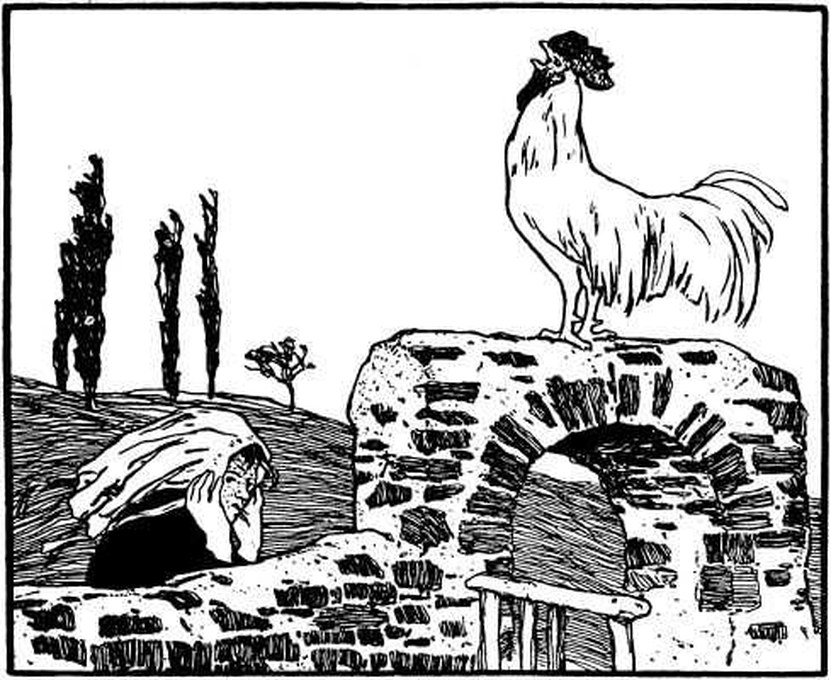
With an iron nose, a sharp eye for the distaff and a gruesome punishment for the idle, Frau Perchta walks abroad on the night before Epiphany. Today thousands of masked Perchten storm through the villages of the Pongau with cowbells on their backs. Both carry the same name, yet their histories are different. We follow the evidence from a calendar word of the High Middle Ages through sermons and court records to the show runs of the present, and we keep apart what is source, what is folklore collecting and what is interpretation.
Travel through Bad Hofgastein, St. Johann im Pongau or Altenmarkt in January and you see two worlds side by side. There are the Schönperchten, the "beautiful Perchten", with towering headdresses studded with mirrors, who stride through the village with great dignity and wish everyone luck for the new year. And there are the Schiachperchten – schiach means ugly or wicked in the Bavarian dialect – with carved wooden masks, horns, furs and heavy bells, who come crashing down the street. Both are called Perchten. And both claim descent from a figure known in the Alpine countries as Frau Perchta, Percht or Berchta.
This Frau Perchta belongs to the night before Epiphany, the Feast of the Three Kings on 6 January. She checks whether the house is clean, whether the maids have spun their flax and whether the proper feast-day dish is on the table. The diligent may find a coin in their pail. The lazy are threatened with having their belly cut open and stuffed with straw or chaff. That, at least, is how folk tradition tells it, as nineteenth-century collectors wrote it down.
Since Jacob Grimm, many have seen in her the remnant of a Germanic goddess. The Perchten runs, for their part, are advertised in brochures as an "ancient pagan custom". Both claims can be tested. The answers are more sober than the masks suggest, but no less interesting: the story leads through calendar language, penitential sermons, Baroque court files, an emperor's visit and twentieth-century folklore research. For the closely related Frau Holle we refer to our own article Frau Holle; this piece is about Perchta and the Perchten of the south.
The oldest secure anchor for the name is not a myth but a holiday. The Feast of the Epiphany on 6 January – from Greek epiphaneia, "appearance" or "manifestation" – was called Perchtentag or Prechtag in the Bavarian-Austrian region for centuries, and its eve was the Perchtnacht. The Salzburg regional historian Friedrich Johann Fischer, writing in 1963, cites as early witnesses a gloss from the monastery of Mondsee from around the year 1000 with the form giperehtennaht, and a charter of 1314 that uses "Perchtentag". Michael Greger, current head of the Salzburg Institute for Folk Culture Studies (Salzburger Landesinstitut für Volkskunde), likewise dates the rendering of Epiphany as "Perchtag" to the eleventh century.
This is where the debate begins. Was there first a goddess, after whom the day was named? Or was there first the day – the "shining night" of Christ's manifestation – which only later turned into a person? The gloss of around 1000 is a translation aid for a Latin text. It shows that a monk rendered the Christian feast with a vernacular word that can mean "night of radiance" or "night of the manifestation". Of a woman walking abroad it says nothing at all.
Middle High German berht or bercht means "bright, shining". The same element survives in names such as Berthold, Albrecht and Bertha. That the Feast of the Epiphany, the feast of the Star of Bethlehem and the appearance of divine light, should be translated as "the shining night" is theologically obvious and needs no pagan model. The calendar name on its own therefore settles nothing. It only shows that the word family was tied to 6 January before any Perchta figure becomes visible in the sources.
Jacob Grimm derived Perchta from an Old High German Perahta, "the shining one", and so placed her alongside the light goddesses of antiquity. That Old High German form, however, is attested nowhere; it is a reconstruction. Grimm himself admitted that Perchta appears in literature only from the thirteenth to the fifteenth centuries. The literary and folklore scholar Martin Puhvel noted in 1989, according to the summary in the English Wikipedia, that no firm evidence has been produced to support Grimm's derivation.
Other proposals exist alongside it. The Germanist Eugen Mogk thought of an Old High German verb pergan (related to modern German bergen), "to hide" – Perchta would then be "the veiled one". The Bavarian linguist Johann Andreas Schmeller saw in her nothing more than the personification of the calendar day. More recently, a derivation from giberaht naht, "night of the manifestation", has been argued. A Celtic root has occasionally been suggested as well, without gaining acceptance.
In favour of the personification theory is the fact that calendar days readily become persons in popular belief, as the Lucia of 13 December shows. Against it is the fact that Perchta has traits that have nothing to do with Epiphany: the spinning, the unbaptised children, the power to punish. Those traits, though, may have attached themselves later. Only the order of the evidence is certain: first the day, then the woman.
When does the Perchtentag become a figure people believe in? The Germanist Erika Timm sorted the evidence in her 2003 study Frau Holle, Frau Percht und verwandte Gestalten ("Frau Holle, Frau Percht and related figures"). By her reckoning, the earliest certain instance dates from the thirteenth century, a probable one from the twelfth, and one that merits no more than consideration from the eleventh. In the thirteenth century we meet the Latin phrase Domina Perchta, "Lady Perchta". We have not been able to see the wording of these early passages ourselves; we report them after Timm and the secondary literature.
Perchta becomes clearly visible in the late Middle Ages, and almost entirely in one kind of text: the Church's critique of superstition. Preachers, theologians and the authors of confessional manuals listed what the common people wrongly believed, in order to wean them off it. Their writings prove that in the fifteenth century there was a notion of a "Frau Percht" in the Eastern Alps and in Bavaria. They do not prove how old that notion was, and they colour it to suit their purpose: as the devil's work, as sin, as folly.
An early example comes from a didactic poem. In 1411 the Tyrolean Hans Vintler wrote Pluemen der tugent ("Flowers of Virtue"), a free adaptation of the Italian Fiore di virtù. In a long catalogue of superstitions, which Jacob Grimm printed from the Gotha manuscript in the appendix to his Deutsche Mythologie, we read, among a great deal else:
"und ettlich glaubent an die frawn / die haisset Precht mit der langen nas."
("And some believe in the woman who is called Precht, with the long nose.")
Hans Vintler, Pluemen der tugent (1411), from the Gotha manuscript as printed in Jacob Grimm, Deutsche Mythologie, appendix "Aberglaube", section G; English translation by the editors
Two lines, nothing more. But they tell us three things: the figure is a woman, she has a name, and she has a bodily mark – the long nose that returns in later legends as an iron nose or a bird's beak. The Schnabelperchten ("beaked Perchten") of Rauris, who still go from house to house on the eve of Epiphany, wear exactly this feature as a long beak in front of the face.
A little later, around 1418, the Dominican Johannes Herolt mentions in his Sermones dominicales the belief in a "Fraw Percht" who leads a host of women by night. That recalls the older church text about the nocturnal ride of women, the Canon Episcopi, and the Wild Hunt, which we cover in detail in The Wild Hunt in the Twelve Nights. Whether Herolt describes a living folk belief or projects a learned scheme onto a familiar name cannot be disentangled.
What fifteenth-century theologians condemn most often is not belief in a flying woman but a very concrete habit. On the Perchtnacht people left food and drink standing on the table, so that "Frau Percht" and her retinue might help themselves and the household would enjoy luck and plenty in the new year. The Viennese theologian Thomas Ebendorfer of Haselbach condemned the practice in 1439 in De decem praeceptis, his commentary on the Ten Commandments. A treatise widely read in Bavaria, the Thesaurus pauperum, did the same in 1468; a footnote in the secondary literature also gives 1483, so the date is not fixed.
The Thesaurus pauperum explicitly equates the folk figure with names drawn from learned tradition: Habundia (Abundia, "abundance") and Satia ("satiety"). The Church knew these figures from older writings about night-wandering women who had to be entertained so that they would bring plenty. For researchers this is both a stroke of luck and a problem. We learn that the custom of the laid table existed, but we cannot cleanly separate the folk belief from the preacher's lens.
According to Timm, the literature of the thirteenth to fifteenth centuries already treated even a small food offering to the Percht as a mortal sin. Nineteenth-century folklore collectors still recorded customs in Bavaria and Austria in which leftovers of the feast stayed on the table during the Perchtnacht. People ate from the dish but left their spoons in the bowl. If a spoon lay upside down in the morning, its owner was expected to die in the coming year. Between the witnesses of 1439 and the records of the nineteenth century, however, lie four centuries in which we know almost nothing about the custom. Continuity is likely, but it is not documented without gaps.
According to folklore reports, the feast also involved a particular fasting fare. The Perchtnacht was the eve of a feast and therefore, in the church calendar, a fast day. Anyone who failed to eat the prescribed food on that day – usually fish and porridge or flour dishes – was especially at risk from Perchta. Here, then, Perchta punishes not a breach of pagan rites but a breach of Christian fasting rules.
One influential reading of the medieval evidence comes from the narrative scholar Marianne Rumpf. In studies of 1976 and 1991 she examined Domina Perchta alongside Frau Welt, "Lady World", a well-known allegory of late medieval art: from the front a beautiful, richly dressed lady, from behind eaten away by worms and toads. On Rumpf's reading, as the secondary literature summarises it, Domina Perchta in some texts stands not for a folk deity but as an image of the sinful world, of vanity and pride, comparable to the Luxuria of the catalogues of vices.
This thesis matters for how we understand the later masks. The Heimatlexikon in the Austria-Forum, drawing on material from the Salzburg association for folk culture, interprets the splendid Schönperchten as an emblem of pride, the Schnabelperchten as an image of malicious gossip, and the Schiachperchten as a relic of medieval catechesis, the Church's instruction in the faith. Read this way, the Perchten are no pagan heritage but a moral lesson that the Church itself staged, or at least shaped.
That, too, is an interpretation. It explains well why the masks swing between beauty and terror, less well why the same figure inspects the distaff in farmhouse parlours. Several layers probably overlap. The Salzburg folklorist Ulrike Kammerhofer-Aggermann speaks of a network of many-layered influences of the most varied origins, with marked changes over time; in her judgement, one-dimensional explanations, pagan or ecclesiastical, fall short.
The most gruesome motif in the Perchta tradition has its own technical term. In his 1913 study of Perht, Holda and related figures, the folklorist Viktor Waschnitius called it gastrotomy, "cutting of the belly". The basic form runs like this: anyone who has not eaten the prescribed food on Perchta's evening, or has not finished their spinning, has their belly slit open by Perchta, who takes out what they have eaten and fills them with straw, chaff, tow or stones. In some variants she sews up the wound with a ploughshare instead of a needle and an iron chain instead of thread. In others, the body filled with stones is sunk in a well.
There are milder versions. Perchta scratches, she breathes on the disobedient so that they go blind or swell up, or she sends a nightmare. One Styrian legend type tells of a farmhand who watches the Perchtlgoba through a hole in the stove and is struck blind for it; he regains his sight only when he returns to the same spot a year later. All the variants share the same pattern of rule, transgression and punishment.
How old is the motif? The belly-cutting does not appear in the late medieval sermon evidence; it is known above all from early modern and modern records. The medievalist Thomas Hill has pointed to a surprising parallel in the Icelandic Laxdæla saga from the thirteenth century. There (chapter 48) a man named Án dreams that a woman cuts open his belly, takes out his entrails and puts brushwood in their place; he is afterwards known by the nickname hrísmagi, "brushwood-belly". Whether there is a link between an Icelandic dream and an Alpine bogey, or whether an obvious motif was invented twice independently, remains open.
The folklorist John B. Smith proposed a different explanation in 2004 in the journal Folklore, under the title "Perchta the Belly-Slitter and Her Kin", which we know only from its summary. He links Perchta's behaviour, and that of other bogey figures, to their historical setting: originally, he argues, the figure policed communal taboos, especially the rest from work and the food rules of the festive season; the cruel punishments were a later escalation.
Besides the fasting rule, spinning is the second great domain over which Perchta keeps watch. According to widespread popular belief, no spinning was to be done in the Twelve Nights between Christmas and Epiphany, or at least the flax had to be spun off by the Perchtentag. Anyone who still had tow on the distaff on the eve found the yarn tangled or soiled by Perchta, or was punished outright. She shares these rules with Frau Holle in central Germany; we treat the Holle material in Frau Holle and the wider Rauhnacht context in the overview The Rauhnächte and Modranecht.
Perchta can also reward. In folk tales, maids who have been diligent find full spindles, golden threads, flax or coins, often in a pail by the well. Anyone who helps her, for instance by mending her cart, receives wood shavings that turn to gold the next morning. This tale type – the humble gift that the ungrateful throw away and that turns to gold for the grateful – is widespread and by no means limited to Perchta.
What explains this link between spinning and the turn of the year? A sober answer lies in the farming year. Spinning was the great winter work of women, carried out in the spinning rooms where young people gathered, sang and told stories. A fixed end to the work before Epiphany structured the working year, and a figure who watched over that deadline gave the rule its teeth. Marianne Rumpf made a special study of these spinning-room women, among whom Perchta belongs. That an older religious core lies within such rules is possible, but it cannot be demonstrated.
One strand of the tradition comes not from the Alps but from Thuringia and Franconia. There Perchta, often called "Frau Bertha", appears as leader of the Heimchen. The word actually means the house cricket, but in popular belief it also denotes small, dwarf-like beings. In legends from the Orlagau on the river Saale, which Ludwig Bechstein published in his nineteenth-century collections of legends, the Heimchen are the souls of unbaptised children who travel with Perchta. They help the farmers, and the land prospers. When the people, on the advice of a stranger, turn away from them, Perchta departs with her host across the water and never returns.
Related to this is a motif that overview works cite on the authority of Jacob Grimm: Perchta leads a host of unbaptised or early-dead children. Anyone who meets her procession and gives a name to the last child stumbling behind redeems it and is rewarded. Such stories are tales of grief from a society with high child mortality and with the church teaching that unbaptised children could not enter heaven. They show Perchta from quite another side: not as the punisher, but as a guardian of the dead.
Whether these Thuringian legends and the Alpine punishing figure originally meant the same being is disputed. Grimm brought them together, and later collectors went looking specifically for "Berchta" – an effect we will return to below under the heading of "feedback".
Perchta is not the figure of a single valley. Her names run through Bavaria, Austria, South Tyrol, Switzerland, Bohemia, Moravia and Slovenia, and every landscape has produced its own forms. In Styria she is called Perchtlgoba or Pudelmuatta; in the Ausseerland the Berigln appear; in Lower Carinthia the Bechtrababa is hunted. In parts of Tyrol and Switzerland we meet the Stampa, Stempa or Gstampa, whose name alludes to stamping; Jacob Grimm spoke of the "Stempe". In Czech there are Parychta, Peruta and Šperechta, in Slovene Pehtra Baba or Pehta. There too she threatens children who eat before the proper time with having their bellies cut open.
A special neighbour is the Lutzelfrau or Luzier, who walks abroad on St Lucy's Day, 13 December. Around Passau and in parts of Austria she has taken on many of Perchta's traits: she checks the spinning, she punishes, she slits bellies. The German Wikipedia, following Timm, explains this through the calendar: under the Julian calendar, the longest night in the fourteenth and fifteenth centuries fell roughly on St Lucy's Day. In Burgenland, in Unterwart, the "Lutzln" run on 13 December. And in the Lower Inn Valley (Unterinntal) the "Perschtln" are out as early as 5 December, St Nicholas' Eve. The dates wander; the motifs stay.
The best-known relative is Frau Holle, the Holda of the sources. The Germanist Erika Timm regards Holle and Perchta as by-names of the same goddess, probably Frija, who is called Frigg in the North. In her view, Germanic groups brought a female numen – a divine power without a fixed image – into southern Germany, where it absorbed elements of the pre-Germanic population. That is a reasoned scholarly hypothesis, not an established fact. For the Norse goddess see our article Frigg.
The modern history of Perchta begins in 1835. That year Jacob Grimm published his Deutsche Mythologie ("Teutonic Mythology"), an attempt to reconstruct a lost world of gods from legends, customs, curses, place names and medieval texts. In the chapter on goddesses he treats Holda, Berhta and Herke as figures who travel about at Christmastide, "in the so-called Twelves". Berhta appears in his account as a goddess dressed in white, mistress of spinning and weaving, leader of a nocturnal procession, related to Holda and to male figures such as Berchtold. Through the reading "the shining one" he set her beside Diana, Selene and Artemis.
Grimm assumed that fragments of a pagan religion had survived in the folk belief of his day and could be pieced together again like a broken vessel. So the bogey of the farmhouse parlour became a dethroned goddess. Grimm saw the weakness himself: the evidence starts late, and the bridge to pre-Christian times has to be built by interpretation, not by the source.
Later scholars went further than Grimm. In the second half of the nineteenth century Wilhelm Mannhardt interpreted Perchta as a personification of natural forces, a vegetation spirit that rests in winter and walks abroad at the turn of the year. In the early twentieth century Otto Höfler and Lily Weiser-Aall connected the Perchten processions with the idea of cultic men's societies that had supposedly gone about masked as an army of the dead in Germanic times. Research today regards this thesis as marginal, not least because it lent itself so readily to ideological capture in the first half of the twentieth century.
Present-day research has become cautious about searching for a pagan primal myth. The folklorist Ingeborg Weber-Kellermann was already critical of the Grimms' romantic-mythological approach. The question asked today is rather what the figure did for the people who told stories about her: she enforced the rest from work and the fasting rules, she helped raise children, she offered a language for grief over unbaptised infants, and in sermons she served as an image of sin.
The positions can be roughly sorted like this. Erika Timm argues for a moderate continuity thesis: a pre-Christian female numen at the core, overlaid by many younger layers; the Perchten runs, she holds, are considerably younger than the legends. Marianne Rumpf stresses the Christian, allegorical side of the medieval evidence. John B. Smith explains the figure functionally, from her social setting. A university thesis by Natko (2014) concludes that there is no direct connection between the mythical figure and the processions. And the Salzburg folklorist Michael Greger puts it bluntly in an interview with Salzburg24: the name comes from the Perchtag, and the goddess is an invention of Jacob Grimm that has long since been deconstructed.
There is no consensus among these positions on the origin of the figure. There is consensus, however, on two points. First, written evidence for Perchta as a person begins in the High Middle Ages at the earliest and, until the fifteenth century, passes almost entirely through a church filter. Second, the Perchten runs become visible as a custom only in the early modern period and have changed greatly since then. Whether a goddess of this name was worshipped before the Middle Ages is an open question that the material we have can probably not decide.
Up to this point we have been dealing with Frau Perchta, a figure of belief. The Perchten in the plural are something else: people who disguise themselves and go about in procession. When does that begin? The answer depends on how you count. Churchmen were criticising noisy masked processions at the new year as early as late antiquity; according to the secondary literature, Caesarius of Arles around 500 describes people disguising themselves as animals and female figures at the Kalends of January. Masks at the start of the year are therefore very old – but between Caesarius and the first evidence for Alpine Perchten runs lie more than a thousand years without a bridge.
For the Perchtenlauf proper, the German Wikipedia, drawing on Timm, gives 1582 as the first written record; we were unable to check where this record comes from or what it says. The Austria-Forum points to the first mention of the Tyrolean Schemenlaufen in 1597, though these took place at Carnival, not in the Perchten season. According to Michael Greger, Perchten runners are attested in Berchtesgaden in the seventeenth century. The disguises of this early period were simple, by his account – often just rags of cloth with eye-holes cut into them. Carved wooden masks only appeared in the late eighteenth century.
Who did the running matters too. The sources almost always speak of young, unmarried lads. Perchten-going was a custom of a village's young men's associations, with noise, dancing, "begging" – going round the farms to collect gifts – and public shaming. Behind the mask one could say what no one else dared to say aloud: mockery of a stingy farmer's wife, secret love affairs, harsh masters. It was precisely this social function that made the custom suspect in the eyes of the authorities.
It was not uniform everywhere. In Styria, according to material evaluated by the ethnologist Hans Peter Duerr, women played the Perchtln right into the nineteenth century.
The densest evidence for early Perchten runs comes from files meant to stop them. According to the Austria-Forum, between 1664 and 1792 the prince-archbishops of Salzburg saw in the masquerades an occasion for unrest, rebellion and immorality, and issued ban after ban. In 1963 Friedrich Johann Fischer analysed the eighteenth-century records of the Salzburg court council (Hofrat) in the Mitteilungen der Gesellschaft für Salzburger Landeskunde. They read like a map of the custom.
In 1721 miners on the Dürrnberg near Hallein go running on the night of Epiphany; a brawl with the court patrol follows. The penalties are graded by means: those who can pay, pay; those who cannot must do a month of entrenchment work, that is, labour on the fortifications. In 1730 "young lads" in Gastein rampage around at Epiphany and Shrovetide in fools' costumes and with all manner of bells; a court order demands that it stop. In 1736 the custom is said to be especially common in Hallein and Moosham, and the ban is also to be enforced in Zell, Saalfelden and Taxenbach. In 1741 the court confirms the general ban on masquerading and Perchten-going.
The cases grow harsher. In 1750 eleven lads are caught in Unken, and two of them throw poles in the path of the senior clerk. In 1756 a report from the area around Neukirchen am Großvenediger says the custom goes about circa festum Epiphaniae, around the feast of Epiphany. In 1759 lads are arrested in Mittersill and sentenced to military service or entrenchment work; one of them is already fifty years old, another escapes from the fortifications, and in Rauris a Perchten runner is sent off to the army. In 1777 mine and trade workers in Hüttschlag in the Großarl valley are fined three to five gulden; the court rejects their petition for leniency.
The picture is clear. In the eighteenth century Perchten running was widespread in the Salzburg mountains, it was forbidden, and the ban was renewed again and again because it did not work. The runners were miners, farmhands and young lads, not the priests of a cult. And not one record speaks of a goddess. The Austria-Forum sums up that the descriptions surviving since the sixteenth century show the participants never understood what they were doing as cultic.
Towards the end of the eighteenth century the way people looked at the custom changed. Enlightenment writers and travellers no longer described the customs of the mountains as sin but as a sight worth seeing. The Salzburg publicist Lorenz Hübner reported in 1796, in his Beschreibung des Erzstiftes und Reichsfürstenthums Salzburg (a description of the archbishopric and principality of Salzburg), that in the Pinzgau the Perchten sometimes numbered one to three hundred people, and that they danced "with the most comical masks". Count Friedrich Spaur saw Perchten in Saalfelden in 1798 carrying long staffs armed with spikes, and published the account in 1800 in his Reise durch Oberdeutschland ("Journey through Upper Germany").
A turning point came in 1837. In the Gastein valley, Perchten from the Kötschach valley were presented to Emperor Ferdinand I. According to Michael Greger, they still wore lower headdresses at the time, possibly influenced by Carnival runs in the Lower Inn Valley. The emperor is said to have been delighted and to have invited the Perchten to dine – a "world honour", as Greger puts it, that raised the standing of the custom. Gastein's tourism marketing tells that he then lifted the bans; this is a local tradition that we could not check against any document.
After that, things moved quickly. The Tresterer dance in the Pinzgau is attested from 1841, and in 1874 a Tresterer-Pass of its own was founded in Zell am See – in Salzburg usage a Pass is a custom group. From the 1870s, Greger says, Schönperchten and Tresterer became a hallmark of Salzburg among the crown lands of the Habsburg monarchy. In the same period the national-romantic interpretation emerged, which saw in the Perchten a Germanic-pagan nature cult. According to Greger, the Schönperchten in their present form are a product of the nineteenth century, the Schiachen arose more or less as their counterpart, and the figure of Frau Percht in the Gastein run is likewise a creation of that century.
A large Perchten run is an ensemble with fixed roles. At its centre are the Schönperchten, known in the Pongau as Kappenperchten ("cap Perchten") or Tafelperchten ("board Perchten"). Their headdresses can be more than two metres high and weigh up to 50 kilograms. They are covered with mirrors, fabric flowers, ribbons and pictures, including religious and rural motifs. Wearing a headdress counts as the highest rank in a Pass. The cap-bearers are accompanied by the Gesellinnen, young men dressed as women.
The Schiachperchten provide the contrast: fur, wooden masks with horns and long teeth, heavy bells, switches of birch twigs or horsehair. According to the secondary literature, cows' tails filled with sand were once used as striking weapons. Then come the character roles: the Herreiter, who leads the procession; the Hanswurste, clowns who keep order and clear the way; the bear with his keeper; the Habergoaß, a goat figure also spelled Habergeiß; witches, huntsmen and poachers; the Werkl, a barrel organ; and in Gastein the Three Kings as well.
Away from the big runs there are types of their own. The Schnabelperchten of Rauris are a mixture of bird, cleaning woman and bogey: long beaks made of wooden sticks and linen, a basket on the back, a large pair of scissors, needle and thread, a broom. On the eve of Epiphany they go from house to house and check whether the home is in order – precisely what the legends attribute to Frau Perchta. In Dienten the Krapfenperchten appear with wooden masks; according to the book Salzburger Brauch, their name may go back to poor people who went about in disguise begging for Krapfen, doughnuts. In Golling a summer-and-winter play with some twenty performers goes round on 5 January, led by a Frau Percht; after a verbal contest, summer wins.
The Tresterer of the Pinzgau, finally, are Schönperchten who dance. In Zell am See they wear red-and-gold brocade and a crown with white cock's feathers, in Unken simple black hats with flowers and ribbons. The dance is an intricate round dance with hopping and stamping steps, performed only by men, and it ends with new year wishes. In the Pinzgau the name is derived from threshing with the feet; a derivation from treading grapes or must is not attested. Since 2013 the Pinzgau Tresterer dance of the Salzburger Alpinia has been on Austria's national inventory of intangible cultural heritage.
The Gastein Perchten run takes place only every four years, on New Year's Day and on Epiphany; the most recent was in January 2026. On the first day the procession moves through Bad Gastein to Bad Bruck, on the second from there through villages and farms to Bad Hofgastein. Some 140 to 165 figures take part, for about nine hours each day and over many kilometres. Since 2011 the Gastein Perchten run has been on the national inventory of intangible cultural heritage kept by the Austrian Commission for UNESCO.
Alongside it there is the Pongau Perchten run, which several towns host in rotation each year, among them St. Johann, Bischofshofen, Altenmarkt and Gastein, likewise around 6 January. It is regarded as the model for many similar events and has long been a fixture of the tourist calendar. How vigorous the whole tradition is was shown around the year 2000 by a questionnaire survey in the province of Salzburg: it counted 161 Perchten groups, more than half of them in the Gastein valley. According to the secondary literature, the folklorist Grieshofer was already speaking in 1992 of a "Perchten-isation" (Verperchtung) of Austria, because almost every village was founding a new group.
The Salzburg federation of local heritage associations insists that the Perchten season runs from 21 December to 6 January. Historically, though, the dates have shifted again and again, as far as Carnival.
For many visitors, Perchten and Krampuses are one and the same: shaggy figures with horns and bells. In origin they are different. The Krampus is the companion of St Nicholas and appears on the evening of 5 December, the eve of St Nicholas' Day. Nicholas rewards good children; the Krampus threatens the naughty ones with switch and chain. The figure belongs to the world of the Nicholas plays, which arose as parlour plays in the age of the Counter-Reformation and are still performed today in Bad Mitterndorf and Tauplitz in the Styrian Salzkammergut, for example. Masked devils are attested in the German-speaking lands from the sixteenth century; the claim that the Krampus himself is older is often made, but historians do not consider it demonstrable.
The blending is recent. According to a doctoral thesis at the University of Sheffield (Carter 2016), Krampus and Schiachpercht merged from the late 1960s into a single "furry devil", and the bulk of the new, horror-style masks emerged between 1972 and 1992, according to Dengg as cited there. Most of today's groups were founded from the 1970s onward. Since then "Krampus-Perchten" have appeared, and in many places Krampus runs are held as large evening events at which people are repeatedly injured; in 2013, after runs in East Tyrol, eight people were admitted to Lienz hospital and more than sixty were treated as outpatients, as the Tiroler Tageszeitung reported at the time.
The Glöckler of the Salzkammergut are something else entirely. On 5 January, the eve of Epiphany, they go through the villages in white garments with large headdresses lit from within and cowbells on their backs. The Glöckler run of Ebensee has been on Austria's national inventory of intangible cultural heritage since 2010. Whether the Glöckler count as Perchten is disputed among those who know the scene: some groups reject the label, others see themselves as "light Perchten". In Altaussee the Glöckler ring their bells against the Berigln, the Schiachperchten of the Ausseerland.
The North, too, knows winter bogeys and begging figures of a similar kind, such as Grýla and the Jólasveinar or the Yule Goat. But related in function does not mean related by descent.
Around 1900 a national-romantic reading took hold in Austria and Bavaria: the Perchten were seen as the remnant of a Germanic-pagan nature cult, the beautiful ones as beings of light, the ugly ones as winter demons to be driven out. This interpretation was popularised in the first half of the twentieth century and exploited politically; Greger calls the ideological reshaping into a "Germanic" cultural event "complete nonsense". It has had a long afterlife, in commemorative booklets, brochures and club websites.
Folklore studies coined terms for this process. In 1964 Hans Moser spoke of Folklorismus ("folklorism"), the second-hand transmission and staging of folk culture, and of Rücklauf, "feedback": learned interpretations flow back into practice and are retold there as age-old tradition. When a club writes that the bells drive away the winter spirits just as they did among the ancient Germanic peoples, that is very often this feedback at work. The custom is genuine all the same – only its justification is younger than claimed.
The Perchten left the Alps long ago. In Bavaria the Kirchseeon Perchten run was revived in 1954, and in 2021 a dedicated Perchten museum, the Maskeum, opened there; a run was even revived in Nuremberg-Almoshof in 2014. In Passau and elsewhere groups fuse Krampus and Percht into fantasy horror figures who perform in halls and on stages. Perchten costumes now turn up in Carnival parades and at Halloween.
Is that still custom? Folklore studies ask this question more cautiously today than they once did. Michael Greger stresses that traditions are no unchanging inheritance from the forefathers; the German word Brauch, custom, is related to brauchen, to need, and customs arise from the needs of groups, not from some folk soul. Scholarship, he says, is no "custom police". From this point of view a show run of today is no more "inauthentic" than a Tresterer dance of 1841.
That is also why we at our workshop in Alsdorf, where we laser-engrave Norse motifs, do not call Perchta a goddess where the sources show a calendar figure, a sermon figure and a custom of the village lads. The story is rich enough without a primeval past.
Who is Frau Perchta? A figure of popular belief in Bavaria, Austria and neighbouring regions who inspects houses on the night before Epiphany, rewards diligence and punishes laziness or breaches of the fasting rules. She is securely attested from the thirteenth century and well documented in the fifteenth, in church criticism.
Where does the name Perchta come from? It is connected with the Perchtentag, the old name for 6 January, and with Middle High German berht, "bright, shining". Whether a goddess or the feast day carried the name first is disputed; the name of the day is attested earlier than the person.
What is the difference between Schönperchten and Schiachperchten? Schönperchten wear splendid headdresses and bring good wishes; Schiachperchten wear fur, horned masks and bells and are bogey figures. In their present form both are largely creations of the nineteenth and twentieth centuries.
Are Perchten and Krampus the same thing? No. The Krampus accompanies St Nicholas on 5 December, while the Perchten belong to the days around 6 January. Since the late 1960s the masks have merged in many places.
How old are the Perchten runs? The oldest hints date from the late sixteenth century; they are securely and densely documented in the seventeenth and eighteenth centuries, at that time as a forbidden custom of young lads. An origin in Germanic times cannot be demonstrated.
Frau Holle & the old goddess · The Wild Hunt in the Twelve Nights · The Twelve Rauhnächte Night by Night: Dates, Counts, Omen Days and Customs · The Yule Goat · Grýla & the Yule Lads.
All Festivals & Belief articles →
There is hardly a house that does not burn frankincense every day – that, roughly, is how Sebastian Franck described …
Read more →Ask five people when the Rauhnächte begin and you will get three answers: on 21 December, on Christmas Eve, or on …
Read more →The Rauhnächte are the roughly twelve nights between Christmas and Epiphany, a stretch that German and Alpine folk …
Read more →The Norse had no holy book, no pope and no fixed liturgy. Their faith lived in action: in the sacrificial feast at the …
Read more →