Ask five people when the Rauhnächte begin and you will get three answers: on 21 December, on Christmas Eve, or on Christmas Day. Each of them has a tradition behind it. This article walks through the time between St Thomas's Night and Epiphany one night at a time – with the saints' days on which the customs actually hang, with the farmers' almanac of 1508 that gave us the idea of "twelve days for twelve months", and with an honest look at which assignments were only invented in the last few decades.
The Rauhnächte – the "rough nights" of the German-speaking Alps and southern Germany – have a curious reputation. They are said to be ancient, a time "outside of time", a window into the year to come. Anyone who tries to enter them into a calendar soon discovers that there never was one single Rauhnacht calendar. In parts of Bavaria and Austria only four nights really mattered. In northern Germany people spoke of "die Zwölften", "the Twelves", and meant the days between Christmas and Epiphany. Present-day guidebooks, in turn, give every single night its own month, its own theme and sometimes its own wish.
The foundations – Bede's "Mothers' Night", the question of why the number is twelve, the etymology of "rauh" (rough, hairy) and "Rauch" (smoke) – are covered at length in our overview article The Rauhnächte and Modranecht. This piece deals with something else: the calendar itself. Which nights count in which reckoning? Which saints' days fall within the span, and which customs attach to them? Where does the rule come from that each of the twelve days reveals the weather of one month? And how much of it is folk custom of the sixteenth to nineteenth centuries, how much a modern attribution?
One guiding thread runs through the whole text. Most customs of the Rauhnächte do not belong to "the third night" or "the seventh night" but to a particular church feast. St Stephen's Day has its horses, St John's Day its wine, Holy Innocents' Day its switches, Epiphany its star singers. Once you know this, you quickly see where an assignment comes not from tradition but from a book published in recent years.
Before going into the individual nights, it is worth doing a small sum that trips up almost every popular account. Between 25 December and 6 January there are twelve days if you leave 25 December out – or thirteen if you include both end points. The nights work the same way. In folk usage a Rauhnacht is the night before a day: Christmas Night is the night from 24 to 25 December, Epiphany Night the night from 5 to 6 January.
If you count from Christmas Night (24/25) up to and including Epiphany Night (5/6), you arrive at thirteen nights: eight in December (the nights beginning on the 24th, 25th, 26th … 31st) and five in January (the nights beginning on the 1st to the 5th). Whoever wants exactly twelve has to move one of the boundaries. Two solutions are common:
Modern Rauhnacht books mostly use Count A and treat Epiphany Night as the "thirteenth" or as a closing night. That is part of the reason for the confusion surrounding the number thirteen, which reappears in the "ritual of the thirteen wishes". A third, older reckoning starts as early as St Thomas's Night and ends at New Year. It, too, comes to twelve: the nights beginning on 20 to 31 December make exactly twelve, New Year's Eve included.
None of these counts is "wrong". They come from different customs with different purposes. Anyone who used the twelve days as a weather oracle for the twelve months needed a clean series of twelve. Anyone who censed house and byre, on the other hand, went by the great feasts – and so arrived at three or four nights rather than twelve.
The following table sets the common reckonings side by side.
| Reckoning | First night | Last night | Number | Where and what for |
|---|---|---|---|---|
| Zwölften / Twelve Nights (A) | 24/25 December | 4/5 January | 12 (+ Epiphany Night) | most widespread count today, many guidebooks |
| Zwölften (B) | 25/26 December | 5/6 January | 12 | the Twelve Days of Christmas in the church's sense, weather rules |
| From St Thomas | 20/21 December | 31 December/1 January | 12 | regional, ends at New Year |
| Four "great" Rauhnächte | St Thomas's Night | Epiphany Night | 4 | Alpine region, censing with incense and holy water |
| Three Rauhnächte | Christmas Night | Epiphany Night | 3 | Christmas Night, New Year's Eve, Epiphany, regional |
German-language literature gives a range of between three and twelve nights. Which region preferred which count can only be shown for individual places, from the folklore collections of the nineteenth and early twentieth centuries; there are no comprehensive, reliable maps. That is why the table deliberately names no federal states or provinces.
In Bavaria, Salzburg, Tyrol and Styria not every night between Christmas and Epiphany counted as a Rauhnacht in the strict sense. The Austrian encyclopaedia AEIOU names four: the night before St Thomas's Day, Christmas Eve, New Year's Eve and the night before Epiphany. Two of them, Christmas Night and Epiphany Night, are called the "foaste" Rauhnächte in dialect – the "fat" ones. On those nights there was more to eat, and whatever happened in them was thought to carry special weight.
What people did in these four nights is described quite consistently in the collections. The head of the household or the farmer's wife carried embers in a pan through house and byre and laid incense and blessed herbs on them; a second person sprinkled holy water. Prayers were said as they went, often the rosary. The livestock were given blessed fodder, called "Maulgaben" ("mouth gifts") in some places, so that misfortune would stay away from farm and stable. On top of that came gifts to beggars, star singers and other door-to-door visitors, who were meant to bring luck for the new year.
At its core this is a church blessing. The censing of houses with incense, in Latin thurificatio domorum, already appears in a Salzburg ritual book, the Obsequiale of 1511. The historian Robert W. Scribner pointed out that the same custom was still not usual in the diocese of Mainz in the seventeenth century – a neat reminder of how regionally scattered even the "classic" Rauhnacht customs were. How the censing was carried out in detail, and what is not known about older forms, is the subject of a separate article, Smudging and censing in the Rauhnächte.
For the calendar something else matters: these four nights are not random dates but the eves of major feasts. St Thomas's Day was an apostle's feast, Christmas and Epiphany the two high feasts of Christ's birth and manifestation, New Year the octave day of Christmas. In the Alpine region, then, the Rauhnacht is the vigil – the eve – of a holy day. That explains why precisely these nights attracted censing and blessing: in Catholic tradition eves were in any case days of fasting, prayer and consecration.
The season has many names, and they do not always mean the same thing. The folklore encyclopaedias list, among others, Rauhnächte, Raunächte, Rauchnächte, the Zwölften or Twelve Nights, Innernächte, Unternächte and Glöckelnächte. Then there is the sober everyday phrase "zwischen den Jahren", "between the years", which is used across the whole German-speaking world today.
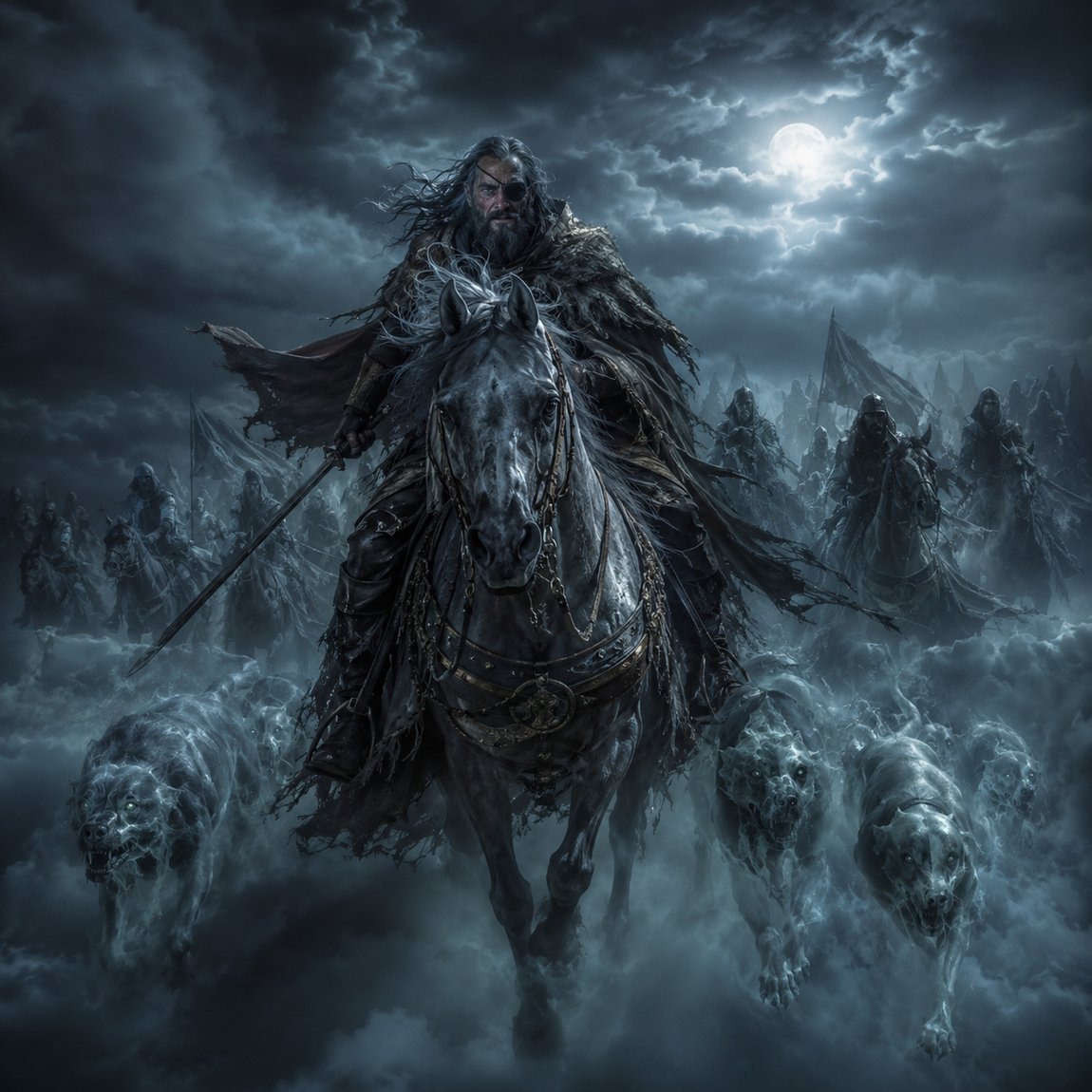
Zwölften is the name that prevails in central and northern Germany. It says nothing about smoke or spirits; it simply counts the days. In the legends of Mecklenburg and Pomerania this is the season when Wode and his host ride through the air; we have gathered the northern German traditions in The Wild Hunt in the Twelve Nights.
Rauhnächte, Raunächte, Rauchnächte are the Upper German names, above all Bavarian and Austrian. Whether the word comes from Middle High German rûch, "hairy, rough", or from censing (räuchern) has still not been settled; the debate is set out in the overview article. For the calendar all that matters is that the spelling "Rauchnacht" is closely tied to the censing on the great eves – that is, to the three or four nights, not to the series of twelve.
Innernächte and Unternächte ("inner nights", "under nights") are names that turn up in the encyclopaedias without their distribution being clearly definable. The "unter" is usually understood as "in between", meaning nights between the years. We could not find a reliable regional assignment and therefore leave it open.
Glöckelnächte are a special case that calls for care. In Salzburg and the neighbouring parts of Bavaria the Thursdays in Advent are called "Klöpfel-" or "Klöckelnächte", knocking nights. On them children and young men went from house to house, knocked, sang and asked for gifts. As early as 1520 Johannes Boemus describes such children knocking at doors, announcing the birth of the Lord, wishing a good new year and receiving fruit, nuts and pennies in return; Sebastian Franck names the Klöpfelnächte in 1534 in his Weltbuch. These Advent nights therefore fall before Christmas and strictly speaking do not belong to the Rauhnächte, even though some accounts merge the two. Something different again are the Glöckler of the Salzkammergut, who run through the villages on the evening of 5 January with illuminated headdresses and bells – they really do belong to the last Rauhnacht.
In the North the season has names of its own. In Norwegian the days between Christmas and New Year are called romjul. In Sweden the Christmas season only ends on tjugondedag jul, the twentieth day after Christmas, 13 January, which is known there as St Knut's Day: that is when Christmas is "danced out". In Iceland thirteen days of Jól are counted up to Þrettándinn on 6 January, when the last of the thirteen Yule Lads return to the mountains. Even between the Alps and the North Atlantic, the midwinter calendar varied greatly in length.
That the days between 25 December and 6 January form a unit is, first of all, a result of the church year. The Western church celebrated Christ's birth on 25 December; the Eastern church originally did so on 6 January, the feast of the Manifestation (Epiphany). When both dates found a place in both halves of the church during the fourth and fifth centuries, a festal span of twelve days lay between them.
It is often claimed that the Council of Tours introduced the "twelve holy days" in 567. That is an overstatement. The relevant canon of this council, canon 17, regulates the fasting seasons of monks. It lays down that between Christmas and Epiphany monks may eat every day, because each of those days is a feast. The exception is the first three days of January: on these, private rogations – litanies – were to be held, expressly against the pagan customs of the January Kalends, that is, against the Roman New Year festival. The canon presupposes the festal season rather than inventing it, and it is addressed to monks, not to the population at large.
The second major witness to customs at the turn of the year is some 450 years younger. Around 1010 Bishop Burchard of Worms asks in his penitential, the Corrector, whether anyone has observed the January Kalends in the manner of the pagans – according to the scholarly summaries, for example by decorating the house specially or leading processions of singers and dancers through the streets. Here too the subject is the start of the year on 1 January, not a series of twelve. Anyone who takes the Rauhnächte for a Germanic twelve-night festival will therefore find little support in these early sources: the number twelve comes from the church calendar, and the early prohibitions target New Year.
There is a northern counterpart all the same. Writing around 1230, Snorri Sturluson reports in Hákonar saga góða that King Hákon the Good moved the Yule feast by law to the time of the Christian Christmas; before that, it had begun on hǫkunótt, "Hǫku night" at midwinter, and lasted three nights. Three hundred years between the events and their telling call for caution, and the passage says nothing about a twelve-day feast. More on this in the article on Hákon the Good and under Yule.
The German phrase "zwischen den Jahren" sounds poetic, but it probably has a very practical background. In the Middle Ages the year did not begin on the same day everywhere. Many chanceries in the German-speaking lands long used the so-called Christmas style, in which the new year began on 25 December. Others reckoned from 1 January, the feast of the Circumcision of Christ, and still others from the Annunciation on 25 March or from Easter. Bede already records in the early eighth century that the pagan Anglo-Saxons began their year on the night before 25 December.
Anyone who drew up a charter between 25 December and 1 January therefore had to decide which year it belonged to. Many authors explain the phrase this way: depending on the reckoning, the days in between belonged to the old year or to the new one. The theologian and historian of customs Manfred Becker-Huberti links the expression to exactly these competing New Year dates, among which 6 January also counted. It is a plausible and widely repeated explanation; we were not able to check an unambiguous first attestation of the phrase that would prove it.
Only in the early modern period did 1 January generally prevail as the start of the year in the Holy Roman Empire. The Salzburg Institute of Folklore (Salzburger Landesinstitut für Volkskunde) gives 1691, under Innocent XII, as the date of the papal ruling on 1 January – an often-repeated figure whose papal document we were unable to consult; in practice many territories and chanceries had already switched in the sixteenth century. For the Rauhnächte this means that the notion of a "time outside of time" has a very tangible root in the disorder of the calendars themselves.
Many guidebooks say the Rauhnächte begin with St Thomas's Night because it is the longest night of the year. For the present day that is roughly true: in the Gregorian calendar the winter solstice falls on 21 or 22 December. For the period in which most of the customs took shape, it is not.
The Julian calendar, introduced by Julius Caesar in 46/45 BC, was slightly too long: against the solar year it lost about one day every 128 years. In the fourth century the solstice did indeed fall around 21 December, but by the late Middle Ages it had moved forward to 12 or 13 December. That is why, in Swedish popular tradition, St Lucy's Day on 13 December is still called the longest night – a remnant of the old reckoning. In 1582 Pope Gregory XIII had Thursday, 4 October, followed directly by Friday, 15 October. Since then the solstice has once again sat beside St Thomas's Day. The Protestant territories of the Empire adopted the reform only in 1700, so for more than a century two calendars ran side by side in the German-speaking lands.
For every custom older than 1582, then, the following applies: St Thomas's Night was not the longest night at the time but lay some nine to ten days after the solstice. For the late Middle Ages the link between St Thomas and the solstice is an accident of the Gregorian correction – or a memory of late antiquity, depending on how you read it. Anyone who suspects an ancient solstice celebration behind the Rauhnächte should bear this in mind; there is more on the astronomical date in the article on the solstice.
Until 1969, 21 December was the feast of the Apostle Thomas in the Roman calendar – "Doubting Thomas", who wanted to touch the wounds of the risen Christ. With the calendar reform that followed the Second Vatican Council his feast moved to 3 July; in many Protestant and Anglican calendars he stayed on 21 December. Folk custom held on to the old date regardless. St Thomas's Night is therefore still the night from 20 to 21 December – in some accounts the following night instead, which adds yet another layer of confusion to the counting.
In the Alpine region it was the first of the great Rauhnächte and so the first night of censing. It was also a night of divination, above all for young women who wanted to learn something about their future husband. Such love oracles were tied to several winter nights – to St Andrew's Night on 29/30 November, to St Thomas's Night, to Christmas Night and to New Year's Eve. The practices involved, from throwing a shoe over one's shoulder to listening at doors, are covered in the article Oracles between the years.
One reason why St Thomas in particular opened the season is fairly obvious: his was the last major saint's day before Christmas, and its eve offered itself as the start of the festal period. Then there is the closeness to the solstice – which, as we have seen, has only been accurate again since the calendar reform.
The night from 24 to 25 December is the core night of every reckoning. For the church it is Holy Night, with Midnight Mass; for the folklorist it is the densest night of the winter. According to a widespread belief, animals in the byre could speak at midnight, and whoever eavesdropped on them, people said, would hear news of their own death and die within the year. Well water was supposed to turn into wine at midnight, trees to blossom, treasures to open up. In the Alpine lands houses were censed on Christmas Night, and it was one of the "fat" nights, with plenty to eat after the fast of Christmas Eve.
Many of these ideas are miracles given a Christian reading: the animals speak because they stood by the manger; water turns to wine in memory of the wedding at Cana, which the old liturgy associated with Epiphany. Whether older, pre-Christian notions lie behind them is an open question that the sources cannot settle.
26 December is the day of St Stephen, the first martyr. In the Bavarian and Austrian region he was regarded as the patron of horses. On St Stephen's Day horses were blessed, in some places with a mounted procession, the Stephansritt, and they were given blessed oats or blessed salt. There is a parallel in the North: in Sweden the Staffan song celebrates a "Staffan Stalldräng", a stable lad who waters the horses early in the morning. How the horses came to be linked with Stephen has not been explained. All that is certain is that the custom hangs on this church day and not on "the second Rauhnacht".
27 December belongs to the Apostle and Evangelist John. On this day the Catholic Church still blesses St John's wine. It was drunk as "Johannesminne", a toast to the love of St John, and given to travellers, bridal couples and the sick. The legend behind it tells that John blessed a poisoned cup, whereupon the poison escaped from it in the form of a snake. That the word "Minne" here recalls an older drink of remembrance is a long-standing scholarly suggestion; but St John's wine cannot be traced with any certainty to the Germanic memorial cups that the sagas describe at Yule banquets.
28 December is Holy Innocents' Day, commemorating the massacre of the children of Bethlehem. Of all days, this one became the children's day. In Bavaria, Austria and Franconia children went from house to house with switches of birch or juniper and struck the adults lightly with them, a custom known regionally as "Pfeffern" ("peppering") or "Fitzeln". As they did so they recited verses of good wishes and received pastries or money. The stroke of the "rod of life" was meant to bring health. In Styria no washing was to hang outside in the night before 28 December, because the souls of unbaptised children might get caught in it – a tale that ties the washing taboo to this calendar day.
The 29th and 30th of December are days without a major feast. In the Roman calendar the 29th is dedicated to Thomas Becket, the Archbishop of Canterbury murdered in his cathedral in 1170; hardly any popular customs attach to him in the German-speaking lands. These "quiet" days are exactly what explains why the series of twelve mattered less in folk custom than the great eves. Where there was no saint with a custom of his own, there was also little that had to be done in a particular night – apart from the general taboos that applied to the whole season.
31 December bears the name of Pope Sylvester I, who is said to have died on this day in 335; German still calls New Year's Eve "Silvester". It was the fact that his death day falls on the last day of the year that made him the emblem of the turn of the year, not any link with older New Year customs. In the Alpine lands New Year's Eve is the third of the great Rauhnächte and once again a night of censing.
New Year's Day itself, 1 January, was in the old liturgy the octave of Christmas and the feast of the Circumcision of Christ; since the calendar reform of 1969 the Catholic Church has kept it as the Solemnity of Mary, Mother of God. The Roman origin of 1 January as the start of the year is clear: from 153 BC onwards the consuls took up office on that day. That is why the early church prohibitions were aimed at the "Kalends of January" – the Roman New Year festival, with its gifts, masquerades and feasting, lived on stubbornly in Christian communities.
Many of the best-known New Year's Eve customs of today belong to layers of their own. The ceremonial firing of guns to greet the new year, for instance on the Dürrnberg and the Mönchsberg in Salzburg, counts as a salute to the coming year; fireworks have been known in Europe since the Renaissance. Lead pouring – dropping molten metal into water and reading the shapes – is a divination custom whose history, and whose present-day substitutes of wax or tin, are traced in a separate article. Wishing a happy new year was a begging custom: children, servants, night watchmen and musicians went from house to house with verses of good wishes. The lucky charms, too – pig, four-leaf clover, horseshoe, chimney sweep – are early modern or later. How people consulted the future on this night is told in Oracles between the years.
The night from 5 to 6 January is the last and, in many regions, the most dangerous Rauhnacht. Since the late Middle Ages 6 January has also been called Perchtentag or Perchtag in the Bavarian and Austrian region – named after a figure who went about in this night, checked on the spinners and punished lazy maidservants. The connection between Perchta and Epiphany is old; the interpretation of her as a Germanic goddess, by contrast, is a nineteenth-century thesis of Jacob Grimm. Both are dealt with in the articles Perchta and the Perchten and Frau Holle.
In the same night the Glöckler run through the Salzkammergut with their illuminated, intricately cut headpieces; in the Pinzgau, the Pongau and the Gastein valley groups of Perchten go on their rounds. Salzburg folklore research traces many of these masked processions back to Baroque religious teaching and the period's love of play, and points out that it was only in the nineteenth century that summer visitors and scholars began interpreting them as "ancient" and rooted in nature myth. That corrects the widespread notion that Perchten runs are direct descendants of pagan cults.
6 January itself is the feast of the Epiphany of the Lord. Bound up with the legend of the three wise men from the East – known since the Middle Ages as Caspar, Melchior and Balthasar, whose relics have been venerated in Cologne since 1164 – are Epiphany water, the blessing of chalk and star singing. The letters written above the front door – such as 20*C+M+B+27 – are read today as Christus mansionem benedicat ("May Christ bless this house"), and popularly also as the initials of the three kings. As an organised charity campaign, star singing has existed in Austria since 1954 and in Germany since 1959; the custom of singers going round for gifts is older.
With Epiphany the Christmas season ends in central Europe by the popular reckoning. The spinning wheels could come out again; the rest from work was over. In the church, under the older order, the Christmas cycle extended to Candlemas on 2 February, the day on which in many places the farming year also began afresh, with the settling of accounts and the change of farm servants.
The best-known rule of the Rauhnächte runs like this: the weather of each of the twelve days shows the weather of one of the twelve coming months. The first day stands for January, the second for February, and so on. A "Lostag" – an omen day – is a fixed date on which people inferred the weather of a longer period; the weather, as it were, "drew the lot" for the weeks ahead. In the Zwölften this logic is applied to a whole run of days.
Where does it come from? The earliest clearly identifiable evidence in the German-speaking world is a printed book: the so-called Bauernpraktik, or "farmers' practice", which first appeared in 1508 as Pauren practick. Its author is unknown; scholarship, led by Hellmut Rosenfeld in the Verfasserlexikon, places him in eastern Swabia. The core of the original booklet was exactly this method: predicting the weather of the twelve months from the weather of the twelve days after Christmas. Later editions expanded the text with calendar material, further weather rules that often repeat or contradict one another, and the Cisiojanus, a rhymed mnemonic of the saints' days. By 1530 the work had found its lasting form; more than sixty editions appeared in Germany. It was translated, among other languages into Danish, where the first edition came out in 1597 and many further ones were printed in Norway.
It is worth being clear about what this book stands for. It is not evidence of primeval peasant wisdom but early modern popular literature, printed, sold and aimed in good part at town readers. Its weather rules rest largely on astrological learning mixed with German folk tradition. The idea that the first days of a period anticipate its whole course is a figure of thought from learned astrometeorology, which passed into print and from there into oral tradition. The Norwegian reference work Store norske leksikon notes that, despite its many printings, the Bauernpraktik left only few traces in Norwegian folk tradition – a hint that printed rules did not automatically become folk custom.
A good three hundred years later Joseph Görres discussed an edition of this "Bauernpractika oder Wetterbüchlein" in his book Die teutschen Volksbücher (Heidelberg 1807). He names a Frankfurt printing of 1570 and an author "Henericum von Uri" as his source, but expressly does not rule out older predecessors. His explanation of the method is still one of the clearest:
„Man kennt das alte astrologisch meteorologische Dogma, daß die Natur der zwölf Monathe des Jahrs vorgebildet werde durch die zwölf Nächte, die der Christnacht oder eigentlich dem Wintersolstitium folgen. Dies Dogma gründete sich auf die alte mythologische Ansicht, daß das Jahr gleichsam mit dem Wintersolstitium gebohren werde, und daher in der zarten Jugend schon, wie am Menschen, die spätere Entwickelung sich spiegeln müsse […].“
"Everyone knows the old astrological and meteorological dogma that the nature of the twelve months of the year is prefigured by the twelve nights that follow Christmas Night, or rather the winter solstice. This dogma was founded on the old mythological view that the year is, as it were, born at the winter solstice, and that therefore, as in a human being, its later development must already be mirrored in its tender youth […]."
Joseph Görres, Die teutschen Volksbücher, Heidelberg 1807, section on the "Bauernpractika oder Wetterbüchlein" (original wording from the digitised text at Projekt Gutenberg-DE; English translation our own)
Görres goes on to say that this assumption is "scientifically inadmissible", because it contradicts the cyclical nature of the heavenly motions, yet he grants it "a poetic charm of its own". That he already considered the "dogma" old and mythological in 1807 proves no Germanic origin, but it shows how early this reading set in.
Older than the Bauernpraktik are prophecies based on the weekday on which the year begins. English and continental manuscripts of the high Middle Ages contain so-called prognostics that derive the harvest, weather and misfortunes of the coming year from the weekday on which Christmas or 1 January falls; one widespread group of texts goes under the name "Revelation of Ezra" (Revelatio Esdrae). Prognostics based on the wind during the twelve days of Christmas are also known from Old English manuscripts. These texts show that divination at the turn of the year was at home in the learned Christian manuscript culture of the Middle Ages – long before folklorists interpreted it as a pagan inheritance. We know the details of this manuscript tradition only from secondary literature.
In practice the method was simple. On each of the twelve days you observed the sky, the wind and the precipitation and noted down the result, sometimes directly in the calendar. A bright, cold first day promised a clear January, a stormy fourth day a stormy April. Exactly where the series began – on Christmas Day, on St Stephen's Day or as early as St Thomas – varied between printings and regions.
Meteorologically the twelve-day rule cannot be sustained. There is no physical mechanism by which the weather of a December day could determine the weather of a particular month in the following year, and no analysis has shown any such connection. Things are different with individual recurring weather patterns, known as singularities: weather situations that occur more often than chance would predict at a certain time of year. Among the few that meteorologists regard as reasonably well defined for central Europe is the "Christmas thaw" – the mild, often rainy spell around the holidays that so often spoils the hope of a white Christmas. But it says something only about the holidays themselves, not about the coming year.
There is a calendar trap as well. Anyone who set up a rule before 1582 meant Julian dates. Measured against the solar year, the "twelve days" then fell about ten days later than they do now. A rule that ties one particular day to one particular month had therefore already been thrown out of step by the calendar reform.
Alongside the oracles stand the taboos. They are the part of the Rauhnächte that has survived most stubbornly to this day – often among people who otherwise have nothing to do with Rauhnacht customs.
Do not hang out washing. A widespread rule said that white laundry should not be left outside to dry during the Twelve Nights and that no clothes lines should be strung up. The reasons vary: the Wild Hunt might get tangled in the lines; the spirits would take the sheets and bring them back in the coming year as a shroud for a member of the family. A sober explanation sits alongside: in an age without tumble dryers washing in winter was laborious, and the holidays were days of rest. The two do not exclude each other.
Do not spin. Spinning wheels were put away, and the distaff had to be spun empty before Christmas. Anyone who went on spinning or left flax on the distaff was threatened, in the world of legend, by Perchta or Frau Holle, who punished negligent spinners. Behind this lies a working year in which the spinning room filled the winter and the feast days meant an enforced break.
Nothing turning, nothing stirring. In parts of Bavaria no spinning wheel was allowed to run and no dough to be stirred during this time. Whether this reflects an idea of a year "standing still" or simply holiday rest cannot be separated out from the evidence.
Do not go out alone. Women and children were not to be outside alone after dark, card games and noise were forbidden, and doors and windows were to stay shut.
Almost all of these taboos are only densely documented in the collections of the eighteenth and nineteenth centuries. They show an attitude to the festal season that is strongly Christian in character: rest from work on holy days, caution at night, order in the house. Some of the figures who watch over these rules are older – but here too many centuries lie between the earliest records and the farmhouse parlour of the nineteenth century, and they cannot simply be skipped over.
Anyone who buys a Rauhnacht calendar today or looks one up online usually finds a table in which each night is given a month and a theme: the first night stands for January, the second for February and so on, together with keywords such as "letting go" or "trust" that are distributed differently from book to book. Added to this are journaling prompts, incense blends for each night, and assignments of angels, colours or crystals.
The framework of this table – one night per month – is a further development of the omen-day logic of the Bauernpraktik. "The weather of the first day shows the weather of January" becomes "the mood of the first night shows the mood of January". The themes themselves, however, are new. They differ from book to book, and there is no evidence for any of these assignments in the folklore collections of the nineteenth and early twentieth centuries. The dream rule, too – whatever you dream in the twelve nights will come true in the corresponding month – is presented in guidebooks as tradition; we were unable to check in what form it appears in older collections.
The same goes for the "ritual of the thirteen wishes". Before the first Rauhnacht you write thirteen wishes on separate slips of paper, fold them, and in each of the twelve nights burn one of them unread; the thirteenth wish, the one left over, you have to fulfil yourself. The ritual has become so widespread that pastors mention it in their Rauhnacht programmes and psychologists recommend it in media interviews. We found no historical evidence for it in folklore research, in legend collections or in older descriptions of customs. Everything suggests that the ritual arose in self-help literature of the last few decades; who invented it is not clearly documented. The number thirteen is probably explained by the arithmetic problem at the start: counting from Christmas Night to Epiphany Night gives thirteen nights.
Customs are always being created anew, and a ritual that helps people reflect on the old and the new year does not need a Germanic pedigree – it simply should not claim one. For a quieter way of remembering the dead in these days there is a separate article: Remembering the ancestors in the Rauhnächte.
If you sort everything by the age of its evidence, a small solid core remains – with four younger layers on top: the Christian festal calendar, the early modern period with its ritual books and the Bauernpraktik, the folk custom collected from the eighteenth to the early twentieth century, and the present day.
Much that is often presented as certain, on the other hand, remains open: whether there was a fixed number of midwinter nights before Christianisation, whether individual taboos carry older ideas forward, and which region preferred which count. The surviving sources do not answer these questions.
For the coming turn of the year, the most important dates look like this. The table gives the evening on which each night begins and the feast of the following day, to which the traditional customs are attached.
| Night | Evening | Feast of the following day | Traditional association |
|---|---|---|---|
| 20/21 Dec 2026 | Sunday | St Thomas (old date) | first great Rauhnacht, love oracles |
| 24/25 Dec 2026 | Thursday | Christmas Day | "fat" Rauhnacht, censing |
| 25/26 Dec 2026 | Friday | St Stephen | blessing of horses |
| 26/27 Dec 2026 | Saturday | St John | St John's wine |
| 27/28 Dec 2026 | Sunday | Holy Innocents | "Pfeffern", "Fitzeln" |
| 31 Dec 2026/1 Jan 2027 | Thursday | New Year | third great Rauhnacht, divination customs |
| 5/6 Jan 2027 | Tuesday | Epiphany, Perchtentag | last great Rauhnacht, Glöckler, star singers |
When do the Rauhnächte begin? That depends on the reckoning. Today the most common start is Christmas Night, from 24 to 25 December; older Alpine counts begin with St Thomas's Night, from 20 to 21 December, and the Twelve Days of Christmas in the church's sense begin on 25 December.
Are there twelve nights or thirteen? From Christmas Night up to and including Epiphany Night there are thirteen. If you want exactly twelve, you leave out either Christmas Night or Epiphany Night as a separate frame.
Which Rauhnächte are the most important? In the Alpine region, four: St Thomas's Night, Christmas Night, New Year's Eve and the night before Epiphany. Christmas Night and Epiphany Night were considered the "fat" Rauhnächte there.
How old is the rule "twelve days for twelve months"? In the German-speaking world it is first securely attested in the printed Bauernpraktik of 1508. Divination at the turn of the year already existed in the learned manuscript culture of the Middle Ages; a Germanic origin is not documented.
Is it all right to do the laundry between the years? The taboo is a folk belief that is densely documented in the collections of the eighteenth and nineteenth centuries. Anyone who keeps it today is keeping up a custom – no serious source suggests any danger in breaking it.
The Rauhnächte & Mother's Night · The Wild Hunt in the Twelve Nights · Oracles Between the Years: Lead Pouring, the Onion Calendar and the Divination Customs of the Winter Nights · Perchta and the Perchten: from the goddess theory to the Perchtenlauf · Frau Holle & the old goddess.
All Festivals & Belief articles →
The Rauhnächte are the roughly twelve nights between Christmas and Epiphany, a stretch that German and Alpine folk …
Read more →The Norse had no holy book, no pope and no fixed liturgy. Their faith lived in action: in the sacrificial feast at the …
Read more →Samhain is said to be the festival when the boundary to the otherworld grows thin, the "Celtic New Year" and the true …
Read more →Barbarossa sits in the Kyffhäuser, his beard growing around a stone table, waiting. Almost every German knows the …
Read more →