A spoon held over a candle, a hiss in the water glass, and everyone leans in over a lump that is supposed to be a ship, a heart or perhaps a hedgehog. Pouring lead on New Year's Eve is the last survivor of a dense web of oracles through which people in the winter nights between St Andrew's Day and Epiphany asked about their future. Young women threw shoes over their shoulders, slipped onions under their pillows and pulled logs from the woodpile in the dark; farmers filled twelve onion skins with salt. This article follows these customs through their layers of time – from late antique church prohibitions through seventeenth-century writers and nineteenth-century folklore studies to EU law in 2018 – and separates what the sources actually show from what is often claimed.
German has a phrase for the days after Christmas: zwischen den Jahren, "between the years". It describes a stretch of time that no longer quite belongs to the old year and not yet to the new one. That the twelve days from Christmas to Epiphany form a single festive season goes back to a church decision, taken at the Second Council of Tours in 567. How this season became the "Rauhnächte" – the rough or smoke nights of German-speaking Europe – and why there are twelve of them is the subject of our introductory article on the Rauhnächte and Modranecht. This article is about one particular activity that shaped these weeks: questioning the future.
The logic behind it was simple. What happens at the beginning sets the direction for the whole. The English folklorist Clement A. Miles summed this up in 1912 with the German proverb Anfang gut, alles gut – a good beginning makes a good whole – and described New Year customs as attempts to read or influence the future through supposed analogies. Have money on the table at the start of the year and you will have it all year long. Dream on Christmas night and you see what is coming. Say the right rhyme on St Andrew's Eve and you will learn whom you are going to marry.
Not all of these dates fall within the twelve nights. The oracle calendar opened on St Andrew's Eve, the night of 29 to 30 November, continued through St Barbara's Day on 4 December, St Lucy's night before the 13th and St Thomas's night before the 21st, peaked on Christmas Eve and faded out with New Year's Eve and the night before Epiphany. Which night counted as a day of portent varied from one region to the next. The individual nights with their names and ways of counting, the weather days and the rule that each of the twelve days foretells one month are covered in our companion piece The twelve Rauhnächte night by night. This text concentrates on the oracles people performed themselves: pouring, throwing, placing, pulling and dreaming.
Anyone reading about winter oracles soon comes across sentences like "the ancient Germans already poured lead". Such statements blur the question of when our information actually dates from. The oldest layer consists of church prohibitions from late antiquity and the early Middle Ages that condemn customs held on the Kalends of January, the Roman New Year's Day. They tell us that New Year oracles existed, but rarely what they looked like. The second layer is formed by Old Norse narrative texts of the thirteenth and fourteenth centuries about seeresses and nocturnal "sitting out". The third consists of early modern writers – preachers and collectors of the sixteenth and seventeenth centuries who listed Christmas superstitions, usually with disapproval, and in doing so describe individual oracles in recognisable form for the first time.
The fourth and by far the thickest layer is the folklore scholarship of the nineteenth and early twentieth centuries, which flowed into reference works such as the ten-volume Handwörterbuch des deutschen Aberglaubens (Concise Dictionary of German Superstition, 1927–1942). Almost everything we know about shoe throwing, log pulling or onion oracles comes from here. The fifth layer is the present: drugstore kits, New Year's Eve parties, Rauhnacht self-help guides and European chemicals law. That a custom was first written down in the nineteenth century does not mean it originated then – but neither does it mean it is a thousand years old. For most winter oracles, their age simply cannot be determined.
The earliest references come from people who wanted to abolish these customs. In the late antique West, 1 January was a boisterous festival of masked processions, gifts and omens. A sermon transmitted under the name of Augustine, which according to Miles probably goes back to Caesarius of Arles in the sixth century, rebukes people who interpret omens on the Kalends of January and refuse to give fire out of the house on that day. Whatever you give away on the first day, so the reasoning went, you will lack for the rest of the year.
In 742 the missionary Boniface complained to Pope Zacharias about reports from Rome itself: travellers from the Frankish kingdom had seen pagan processions and laden tables there on the Kalends of January, and nobody was willing to lend a neighbour fire or iron. Boniface feared that such scenes undermined his mission. The episode shows that New Year superstition was not a peculiarly Germanic possession but a legacy of the Roman New Year that had spread across Europe.
For the German-speaking lands the best-known document is the Corrector sive Medicus in the canon-law collection of Bishop Burchard of Worms, compiled around 1008 to 1012 – a catalogue of questions for confessors. According to the translation given in the scholarly literature (I was not able to consult the Latin wording myself), Burchard asks in question 62 whether anyone at New Year has laid the table in the house with stones or food, or has sat on the roof of the house and drawn a circle around himself with his sword in order to see what lies ahead in the coming year, or has sat for the same purpose on a bull's hide at a crossroads. How much of this reflects lived practice in the Rhineland and how much was copied from older penitentials is disputed, because such texts frequently borrowed from one another.
A later witness that Miles cites comes from Bohemia: the Largum sero of the monk Alsso of the monastery of Břevnov, written around 1400. He complains that people put money on the table on Christmas Eve to conjure up wealth, and cut open fruit in order to read the future. Here an oracle appears that still belongs to Christmas Eve in the Czech Republic today.
Were there similar winter oracles in the North? There is prophecy in winter, but no evidence for a fixed Yule oracle. The best-known scene comes from Eiríks saga rauða, the Saga of Erik the Red. During a famine winter in Greenland, the seeress Þorbjörg, "the little völva", is invited to a farm to say when the hardship will end. Only after the young Christian woman Guðríðr sings an old chant does she see what is to come. Our article on the völva tells the scene in detail, and the one on seiðr places the magical practice in context. Two things matter for our theme. The prophecy happens in winter because winter is the season of want, and it is performed by a specialist, not by every household. The saga, moreover, was only written down in the thirteenth century.
Closer to farmhouse custom is útiseta, "sitting out" at a crossroads or on a burial mound in order to gain hidden knowledge; according to scholarly accounts, medieval Christian laws of the North prohibited the practice. In Icelandic folk tradition as collected by Jón Árnason in the nineteenth century, sitting at the crossroads is tied to Christmas night or New Year's night, when the elves move house and offer gifts to the person waiting there. The parallel with Burchard's bull's hide at the crossroads is striking. Whether it reflects a common root or whether similar ideas arose independently cannot be decided from the sources we have.
The lot oracle described by Tacitus is also often linked to the Rauhnächte. In chapter 10 of his Germania, written in AD 98, he describes how the Germanic peoples cut a branch into slips, marked them with signs, scattered them on a white cloth and interpreted three of them; our article on Germanic oracles explains the procedure. But Tacitus names no date in the yearly cycle. The lots were consulted when a decision was pending, not at the turn of the year. The sources draw no line from those marked slips to lead pouring.
The apostle Andrew's feast falls on 30 November; the first Sunday of Advent is the Sunday nearest to that day. In the folklore of Central and Eastern Europe, the night before is above all the great night of marriage oracles. Why Andrew in particular acquired this role is unclear; nothing in his legend explains it. It probably has to do with his place in the calendar at the threshold of the dark season, but that cannot be proven.
Miles assembled what happened on this night from older German and Eastern European collections. Before falling asleep, a girl recites a rhyme to the saint and sees her future husband in a dream; such "St Andrew's prayers" are recorded in many regional versions across the German-speaking world. Another form involves setting out two cups, one of wine and one of water. If the man in the dream drinks from the wine, he will be rich; if he reaches for the water, he will stay poor.
Especially important for our theme is a third procedure that Miles gives for St Andrew's Eve: molten lead or tin is poured through the bit of a key into cold water, and the shape reveals the trade of the future husband. In some places egg white was used instead. Lead pouring, in other words, was originally neither tied to New Year's Eve nor a family game, but one of several love oracles practised by young women.
St Andrew's Eve has stayed most alive in Poland. At the andrzejki on the evening of 29 November, people pour wax through the hole of a large key into cold water and interpret the shadow the figure casts on the wall. For the North, by contrast, there is almost nothing connected with Andrew: the St Andrew's oracles are a Central and Eastern European phenomenon, densely attested in Germany, Austria, Bohemia, Poland, Romania and the Balkans.
What links these oracles is their material. Nobody needed a seeress or special equipment; people used whatever was in the house. In log pulling, a girl went to the woodpile in the dark and drew out a log without looking. A straight, smooth piece promised a slim, well-built husband; a gnarled one a coarse or even hunchbacked man. The interpretation is so obvious that it reads like a joke, and often it probably was one. It was precisely this mixture of earnestness and laughter that gave the custom its appeal.
In the nutshell oracle, half walnut shells carrying candle stubs were set afloat in a bowl of water, each standing for a girl or a young man, and the shells that drifted towards each other foretold a couple. Not every oracle was about love. Whoever heaped up a small pointed mound of flour on St Andrew's Eve and found it collapsed in the morning was, according to popular belief, destined to die in the coming year. In Romania mothers put a twig in water for each child, and the child whose twig blossomed was to have good fortune – a close relative of the Barbara branches cut on 4 December so that they flower by Christmas. In Croatia young people fasted on St Andrew's Eve in order to see their future partner in a dream. Piety and curiosity about the future lay close together: the Church condemned the oracles, yet they took place on saints' days and with prayers addressed to saints.
St Lucy's night, leading into 13 December, fell close to the winter solstice before the calendar reform of 1582 and was regarded in many places as a particularly long night. In Scandinavia Lucia is today the festival of light, a custom attested only from the eighteenth century; our article on the Nordic roots of Christmas customs puts it in context. Older reports know an oracular side as well. Following the Danish folklorist Henning Frederik Feilberg, Miles quotes a prayer of Danish maidservants in which they ask Lucia whose table they will lay, whose bed they will make and whose child they will carry. From Lower Austria he reports girls who cut notches into willow bark beside a stream at midnight and read the marks on New Year's Day.
St Thomas's night, leading into 21 December, bears the name of the "doubting" apostle, whose feast fell on that day until the Catholic calendar reform of 1969; since then the Roman Catholic Church has kept it on 3 July. For folklore, the old date is what counts. St Thomas's night was regarded in many places as the first, or as one of the "great", Rauhnächte, and it was an uncanny night. Miles reports that girls wrapped a peeled onion in a handkerchief, laid it under the pillow and asked the saint for a dream of their sweetheart. Shoe throwing also belongs here. For Westphalia he records the belief that one had to eat and drink plentifully on St Thomas's night so as not to suffer want in the new year – once again the analogy of the beginning.
The night from 24 to 25 December was the most powerful night for oracles. For the German Christmas Eve, Miles lists lead pouring, shoe throwing, log pulling and nutshells, and remarks drily that it would be tedious to describe every method individually. More important than any single one is the overall finding: the forms used on St Andrew's Eve recur on Christmas Eve. The oracles were attached less to a particular day than to the whole dark season.
There were also customs peculiar to Christmas Eve. Among the South Slavs a girl laid a table with white bread and cutlery and went to bed; at midnight the spirit of her future husband was supposed to appear. In Russia people sang the podblyudnye, the "dish songs", around a covered bowl of water holding rings and tokens. After each song a token was drawn, and its owner applied the verses to herself. Best known is the belief that animals in the stable speak with human voices at midnight. Miles retells the legend of an Alpine farmhand who hid in the stable, heard the horses talking about his approaching death and died that very week. Here the line between oracle and cautionary tale blurs: nobody was supposed to try this, and that was precisely the message. Anyone who went out at night to listen also risked, according to popular belief, meeting the furious host described in our article on the Wild Hunt in the twelve nights.
Hardly any winter custom is so routinely called "ancient" as lead pouring. Popular texts trace it back to the Romans, the Greeks or Babylon. During research for this article, no ancient source could be found for any of these claims. The derivation sounds plausible because the Romans worked lead in enormous quantities. But the availability of a metal does not mean anyone used it for divination. Even an article on the German site wissen.de that repeats the Roman origin wraps it in "some say" and "allegedly" and names no source.
Nor does the learned term molybdomancy – from Greek mólybdos, "lead", and manteía, "divination" – prove great age. It is a coinage modelled on ancient terms for divination, and I could not date its first appearance. For comparison: in 1456 the physician Johannes Hartlieb, in his "Book of All Forbidden Arts", a work commissioned by Margrave John of Brandenburg-Kulmbach, classified the divinatory arts as necromancy, geomancy, hydromancy, aeromancy, pyromancy, chiromancy and spatulamancy (reading shoulder blades). I have not come across an explicit medieval reference to pouring lead at New Year. The practice becomes tangible in the folklore record, first as a love oracle on St Andrew's Eve and on Christmas Eve. The literature available to me was not sufficient to date the first German reference precisely.
A side glance shows that pouring metal was not only meant to reveal the future but also to heal. In Turkey kurşun dökme is a folk-medical ritual against the evil eye: molten lead is poured into a bowl of water held over the sick person's head, and the shape reveals the cause of the ailment. Similar practices are described for Bosnia and for the Yiddish folk medicine of Eastern Europe. No single origin can be derived from this.
In northern Europe, Finland has preserved the custom most faithfully. Uudenvuodentina, "New Year's tin", is melted in a ladle on New Year's Eve and tipped into a bucket of cold water; people read both the figure and its shadow in the candlelight. Despite the name, the casting pieces long consisted largely of lead. According to overview accounts, the Finnish Safety and Chemicals Agency, Tukes, made clear in 2018 that selling lead to consumers was not permitted; since then New Year's tin has been mostly lead-free.
In the course of the nineteenth and twentieth centuries, lead pouring in the German-speaking world shifted from St Andrew's Eve and Christmas Eve to New Year's Eve, and an oracle of young women became a game for everyone. There is no precise date for this change, but it fits the way 31 December, with urban New Year's Eve celebrations, became the real turning of the year while St Andrew and St Thomas faded from everyday life. With the date, the question changed too: no longer "Whom shall I marry?" but "What will the new year bring me?"
The kits with lead bars in the shape of good-luck charms, a pouring spoon and an instruction leaflet turned an open game of interpretation into a semi-standardised one. The leaflet would explain that a ship meant a journey, a heart meant love, a pig meant luck. These meanings vary from manufacturer to manufacturer and rest on no fixed tradition. Yet the openness of the shapes was the heart of the custom. A lump of solidified metal is almost never unambiguous, and what people see in it says more about the onlookers than about the future.
Since 2018, German drugstores have no longer sold pouring kits containing real lead. Many reports say that the EU "banned" lead pouring, and "from April 2018". Neither statement is accurate as it stands. The legal position follows from two regulations of the European Commission.
Regulation (EU) 2016/1179 of 19 July 2016 amended the European classification regulation for chemicals, the CLP Regulation (EC) No 1272/2008. It classified lead as toxic to reproduction, category 1A – a substance known to impair fertility or the development of the unborn child. The Risk Assessment Committee of the European Chemicals Agency had proposed this on 5 December 2013. Because it was uncertain how well the body absorbs compact lead, the regulation distinguishes lead powder with a particle size below one millimetre, with a limit of 0.03 per cent, from lead in massive form of one millimetre and above, with the general limit of 0.3 per cent. Under Article 2 it applies from 1 March 2018.
Regulation (EU) 2017/1510 of 30 August 2017 added the newly classified substances to the appendices of Annex XVII of the REACH chemicals regulation, Regulation (EC) No 1907/2006. Lead has since been listed in Appendix 5, both as powder and in massive form; this too applies from 1 March 2018. Appendix 5 belongs to entry 30 of Annex XVII, which prohibits supplying such substances on their own or in mixtures to the general public once their concentration reaches the limit.
For lead pouring this means that since 1 March 2018, no lead at 0.3 per cent or more may be sold to consumers in the EU. According to press reports, the usual kits consisted of around 70 per cent lead. The frequently quoted date "April 2018" does not appear in the regulations. What is prohibited, moreover, is neither the custom nor owning old kits, but supplying lead to the public. Even so, old pieces of lead should no longer be heated. The German Environment Agency has repeatedly warned that heating releases lead oxides into the room air and that residues cling to hands and objects, which is particularly dangerous for children. Even small amounts of lead can impair their development. Old kits belong at a hazardous-waste collection point, not in household rubbish.
Shops today mainly offer wax and lead-free tin. Wax pouring is the simplest option. Melt candle ends in an old spoon over a candle or in a bain-marie and pour the wax quickly into cold water. The soft figures work well for the shadow play on the wall that belongs to the custom in Finland and Poland anyway. Wax must never be heated until it smokes, because overheated wax can ignite – and burning wax must never be put out with water, since it spatters explosively. Keep a lid within reach on the table.
Tin pouring comes closest to the metal lumps of the past. Tin melts at around 232 degrees Celsius, lead at about 327 degrees; both are hot enough to cause severe burns. The most important rule is that spoon and metal must be completely dry: a single drop of water in the hot spoon flashes into steam and can fling molten metal out. Pour with your arm outstretched, without leaning over the bowl, which should stand firmly and not be made of thin plastic. Children watch from a distance and under supervision. If you buy tin, look for a clear "lead-free" label and a seller based in the EU.
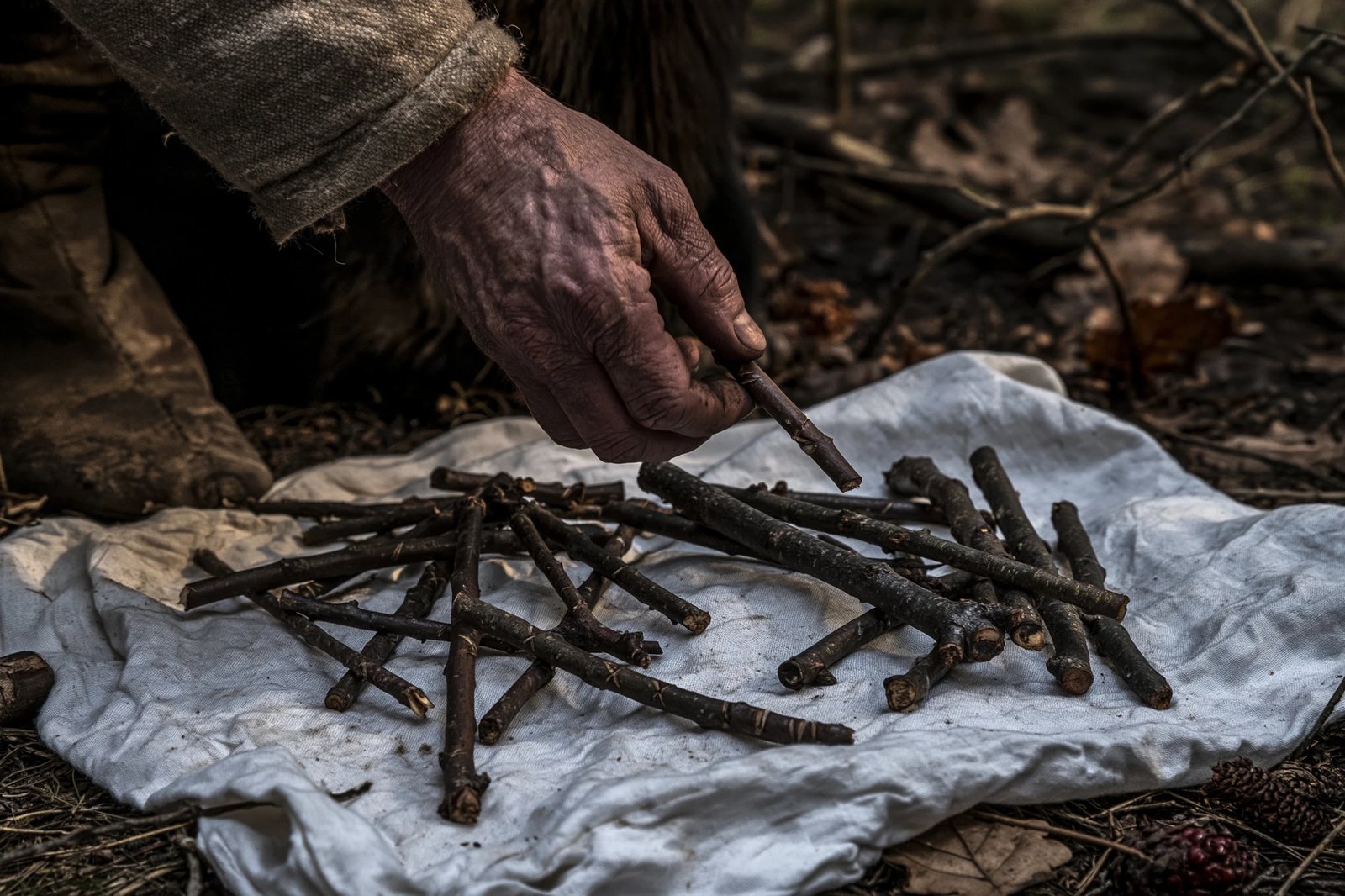
The second great oracle of the winter nights is a weather oracle, and it is surprisingly well documented. You cut an onion in half, separate twelve cup-shaped layers, name each after a month of the coming year, set them out in order on a board or table and fill each with a little salt. The next morning you check. Where the salt has turned damp or a small pool has formed, that month will be wet; where it has stayed dry, the month will be dry.
The most thorough account is the entry "Zwiebel" (onion) in the Handwörterbuch des deutschen Aberglaubens, written by the botanist and folklorist Heinrich Marzell (volume 9, columns 964–971). According to Marzell, the onion calendar was usually set up on Christmas Eve or New Year's Eve, occasionally on St Thomas's night. It was known throughout the German-speaking area, though apparently less often in northern Germany. Beyond that, Marzell cites records from France, from the Romanians of Bukovina, the Sorbs, Czechs, Slovenes, Serbs and Croats, the Hutsuls, Bulgarians and Russians, and emigrants carried the oracle as far as the German-speaking communities of Pennsylvania. The onion calendar is therefore not a specifically Germanic oracle but a pan-European one.
As the first literary reference, Marzell names the Magiologia of the Swiss pastor Bartholomäus Anhorn, published in 1675. Like many Protestant clergymen of his time, Anhorn wrote against superstition and sorcery, and precisely for that reason he described it carefully:
„Andere stellen am Christ-Fest-Abend zwölff / außgehölte / vnd mit Salz gefüllte [Zwiebeln] oder Böllen auf.“ – "Others, on the eve of the Christmas feast, set out twelve hollowed-out onions [or 'Böllen'] filled with salt."Bartholomäus Anhorn, Magiologia (1675), p. 136; wording quoted from Heinrich Marzell, art. "Zwiebel", Handwörterbuch des deutschen Aberglaubens, vol. 9, col. 967 (abbreviated there as "Z.en", expanded here); not checked against the original print. English translation our own.
Böllen is the Alemannic word for onions, still alive in Switzerland today. The sentence is short, but it contains the whole procedure: the date on Christmas Eve, the number twelve, the hollowed skins, the salt. It does not tell us how old the custom already was in 1675. It only shows that it was familiar enough at the time for a pastor to cite it as an example. The frequent claim that the onion calendar dates "from pagan times" has no source behind it. It presupposes the months of the Christian calendar and belongs to the same world of calendar forecasts as the rule that the twelve days between Christmas and Epiphany foretell the weather of the twelve months. In printed form that rule can be traced back to the Bauernpraktik, the farmers' almanac of 1508; more on this in the article on the Rauhnacht calendar.
Physically the process is easy to explain. Table salt draws water from the air and from the moist onion skin, and how strongly it does so depends on the humidity of the room, the thickness of each layer, the amount of salt and how fresh the onion was. The inner, juicier layers give off more moisture than the outer ones. As a weather forecast months in advance it does not work, but it makes a charming kitchen-table experiment whose results you can compare with the actual weather over the year. In Franconia, for example, some villages hold a public "onion oracle" every year, and the local press reports on it.
The onion could reveal not only the weather but also the bridegroom. The oldest reference Marzell gives for this is a little earlier than Anhorn: the Saturnalia of the Leipzig writer Johannes Praetorius, published in 1663, a collection of Christmas customs and superstitions. It records an onion oracle at Christmastide that concerns love.
The folklore records Marzell assembles know several variants. In one, a girl places four onions in the four corners of the parlour at Christmas and gives each the name of a young man. Whichever onion sprouts by Epiphany bears the name of her future husband; if none sprouts, there will be no wedding in the coming year. In a second variant the onions are put under the bed or under the stove, where the warmth speeds up sprouting. In a third, a girl cuts open a white onion, sprinkles it with salt and expects to recognise her sweetheart's features in it by morning. In the Eagle Mountains (Adlergebirge, on today's Czech–Polish border), according to Marzell, the four-corner method was also used to forecast the fertility of the coming year.
Then there is the St Thomas's night onion under the pillow described by Miles. The onion is an obvious oracle plant. It survives the winter, it sprouts even without soil, and in many places its strong smell was credited with protective powers. That it became a bearer of the future in the winter nights has to do with this life of its own. A plant that turns green on the windowsill in the middle of winter looks like a promise.
Shoe throwing is perhaps the simplest of all winter oracles. A girl stands with her back to the door, slips off a shoe or slipper and throws it backwards over her shoulder. If the toe of the landed shoe points towards the door, she will leave the house in the coming year, which was usually understood as marriage. If it points away from the door, she will stay at home for another year. Miles describes the procedure for St Thomas's night and also lists it among the German oracles of Christmas Eve; our introductory article on the Rauhnächte includes it among the divination customs of the twelve nights.
That the shoe of all things became an oracle probably has to do with its significance in wedding customs. In many European traditions the shoe stands for path and departure, for leaving the parental home and entering a new one. Whether the oracle grew out of this setting or the other way round cannot be decided, and there is no secure derivation.
What matters is the social situation in which the oracle made sense. For a young maidservant, "leaving the house" meant not only marrying but also changing employer. In many regions farm servants were hired anew at Candlemas on 2 February, just a few weeks after the winter nights. Whether one would stay or go was a very real question for young women and men in rural service, and the shoe oracle gave an answer that could be read either way.
In Poland a related form is common at the andrzejki. The girls line up their shoes one behind the other from the wall to the door, repeatedly moving the last shoe to the front, and the girl whose shoe reaches the threshold first will be the first to marry. Here too the oracle is bound up with the image of the path out of the house.
The apple served as an oracle too, and two forms can be distinguished. The first is cutting it open. As early as around 1400, the Bohemian monk Alsso complained that people cut open fruit on Christmas Eve to read the future. In the Czech Republic the apple oracle still belongs to Christmas Eve: everyone at the table cuts an apple crosswise. If the core shows a regular star, it promises health and a good year; a cross, or a rotten core, was taken as a sign of illness or death. Whether today's form corresponds exactly to what Alsso meant cannot be told from his brief complaint.
The second form is the apple peel. You peel an apple in a single long ribbon, throw the peel over your shoulder and read the initial of your future partner from the shape it lands in. In the English-speaking world this oracle is associated above all with Halloween and is well attested in folklore collections there. For the German-speaking area and the Rauhnächte, my research turned up no older reference; today it appears mainly in modern Rauhnacht guides. It therefore belongs in this series only with reservations – as a relative of shoe throwing, not as an established Rauhnacht custom.
Many oracles of the winter nights work through dreams: the St Andrew's prayer before sleep, the onion under the pillow on St Thomas's night, the fasting of Croatian girls. Dreams were thought particularly meaningful on these nights because the boundary between worlds was imagined as permeable. Folklore records the belief that dreams of Christmas night or of the twelve nights would come true.
Today one often reads a more precise rule: each dream of the twelve Rauhnächte stands for one month of the new year, the first night's dream for January, the second for February, and so on. This assignment transfers the scheme of the weather days to dreams. No older source for it could be found during research. It is widespread in Rauhnacht guidebooks of recent decades and should be regarded as modern until proven otherwise. Writing down your dreams on these nights makes a fine ritual of self-observation, but it is not a traditional oracle.
Set the winter oracles side by side and you notice how few questions they actually ask. They are about marriage and partners, about staying or going, about life and death, and about the weather. These are the questions of a rural society whose future depended on a handful of events: a good harvest, a marriage that secured a farm, a position in service, good health. The love oracles were almost exclusively the business of young unmarried women, for whom marriage decided the whole of their later life. The death oracles show how close death was in winter. And the weather decided the harvest.
Then there is the rhythm of the farming year. In winter fieldwork rested, the evenings were long, and people gathered in the spinning room. Oracles supplied conversation, suspense and a way of voicing wishes without stating them outright. A girl who threw a shoe could show everyone that she was thinking about marriage while insisting it was only a game. Folklorists have therefore repeatedly stressed that many of these customs were as much about sociability as about belief.
The weather forecasts of the portent days, the farmers' weather sayings and the twelve-day rule form a separate strand with its own history. They are dealt with in detail in the companion article on the twelve Rauhnächte night by night and are not repeated here.
Celebrating the winter oracles today requires no belief in prediction to be enjoyable. An evening of wax pouring on New Year's Eve, an onion calendar on the windowsill whose verdict you compare with the summer weather, a shoe thrown among friends on St Andrew's Eve: these are games that open up conversations and give shape to a dark season. They work best when taken as what tradition often already made of them – half-serious, half-playful questions put to the future.
The honest way to keep them is not to load them with claims the sources cannot bear. No lump of lead and no onion skin knows what the new year will bring. When explaining the custom to children, you can tell them that for many centuries people have tried to glimpse what lies ahead at the turn of the year, that churchmen forbade it and maidservants did it anyway, and that the forms keep changing to this day. And paying attention to safety, with metal as with wax, ensures that only the good memories of the evening remain.
In our family workshop in Alsdorf we laser-engrave Nordic motifs into glass and slate; for winter evenings, what suits them best is a quiet light on the table around which people pour, interpret and tell stories.
Is lead pouring banned in Germany? Not the custom, but the sale of lead to consumers. Since 1 March 2018, EU chemicals law has prohibited supplying products containing 0.3 per cent lead or more to the general public. Old kits should no longer be used; take them to a hazardous-waste collection point instead.
What do people use instead of lead today? Wax or lead-free tin. Wax is the simplest and safest; tin produces figures like those of the past. For both: a dry spoon, a stable bowl of cold water, keep your distance, and children only under supervision.
How does the onion calendar work? Twelve onion skins are named after the months, filled with salt and left overnight, usually on Christmas Eve or New Year's Eve. Damp salt is supposed to signal a wet month. The earliest literary reference dates from 1675.
Why St Andrew's Eve for love oracles? Nobody can say for certain. The apostle's legend offers no clue; his date at the start of the dark season and of Advent probably plays a role. The St Andrew's oracles are attested mainly in Central and Eastern Europe, not in the North.
Do the winter oracles have Germanic roots? New Year oracles are attested in church prohibitions from late antiquity onwards, but most of the specific procedures only appear in the early modern period. The sources show no direct line to Germanic lot oracles or to the Yule festival.
Germanic Oracles · The Twelve Rauhnächte Night by Night: Dates, Counts, Omen Days and Customs · The Rauhnächte & Mother's Night · Draumar – dreams as omens · Seiðr – the magic.
All Festivals & Belief articles →
Yes, the old gods really do survive in place names: Odense in Denmark comes from Óðins vé, “Odin’s sanctuary” …
Read more →With an iron nose, a sharp eye for the distaff and a gruesome punishment for the idle, Frau Perchta walks abroad on the …
Read more →There is hardly a house that does not burn frankincense every day – that, roughly, is how Sebastian Franck described …
Read more →Ask five people when the Rauhnächte begin and you will get three answers: on 21 December, on Christmas Eve, or on …
Read more →