There is hardly a house that does not burn frankincense every day – that, roughly, is how Sebastian Franck described the twelve nights between Christmas and Epiphany in 1534. Censing house and stable is one of the best-known customs of the Rauhnächte, the “rough nights” of the German-speaking midwinter, and hardly any other is so often labelled “ancient Germanic”. This article separates the layers: what the sources actually say about frankincense, blessed herb bundles and the old ember pan, where the claims attached to individual plants come from – and how to burn incense at home today without putting your flat, your lungs or your pets at risk.
A farmhouse in Tyrol on Christmas Eve. Someone scoops embers from the hearth into a pan. On top go a few grains of frankincense, a couple of twigs from the palm bundle that was blessed on Palm Sunday, and a handful of dried herbs. Then a small procession sets off: in front the person leading the prayers with the smoking pan, behind them someone carrying holy water. They walk through the parlour, the bedrooms and the stable, praying and sprinkling every room. In some valleys people believed that whoever missed this round would meet misfortune in the coming year – at worst, death.
That is how folklorists recorded the custom of censing during the Rauhnächte in Tyrol. It still survives, unchanged in some families and in a new shape in many flats: as a tea-light incense warmer, as a bowl of resin and mugwort, as a ritual taken from a self-help book.
Centuries lie between these forms, and they are not the same thing. Anyone who wants to know what they are actually doing has to keep the layers apart: a resin imported from Arabia and its career in Christian liturgy; the church-shaped blessing customs of the late Middle Ages and the early modern period; the blessed herbs of the feast of the Assumption; the collections of nineteenth- and twentieth-century folklorists; and finally today’s incense culture with white sage and palo santo. For an overview of the Rauhnächte themselves – Bede and the “Night of the Mothers”, the question of why there are twelve nights – see Rauhnächte and Modranecht. This article is only about the smoke: first its history, then the practice.
The oldest text that explicitly describes censing during the twelve nights does not come from a saga or a conversion narrative. It comes from a book of the Reformation era. Sebastian Franck (1499–1542), a Swabian theologian, printer and independent-minded free thinker, published his Weltbuch (“World Book”) in Tübingen in 1534, a description of the countries and peoples of the earth. In the section on the customs of the Germans – more precisely the Franconians – he writes about the time between Christmas and Epiphany:
„Die zwölff nächt zwischen Weihenacht und Heyligen drey Künig tag ist kein hauß das nit all tag weiroch rauch in yr herberg mache / für alle teüfel gespenst vnd zauberey.“
Sebastian Franck, Weltbuch, Tübingen 1534; original spelling as quoted in Dünninger/Schopf, Bräuche und Feste im fränkischen Jahreslauf (1971), p. 24, via the German Wikipedia article “Raunacht”. Our translation: “In the twelve nights between Christmas and the day of the Holy Three Kings there is no house that does not make frankincense smoke in its dwelling every day – against all devils, ghosts and sorcery.”
Three things stand out in this sentence. First, the substance burned is frankincense – an imported resin, not a native herb. Second, the purpose is protection: against devils, ghosts and sorcery, powers that were entirely at home in the Christian imagination of the sixteenth century. Third, Franck describes an ordinary household custom, not a secret cult. “There is no house that does not” is the language of an observer recording something everybody takes for granted.
Franck was not the first to mention it. Besides Franck, Kluge’s etymological dictionary of German cites the humanist Johannes Boemus, whose description of the peoples of the world appeared in 1520 and also covers Franconian customs. I was not able to check the Latin wording of the Boemus passage against the original; what is certain is that Kluge cites both authors as early witnesses for censing at this time of year. I know of no older evidence that people burned incense specifically during the twelve nights. The Innsbruck database “Feste und Bräuche” (Festivals and Customs) dates the custom in general terms to the late Middle Ages and describes its purpose as warding off spirits and demons.
That is the first layer we can grasp with confidence: the early sixteenth century, Franconia, frankincense, demon-warding framed in Christian terms. Anything that claims to reach further back than this needs evidence of its own.
Frankincense is the dried gum resin of trees of the genus Boswellia. The most prized grades come from Boswellia sacra and related species that grow in southern Arabia – today’s Oman and Yemen – and in the Horn of Africa. The bark is cut, and the milky sap that oozes out hardens into tears in the air. Already in antiquity this was a long-distance trade good of the first rank: in the first century AD Pliny the Elder describes a caravan route from Yemen to Gaza with dozens of stopping places. Frankincense has never grown in Central Europe. When a Franconian or Tyrolean farmer laid it on the embers, he was burning something that had travelled thousands of kilometres.
In the Old Testament the incense offering is firmly anchored in temple worship. Exodus 30 describes a dedicated altar of incense and a precisely specified blend for the holy incense. Psalm 141 compares prayer to rising smoke – an image that has accompanied Christian liturgy ever since. And in Matthew’s Gospel the wise men from the East bring gold, frankincense and myrrh. That tied frankincense to the very feast that closes the Rauhnächte: Epiphany, the day of the Three Kings.
The early Christians, however, were wary of incense at first. In the Roman Empire, scattering a few grains of incense before the image of the emperor or a god was a test of loyalty; under the emperors Decius and Diocletian Christians were required to make such offerings, and refusing could cost them their lives. Around AD 200 the church writer Tertullian put it bluntly in his defence of Christianity, the Apologeticum (chapter 42): “Thura plane non emimus” – “we certainly buy no frankincense”. If the Arabians complain, he adds with some irony, the Sabaeans should know that more of their costly wares are spent on burying Christians than on fumigating the gods. For the first three centuries there is no reliable evidence of incense in Christian worship. Only after the persecutions ended, from the fourth century onward, did it gradually establish itself there – now explicitly not as an offering to gods but as a sign of reverence and of prayer.
For our subject this means: by the time household censing in the Rauhnächte becomes visible in writing, frankincense had been a liturgical material of the Church for more than a thousand years. It was used at Mass, at blessings and at funerals. That farming families also used it for their own homes during the holiest season of the year was a transfer from church to house – an example of what German folklore studies call Hausliturgie, “domestic liturgy”.
Guidebooks and course websites often say that censing in the Rauhnächte goes back to the ancient Germanic peoples and that the Church merely “overlaid” the custom. Even a church handout from the Diocese of Linz in Austria on house blessings during the Rauhnächte (2003) states that the Rauhnacht customs, censing included, date from before Christianisation. That is a widespread assumption. It is not evidence.
Let us look at what the sources on Germanic and Scandinavian religion actually provide. Around AD 98, Tacitus reports in his Germania (chapter 27) that at funerals the only care taken is that the bodies of famous men are burned with particular kinds of wood. That is a statement about wood on a pyre, not about incense in the house. The Old Norse accounts of sacrificial feasts, for instance in the saga of Hákon the Good, tell of fires down the middle of the hall, of cauldrons, sacrificial blood and toasts – but not of incense pans or herb smoke. Archaeologically, no group of vessels from the Germanic or Viking-age North is known that could clearly be interpreted as incense burners for a household cult.
The find most often read in this direction is the pouch of henbane seeds from woman’s grave 4 at Fyrkat in Denmark, a burial often thought to be that of a seeress. Whether those seeds were ever burned is an open question; the find proves possession, not use. There is more on this in the article on henbane. Herodotus’ much-quoted account of Scythians intoxicating themselves in tents with the fumes of hemp seed does not count either: the Scythians were an Iranian-speaking steppe people, not Germanic, and Herodotus was writing in the fifth century BC.
None of this means that people in pre-Christian Central Europe never burned anything fragrant. That would be just as unproven as the opposite. Smoke was part of daily life in every house with an open hearth, and it is quite possible that certain plants carried meaning in that context. We simply do not know. The concrete custom of walking through house and stable with frankincense and blessed herbs during the Rauhnächte is framed in Christian terms in the sources, attested from the sixteenth century, and tied to prayer and holy water. A Germanic forerunner can be guessed at, but it cannot be shown.
When herbs went onto the embers along with frankincense during the Rauhnächte, in Catholic regions they usually came from one particular bunch: the herb bundle blessed in church on 15 August, the feast of the Assumption of Mary. In Bavaria it is called Kräuterbuschen or Würzbüschel, in Austria also Weihbuschen, in the Rhineland Krautwisch. According to the Salzburg Institute of Folklore (Salzburger Landesinstitut für Volkskunde), the blessing of herbs on this day has been documented in the German-speaking lands since the tenth century; Sebastian Franck mentions it in his Weltbuch of 1534 as well.
What goes into the bundle varies from place to place. The Salzburg institute lists a long series of culinary and medicinal plants that flower in August, among them arnica, valerian, St John’s wort, chamomile, mullein, yarrow, centaury, thyme, wormwood, lady’s mantle, sage and ears of grain. “Magic” numbers are popular: seven, nine, or three times nine plants. For Salzburg a “bundle of nine” is recorded, with mullein in the centre surrounded by St John’s wort, yarrow, valerian, arnica, chamomile, wormwood, peppermint and centaury.
The dried bundle was kept in the “Lord’s corner” of the parlour, where the crucifix hung, or up in the loft, and it served several purposes over the year. During thunderstorms people threw leaves into the hearth fire; the sick were given some of it in their tea, and sick livestock had it mixed into their feed. And for censing, the Salzburg institute says, the bundle was mixed with frankincense, catkins from the palm bundle and birch twigs from the Corpus Christi procession. This shows a principle that applies to household censing as a whole: people did not burn just any plants, but things that had passed through a church blessing. The smoke carried the Church’s blessing through the house.
Besides the herb bundle, the farming year knew other blessed objects that ended up in the ember pan. The most important was the palm bundle from Palm Sunday – in the Alpine countries a bunch of willow catkins, box, holly, juniper or other evergreen twigs, varying from region to region. The Innsbruck folklorists explicitly name parts of the blessed palm bundle as incense material for the Rauhnächte. Then there was holy water, blessed at the Easter Vigil or on Epiphany. The water blessed on 6 January is called “Three Kings’ water” in many areas and is considered especially potent.
Epiphany closes the Rauhnächte, and it carries a custom closely related to censing: blessing the house with chalk. Above the front door people write the year and the letters C+M+B, for example “20*C+M+B*27”. Today these are usually read as the names of the Three Kings, Caspar, Melchior and Balthasar. Originally, according to the Salzburg Institute of Folklore, the letters stood for the blessing Christus mansionem benedicat, “May Christ bless this house”, and go back to medieval blessing formulas. The chalk is blessed just like the frankincense that has been carried through the house beforehand.
The star singers who bring the blessing to the doors in many places today have a separate, well-documented history. Epiphany plays performed in church are attested as early as around the year 1000; at St Peter’s Abbey in Salzburg the “singers with the star” were paid for taking part in Mass in 1541. With the Counter-Reformation from about 1560 the custom spread, and during the Enlightenment it was banned between 1780 and 1796. The modern star singers’ campaign, in which children collect money for aid projects, began in Austria in 1955 and in Germany soon afterwards. This Christian complex of customs has nothing to do with a Germanic heritage.
For the details of how censing was actually done, we depend on the folklorists of the nineteenth and twentieth centuries – on collections such as Friedrich Haider’s Tiroler Brauch im Jahreslauf (Tyrolean Custom through the Year, 1968) or the ten-volume Handwörterbuch des deutschen Aberglaubens (Concise Dictionary of German Superstition, 1927–1942). They show a custom with a firm framework and many local peculiarities.
The framework: embers from the hearth, frankincense and blessed plants on top, a round through every room of the house and through the stable, prayer, holy water. The censing was done by the head of the household, father or mother, and in earlier times occasionally by the priest. This is the source of one of the two explanations of the word “Rauhnacht”, which derives it from Rauch, smoke, and the practice of censing. The other traces it to Middle High German rûch, “hairy, shaggy”, and thinks of the shaggy masked figures of the Perchten. Which is right is still disputed; the article on Rauhnächte and Modranecht sets out both sides.
The censing nights were counted in different ways. Often it was not all twelve but the four “great” Rauhnächte: St Thomas’ Night from 20 to 21 December, Christmas Night, New Year’s Eve and the night before Epiphany. The Diocese of Linz gives the same four dates in its 2003 handout and in places also St Andrew’s Night, from 29 to 30 November. The Innsbruck database reports that in some Tyrolean villages people now cense only on Christmas Eve, at New Year or on the eve of Epiphany, for example in Matrei in East Tyrol. If you want to know more precisely which night is counted where and how, see the Rauhnächte calendar.
The local variations are often the most charming details. In South and East Tyrol people held a hat or a headscarf over the smoke and then put it on – it was supposed to protect against headaches for the whole year. In Wängle in the Ausserfern district the leftover embers were tipped under a fruit tree after the censing; elsewhere they went back into the hearth fire. In Hafling near Merano people stepped outside after the censing, rubbed their hands with snow and then prayed a rosary. And it was widely believed that no member of the household should be missing from the round.
The stable was included because the livestock meant survival. The custom was a plea for protection over everything that belonged to the farm – against sickness, misfortune and the powers believed to roam during the long nights, from the Wild Hunt to the Perchten.
As rural life declined in the twentieth century, household censing disappeared in many places. The Innsbruck folklorists write that it was once widespread in Tyrol but is now known only in remote pockets. At the same time, an entirely new incense culture has grown up over the past few decades, carried by guidebooks, workshops, herbal education and esoteric fairs. Titles such as Die Heilkraft der Raunächte. Rituale, Räuchermischungen und Rezepte (The Healing Power of the Rauhnächte: Rituals, Incense Blends and Recipes, 2021) stand for this wave.
This modern incense culture differs from the historical custom in several ways. It is usually not tied to the Church; prayer and holy water are missing or replaced by personal words and intentions. It works with a far wider range of plants, including imports such as white sage from California and palo santo from South America. It talks of “energetic cleansing”, “letting go” and “new beginnings” rather than of warding off demons. And it assigns themes and effects to particular nights or plants that do not appear in the folklore collections.
Many elements of this culture come from entirely different traditions. Fanning smoke from a bundle of smouldering herbs, now generally called “smudging”, goes back to smoke practices of Indigenous peoples of North America and, according to the usual account, reached Europe only with the esoteric movement of the late twentieth century. Historically it has no connection with the Alps or the Rauhnächte. That does not make modern practice worthless; it is simply more honest to call it a new tradition built from old and borrowed pieces.
Before we turn to practice, it is worth taking a close look at what goes into the incense bowl today. For every plant the same question arises: where does the claim come from? From a historical source, from folklore, from herbal medicine – or from a modern guidebook?
Frankincense is, as we have seen, the best-attested incense of the Rauhnächte. Franck names it, the Tyrolean and Salzburg collections name it, the church handouts name it. It is also an import, and that is no contradiction: the custom is Christian, and frankincense is the Church’s incense.
Myrrh, the resin of Commiphora species from north-east Africa and south-western Arabia, is also one of the gifts of the wise men. In folklore descriptions of household censing it appears less often than frankincense, but it is common in today’s Rauhnacht blends. It smells harsher and more bitter, and it is usually added in small amounts.
Spruce and pine resin are often sold today as “forest incense” or “farmer’s incense” (Waldweihrauch, Bauernweihrauch), with the explanation that poor people could not afford the expensive import and used native resin instead. That is plausible: resin was easy to get and burned well. But in the sources I checked I found no concrete historical evidence that spruce resin, rather than frankincense, was deliberately burned during the Rauhnächte. The name “farmer’s incense” is common in the trade; how old it is could not be established. Conifer resin produces more soot than frankincense and can quickly turn black on the charcoal, so a piece the size of a pea is enough.
Hardly any native plant is so closely associated with smoke as common juniper (Juniperus communis). The reason is first of all a very practical one: juniper berries and twigs flavoured the smoke used to cure sausages and hams. The forestry research portal waldwissen.net mentions juniper brushwood used for smoking sausages and ham. Juniper smoke, in other words, had a place in the kitchen long before any incense bowl.
You will also often read that during plague epidemics houses and streets were fumigated with juniper to drive out the “bad air”. Behind such claims lies the early modern idea that epidemics arose from corrupted air, the miasma, and could be driven off by pleasant smells. How widespread juniper in particular was in the plague treatises I could not check against the originals; the claim appears mainly in secondary literature and guidebooks. Juniper twigs are part of the palm bundle in some regions, and that was another route by which juniper reached the ember pan.
A practical point that matters: only common juniper is considered non-toxic. Savin (Juniperus sabina), also native to Central Europe and widely planted as an ornamental shrub, is highly poisonous, and so are many ornamental junipers of uncertain identity from gardens and garden centres. If you want to burn juniper, you should be able to identify it with certainty or buy it from a pharmacy or a specialist supplier. Then there is nature conservation, discussed further below: in its natural habitats juniper has become rare in many places.
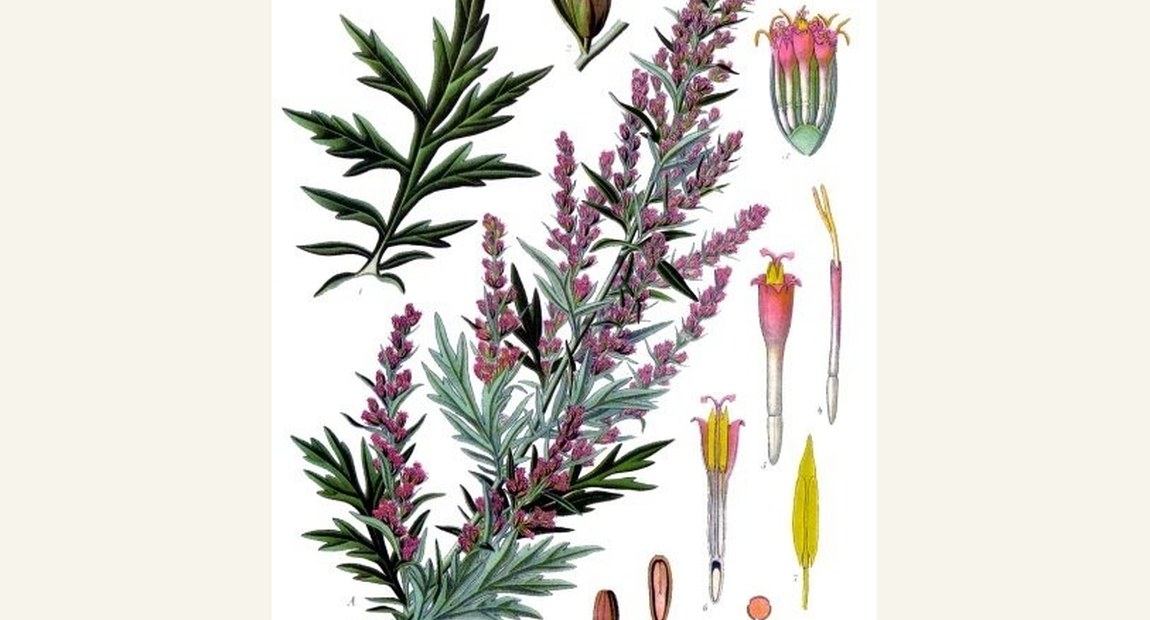
Mugwort (Artemisia vulgaris) is a staple of modern incense books, often called the “mother herb” of incense culture. Historically it is attested above all as a medicinal and magical plant: in the Old English Nine Herbs Charm from the Lacnunga manuscript (around 1000), mucgwyrt, mugwort, is the first of the herbs to be addressed. There is more on this text in the article on the healing herbs of the Germanic peoples and Vikings. It is no evidence that the charm involved burning anything – the text ends with instructions for a salve. In folklore, mugwort is also linked to Midsummer, St John’s Day. For censing in the Rauhnächte itself I found no explicit older evidence in the sources I checked. Mugwort pollen is also a major trigger of hay fever; anyone who reacts to it should be careful with mugwort smoke too.
St John’s wort (Hypericum perforatum), by contrast, is firmly anchored in the herb bundle; in the Salzburg “bundle of nine” it comes first. It reached the ember pan by way of the blessed bunch. The same applies to yarrow, wormwood, mullein, chamomile, thyme and the other bundle plants: their role in the Rauhnacht smoke depends on the herb bundle, not on a separate incense tradition.
Sage is a special case. Common sage (Salvia officinalis) comes from the Mediterranean and has been grown in Central European monastery and cottage gardens since the Middle Ages. It appears on some lists for the herb bundle, and so it could find its way into the smoke. Today’s popular “sage cleansing”, however, mostly goes back to white sage – and that is an entirely different plant.
For lavender, rosemary, elecampane, angelica and many other plants in modern blends, the same holds: the labels attached to them – “protective”, “clarifying” – come from modern guidebooks, not from historical Rauhnacht sources.
Two incense materials have become so popular in recent years that they deserve a section of their own. White sage (Salvia apiana) grows in southern California and northern Mexico. For several Indigenous peoples of the region it is a sacred plant. The worldwide demand for “smudge sticks” has brought reports of wild stands being harvested without permission and of a foreign religious practice being commercialised; Indigenous voices have criticised both. White sage played no historical role whatsoever in censing in the Alpine countries.
Palo santo, “holy wood”, usually comes from the tree Bursera graveolens of western South America. Under the same trade name, wood of Bulnesia sarmientoi from the Gran Chaco is occasionally sold as well; that species is considered threatened and its international trade is regulated under species protection rules. If you buy palo santo, check the species and the source. Palo santo, too, has no historical connection with European Rauhnacht customs.
When you burn plant material, its constituents end up in the air you breathe – that is the whole point. With toxic plants this is a real risk, especially as the composition of the smoke is hard to predict. Some plants that are occasionally recommended as incense in esoteric or “witchcraft” literature should never go into the bowl.
Painted, stained or treated wood, printed paper, plastic and leftover Christmas decorations do not belong in the incense bowl either. And one rule that sounds obvious and is still often ignored: only burn what you can identify with certainty. When in doubt, buy incense material from a specialist shop or a pharmacy, where the plant is clearly named.
Many people like to gather their incense herbs themselves. In Germany this is permitted within limits; other countries have their own rules, so check the law where you live. In Germany the key provision is section 39 of the Federal Nature Conservation Act (Bundesnaturschutzgesetz, BNatSchG). It generally prohibits removing wild plants from their habitat “without good reason”. Subsection 3 makes an exception, often called the “hand bouquet rule”: anyone may “carefully take, in small quantities for personal use” wild flowers, grasses, ferns, mosses, lichens, fruits, mushrooms, tea and medicinal herbs and twigs – but only from places not subject to an access ban.
A few practical rules follow from this, and most of them make sense anywhere. In nature reserves, national parks and other protected areas, stricter bans usually apply; do not gather there. Specially protected species must not be taken at all; in Germany these are set out in the Federal Species Protection Ordinance (Bundesartenschutzverordnung). Take only what grows in abundance, and never the whole plant with its root. And “small quantities” means a hand-sized bunch, not a laundry basket.
With juniper, extra caution is worthwhile. In the wild it grows mainly on open, nutrient-poor land such as heaths and sheep pastures, and it depends on grazing, because otherwise other trees and shrubs overgrow it. The German Forest Protection Association (Schutzgemeinschaft Deutscher Wald) describes it as threatened by habitat loss and by open land growing over. Juniper heaths are protected in the European Union as a habitat type of their own (Natura 2000, code 5130), and many of them lie within nature reserves – in Germany, for example, on the Lüneburg Heath, the Swabian Jura or in the Eifel. Cutting twigs there is generally forbidden. I was not able to check the protected status of common juniper as a species in every German state; if in doubt, ask your local nature conservation authority. The simplest solution is to buy juniper berries and tips from a shop.
With resin, property law also comes in. Woodland always belongs to someone, and a general right to walk in the forest does not include a right to injure trees. If you want to collect resin, take at most small drops that have already oozed out of old wounds, never scrape open fresh wounds, and if in doubt ask the owner or the forestry office. Resin is the tree’s wound dressing; scraping it off opens the wound to fungi and insects.
There are two basic methods: burning on glowing charcoal, which is closest to the historical custom with embers from the hearth, and burning on an incense warmer with a mesh screen, heated by a tea light. For flats and apartments the warmer is the better choice in most cases. It produces much less smoke, the temperature is lower, the material smoulders more slowly and smells more delicate – and there is no charcoal giving off carbon monoxide.
For burning on charcoal you need:
For burning on a warmer, all you need is an incense warmer with a fine metal screen, a tea light and the incense material. With resins, a little sand on the screen keeps it from getting sticky. Whichever method you use, keep within reach a container of sand or a lid for smothering the embers, a glass of water – and remember the smoke alarm.
The following guide follows the sequence of historical household censing – preparation, a round through every room, conclusion – and combines it with the safety rules that apply in a modern home.
Burning incense means carrying open embers through a home full of flammable things, at a time of year when Advent wreaths, dry fir branches and candles stand everywhere. The most important rule is therefore: never leave embers or a flame unattended, not even “just for a moment”.
The incense bowl belongs on a stable, heat-resistant base, never directly on wood, plastic or a tablecloth. Under a thin ceramic bowl the surface beneath can get hot too; the layer of sand protects against that. Keep your distance from curtains, net curtains, Advent arrangements and the Christmas tree. Long hair and wide sleeves are an underestimated hazard while you are carrying the bowl.
In Germany, smoke alarms are now required in homes in every federal state, and many other countries have similar rules. Smoke alarms are meant to react to smoke, and dense incense smoke can set them off. The right response is to burn less and ventilate better – not to cover the alarm or take out the battery. A disabled alarm that is not switched back on in the night after censing is exactly the scenario fire services warn about. If a fire breaks out: leave the room, close the door and call the emergency number – 112 in Germany and throughout the European Union, 911 in the United States and Canada, or the local equivalent where you live.
Smoke is smoke, however pleasant it smells. The Swiss Federal Office of Public Health explicitly lists incense sticks, alongside tobacco smoke and sooting candles, among the sources that can make indoor concentrations of fine particles rise sharply, and it recommends avoiding such smoke. Nothing fundamentally different applies to incense burned on charcoal. If you cense, do it rarely, in small amounts, and always ventilate thoroughly afterwards.
Charcoal deserves special attention. Smouldering charcoal releases carbon monoxide, a gas you can neither smell nor see. Germany’s Federal Institute for Risk Assessment (BfR) expressly warns against letting charcoal smoulder in enclosed rooms: carbon monoxide blocks the transport of oxygen in the blood, and without rapid intensive care, poisoning can lead to severe brain damage or death. A small incense charcoal tablet is not comparable to a charcoal barbecue. Even so, use charcoal only in well-ventilated rooms, never leave it standing in small enclosed spaces such as a bathroom or a storage cupboard, and never let it smoulder on in a bedroom. Headache, dizziness, nausea or drowsiness during or after censing are warning signs: get into fresh air at once, open the windows, and if the symptoms persist call the emergency number (112 in Europe, 911 in North America). A carbon monoxide detector adds a further layer of protection in homes where charcoal or other combustion is used.
Caution is also needed for people with asthma, chronic lung disease or allergies, for pregnant women, babies and small children, and for older people with heart or lung problems. Even a little smoke can cause breathing difficulties for them. If in doubt, do not cense at all, or only in a room that these people enter again after it has been aired. With mugwort and other members of the daisy family, possible allergies come on top, and for pregnant women specialist information advises general restraint with several herbs, including mugwort and juniper.
Finally: censing is a custom, not a therapy. It replaces neither doctor nor medicine, and it does not “cleanse” the air in the sense of making it healthier afterwards. If poisoning is suspected – for example, if a child has eaten incense material or plant parts – contact a poison centre. In Germany each region has its own poison information centre; for North Rhine-Westphalia, where Glanz & Gravur is based, it is the Poison Information Centre at Bonn University Hospital (Informationszentrale gegen Vergiftungen), German telephone number 0228 19240, and the BfR publishes the numbers of the centres for the other German states. In the United States, Poison Help is reached at 1-800-222-1222; elsewhere, look up your national poison centre before you need it. In life-threatening cases, always call the emergency number straight away.
Pets cannot tell you that the smoke is too much for them, and in a closed flat they often cannot get away from it. Birds are especially sensitive. Their respiratory system with its air sacs takes up pollutants from the air very efficiently, which is why birds should always be moved out of the room whenever there is smoke, vapour or fragrance of any kind; the MSD Veterinary Manual likewise rates birds as particularly sensitive to fragrances because of their unusual respiratory tract. Cats, for their part, break down certain constituents of essential oils – above all phenolic compounds – poorly, because they are largely deficient in the enzyme glucuronyl transferase, as the same manual explains; for this reason many vets also advise against oil burners and diffusers in homes with cats. Similar caution applies to rabbits, guinea pigs, and dogs with respiratory problems.
The simple rule: animals stay in a different, unsmoked room while you cense and air the rooms, and come back only once the smell has largely gone. Never cense a birdcage or a terrarium. Keep incense material, charcoal and ash out of reach of curious paws and beaks, because dropped resin or dried herbs can be eaten too. If an animal coughs, breathes heavily, drools or seems listless after censing, take it into fresh air and call your vet or an emergency veterinary service; in the United States the ASPCA Animal Poison Control Center also offers advice. Plant material from thuja or yew is as poisonous to animals as it is to people.
Historically, censing was never just about scent; words were always part of it. If you want to follow the church model, handouts such as the one from the Diocese of Linz offer a fixed sequence: light a candle, sing a hymn, read from Scripture – on New Year’s Eve, for instance, the Aaronic blessing from Numbers 6 –, pray, walk through the house with frankincense and holy water, ask for a blessing. If you are not religious, you can shape the round as a conscious farewell to the old year: a moment in each room, a thought about what happened there over the past twelve months, a wish for the year ahead. Both are legitimate, as long as nobody claims that one is more “original” than the other. If you would like to approach the Rauhnächte through remembering the dead as well, the article on honouring the ancestors in the Rauhnächte offers ideas.
On which nights is incense traditionally burned? Mostly on the four great Rauhnächte: St Thomas’ Night (20/21 December), Christmas Night, New Year’s Eve and the night before Epiphany. Some families cense on all twelve nights, others on just one of these dates.
What was burned historically? Above all frankincense, together with blessed herbs from the Assumption herb bundle and twigs from the Palm Sunday bundle.
Is burning incense at home dangerous? It carries risks: fire, fine particles and, with charcoal, carbon monoxide. Small amounts, constant supervision, a heat-resistant base, thorough airing, or a tea-light warmer instead of charcoal reduce them considerably.
May I cut juniper in the woods? In protected areas and on juniper heaths, generally not. Elsewhere in Germany, section 39 of the Federal Nature Conservation Act allows only small quantities for personal use; other countries have their own rules. Juniper from a shop is the simpler option.
Can I burn incense if I have pets? Only if the animals stay in another room until everything has been aired. Birds and cats are considered especially sensitive.
The Rauhnächte & Mother's Night · Herbs & healing of the Vikings · Henbane · The Twelve Rauhnächte Night by Night: Dates, Counts, Omen Days and Customs · Honouring the Ancestors in the Twelve Nights: Customs, Background and a Guide for Today.
All Festivals & Belief articles →
Ask five people when the Rauhnächte begin and you will get three answers: on 21 December, on Christmas Eve, or on …
Read more →The Rauhnächte are the roughly twelve nights between Christmas and Epiphany, a stretch that German and Alpine folk …
Read more →The Norse had no holy book, no pope and no fixed liturgy. Their faith lived in action: in the sacrificial feast at the …
Read more →Samhain is said to be the festival when the boundary to the otherworld grows thin, the "Celtic New Year" and the true …
Read more →