Between Christmas and Epiphany time seems to stand still, or at least it feels that way. Many families use these days to think of the people who no longer sit at the table with them. This article does two things. It sorts out, briefly, what the sources actually say about remembering the dead in midwinter – from Bede's "Night of the Mothers" to the laid table that a German bishop forbade around the year 1000. And it shows, step by step, what a remembrance can look like today: a place for pictures and light, food and names, parish registers and civil records, children and fresh grief. No promises nobody can keep, and no customs that never existed.
A scene many families will recognise: on the first Christmas Eve after the grandmother's death, someone puts her cup on the table. Nobody arranged it. The cup simply stands there, chipped handle and all – the one she refused to throw away – and suddenly someone is telling the story of how she once cycled halfway across the Eifel hills because the bus never came. That is how remembering the ancestors begins in most families. Not with a ritual, but with an object, a sentence, a story that is suddenly back in the room.
The Rauhnächte – the German name for the twelve nights between Christmas and Epiphany on 6 January, roughly the English Twelve Days of Christmas – make a good frame for such moments. Work pauses, the family is together, the year is drawing to a close. Anyone who remembers the dead in these days does not need to invoke an "ancient Germanic festival of the ancestors". That would be hard in any case, because no such festival can be traced in the sources. There are, however, a handful of genuine historical anchors, and there is folklore, which shows how people in Europe kept the dead in mind during midwinter – sometimes tenderly, sometimes in fear.
So this article moves in two steps. The first sections summarise the evidence briefly and point to our longer articles for the history. The larger second part is a practical guide: how to set up a memorial place, what light and food can mean, how to speak names, how to find the traces of your own forebears in the archives, and how to handle children, fresh grief and difficult family histories. Each time, we say what is historically attested and what is a gesture of our own time.
Anyone looking for the roots of remembering the dead in midwinter comes across four very different kinds of source. They come from different centuries and regions, and they cannot be fused into a single tradition.
The first anchor is the Venerable Bede. Writing around 725 in his treatise on time-reckoning (De temporum ratione, chapter 15), the Anglo-Saxon monk says that the pagan English began their year on the night before 25 December and called that night Modranecht, "the night of the mothers" – probably, he suspects, because of the ceremonies they performed while keeping watch through it. Who the "mothers" were, Bede does not say. Whether he meant female ancestors, protective goddesses like the Rhineland Matronae, or something else entirely is an open research question. For the full story, see The Twelve Nights and the Night of the Mothers.
The second anchor lies in the Saga of Hákon the Good (Hákonar saga góða), written down by Snorri Sturluson in the thirteenth century. At the sacrificial feast, after the toasts to the gods, the participants also drank a cup to the dead – the minni, the memorial draught. Samuel Laing, in his 1844 translation, renders the passage in the chapter on sacrifices (chapter 16 in his numbering) as a goblet emptied "to the memory of departed friends". It is the clearest hint of remembering the dead at a Norse midwinter feast – but from a source written some three hundred years after the events it describes. The details, and the question of how far Snorri can be trusted, are covered in Ancestor Veneration at Yule.
The third anchor is a church prohibition from the early eleventh century that speaks of a table laid for invisible guests. The next section is devoted to it. The fourth, finally, is the folklore of the nineteenth and twentieth centuries. Collectors such as the Brothers Grimm and their successors recorded customs in many parts of Europe in which the dead play a role at Christmas or during the Twelve Nights. These records are valuable, but first and foremost they show the beliefs of the modern period. How far back they reach can rarely be said in any individual case.
Burchard became Bishop of Worms, on the Rhine, in the year 1000 and died in 1025. His great work of church law, the Decretum, contains in its nineteenth book a guide for confessors known as the Corrector. In it, penitents are asked about all kinds of practices the Church regarded as superstition, and each comes with a penance. That makes the text one of the most important sources for popular belief in the German lands around the year 1000 – because whoever forbids something has to describe it first.
One of these questions concerns women who, "at certain times of the year", prepare a table in their house, set food and drink on it and lay three knives beside them. Jacob Grimm printed the passage in his Deutsche Mythologie, in the appendix collecting testimonies of superstition. The end of the sentence reads:
"… ut si venissent tres illae sorores, quas antiqua posteritas et antiqua stultitia Parcas nominavit, ibi reficerentur." – "… so that, if those three sisters came whom ancient posterity and ancient folly called the Parcae, they might refresh themselves there."Burchard of Worms, Decretum XIX, 5 (Corrector); Latin text as printed in Jacob Grimm, Deutsche Mythologie, appendix "Aberglaube", section on Burchard; English translation of the closing clause: our own
The passage is fascinating, and it still has to be read with care. First, the guests are not ancestors but three sisters whom Burchard equates with the Roman goddesses of fate. That native figures stand behind them – women who know destiny, such as the Norns or the Matronae – is an obvious interpretation, but a disputed one. Second, the text gives no date. "At certain times of the year" may mean New Year, but it need not. Another passage of the same penitential explicitly forbids laying the table with stones or food at the Kalends of January, that is, at the start of the year. Third, Burchard describes what the Church wanted to stamp out, not necessarily what was widespread; some wording in these penitentials was taken over from older models.
What remains is still remarkable. As early as the year 1000, people in the orbit of the Bishop of Worms knew the idea that one could lay a table for invisible visitors on fixed dates. Whoever sets out a plate for the dead during the Twelve Nights today is not continuing an attested ancestor custom – but is taking up a very old gesture of hospitality towards the unseen.
In Christian Central Europe, the great remembrance of the dead does not fall in the Twelve Nights but in November. All Souls' Day on 2 November was introduced in 998 by Abbot Odilo of Cluny for the monasteries of his network, as a day of remembrance for all the faithful departed. From Cluny it spread throughout the Western Church. The idea behind it is intercession: according to Catholic teaching, the living can help the souls in purgatory – the "Holy Souls" or "Poor Souls" – through prayer, Masses and good works.
A rich body of custom grew up around the day, and some of it is still alive. In Austria and Bavaria, godparents give their godchildren the braided Allerheiligenstriezel, a sweet loaf regarded as a symbolic feeding of the souls. The Graz folklorist Leopold Kretzenbacher showed in 1959 how old some of these forms are in Styria: a foundation of 1410 provided gifts for "arm leut", the poor, who received them on behalf of the souls. For Garsten in Upper Austria he found bowls of food for the souls in 1656. And the sea of candles on cemeteries, now considered the All Souls custom par excellence, was actually banned by a court chancery decree in 1764 – which shows that the authorities already saw it as an abuse at the time.
The Protestant churches do not observe All Souls. But a day of remembrance for the dead at the end of the church year appears already in church orders of the sixteenth century, and in 1816 King Frederick William III made it general in Prussia, under the impression of the many dead of the Napoleonic Wars. This became Totensonntag or Ewigkeitssonntag, the Sunday of the Dead or Eternity Sunday, the last Sunday before Advent.
For remembering the ancestors in the Twelve Nights, this means: anyone from a Catholic or Protestant background already has a cycle of remembrance in November, with a visit to the cemetery, a grave light and prayer. A remembrance "between the years", as Germans call the days after Christmas, does not replace it; it strikes a different note. In November the eye turns to the grave; in the Twelve Nights, rather to the family table and to the year that is passing. More on how the dead were treated in earlier times can be found in How the Germanic Peoples Honoured Their Dead.
The idea that the dead come home at Christmas stands out more clearly in Scandinavian and Baltic folklore than in the German-speaking world. For Sweden, the folklorist Nils Keyland gathered a whole series of such beliefs in 1919. According to these, Christmas night was in a sense the night of the dead, who visited their former homes. That is why the table was not cleared on Christmas Eve, so that the visitors would find something, and in some places people even left their beds to them and slept on straw on the floor. At the same time, they protected themselves with steel at the door, crosses of tar, fire and light against everything that was abroad on that night. Care for the dead and fear of them lie very close together here.
Also widespread in Scandinavia was the legend of the Christmas service of the dead. Someone oversleeps, hurries through the night to the early Mass and finds the church full of the village's dead, celebrating their own service. The Nordiska museet in Stockholm lists this story among Swedish Christmas tales. It is not an invitation to remember but a warning: the night belongs to the dead, and the living have no business there.
In Lithuania the picture is friendlier. On Christmas Eve, Kūčios, the family gathers for a meal traditionally made up of twelve meatless dishes. The Lithuanian National Museum describes it as an old custom to invite the souls of the dead to the festive table, to set a place for them and to leave the food standing untouched overnight. Here, too, the descriptions come mainly from more recent folklore; the notion that the worlds of the living and the dead draw close in the longest night is explicitly presented there as the conviction of many people, not as a historical finding.
In German popular belief of the modern period, the Twelve Nights are above all a time of danger. The word Zwölften, "the Twelves", for these days is found in many regions, and it carries ideas of roaming spirits, of the Wild Hunt – in which nineteenth-century legends sometimes send a whole army of the dead roaring through the air – and of figures like Frau Holle or Perchta, who go through the houses checking order and diligence. In legends from the Orlagau region of Thuringia, published by Ludwig Bechstein in the nineteenth century, Perchta is accompanied by the Heimchen, according to the folkloristic reading the souls of children who died unbaptised. More on this in Frau Holle and Perchta and the Perchten.
Then there are the prohibitions. During the Twelves, one was not to hang out washing, not to spin, not to let any wheel turn. The explanations varied; often it was said that the roaming spirits would get caught in them, or that they would take offence at the work. And there are the revenants of Old Norse literature, the draugar, who are at their worst precisely in midwinter, like Glámr in Grettis saga.
This side of the tradition belongs to the truth. The dead of the old stories are seldom kindly ancestors; they are demanding and sometimes threatening. Whoever remembers lovingly today is selecting from this tradition. That is legitimate – it simply is not an unbroken tradition. For the history of the terms Rauhnacht and Zwölften, see the Twelve Nights Calendar; for the Wild Hunt in particular, The Wild Hunt in the Twelve Nights.
Before turning to practice, it is worth taking an honest look at how much of all this is secure. The layers lie far apart: a monk in Northumbria in the eighth century, a bishop on the Rhine around 1000, an Icelandic scholar in the thirteenth century, folklorists in the nineteenth and twentieth. Anyone who merges them into a single "ancestor cult of the Twelve Nights" produces a picture that none of these sources shows.
That is less than some guidebooks promise, but it is enough for a practice that can draw on real gestures: the cup raised to the dead, the place laid at the table, the light in the darkest time of year, the speaking of names. The following sections show what that can look like in concrete terms.
A remembrance works better if you have answered a few questions for yourself beforehand. The first is: who should be part of it? For some, it is their own parents or grandparents, people they knew. Others want to go further back, to great-grandparents whose names survive only on a yellowed photograph. Others again think of friends, of a lost child, of a teacher – people who do not appear in any family tree and still belong to their life. Remembering the ancestors does not have to stop at blood relations. Even the memorial cup of the Saga of Hákon was not raised to a single forefather but to the departed as a whole; Samuel Laing translated the passage in 1844 as "departed friends".
The second question is about intention. Do I want to give thanks, tell stories, grieve, ask questions that no one can answer any more? Do I want to show the children where the family comes from? Or simply to have a quiet evening on which the dead belong too? The clearer the intention, the easier the form. An evening of gratitude looks different from an evening on which you weep for someone.
The third question concerns the others in the household. Not everyone in a family wants the same thing. One person finds a memorial place beautiful; another finds it oppressive or religiously presumptuous. It helps to talk beforehand and to start small. A light and a photograph on the windowsill are quickly set up – and just as quickly put away again if it does not feel right.
And why the Twelve Nights in particular? Historically there is nothing compelling about this date. But many people have time off, the family gathers, and the end of the year invites a look back. Anyone who prefers All Souls, a Sunday of remembrance or the anniversary of a death loses nothing. The suggestions below can be carried over to any of these dates.
A memorial place – some call it an ancestor table or ancestor corner – is at first nothing more than a free surface: a shelf, a chest of drawers, a windowsill, a small table in a quiet corner. It needs no particular compass direction and no special objects. What matters more is that it is not in the way and not in a draught, especially if a candle is to burn there.
A plain cloth underneath helps set the place apart from everyday life. On it go photographs of the people you want to remember. If you have no pictures, you can write a name on a card, with the years of birth and death and the place someone came from. Then the things: a grandfather's glasses, a prayer book, a notebook of recipes, a tool, a medal, a letter. Objects someone actually used often say more than any photograph. A stone from a grave or a home village, a sprig from the old garden, a handful of earth can find a place too.
In households with small children or pets, everything fragile and valuable belongs up high – candles in any case. Original photographs and old documents tolerate neither direct sunlight nor the warmth of a candle; prints or copies are better for the memorial place, while the originals stay protected in a folder. A small slip of paper with a story for each object makes the place understandable to guests and children.
The place can stay up for all twelve nights or for just one evening. When you clear it away, you can do so deliberately: take each picture in your hands, pause a moment, then pack it up. The end of a remembrance matters as much as its beginning.
In the German-speaking world, a light for the dead is known above all from the cemetery – the grave candle at All Saints and All Souls. The light in the window on Christmas Eve, customary in many families, is also often associated with the departed. Historically, light is an ambiguous sign. In Swedish folklore it protected against the roaming powers of Christmas night; in the church year it stands for the eternal light wished for the dead; and at the winter solstice it is first of all an answer to the long darkness. You do not have to choose any one of these meanings.
In practice, a single candle in a glass or a tea light in a lantern is enough. A glass protects against draughts and stops wax dripping onto the photographs. A few basic rules are still necessary, because fire services warn every year about candle fires in the Christmas season:
Some people light the candle at the same time every evening of the Twelve Nights and say a name as they do so. Others let it burn on one single night, such as Christmas Eve or New Year's Eve. A fixed habit has the advantage that it needs few words: when the light is burning, everyone knows the dead belong now too.
The gesture of giving the dead a share of the meal takes many forms in Europe, and each has its own layer of evidence. Around 1000, Burchard forbids the laid table for the three sisters. The Styrian soul-breads and the gifts to the poor belong to the All Souls customs of the late Middle Ages and the modern period. According to Keyland, the Swedes left the Christmas table standing overnight; Lithuanians set a place for the souls at Kūčios. Whoever sets aside a share for the departed today can refer to these gestures without claiming any particular ancient rite.
What that can look like in practice:
What happens to the plate the next morning? A sober thought is in order here. Leaving food unrefrigerated overnight and then throwing it away sits badly with a gesture that is about care. Many people therefore set out only a small symbolic portion – a piece of bread, a few nuts, an apple, a glass of water – and use it the next day, give the bread to the birds or put the apple out in the garden. With pets in the house: chocolate, raisins and grapes, onions and alcohol must stay out of their reach, including on a low memorial shelf.
If there is one gesture that recurs in almost every form of remembering the dead, it is saying their names aloud. Viking Age rune stones record who had the stone raised for whom, often with the relationship: for his father, for her son, for the brother. In Catholic parishes, the names of the dead are read out at All Souls and at anniversary Masses; in many German Protestant congregations, on Eternity Sunday, the names of those who died in the past church year. A name spoken aloud brings a person back into the room for a moment.
For an evening with the family, this can be very simple. Someone lights the candle, and one after another each person says a name and, if they wish, a sentence: "I'm thinking of Grandpa Hein, who taught me to swim." Anyone who does not want to speak says only the name, or stays silent. Nobody has to give a speech. With people you never knew, it is worth saying the full name, with dates and place of origin, just as it stands in the parish register. That turns a line in the family tree back into a person.
A few phrasings that have proved useful – offered as suggestions, with no claim to ancient origins:
The second phrasing matters more than it sounds. Every family has ancestors whose names are lost: the children who died young and appear in no album, the farmhands and maids whose trail fades after two generations. A light for the nameless includes them without claiming anything about them.
If you want to use the Twelve Nights as a whole for remembrance, you can divide them into small sections. The following sequence is a present-day suggestion. It rests on no historical assignment of individual nights, because there is none for remembering the ancestors. Depending on the reckoning, the Rauhnächte begin on 21, 24 or 25 December; the Twelve Nights Calendar explains the variants. Here we count from Christmas night.
A single evening is enough.
The Twelve Nights are a good time to begin researching your own family history, because the most important source is often sitting at the table: the older generation. What grandparents and great-aunts can tell you is in no archive. Who lived where, who did what work, who emigrated, why contact with one branch of the family broke off – such information is almost impossible to replace later.
Family historians therefore advise almost unanimously to start with conversation and only then go to the archive. Concrete questions help more than general ones: not "Tell me about the old days" but "Where did you live as a child?", "What were your grandparents called?", "Who were your godparents?". Photographs help memory. If you record the conversation, ask first and keep the recording carefully afterwards.
The second step is the papers that lie in shoeboxes and drawers in so many families: family registers, birth and marriage certificates, memorial cards, death notices, baptismal certificates, school reports, letters, wartime post, employment records, membership cards. Each of these documents names people, dates and places. If you transfer them into a simple list, with a column noting which document each item comes from, you already have the skeleton of a family tree. Noting the source seems pedantic, but it is the most important thing: only then can you later tell apart what is documented from what an aunt merely "heard somewhere".
For the tree itself, paper is enough at the start; if you work digitally, choose a program that supports the GEDCOM exchange format, so your data is not locked in. In Germany, the Verein für Computergenealogie (CompGen) and regional genealogical societies help with questions about local sources; most countries have comparable family history societies.
This section and the next describe the situation in Germany, where we are based; record types and access rules elsewhere are similar in principle but differ in detail, so readers researching ancestors in other countries should check with the national or regional archives there. In Prussia, state registry offices (Standesämter) recorded births, marriages and deaths from 1 October 1874; for the whole German Empire, the Civil Status Act of 6 February 1875 applied from 1 January 1876. For researchers in the Rhineland, including the area around Aachen, there is an important peculiarity: here the French had already introduced state civil registers around 1800, and in the territories west of the Rhine these continued to be kept after French rule ended in 1814. For that region, state records therefore reach back much further than in the rest of Germany.
Today the German Civil Status Act (Personenstandsgesetz, PStG) governs how long registry offices keep their registers themselves. Under § 5 (5), the periods are 110 years for birth registers, 80 years for marriage and civil partnership registers and 30 years for death registers. After that, the registers are offered to the responsible public archives, usually a municipal or district archive, and archive law applies. In practice, someone looking in 2026 for a birth from 1910 will normally turn to the archive, but for a birth from 1925 still to the registry office. Within these periods, § 62 PStG gives the right to certificates, information and inspection to the persons the entry concerns, their spouses and civil partners, and their ancestors and descendants – parents, grandparents, children and grandchildren, for instance. Siblings need only a "legitimate interest" for birth and death registers; everyone else has to show a legal interest. If the last of the persons concerned has been dead for at least thirty years, a legitimate interest suffices even before the periods expire (§ 62 (3)); once they have expired, archive law governs access (§ 61 (2)).
A great deal is now online. For its Rhineland department, the State Archive of North Rhine-Westphalia (Landesarchiv NRW) offers digitised marriage registers from 1874/76 to 1899 and death registers up to 1938, among them the volumes for Aachen; the digitisation was carried out together with FamilySearch. Many duplicate parish registers from the Rhineland can be viewed there as well. For the war dead of the two World Wars, the German War Graves Commission (Volksbund Deutsche Kriegsgräberfürsorge) runs an online grave search, and for people persecuted and deported in the twentieth century, the Arolsen Archives maintain an online archive.
A note on data protection: in the European Union, the General Data Protection Regulation protects the data of living people. If you publish a family tree online, include living relatives only with their consent, or hide their entries. With the recently deceased, restraint is advisable out of consideration for the bereaved, even where the law is less strict.
Anyone who wants to go back further than the civil registries ends up with the parish registers. On the Catholic side, the Council of Trent in 1563 required priests to keep baptismal registers listing godparents and marriage registers with the couple, witnesses, date and place. The Rituale Romanum of 1614 then named five books: baptisms, marriages, confirmations, burials and the status animarum, a kind of census of the souls of the parish. In Protestant territories, parish registers began in many places as early as the sixteenth century with the church orders of the Reformation. Some parishes have older books; elsewhere they were lost to war and fire.
In Germany, Catholic parish registers are today mostly held in diocesan archives, Protestant ones in the archives of the regional churches. Many have been digitised: the Matricula portal shows registers from numerous Catholic dioceses in Germany, Austria and other countries free of charge online, while the Archion portal brings together Protestant registers for a fee. What is online for a particular parish is most quickly answered by an enquiry to the responsible archive.
A few pointers help with reading. Until well into the eighteenth century, Catholic priests mostly wrote in Latin: baptizatus means baptised, copulati married, sepultus buried, infans a small child. Protestant entries are more often in German, but in the old German cursive script known as Kurrent, which has to be learned first; reading aids and script tables are available from genealogical societies and archives. And entries are not always what they seem: a baptismal register often gives the date of baptism, not the birthday; a burial register sometimes the day of the funeral rather than the death. Names are spelled differently depending on the clerk, and the ages given for the dead are often only estimates. Knowing this makes the contradictions less frustrating.
At the end of a Twelve Nights season of conversations, photographs and archive finds, a lot of material lies on the table. A remembrance book holds it together. That can be a handsome bound volume, a binder of clear sleeves or a digital collection. The form matters less than the order: a page or a chapter for each person, with name, dates, places, photographs and the stories told about them.
A few things make a remembrance book valuable for later generations. Photographs should be labelled – names, place and approximate year – while someone still knows who is in them; pencil on the back harms prints less than ballpoint. Every piece of information should carry a note of where it comes from. Family stories may stand alongside documents but should be marked as stories: "According to Aunt Marie, great-grandfather was a miner in Alsdorf" is more honest than the bare claim, and it keeps the trail open for later checking. Copies of important pages belong in more than one place, so that a single water leak cannot destroy everything.
Some families put the book back on the memorial place every year during the Twelve Nights and add what the year has brought: a new find in the archive, a story someone told at a funeral, and the names of those who died in the past year. In this way the book grows with the family.
Children often deal with death more openly than adults expect. They ask directly, and they can cope with honest answers if those come in simple words. Bereavement counsellors frequently advise using clear terms: "Grandpa has died" rather than "Grandpa has gone to sleep" or "passed away". Figurative phrases can confuse or frighten young children in particular – for example, if they then become afraid of falling asleep.
A memorial place gives children plenty of ways to take part. They can paint a picture to put beside the photographs, decorate a stone, help light the candle or ask who is in the old pictures. Older children are often drawn to the family tree, especially when they discover that an ancestor had the same first name or went to school in the same town. A child who hears the story of a great-grandmother experiences the family as something that reaches far beyond their own lifetime.
Care is needed with the dark tales of the Twelve Nights. Stories of the Wild Hunt, of the walking dead and of Perchta slitting open the bellies of lazy maids have their place, but they fit badly with an evening on which a child is mourning a grandfather. If you tell them, make it clear that they are legends people used to tell each other on long winter nights – and that Grandma will not come back as a ghost.
The first Christmas after a death is, for many people, the hardest. What is comforting in other years – the light, the laid place, the round of stories – can then be almost unbearable. A ritual of remembrance is not a compulsory programme. It is fine to leave everything out, to light just one candle or to spend the evening alone. And it is just as fine to laugh in the middle of the round of stories.
It helps to agree beforehand with the others what each person needs. Some want the dead person's name to be said; others dread exactly that. A memorial place you can go to, but need not, is often the better path than a ritual in which everyone at the table is expected to join. And anyone who notices that grief is not easing over weeks will find support from bereavement groups, hospice associations, chaplains and counselling services. In Germany, the TelefonSeelsorge helpline can be reached free of charge around the clock on 116 123 as well as 0800 111 0 111 and 0800 111 0 222, holidays included. Outside Germany, your doctor, a local hospice or the national crisis line of your country can point you to help.
Not everyone knows where they come from. Adopted people, foster children, people with an unknown father or with broken contact to their family often approach remembering the ancestors with mixed feelings. Here remembrance can be understood more broadly: it can be for the people who raised you, and equally for unknown birth ancestors, for whom a light burns without a name. The two do not exclude each other. In Germany, adopted people over the age of sixteen can themselves request a certified copy of their birth entry under § 63 PStG and inspect it; it may show the birth parents. Advice is available from the adoption placement services of the youth welfare offices. Other countries have their own rules on access to adoption records, which the relevant authorities can explain.
It is harder with forebears who caused others harm. To remember is not to revere. You can remember a violent grandfather without dedicating a light to him, and you can write the story down as it was. For many families, it is precisely the honest telling that is the most healing part of working with their ancestors.
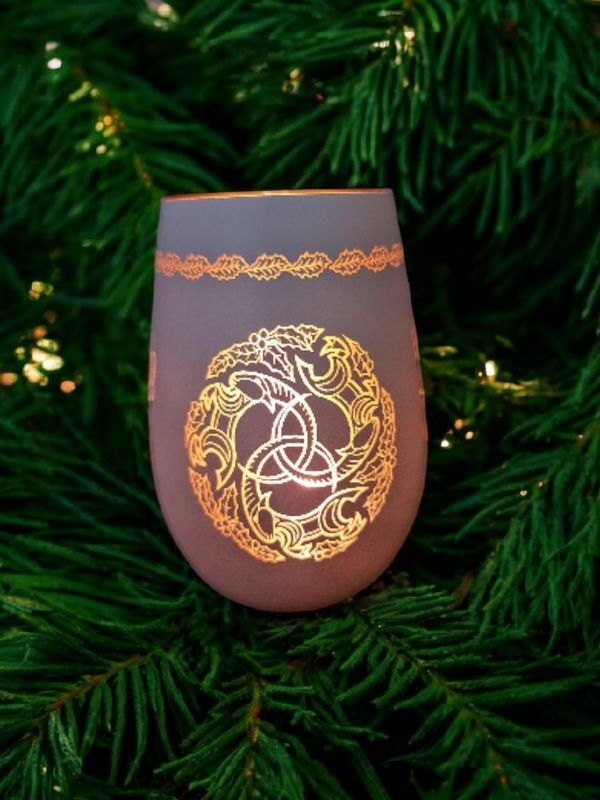
The gestures described here fit very different world views. Christian families link the light with a prayer for the dead, visit the grave between the years or have a Mass said. Those who count themselves among today's heathens tend to draw on the minni of the sagas and on the round of toasts called sumbel, as described in Heathens Today: Blót and Sumbel. And those who belong to no religion need neither prayer nor gods: a light, a photograph, a story and a raised glass are signs of remembrance that do without any idea of an afterlife. A lantern laser-engraved with a name or a knot pattern, like the ones we make in Alsdorf, is one possibility among many; a simple candle in a glass does the same service.
Were the Twelve Nights once a festival of the ancestors? No, not demonstrably. In the form handed down to us, the Rauhnächte are a modern-period body of customs made up of cleansing, protection and divination. Remembering the dead in midwinter is attested here and there, for instance in the memorial cup of the Saga of Hákon, but not as a festival of the ancestors in its own right.
Is it all right to set out a plate for the departed? Yes, as a gesture of today. Similar customs are attested in Swedish and Lithuanian folklore, and around 1000 Burchard of Worms forbade a table laid for three sisters of fate. A small symbolic portion that you use afterwards is more practical than a full meal.
Can you make contact with the ancestors during the Twelve Nights? No such promise can be justified, historically or otherwise. Remembering the ancestors is memory, gratitude and storytelling; whatever anyone believes beyond that is their own personal matter.
Where can I find records of my great-grandparents? In Germany, for the period from 1874/76, at the registry offices and, once the periods of 110, 80 and 30 years have expired, in the municipal archives; before that in parish registers held by diocesan and regional church archives. In the Rhineland, state registers go back to the French period around 1800. In other countries, start with the national or regional archives and the local family history society.
How do I explain a memorial place to children? In simple words: here are pictures of people who have died and whom we think of. Children can help shape it, draw and ask questions. Spooky legends of the Twelve Nights should be told clearly as legends.
Ancestor veneration at Yule · How the Germanic peoples honoured their dead · The Dísir – guardian spirits of the kin · The Rauhnächte & Mother's Night · Smoke Blessings in the Rauhnächte: History and How-To.
All Festivals & Belief articles →
At midwinter, it is often said, the dead draw near. Is that true for the age of the Vikings and the Germanic peoples? …
Read more →For our ancestors the year was no sheet on a wall but work: sowing, herding, harvesting, storing. The festivals sat at …
Read more →"Asatru" sounds ancient, yet as an organisation it is younger than many rock bands: the Icelandic association was …
Read more →Anyone who chooses to be laid to rest beneath a tree reaches for an image that looms large in Norse tradition …
Read more →