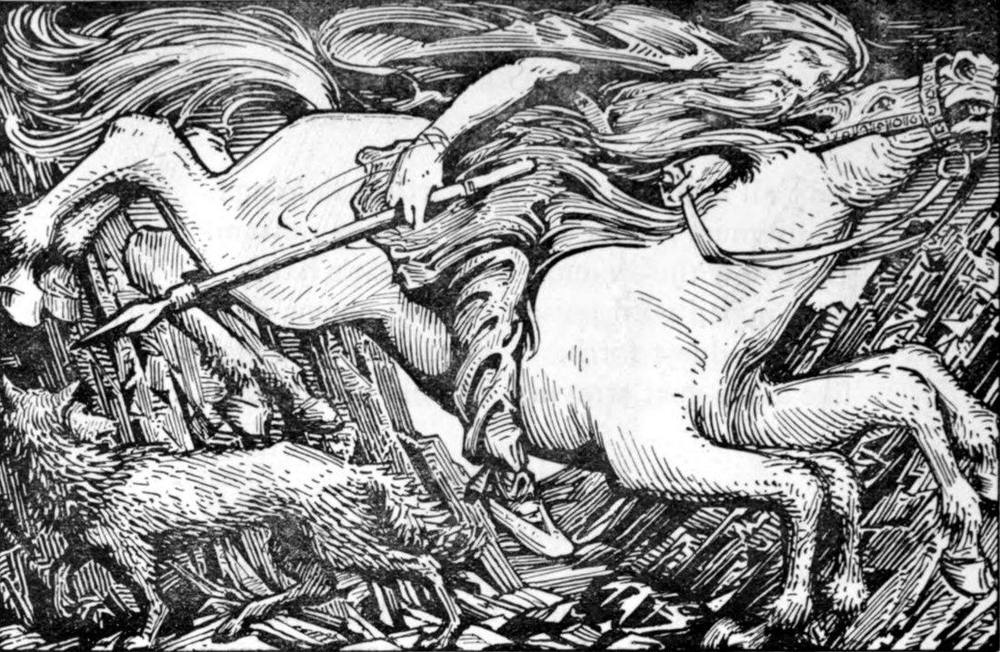
Between Christmas and Epiphany, people in Mecklenburg used to say, Wode passes over the land with his hounds. Leave a door open on one of those nights and you may find a strange dog lying by the hearth in the morning, and it will stay for a year. At the same season in Norway, the Oskoreia drains the Yule ale from the casks, and in Sweden people hear Odens jakt baying across the fields. We retell these legends, say for each one who recorded it, when and where, and ask at the end how much of Odin is really left in this Wode.
We have already written at length about the Wild Hunt as a motif: about Walchelin, the priest who watched a host of the dead pass by in Normandy in 1091, about the black huntsmen of Peterborough in 1127, about Jacob Grimm and the long argument over whether an old god or Christian fear of purgatory lies behind it all. If that history of the motif is what you are after, you will find it in our article on the Wild Hunt. We will not repeat it here.
This piece looks at something else: at the time of year when the hunt is abroad, and at the stories themselves. The Wild Hunt of folk legend is above all a winter figure, and very often a Christmas one. It comes during the "Twelves", the nights between the Nativity and Epiphany, or, further north, at Yule. And it was not handed down in treatises but in short tales. A farmhand sharpens a stick for a mistress of the night. A shepherd mimics the cries of the hunt. A farmer holds a heavy chain for a huntsman he has never seen before.
Almost all of these legends were written down in the nineteenth century, by collectors such as Jacob Grimm, Karl Bartsch or the Norwegian Andreas Faye. They reflect the popular belief of their own day, not that of the Viking Age. For that reason we note for every story which collection it comes from, where it is set and what it does and does not prove. Where we could not read a work ourselves, we give its content in paraphrase only and say so.
A word on names. In Mecklenburg, Pomerania and Holstein the wild huntsman is called Wode, Wod or Waur; in the Prignitz and in south-western Mecklenburg a woman, Frau Gauden or Frau Gode, takes his place. Wodan is the Old High German form of the god's name, Odin the Old Norse one. Whether the names in the legends really go back to the god is one of the questions we follow further down.
The Twelve Nights begin as a piece of church calendar. Between the feast of Christ's birth on 25 December and the feast of the Epiphany on 6 January there are twelve days. The Church treated this span as a single festive season from early on; according to the usual account in church history, the Council of Tours in 567 declared the days from Christmas to Epiphany a festal time. On top of that, in many places during the Middle Ages the new year was reckoned from Christmas. The Twelves therefore sat between two years and between two great feasts.
How exactly people counted them varied from region to region. Most often the sequence started on Christmas Night and ended on the night before Epiphany. Some areas began earlier, on St Thomas's Day, 21 December, the shortest day of the year. In southern Germany and Austria these nights are called "Rauhnächte"; in the north of Germany they were simply "the Twelves". Which customs clustered around them, and where the word "Rauhnacht" may come from, we explain in our article on the Rauhnächte and Modranecht.
One thing matters most for the legends: the Twelves were felt to be a time when the usual order did not fully apply. Work that turned or hung something up was supposed to rest. The dead and other spirits were out and about, animals could speak, dreams were read as omens. A host riding through the night sky fits very neatly into this in-between time. It is the same logic as the belief in "lot days": whatever happens on these days shapes the whole year to come.
The order of the evidence is worth keeping straight. The Twelves as a festive season are Christian and can be traced back to the early Middle Ages. The Wild Hunt is attested from 1091, but Orderic Vitalis places his sighting in January, and the Peterborough chronicler between February and Easter – neither is yet tied to Christmas. The firm link between the hunt and the Twelves only appears in the legend collections of the modern era. Anyone who draws an unbroken line from there back to a pagan midwinter festival is skipping centuries in which the sources say nothing.
In Scandinavia the festive season around the winter solstice is called jól, Yule. What we know about the pre-Christian Yule feast – Bede and the month names Giuli, Hákon the Good and the Yule ale – is covered in our article on Yule. For our subject a single word counts: Jólnir.
Jólnir is one of Odin's many names, and it means something like "the one who belongs to Yule". In the tenth century the skald Eyvindr skáldaspillir even calls the gods as a group jólnar, "Yule beings", in one of his stanzas. This shows that poets thought of Yule and the gods together. How Odin himself kept the feast, whether people sacrificed to him at Yule, and whether he was seen as a leader of the dead at that season, the Old Norse sources do not say. The Edda has no Odin who rides over the farmsteads at Yule with a ghostly host.
What the Edda does have is Odin as lord of the slain. In Snorri's Gylfaginning (around 1220) he is called Valföðr, "father of the slain", and gathers the Einherjar in Valhalla, warriors who fight by day and feast by night until they ride with him into the last battle. He rides Sleipnir, the eight-legged horse, and the Valkyries bring him the dead from the battlefield. A god of the dead, a rider, an army: the building blocks are all there. For more on the god himself, see our article on Odin.
The people who actually put these blocks together, though, were the scholars of the nineteenth century. Jacob Grimm read the Wode of Mecklenburg, the Oden of Sweden and the Yule host of Norway side by side and recognised the old god in all of them. Whether he was right can only be tested by looking at the legends themselves. So let us start in Mecklenburg.
In the Low German north, from Holstein through Mecklenburg to Pomerania, people did not say "the Wild Hunt is passing" but "de Wode tüt" – Wode is on the move. Jacob Grimm recorded this phrase for Mecklenburg, citing the dictionary of Johann Christoph Adelung, and gave "Wode jaget", Wode hunts, for Pomerania and Holstein. He gathered such material in his German Mythology of 1835, which kept growing in later editions. The name is therefore older than Grimm's interpretation of it: it already stood in eighteenth-century dictionaries before anyone linked it with Odin.
Linguistically, the matter is simpler than you might expect. The god's name in Old Saxon was Wōdan, and an Old Saxon ō regularly becomes a long o in Middle Low German. A "Wode", then, sounds exactly the way a Low German descendant of the god's name ought to sound. Alongside it there are forms such as Wod, Waur or Wauden, which have drifted further from the original word.
The figure behind the name, however, is no longer a deity, at least not in the minds of those who told the stories. In the legends Wode is a huntsman, sometimes a damned nobleman, sometimes simply "the Wode", and nobody explains who he is. He has hounds, a horse, now and then a retinue. He hunts at night, calls out, threatens and rewards. Nobody prays to him, nobody makes offerings to him, and no legend calls him a god. If the old Wodan is hiding in here, it is as a name that has outlived its bearer.
That finding is worth keeping in mind as you read the stories that follow. They are evidence of a living belief, in the eighteenth and nineteenth centuries, in a night huntsman called Wode. They are not evidence that the farmers of Mecklenburg worshipped Odin.
The best-known Wode story is in Grimm. It is set in Mecklenburg and runs roughly like this. A farmer is walking home through a wood one night, a little drunk, after a trip to town. Above him he hears the wild hunt and the cry that everyone in northern Germany knew: "midden in den weg!" – keep to the middle of the road. Whoever stays there is safe from the hounds. The farmer pays no attention.
Then Wode comes down on a white horse and asks him whether he is strong. He hands him a heavy chain: let us see, he says, which of us can pull harder. The farmer secretly loops his end around an oak, and the huntsman, rising into the air with the other end, tugs in vain. Again and again Wode comes down and asks whether the farmer has tied the chain to the tree; each time the farmer has quickly undone it and swears he is holding it in his hands. The oak holds. Wode declares him the first man ever to stand up to him and promises a reward – and the reward sounds grisly. A stag drops to the ground, Wode butchers it and offers "blood and a haunch". The farmer has no pail, so he has to pull off his boot. On the way home the load grows heavier and heavier, and when he reaches his cottage the boot is full of gold and the haunch has become a leather bag full of silver.
In a small space this story holds almost everything that makes up the north German Wode legend. The huntsman is dangerous but not evil. There is a rule that protects you. Whoever serves the hunt, or holds out against it, is rewarded, and the gruesome turns into wealth. This twist in particular – carrion into gold – is a narrative pattern found all over Europe, in fairy tales as much as in legends of dwarfs and other underground folk.
Grimm names Mecklenburg informants as the source of his version in the German Mythology. We were only able to check the passage in James Steven Stallybrass's English translation (Teutonic Mythology, vol. 3, around 1883, pp. 917–918), not in the German original. That is why we do not quote it word for word, and why the sequence above follows that translation.
Anyone who joins in uninvited gets a different kind of payment. This is the flip side of the farmer's story, and in northern Germany it is at least as common. Karl Bartsch, a Germanist in Rostock, published a great many such tales in his "Sagen, Märchen und Gebräuche aus Meklenburg" (Legends, Tales and Customs from Mecklenburg, two volumes, Vienna 1879/80), many of them in Mecklenburg Low German and with the names of the places they came from.
In one of them a shepherd imitates the cries of the hunt, which here is called "de Waur" and hunts with hounds. Shortly afterwards something lands at his feet: a woman's leg in a blue stocking. The narrator puts the gift down to the devil – a sign of how Christian the frame of these legends had become by then. And once again the transformation follows: the leg turns into a large sack of money.
A Frau Gode legend from Zielow in Mecklenburg, also in Bartsch, tells the same thing without the happy ending. A man cheers along as the hunt roars over his house. Moments later a leg, stocking and all, comes flying through his window, and a voice calls out something to the effect that whoever wants to hunt along must eat along as well. The punishment is to become part of the hunt – in the most literal sense, as a recipient of its quarry.
This scene turns up in many regions. Sometimes it is a horse's thigh, sometimes a piece of carrion, sometimes a cut of game, and quite often the gift turns into gold by morning. The logic behind it makes plain what the hunt really is: a procession of the dead, at whose meal no living person should sit.
The strongest Christmas motif in the north German legends is an animal. When Wode or Frau Gauden passes by during the Twelves and a house door has been left open, one of the hounds runs in and lies down by the hearth. And there it stays. It whines, eats little and cannot be driven away – for a whole year, until the hunt comes past again in the next Twelves and takes it along.
Grimm names a string of villages in south-western Mecklenburg for this legend: Bresegardt, Semmerin, Conow, Gohren and Boeck. In the Bresegardt version the dog whines all year round and brings sickness, death and the danger of fire. If you kill it, it turns to stone by day, but the stone finds its way back into the house and becomes a dog again at night; the family that struck it dead later lost their house to fire. In Semmerin, people had left their door open on New Year's Eve and found a black dog by the hearth. They brewed their beer through an eggshell set in the tap-hole – at which the dog spoke and vanished. The lesson for listeners was a practical one: during the Twelves, you lock the front door after dark.
Bartsch records a friendlier version. Frau Gode passes over a farm, and afterwards the farmer finds a little puppy on the ground. He takes it in and raises it. The following year the dog has gone, but where it used to sleep there lies a large lump of gold. In another legend, from Wredenhagen, a farmer lashes out with his whip at one of the small dogs as the hunt goes by. The next day his head is badly swollen, and he spends a fortnight in bed.
The dog motif is not confined to Mecklenburg. According to Grimm, people in Westphalia told how Hackelberg's hunt had left a dog behind in a barn, where it lay for a year. Elsewhere the place changes but the pattern holds: the hunt leaves a pledge, and that pledge ties the household to the procession. Whoever treats it well is rewarded. Whoever mistreats it is punished.
Why a dog, of all things? The legends do not say. One could point out that in many European traditions dogs are associated with death and the underworld, in the North for instance the hound Garmr before the realm of Hel. Whether nineteenth-century farmers had such connections in mind is doubtful. The everyday picture is the more likely explanation: a huntsman without a pack is no huntsman, and a pack on the move sometimes loses a dog.
In south-western Mecklenburg and the neighbouring Prignitz it is not Wode who rides but a woman. She is called Frau Gauden, Frau Gode or something similar, and she hunts with a pack of small dogs. In one version, which our main article on the Wild Hunt also mentions, these dogs are her own daughters, transformed.
The loveliest Frau Gode story in Bartsch is set in a stable. Frau Gode promises a farmhand good wages if he will sharpen a stick for her. He does so. When she has gone, the shavings are still lying on the floor, and he keeps a few. By morning they are pure gold. Listeners understood the point: help the mistress of the night and you will grow rich, and if you are clever you pick up the shavings too.
Bartsch printed the Frau Gode legends in the first volume of his collection. We know them through translations and summaries; we have not read the Low German original in full. In another legend, also from Mecklenburg, a cooper hears the hunt at night, the baying of the hounds, and sees a man in a green hunting coat. He runs. Yet the tale still names "Fru Gauden" as the leader – a nice example of how the male huntsman and the female mistress overlap in the tradition.
Who is this woman? Jacob Grimm grouped Frau Gauden with "Frau Gode" and "Frau Wode" and took her for a female form of the god – Mrs Wodan, so to speak. He drew the same line to Frau Holle and Perchta. This reading is Grimm's hypothesis. The legends themselves only say that a woman with dogs hunts during the Twelves, rewards those who help her and punishes those who mock her. That the figure grew out of a goddess cannot be read from them.
Not every leader has a name. In one legend that Bartsch gives in Low German, a wild hunt with large and small hounds and with riders crosses the river Stör. The huntsmen, so the story goes, are cursed noblemen. They stop at a farm and eat an entire trough of dough empty, dough the farmer's wife had set to rise for baking. What they leave behind is horse dung. By morning that, too, has turned into money.
In another tale "de Waur" hunts across a field. Anyone who meets him is warned to keep to the middle of the path, and then the hounds will not bite. It is the same rule Grimm knew from Mecklenburg. It turns up so often that it can fairly be counted a fixed part of the belief: the edge of the road belongs to the hunt, the middle belongs to people.
Tales like these are revealing in one respect. The procession is not imagined here as the army of a god but as a band of sinners condemned to roam as punishment – a thoroughly Christian idea. At the same time it remains a power that has to be fed and that pays its debts. That mix of punishment and blessing gives the north German hunting legends their peculiar tone.
South of Mecklenburg, in the Harz mountains and the Brunswick region, the wild huntsman bears a noble name: Hans von Hackelberg. His story – the dream of the boar, the tusk that pierces his boot, the words on his deathbed that God could keep his heaven as long as he could keep his hunting – we tell in our main article on the Wild Hunt. As early as 1800, Johann Karl Christoph Nachtigal, writing as Otmar, included a legend called "Hackelnberg" in his "Volcks-Sagen"; the Brothers Grimm followed in 1816 with the first volume of their "German Legends".
For our subject, other aspects of Hackelberg matter. First, he is deliberately told as a human being, with an office, a lord and a grave. The god has vanished entirely here, and a sinner has taken his place. Second, his hunt too leaves a dog behind in a Westphalian version, as mentioned above. The motifs travel back and forth between Wode and Hackelberg, and the storytellers cared little whether the huntsman was a god, a nobleman or a nameless spook.
In the Odenwald the huntsman is named after Rodenstein castle. Tradition connects him with the castles of Rodenstein and Schnellerts, and his riding out was taken as a sign that war was coming. The English poet Felicia Hemans took up the material in 1823 in her poem "The Wild Huntsman". Grimm, too, notes in the German Mythology that the appearance of the host announced war. The Rodenstein huntsman has little to do with Christmas, though; he is more a herald of war than a Yuletide guest.
Further south, women lead the procession: Holle in Hesse and Thuringia, Perchta in the Alpine region. The Perchta tradition is especially closely tied to the Twelves, because the figure is linked to Epiphany. For the details we refer you to our article on Frau Holle.
The Wode of the legends is a winter being. In custom, though, you also meet him in summer, out in the fields. Jacob Grimm collected reports on this that rank among the most frequently quoted passages of his mythology.
In Mecklenburg a rhyme addressed to Wode was spoken over the last sheaf of the harvest. Grimm gives it in several versions; they begin "Wode, hale dinem rosse nu voder" or "Wode, Wode, hal dinen rosse nu voder": Wode, fetch fodder for your horse now. The grain left standing was thus meant for Wode's steed. On the estates, the reapers were given "Wodelbier", Wode's ale, once the rye had been cut. And on Wednesday, Woden's day, no flax was weeded, so that Wode's horse would not trample the seedlings.
From Schaumburg Grimm reports a similar ending to the harvest. The mowers worked in teams of twelve, sixteen or twenty scythes and arranged things so that they all finished together on the last day. At the final cut they raised their scythes, struck the blades three times and shouted "Wold, Wold, Wold!" The women shook the crumbs from their baskets onto the stubble. Anyone who neglected the custom, it was said, would get poor hay and poor grain the following year. In Steinhude the young men lit a fire on a hill after the harvest, waved their hats and called out "Wauden, Wauden!"
For the Odin question these customs matter more than any ghost story, because they show the name in a setting that has nothing to do with death and punishment. Here Wode is someone you give a share to, so that next year's harvest will be good. But these customs, too, come from the modern period, and folklorists after Grimm have read them in different ways. Wilhelm Mannhardt, who collected harvest customs across large parts of Europe in the nineteenth century, tended to see such figures as spirits of the grain and the fields rather than as remnants of a cult of the gods. Whether "Wode" in these calls is a god's name or a name that people gave the field spirit remains an open question.
The legends of Wode and Frau Gode were not just spooky stories to pass the time. They underpinned rules, and those rules governed everyday life in winter. The most important one in Mecklenburg was the ban on spinning. From Christmas to Epiphany, according to Grimm, no spinning was done. Ask why, and the answer was that Wode was riding by. The turning wheel and the running thread stood still for as long as the hunt was abroad.
Similar bans are known from many parts of Germany. Besides spinning, no big wash was supposed to be done and hung out during the Twelves. Doors and gates were to be shut at night so that no hound of the hunt could get into the house. Anyone who met the hunt outdoors should stand in the middle of the road, or lie flat and keep quiet. Imitating the huntsmen's cries, calling out along with them or asking for a share of the quarry was strictly forbidden. We have seen the penalty above: the leg in its stocking, the haunch at the door.
Read these rules together and a common idea emerges. During the Twelves you should not disturb the procession, not lure it in and not get in its way. A turning spinning wheel, washing flapping on the line, an open door, a shout into the night – all of these are invitations. Whether you see in this old ideas about dangerous winter days, or simply a reason given for a break in work that was customary anyway between the feasts, is a matter of interpretation. Folklorists have argued for both readings.
What is well documented is this: bans on spinning and other kinds of work during the Twelves are recorded for many regions in the nineteenth century, often linked to a figure who makes sure they are kept. In the north it is Wode or Frau Gode, in Hesse and Thuringia Frau Holle, in the south Perchta. A ban tied to Odin himself is unknown to the Old Norse sources.
Let us move on to Norway. There the ghostly procession is called Oskoreia or Åsgårdsreia, also Julereia or Juleskreia, and there are further regional names. The Store norske leksikon notes that only the second element, rei, is certain: it goes back to Old Norse reið, "ride, band of riders". Where the first element osko- comes from is unknown. The form "Åsgårdsreia", the ride from Asgard, connects the name with the stronghold of the Æsir; some scholars think rather of an Old Norse word for "terrible". The Asgard reading may therefore be a later reinterpretation.
Who rides along? According to the folklore surveys, a noisy band of the dead and of spirits: killers, the drowned, cheats, loose women, along with trolls and tusser, the underground folk. A widespread belief held that these were the dead who had been not good enough for heaven and not bad enough for hell, and who therefore had to ride restlessly over the earth. Here, too, the frame is Christian.
The Oskoreia came above all at Yule. It drank the Yule ale, ate from the festive meal and brought quarrels and killings into the drinking bouts. It could carry people off through the air until they were set down in some unfamiliar place. It rode horses through the night until they were exhausted; in the morning they stood in the stable soaked in sweat and trembling. Anyone caught outdoors by it was supposed to throw themselves flat on the ground, arms outstretched in the shape of a cross.
House and farm were protected against it with steel. A piece of sharp steel went over the door, and crosses of chalk or tar were drawn on doors, over ale casks and storerooms, and on the horses. These defences differ from the German ones: rather than stopping the spinning wheel, Norwegians mainly guarded the Yule ale. That reflects how much the feast revolved around drinking – a feature the sagas already attest for medieval Yule.
At the head of the Oskoreia, according to Norwegian tradition, there often rides Guro Rysserova, also called Rumpe-Guro, on fire-breathing horses. An English-language summary describes her as tall and terrifying, with a black horse called Skokse. Odin, by contrast, does not appear in the Norwegian Oskoreia legends, at least not in any of the accounts we were able to consult.
One of the first to write about the procession was the clergyman Andreas Faye. His collection "Norske Sagn" (Norwegian Legends) appeared in Arendal in 1833, several years before the more famous folk tales of Asbjørnsen and Moe. In his introduction Faye lists what ordinary people believed they could see or hear in the sky, and in doing so he writes a sentence that sums up the Oskoreia briefly and vividly:
"… gjennem Luften farer Asgardreias vilde Færd, bebudende Drab og Krig …"
("… through the air rushes the wild ride of the Asgardreia, heralding slaughter and war …")
Andreas Faye: Norske Sagn, Arendal 1833, introduction; wording from the digital edition at bokselskap.no, English translation our own
In this introduction the Asgardreia appears as an omen, much like the host of the Rodenstein huntsman in the Odenwald. The firm link to Yule is stressed above all in the folklore surveys that bring together evidence from many parts of the country. The poet Johan Sebastian Welhaven made the subject well known in Norwegian literature in 1845 with his poem "Asgaardsreien" in the collection "Nyere Digte", and in 1872 Peter Nicolai Arbo painted the picture that still shapes how people imagine it today. For a description of the painting, see our main article on the Wild Hunt.
In Sweden the huntsman openly bears the god's name. People spoke of Odens jakt, Odin's hunt, and when there was a din in the air at night they said Oden was passing by. One of the earliest pieces of evidence dates from the seventeenth century. In 1647 the jurist Johannes Loccenius, in his work on Swedish antiquities, recorded the popular belief that if a ghost was seen riding with noise and clamour in the evening or at night, it was Odin passing by. We know this statement from a secondary account; we have not consulted the Latin original.
Grimm records the expression Odens jagt from Scania. There it referred to a noise heard on evenings in November and December – according to Grimm's informants, possibly the calls of seabirds on migration. That is a remarkably sober observation: already in the nineteenth century people suspected that wild geese or other migrating birds lay behind some of the "hunting noise".
Modern overviews summarise further Swedish traditions as follows. Odin's hunt was usually heard rather than seen – dogs barking, one or two shots – and it announced a change in the weather or unrest. In western Sweden people said Oden had been a nobleman or king who was condemned to hunt as a punishment because he had hunted on Sundays. That is exactly the Hackelberg pattern, only with the god's name attached. In Småland, it is said, Oden could turn a flock of sparrows into an armed host; according to some accounts he did not ride at all but travelled in a one-wheeled cart. And in Älghult in Småland, people going to church and back at Yule carried a piece of bread and a piece of steel: if you met the rider you threw the steel in front of you, and if the dogs came first, the bread.
For Småland, Gunnar Olof Hyltén-Cavallius's great regional study "Wärend och wirdarne" (1863–1868) is the classic folklore source. Whether the details given here come from it we were unable to check, so we present them only as statements from survey works.
In Denmark the huntsman has the most faces of all. The folklorist Evald Tang Kristensen, who published his many-volume "Danske Sagn" (Danish Legends) in the 1890s, recorded name forms for him such as Wojens, Uns, Jóns or Huens. One may suspect Odin's name in them, but in popular speech they had already been worn down a long way. In some versions he has to hunt because he once went hunting on Easter Day. The same legend attaches itself to King Valdemar.
A distinctively Danish type of tale is the hunt for a woman. In legends from Zealand that Kristensen recorded, farmers see a tall woman with long breasts thrown back over her shoulders fleeing out of the forest, pursued by a rider on a black or white horse. Later the rider comes back with the woman he has killed slung across his saddle. The narrators call him King Valdemar, "Atterdag", or simply the night huntsman. One of them is supposed to have called out that he had just been in Sweden and shot the woman there. The hunted woman is taken to be an elf-woman; in one version she is called a mermaid.
In Denmark this hunt for a supernatural woman is most often attributed to King Valdemar, and according to Kristensen's material sometimes to Odin as well. What stands out is how the cast changes: the same narrative core could be attached to a god, a medieval king or a nameless huntsman. These stories are less firmly tied to Yuletide than the north German Wode legends; the huntsman rides whenever he pleases. The most famous artistic treatment of the Valdemar material is Arnold Schoenberg's Gurre-Lieder, based on poems by Jens Peter Jacobsen and first performed in 1913.
After this journey from Mecklenburg through Norway and Sweden to Denmark, the opening question can be put more precisely. The point is not whether the Wild Hunt as a whole is pagan – our main article deals with that. The point is whether the huntsman who passes over the farmsteads during the Twelves and at Yule is a descendant of the god.
The main argument in favour is the name. Wode in Mecklenburg and Pomerania, Wold and Wauden in Schaumburg, Oden in Sweden, worn-down forms such as Wojens or Uns in Denmark: that is a striking cluster, and it runs through precisely the regions where the god was once worshipped. Add to this the late medieval Munich night blessing with its Wûtanes her, "Wotan's host". That Grimm did not invent these names is certain: Adelung knew "de Wode tüt", and Loccenius knew of Odin riding by almost two hundred years before the German Mythology.
The main argument against a direct line is the content. Not a single one of the huntsmen in these stories has features that only Odin would have: no spear, no ravens, no eight-legged horse, no lost eye. Wode is a huntsman with hounds, Frau Gode a mistress with little dogs, Hackelberg a damned master of the hunt, Valdemar a king. The dead in the procession are not Einherjar training for the last battle but sinners who fit neither in heaven nor in hell. The frame of the tales is Christian, and most of the evidence dates from the eighteenth and nineteenth centuries.
Scholars have stressed both sides. Grimm saw in Wode the god stripped of his power. The Bonn folklorist Karl Meisen, in 1935, looked for the roots rather in Christian and classical ideas of a roaming host of the dead. Later researchers such as Lotte Motz pointed out that the motif is found above all in Germanic-speaking regions. There is no consensus. The most cautious formula might run like this: the god's name attached itself, in parts of northern and central Europe, to a night-riding huntsman; what people thought about him matched the Christian popular belief of their own time.
While the collectors were still writing the legends down, poets and painters had long since discovered the material. Gottfried August Bürger's ballad "Der wilde Jäger" (The Wild Huntsman), from the 1780s, tells of a count who goes hunting on a Sunday, ignores the warnings of a good companion and is damned to hunt forever – the Sabbath-breaker pattern in its purest form, with neither Wode nor Odin. The ballad was translated many times; Walter Scott rendered it into English as "The Chase" in 1796, and César Franck based his symphonic poem "Le Chasseur maudit" on it.
Carl Maria von Weber's opera "Der Freischütz" (1821) has the wild host roar past, among other apparitions, in the Wolf's Glen scene while the magic bullets are being cast. In Norway, Welhaven's poem (1845) and Arbo's painting (1872) turned the Åsgårdsreia into a national image, with Arbo mixing folk legend and Edda. In Richard Wagner's "Die Walküre" (first performed in 1870), Siegmund speaks in the first act of having been pursued by "das wütende Heer", the raging host.
All of these works have one thing in common: they have shaped the popular image more strongly than the legend collections themselves. Anyone thinking of the Wild Hunt today is more likely to picture Arbo's riders above the clouds than a Mecklenburg farmhand gathering up wood shavings. That is exactly why it pays to go back to the stories. They are smaller, more everyday and often funnier than the grand images – and they say a great deal about how country people lived through the darkest time of the year.
Read the stories side by side and you notice how little they care about gods and how much about house, farm and work. The hunt eats the dough out of the trough, drinks the ale from the cask, rides the horses out of the stable. It leaves a dog by the hearth and rewards a farmhand who sharpens a stick. What is threatened is the winter household with its stores; what is rewarded is helpfulness; what is punished is recklessness and mockery.
In the farming world the Twelves were a time when work in the fields had stopped and life went on in the house and the byre. The stories of Wode and Frau Gode gave those weeks an order: what you were allowed to do and what not, when to shut the door, how to behave outdoors. That this order bore a name reminiscent of an old god probably mattered less to the people who told the tales than to those who later interpreted them.
In our workshop in Alsdorf we laser-engrave motifs from this northern world of images, and the Wild Hunt is one of the subjects where we most like to go back to the sources.
When does the Wild Hunt ride, according to the legends? In most German legends during the Twelves, that is the nights between Christmas and Epiphany; some regions counted from St Thomas's Day on 21 December. The Norwegian Oskoreia comes above all at Yule. The oldest medieval accounts give other times of year, such as January or the weeks before Easter.
Who is Wode? That is the name of the wild huntsman in the Low German north, especially in Mecklenburg, Pomerania and Holstein. In sound, the name matches the Old Saxon god's name Wōdan. In the legends themselves, however, Wode is a night huntsman with hounds, not a god anyone worshipped.
Why was spinning forbidden during the Twelves? In Mecklenburg the ban on spinning between Christmas and Epiphany was explained by saying that Wode was riding by. Similar bans on work were common in many regions and were linked with Frau Holle, Perchta or Frau Gode.
What does the dog left behind by the hunt mean? According to Mecklenburg legends, a hound of the hunt runs into the house through an open door during the Twelves and stays for a year. Whoever treats it well is rewarded; whoever kills or beats it is punished. The legend gives the reason for the rule of shutting the doors at night.
Is the Wild Hunt described in the Edda? No. The Edda knows Odin as lord of the slain in Valhalla and as the rider of Sleipnir, but no ghostly procession that roars across the land at Yule. Linking the two ideas is an interpretation of the nineteenth century.
The Wild Hunt · Odin · The Rauhnächte & Mother's Night · Frau Holle & the old goddess · Sleipnir – Odin's steed.
All Festivals & Belief articles →
At midwinter, it is often said, the dead draw near. Is that true for the age of the Vikings and the Germanic peoples? …
Read more →For our ancestors the year was no sheet on a wall but work: sowing, herding, harvesting, storing. The festivals sat at …
Read more →"Asatru" sounds ancient, yet as an organisation it is younger than many rock bands: the Icelandic association was …
Read more →Anyone who chooses to be laid to rest beneath a tree reaches for an image that looms large in Norse tradition …
Read more →