
An old man with a white beard travels through the air in the darkest weeks of the year, drawn by a team with eight legs, and brings gifts to people. To many ears that sounds like Odin on Sleipnir, and online it is treated as almost settled that Santa Claus is a Norse god in disguise. Follow the trail back layer by layer, though, and you meet a bishop from Asia Minor, Martin Luther's nursery, a circle of New York antiquarians, a newspaper poem from 1823, a cartoonist from the Palatinate and a run of soft-drink advertisements. This article tests what holds up in the Odin theory, and what does not.
It comes back every December: in newspaper supplements, on social media, in podcasts about the "pagan roots" of Christmas. The short version usually runs like this. Odin, the one-eyed father of the Norse gods, was called the "Yule father". He rode through the winter nights at the head of the Wild Hunt, and he had a long beard, a broad hat and a wide cloak. Children are said to have set out boots filled with straw for his eight-legged horse Sleipnir and found gifts in them the next morning. From this, the story goes, came the eight reindeer, the Christmas stocking and Santa Claus himself.
It sounds watertight. The links of this chain, however, come from very different centuries and very different kinds of evidence, and some of them cannot be traced at all. So the answer has to be more careful. Santa Claus is not a figure with a single origin. He is a fusion: of St Nicholas, of the gift-bringers of the Reformation and of folk custom, of the English Father Christmas, of a deliberately created New York civic legend, and of the visual language of illustrators and commercial artists. Odin does appear in the story, but mostly as an interpretation that scholars and, later, popular culture read into it after the fact. Some of the folklore parallels are genuine. A traceable line from the god to the man in the red coat is not. For the basics of the festival itself, including the origin of the word, Bede and Hákon the Good, see our overview of Yule.
Folklorists have long warned against treating customs like fossils that only need to be dug out to reveal some "original state". A more useful picture is one of layers that pile up, deform and seep into one another. For Santa Claus at least six such layers can be told apart:
Myra lay in Lycia, on the south coast of what is now Turkey, near the modern town of Demre. Nicholas is said to have been bishop there in the fourth century. Beyond that, the record gives very little. Athanasius and Eusebius, who both attended the Council of Nicaea in 325, do not mention him, and whether his name originally stood in a list of participants preserved from around 510–515 is disputed. The early fixed points are a church in Myra from the first half of the fifth century and the venerated tomb.
One of the oldest stories is the Praxis de stratelatis, the "Account of the Generals": Nicholas saves three officers, condemned though innocent, from execution. Around 583 the Constantinopolitan priest Eustratius already cites this story, referring to a life of the saint that is now lost. The oldest fully preserved life was written only by Michael the Archimandrite, sometime between about 814 and 842, almost five hundred years after the bishop's presumed death. Byzantine tradition also blended him with a sixth-century abbot, Nicholas of Sion. Later still are the slap he supposedly gave the heretic Arius (attested only from the fourteenth century) and the late medieval legend of the three murdered boys whom Nicholas brings back to life. It was this last story, above all, that made him the patron saint of children.
The story that most directly anticipates Santa Claus is told first by Michael the Archimandrite. An impoverished man cannot give his three daughters a dowry, and they face a life of disgrace. At night Nicholas secretly throws a bag of gold through the window, then a second, and finally a third. The third time, the father catches him, but the bishop asks him not to tell anyone who the benefactor was. Later storytellers had the gold land in stockings or shoes, an embellishment that is not in the old life. Whether the legend has a historical core is a matter of debate. What matters here is this: the image of the secret night-time giver comes from Christian hagiography and can be found in writing by the ninth century, before anyone in the North was writing down myths at all.
For the Latin West, the year 1087 was decisive. Sailors from Bari carried off the bones from Myra, which by then lay within the sphere of the Seljuks; 9 May 1087 is given as the day of their arrival. Two years later Pope Urban II laid the relics to rest in the new Basilica of San Nicola. Crusaders who gathered in Bari in 1096 carried the cult north, and relic fragments reached Normandy, Flanders and Lorraine. Nicholas became one of the most popular saints in Europe: patron of sailors, merchants, prisoners and children.
The schools of the Middle Ages show how the wonder-worker turned into a friend of children. The custom of the boy bishop spread through monastic and cathedral schools. A boy was elected, dressed in episcopal robes and played the bishop for a short time, often with processions, mock sermons and gifts. The date varied between St Nicholas' Day on 6 December and Holy Innocents' Day on 28 December; in late medieval England some parishes held such feasts on St Nicholas' Day.
Out of this grew a custom that is still alive. On the eve of 6 December, children put out a shoe, a plate or a boot and find nuts, apples or pastries in it the next morning. Exactly how old this practice is cannot be pinned to a year. What is certain is that giving children presents in the name of St Nicholas was widespread in the late Middle Ages, and that Luther's own household still kept the custom at first: a surviving household account of the Luther couple records an expense for "Niclasgeschenke", St Nicholas presents. The shoe by the door, in other words, starts life as a Christian saint's custom, not a pagan offering.
In the sixteenth and seventeenth centuries St Nicholas plays were added. According to an account by the Salzburg Institute of Folklore Studies, the Jesuits of the Counter-Reformation expanded short scenes into full plays in which the Archangel Michael and the Devil fight over human souls while Nicholas acts as judge and rewarder. When the authorities banned these plays in the 1780s, the same account says, independent bogeyman figures emerged from their devilish cast. This derivation matters for everything that was later claimed about the "Germanic" companions of St Nicholas.
With the Reformation the saint came under pressure. Luther rejected the veneration of saints as a distraction from Christ, and that included the most beloved children's saint of all. According to the usual account, from around 1535 (some accounts give 1531 as the starting point) he encouraged people to give children their presents not on St Nicholas' Day but at Christmas, in the name of the "Heiliger Christ", the Holy Christ. The gift-bringer was to be Christ himself, not a bishop from Lycia. In Protestant areas the giving of gifts thus moved from 6 December to 24 or 25 December.
The Christkind who opens Nuremberg's Christmas market today is no longer the infant Jesus of the crib, however. She is an angelic figure, usually shown as female, with a crown and a white robe. Her confessional path is a paradox. Born in a Protestant milieu, she established herself in the nineteenth century precisely in Catholic families, while many Protestants switched to a bearded figure, the Weihnachtsmann, who, as an account by the University of Münster puts it, looked "suspiciously similar" to the old St Nicholas. Reformed authorities went further still: in Emden, for instance, the city council banned St Nicholas customs in 1667, though such bans often existed only on paper.
Hardly any part of the custom is interpreted as "Germanic" as often as the dark companions of St Nicholas: Knecht Ruprecht in northern and central Germany, Krampus in the Alpine region, Pelznickel or Belsnickel in the Palatinate and the south-west, Hans Muff, a name associated above all with the Rhineland, Schmutzli in Switzerland, and in Mecklenburg the "Rû Clås", the rough Klaus. What they share is fur or rags, a birch rod, a chain or a sack, and a blackened face. Where Nicholas rewards, they threaten.
According to the secondary literature, Knecht Ruprecht first appears in writing in the seventeenth century, as a figure in a Christmas procession in Nuremberg; I was not able to check the exact year against the primary source. Ruprecht is a German form of Robert and in the early modern period was a common cover name for the Devil. In his Deutsche Mythologie of 1835, Jacob Grimm placed him among the household spirits and compared him with the English Robin Goodfellow, while Alexander Tille saw in him a generic figure of the farmhand with no original connection to Christmas.
Online you often read that "Ruprecht" goes back to "Hruodperaht", supposedly a byname of Odin meaning "the one shining with fame". No such name appears in the lists of Odin's names preserved in Old Norse. Hruodperaht is simply the Old High German form of the personal name that became Robert and Ruprecht. In miniature, this shows how the Odin theory often works: a correct etymology is tied to an unsupported attribution.
Krampus and Perchten runs, too, are readily marketed as "ancient". The Salzburg Institute of Folklore Studies considers the popular pagan interpretations untenable and sees today's forms as the result of a development that runs from the devils of the St Nicholas plays, through nature-mythology reinterpretations, to the revival of customs in the twentieth century. Werner Mezger set out the Christian origin of the St Nicholas custom in Sankt Nikolaus. Zwischen Kult und Klamauk (1993); I know his argument only from summaries.
The Dutch Zwarte Piet only came to the fore in the nineteenth century, largely through Sint Nikolaas en zijn knecht, an 1850 children's book by the Amsterdam schoolteacher Jan Schenkman, in which Sinterklaas arrives from Spain by steamship with a dark-skinned servant. The figure has been criticised for years for its racist stereotypes and in many places has been replaced by Pieten marked only with streaks of soot. It has nothing to do with Odin.
In the Netherlands and Flanders, St Nicholas is still the most important gift-bringer for children. In the modern form of the custom, Sinterklaas arrives by boat from Spain in mid-November, a motif taken from Schenkman's book. On the evening of 5 December, pakjesavond or "parcel evening", there are presents, poems and special biscuits; a large share of Dutch families exchange gifts on this evening only.
One detail matters for our question. In the weeks before 5 December, Dutch children set their shoe by the fireplace and put a carrot, some hay or a little sugar in it, for the white horse that carries Sinterklaas over the rooftops. In the morning the fodder has gone and a small present lies in the shoe. This well-attested custom is the most obvious source of the claim that Germanic children set out boots filled with straw for Sleipnir. But the horse belongs to a Christian bishop, has four legs and is linked to Odin in no older source (see also Sleipnir).
How did Sinterklaas reach America? The standard answer is that Dutch settlers brought him to New Amsterdam in the seventeenth century and "Sinterklaas" turned into "Santa Claus". It still appears in many reference works. It is largely unsupported.
The American medievalist Charles W. Jones showed this in 1954 in his essay "Knickerbocker Santa Claus", published in the journal of the New-York Historical Society. He searched children's books, magazines and diaries for traces of a St Nicholas custom in the colony and in early New York and found nothing for the period up to 1773. He regarded the story of customs brought over by the settlers as a nineteenth-century projection into the past.
The earliest evidence Jones found is dated 23 December 1773. Rivington's Gazetteer, a New York newspaper, reported that "last Monday" the anniversary of St Nicholas, "otherwise called Santa Claus", had been celebrated at Protestant Hall. Jones does not connect this with a Dutch heritage. He connects it with the dinners of national societies honouring their patron saints, just as the English celebrated St George and the Scots St Andrew.
The real invention, Jones argues, was the work of a small circle. John Pintard, a merchant who founded the New-York Historical Society in 1804, was already noting St Nicholas' Day in the 1790s and made the saint the society's patron. At its banquet in January 1809 the physician David Hosack raised a toast to St Nicholas, coupled with the wish that the "simple manners of our Dutch ancestors" not be lost. On 6 December 1809, St Nicholas' Day itself, Washington Irving published his satirical History of New York under the pen name Diedrich Knickerbocker, full of allusions to a portly, pipe-smoking Nicholas who flies over the rooftops; much of it was Irving's own joke. In 1810 the society held its first St Nicholas' Day celebration, and Pintard had a broadside printed for it with a woodcut by Alexander Anderson.
In his American form, then, Santa Claus is not a folk tradition that crossed the Atlantic. He is a tradition deliberately founded by educated citizens who wanted to give their city a venerable "Dutch" past. Stephen Nissenbaum took the argument further in The Battle for Christmas (1996). In his reading, which I know from summaries, the domestic gift-bringer helped turn a rowdy street Christmas into a family celebration centred on children.
The reindeer arrive late. In 1821 a slim children's booklet appeared in New York, The Children's Friend, a New Year's present for the little ones "from five to twelve years of age". In it "Santeclaus" drives through the winter night in a sleigh pulled by a single reindeer and brings the children presents. The booklet is regarded as one of the earliest links between Santa and a reindeer.
Two years later, on 23 December 1823, the Troy Sentinel, a newspaper in New York State, anonymously printed a poem titled "Account of a Visit from St. Nicholas". It opens with the line every American child knows today: "'Twas the night before Christmas". Here the saint comes not on 6 December but on the night before Christmas, in a miniature sleigh with eight tiny reindeer. He lands on the roof, comes down the chimney, fills the stockings and is gone again. The poem describes him like this:
"He was dress'd all in fur, from his head to his foot,
"Account of a Visit from St. Nicholas", Troy Sentinel, 23 December 1823, p. 3 (first printing, anonymous; later attributed to Clement Clarke Moore), lines from the description of the saint, quoted in the spelling of the first printing.
And his clothes were all tarnish'd with ashes and soot;
A bundle of toys was flung on his back,
And he look'd like a peddler just opening his pack:
His eyes – how they twinkled! his dimples how merry,
His cheeks were like roses, his nose like a cherry;
His droll little mouth was drawn up like a bow,
And the beard of his chin was as white as the snow."
What is missing is striking: no red coat but fur, no tall man but a plump little "elf" with a pipe, no crozier, no mitre. The eight reindeer have names, including, in the first printing, "Dunder" and "Blixem", Dutch for thunder and lightning, an echo of the oath "Donder en bliksem" and of the Knickerbocker fashion. Only later printings turned them into "Donder" and "Blitzen".
Who wrote the poem is disputed. Clement Clarke Moore, a scholar at a New York seminary, acknowledged it only years later and included it in his collection of poems in 1844. Descendants of Henry Livingston Jr., who died in 1828, have claimed it for their ancestor since the nineteenth century, although he himself never claimed authorship. In 2000 the literary scholar Don Foster backed the Livingston case with stylistic arguments in Author Unknown; others disagreed. Charles W. Jones dated the poem's composition to Christmas 1822 and stressed how much it owes to Irving.
For the Odin question, the number eight is the strongest image: eight reindeer, eight legs on Sleipnir. But the poem does not explain the number, its 1821 forerunner had a single animal, and none of the possible authors is known to have taken any interest in Norse mythology. Agreement in a number is not descent.
The look of the American Santa was shaped above all by a man from the Palatinate. Thomas Nast, born in Landau in 1840, came to New York as a child in 1846 and, as an illustrator for Harper's Weekly, became one of the most influential cartoonists in the United States. On 3 January 1863, in the middle of the Civil War, "Santa Claus in Camp" appeared: Santa, dressed in stars and stripes, hands out presents to Union soldiers.
For decades Nast drew Santa for the Christmas issues. On 29 December 1866 he published the composite picture "Santa Claus and His Works", with the place name "Santa Claussville, N.P." – N.P. for North Pole. It shows Santa making toys, watching children and keeping his books on good and naughty boys and girls. The North Pole, the workshop and the list therefore go back largely to Nast.
Nast's furry, bearded Santa with a pipe follows Moore's poem. Several accounts also connect him with the Pelznickel or Belsnickel of his Palatinate childhood, a fur-clad bogeyman figure that German immigrants had also brought to Pennsylvania. If there is a "Germanic" element in the American Santa, then, it is mainly this one: the early modern companion of St Nicholas from south-west Germany, not a god.
Few Christmas legends are as stubborn as the claim that Coca-Cola invented the red Santa and dressed him in the company's colours. What is true is this: from 1931 the Chicago commercial artist Haddon Sundblom painted, for the company's Christmas campaigns, a warm-hearted, portly Santa Claus with rosy cheeks, a red coat and white fur trim. His first model was an acquaintance named Lou Prentiss; later Sundblom used his own reflection in the mirror. Until 1964 he produced new Santa paintings year after year, which appeared millions of times in magazines and on posters and made the image uniform around the world.
He invented neither the figure nor the colour. Santa appeared in red and white, essentially in his present form, on covers of the satirical magazine Puck, for example in 1902, 1904 and 1905. The mineral-water company White Rock used a monochrome Santa in its advertising in 1915 and coloured ones from 1923 to 1925. Red was already part of the visual tradition of Bishop Nicholas. Coca-Cola did not create the red Santa, but it made him canonical; in the 1940s and 1950s Pepsi also advertised with similar Santa paintings.
A third root is the English Father Christmas. Originally he was not a gift-bringer at all but a personification of the festival itself. By the sixteenth century at the latest, under Henry VIII, he appears as a large, portly man in green or scarlet fur-lined robes, a symbol of eating, drinking and merriment.
He takes literary shape in Ben Jonson's Christmas, His Masque, performed at the English court at Christmas 1616, in which Christmas himself appears with his children, personifications of festive customs. When the Puritans banned Christmas celebrations in the 1640s, pamphlets had old Christmas lament his fate as a persecuted greybeard. After 1660 the festival returned, and Father Christmas lived on in folk plays such as the mummers' plays.
The Victorian Christmas made him popular again. John Leech's illustration for Dickens's A Christmas Carol (1843) shows the Ghost of Christmas Present as a good-natured giant in a fur-trimmed green robe. Only in the late nineteenth century, under American influence, did Father Christmas take on the role of the gift-bringer with stockings and chimney. Here too: no trace of Odin, but a visual tradition of its own, the bearded, festive old man.
While Santa Claus was taking shape in America, the German-speaking lands produced a figure of their own, independently and somewhat earlier than is often assumed. The word "Weihnachtsmann", Christmas man, is attested by the eighteenth century at the latest; the first printed record is generally taken to be a mention of the "Weyhnachtsmann" in the Berlin weekly Mannigfaltigkeiten in 1770. What exactly the word meant then, whether a figure who appeared in the house, a pastry or a toy, cannot be settled from a single mention. In northern Germany the Weihnachtsmann was widely known by the early nineteenth century at the latest.
The breakthrough came with a song. In 1835 August Heinrich Hoffmann von Fallersleben wrote the poem "Der Weihnachtsmann", which begins "Morgen kommt der Weihnachtsmann" ("Tomorrow the Christmas man is coming") and was first published in 1837 with a melody by Ernst Richter. It became famous, however, to the tune of "Ah! vous dirai-je, maman", known from Mozart's piano variations and, in English, as "Twinkle, Twinkle, Little Star". The Weihnachtsmann of the song brings toys: a drum, a pipe, a gun, a flag and a sabre. There is no word of a god, a horse or a hunt.
The image was supplied by, among others, the painter Moritz von Schwind. In 1848 he drew the series "Herr Winter" ("Mister Winter") for the Münchener Bilderbogen, featuring a stern, unloved winter figure whom people prefer to avoid. The figure is often cited as an early visual version of the German Weihnachtsmann. In the first place, though, it is a personification of winter, much as Father Christmas was a personification of the festival.
The German Weihnachtsmann thus emerges among the Protestant middle classes as a replacement for, and continuation of, St Nicholas, complete with rod and sack and features of Knecht Ruprecht. Even Jacob Grimm assigned Ruprecht to the household spirits, not to the father of the gods; for more on Grimm's method, see our article on the Brothers Grimm.
Who brings the presents on Christmas Eve in Germany still depends heavily on the region, and the dividing line roughly follows the old confessional territories. The Weihnachtsmann is at home above all in northern, central and eastern Germany, historically mostly Protestant areas. In the south and west, in the Catholic regions, the Christkind is more likely to come. On top of that comes St Nicholas on 6 December, who fills boots and shoes with sweets everywhere, but in Catholic areas often still appears as a bishop with mitre and crozier, while the Weihnachtsmann wears a pointed cap and a hooded coat.
The Rhineland, including the area around Aachen, traditionally belongs to the Catholic regions in which the Christkind at Christmas and St Nicholas on 6 December were the main gift-bringers; in the Rhineland the dark companion of St Nicholas is often called Hans Muff. How far these patterns still hold today is another question. Advertising, television and migration within the country have brought the Weihnachtsmann everywhere, and many families combine the figures depending on where the parents grew up.
In Scandinavia the gift-bringer was originally often a goat. In the Norwegian julebukk and related customs, people in disguise with goat masks went from farm to farm during the Yule nights, demanding food and drink; in the nineteenth century, in many places, a family member dressed as a goat brought the presents. A derivation from Thor's goats is not attested; more in our article on the Yule goat.
In Sweden and Denmark the farm spirit took over this role towards the end of the nineteenth century: the tomte or nisse, a small bearded house sprite with a red cap. Viktor Rydberg's poem "Tomten" (1881) and Jenny Nyström's Christmas cards turned him into the friendly jultomte, who later merged with Santa (see Nisse and tomte).
In Finland Santa is called Joulupukki, literally "Yule goat", a legacy of the goat customs that survive regionally as nuuttipukki. The idea that he lives on the fell of Korvatunturi in Lapland goes back, according to the usual account, to the radio presenter Markus Rautio, "Uncle Markus", who announced it on his children's programme in 1927. Today Rovaniemi on the Arctic Circle is the centre of a large Santa tourism industry. Odin plays no part in this modern layer.
How did Odin get into the picture? The answer leads to the nineteenth century. Jacob Grimm's Deutsche Mythologie of 1835 set out to reconstruct the lost world of the Germanic gods from legends, customs and figures of speech, on the assumption that pagan remnants had survived in folk belief beneath a Christian shell. Wherever a rider on a white horse, a huntsman or a bearded old man appeared in the winter nights, Wodan seemed close at hand. The method rescued valuable material, but it also meant that much was traced back to Wodan too quickly and later turned out to be Christian or early modern.
The classic example is the Wild Hunt, the host of the dead that sweeps through the air on stormy nights. The oldest detailed account, by the Norman monk Orderic Vitalis, of an apparition in the year 1091, knows no Odin. It speaks of the familia Herlechini, the retinue of a certain Herlechinus. Linking leaders such as Wode or Wod with Odin, and tying the Wild Hunt to the Twelve Nights between Christmas and Epiphany, largely goes back to nineteenth-century collections of legends. How reliable those links are is discussed in our article on the Wild Hunt in the Twelve Nights; on the nights themselves, see Rauhnächte and Modranecht.
This way of thinking was transferred to Santa Claus in the twentieth century. As early as 1917 the American philologist George H. McKnight, according to the secondary literature, considered Odin's influence in a book on St Nicholas, for instance in the white beard and the grey horse. The British folklorist Margaret Baker wrote in a popular book on customs, first published in 1968, that Santa's appearance owes much to Odin riding Sleipnir through the midwinter sky. In 1997 came Phyllis Siefker's Santa Claus, Last of the Wild Men, which sets out to derive Santa from age-old wild-man figures; I have not consulted it. From the 2000s the theory spread across the internet, and with it the story of the straw-filled boots for Sleipnir. In the online texts I checked, it appears without exception without a source.
A fair test has to take the strongest arguments for the Odin theory seriously. Some of them really are backed by sources.
Odin as a Yule god. The Norwegian royal history Ágrip af Nóregs konunga sǫgum, written around 1190, states explicitly in its first chapter that the heathens held a feast in Odin's honour; Odin had many names, among them Jólnir, and Yule was named after Jólnir. In the name list Óðins nǫfn, one of the mnemonic verse lists (þulur) associated with Snorri's Edda, we find Jólnir and Jǫlfuðr, interpreted as "the one belonging to Yule" and "Yule father". In the tenth century the skald Eyvindr skáldaspillir calls the gods collectively jólnar. Scholars reverse the explanation in Ágrip: Odin is named after the feast, not the feast after Odin. But the close link between the god and the midwinter festival is real.
Beard, hat and cloak. Among the names of Odin in Grímnismál, a mythological poem of the Poetic Edda, he is called Síðskeggr, "long-beard", and Síðhǫttr, "long hood" or "broad hat"; the name lists also include Langbarðr. In many sagas he appears as an old one-eyed man in a cloak and hat who visits people unrecognised.
The wanderer. Odin travels through the world of humans. In Baldrs draumar he calls himself Vegtamr, "the one used to the road"; in Hervarar saga he appears as Gestumblindi, the "blind guest"; and Gangleri, "the one weary from walking", is another of his names. The motif of the strange old man who comes by night and brings gifts or trials is therefore old in the North.
The giver. In Hyndluljóð Freyja urges that the Father of Hosts be kept in good humour, for he gives and repays gold to the worthy. In myth Odin is a god who hands out gifts, though to warriors, poets and kings, not to children.
Sleipnir and the sledge. Odin's horse has eight legs, as Snorri tells in Gylfaginning. In the rune stanza Sigrdrífumál 15, runes are to be carved "on Sleipnir's teeth" and on "the straps of the sledge", two items in a long list, without Sleipnir ever pulling a sledge. In 1923 Henry Adams Bellows pointed, for the sledge, to Grímnismál 49, where Odin says he was called Kjalarr when he travelled with a sledge. What lies behind that episode is unknown, and the meaning of the name itself is uncertain; Bellows considered "ruler of keels". Tempting details, and no more than that.
Winter processions. In early modern folk tradition, uncanny figures roam during the Twelve Nights: the Wild Hunt, Frau Holle and Perchta. Some of them were linked with Wodan in the nineteenth century, an echo that fits the flying old man.
The parallels are real. The chain that is supposed to connect them is not. The counter-arguments weigh more heavily, because they rest on the record itself.
First, the missing link is missing. No medieval source shows Odin bringing gifts to children, and none links him with stockings, shoes or Yule presents. Jólnir tells us something about the feast, not about gift-giving. The secret night-time giver, on the other hand, is attested in the legend of St Nicholas from the ninth century and can be traced in custom from the late Middle Ages.
Second, the American sources are known. Santa Claus takes shape between 1773 and 1866 in well-documented steps: society dinners, Pintard, Irving, the children's booklet of 1821, the poem of 1823, Nast's drawings. In none of the people involved can knowledge of Norse mythology be identified as a source. The eight reindeer come from a poem whose forerunner, two years earlier, had exactly one.
Third, the outward features are generic. A long white beard, a cloak and a head covering mark almost every figure in the European visual tradition that stands for age, wisdom or winter: prophets, hermits, personifications of winter, Father Christmas. A shared beard does not prove a shared origin. Moore's visitor, moreover, is small, round, dressed in fur and smokes a pipe, hardly a picture of the gaunt, one-eyed wanderer.
Fourth, the Wild Hunt is not a gift procession. Where folk tradition tells of the wild host, it brings terror, death and misfortune, occasionally a dangerous reward. It is the opposite of the friendly giver, not his forerunner. And the Wodan reading of these legends is itself a scholarly reconstruction of the nineteenth century.
Fifth, the boot custom for Sleipnir is not attested. The Dutch custom of putting hay and carrots in a shoe for Sinterklaas's horse is real. A corresponding custom for Odin's horse appears neither in the Old Norse texts nor in the great nineteenth-century collections of legends that I know or that the specialist literature cites. It only shows up in modern popular writing and on the internet.
Sixth, Scandinavia itself is a counter-example. Precisely where Odin is best attested, the gift-bringer was a goat or a farm spirit until the American Santa arrived. If Santa were a surviving Odin, Norway or Iceland is where you would expect to find him. There, however, he came late, and as an import.
The table below assigns the best-known features of today's Santa Claus to their most likely origin. "Most likely" means: according to the sources that can be dated.
| Feature | Most likely origin | Link to Odin? |
|---|---|---|
| Secret night-time giving | St Nicholas legend (dowry for the three daughters), in writing from the 9th century | no |
| Boot, shoe, stocking | St Nicholas shoe custom from the late Middle Ages; stockings by the chimney in the 1823 poem | no; the Sleipnir version is modern |
| Rod, sack, threatening companion | Knecht Ruprecht, Krampus, Pelznickel, early modern St Nicholas plays | no |
| Sleigh and reindeer | The Children's Friend 1821 (one reindeer), the 1823 poem (eight) | only the number echoes Sleipnir |
| Down the chimney, fur, pipe, belly | the 1823 poem; Irving's Knickerbocker figure of 1809 | no |
| North Pole, workshop, list of good children | Thomas Nast, Harper's Weekly, from 1863/1866 | no |
| Red-and-white coat | bishop's red, Puck covers around 1902–1905, White Rock 1915/1923, Coca-Cola from 1931 | no |
| Long white beard, cloak, cap | general image of old age and winter; St Nicholas, Father Christmas, "Herr Winter" | parallel to Síðskeggr/Síðhǫttr, no descent attested |
| Flight through the air at midwinter | Irving 1809, the 1823 poem; folk processions of the Twelve Nights | possible folklore parallel to the Wild Hunt, not attested |
| "Yule father", goat, farm spirit in the North | goat customs, tomte/nisse, merged with Santa from the late 19th century | the byname Jǫlfuðr is real, the link to today's figure is not |
Santa Claus is not a god in disguise. He is a joint work of many centuries. His core is St Nicholas, whose secret giving has been written down since the ninth century. The Reformation moved gift-giving to Christmas, England contributed the festive Father Christmas, New York an invented Dutch tradition complete with sleigh and reindeer, Nast the North Pole, and advertising the final shade of red. In Scandinavia the imported figure merged with the goat and the farm spirit.
Odin stands at the edge of this story. He was a god of the Yule feast, he wears a beard and a hat, he walks unrecognised among people, and his horse has eight legs. These parallels are real. But between the Jólnir of the twelfth century and the Santa Claus of the nineteenth, every recorded link is missing. The Odin theory therefore says more about the longing to find something ancient in the familiar than about where the figure comes from. As an interpretation it is open to anyone; as history it is not supported. More traces are followed in our article on Christmas customs with Nordic roots.
Was Santa Claus originally Odin? Not according to the sources. He goes back mainly to St Nicholas and was shaped by the Reformation, Father Christmas, New York writers and illustrators. Odin was indeed called Jólnir, but no source shows him bringing gifts to children.
Did children once set out boots filled with straw for Sleipnir? There is no evidence for this, either in Old Norse texts or in older folklore studies. What is attested is the Dutch custom of putting hay or a carrot in a shoe for Sinterklaas's horse.
Did Coca-Cola make Santa red? No. Red Santa pictures existed in the early twentieth century, for example on covers of the magazine Puck and in advertising for the drinks company White Rock. Haddon Sundblom's Coca-Cola paintings from 1931 onwards did, however, make his look uniform worldwide.
Why does Santa have eight reindeer? The eight reindeer come from the poem "A Visit from St. Nicholas", which appeared in the Troy Sentinel in 1823. A children's booklet from 1821 had only one reindeer. The number recalls Sleipnir's eight legs, but no link between the author and Norse mythology is attested.
Why does the Christkind bring the presents in some regions and the Weihnachtsmann in others? The distribution roughly follows the old confessional territories. Luther promoted the "Holy Christ" as gift-bringer; in the nineteenth century Catholic families adopted the Christkind, while in the Protestant regions of northern, central and eastern Germany the Weihnachtsmann prevailed.
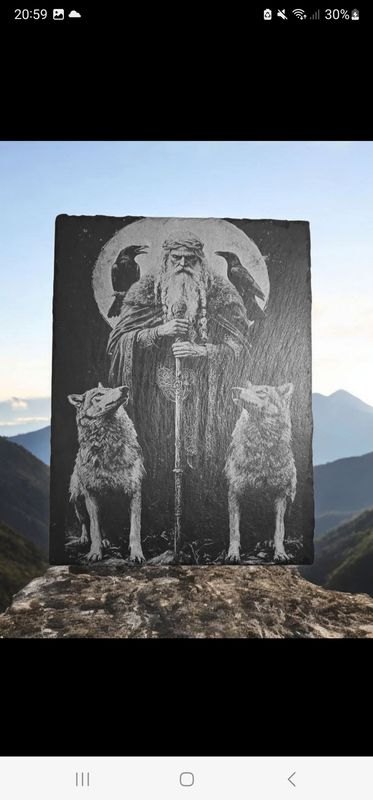
Odin · Nisse & Tomte · The Yule Goat – from straw goats and masked visitors to Joulupukki and the Gävle goat · When Wode Rides Through the Twelve Nights – Odin and the Wild Hunt at Yuletide · Jól – the Yule feast.
All Festivals & Belief articles →
Few places have given archaeology as much as the bog. Where oxygen is absent and tannic acids halt decay, things …
Read more →Yes, the old gods really do survive in place names: Odense in Denmark comes from Óðins vé, “Odin’s sanctuary” …
Read more →The Rauhnächte are the roughly twelve nights between Christmas and Epiphany, a stretch that German and Alpine folk …
Read more →The Norse had no holy book, no pope and no fixed liturgy. Their faith lived in action: in the sacrificial feast at the …
Read more →