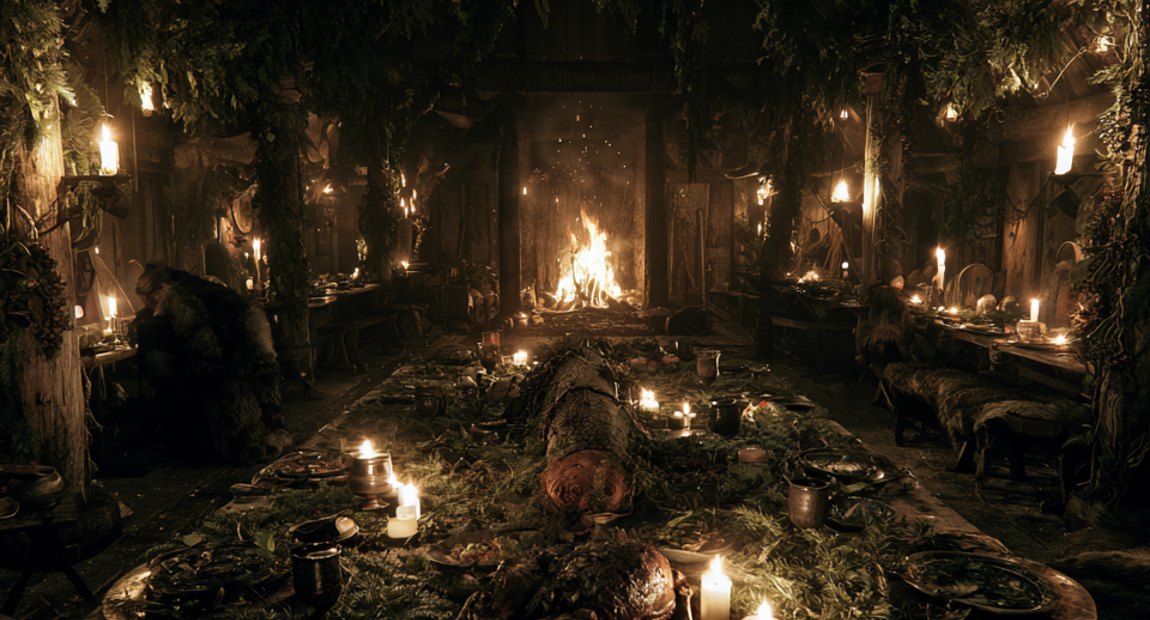
No Viking ever wrote down how his Yule feast went. What survives are fragments: a praise poem from around 900, a Saxon bishop writing around 1015, Icelandic sagas of the thirteenth century, Norwegian church laws, and halls, bones and cauldrons pulled from the ground. Lay them side by side and a sequence emerges – from the day of slaughter, through the blood in the sacrificial bowl and the cups raised to Odin, Njord and Freyr, to the vow sworn on the boar and the morning the ale finally ran out. This article walks through that sequence stage by stage and, at every stage, says how we know and how sure we can be.
Anyone who wants to know what a Yule feast looked like in a tenth-century Norwegian hall runs straight into a problem: the people who celebrated it did not write. Runic inscriptions record names and commemorate the dead, but they contain no festival programmes. Everything we are told about Yule comes from people looking at it from outside, or from a later age. That is no reason for despair, but it is a reason for discipline. We work with five layers of evidence, and at every stage below we say which layer the information comes from.
The first layer is contemporary testimony: skaldic poems, passed on by word of mouth and written down only in the twelfth and thirteenth centuries, but whose wording is thought to be comparatively old because their strict metre made them hard to change, together with the account of Bishop Thietmar of Merseburg. The second is the sagas of the thirteenth century, above all the Heimskringla of the Icelander Snorri Sturluson: vividly told, but Christian history-writing about a world two or three centuries in the past. The third layer is the law, especially the Norwegian regional law codes. They are Christian, yet they reveal which customs the Church found in place and then reshaped. The fourth is archaeology: halls, hearths, animal bones, drinking vessels – contemporary, but silent. The fifth is analogy: where a source describes a sacrificial feast in general terms, we carefully apply it to Yule and say openly that we are doing so.
The basics – where the word Yule comes from, what Bede wrote about the Anglo-Saxon months, who Jólnir was – are covered in our article Yule: the Norse midwinter festival. This piece is about something else: the order of events, the practical steps, and the people in the hall.
Only one source gives a starting point for pre-Christian Yule: the Hákonar saga góða in Snorri's Heimskringla, written around 1230. In earlier times, Snorri says, Yule began on hǫkunótt, which was midwinter night, and people kept Yule for three nights. Samuel Laing, who translated the Heimskringla into English in 1844, renders hǫkunótt as "slaughter night" and adds a date in brackets: 14 December. That date is Laing's own conversion, not something Snorri says. The Old Norse calendar counted the weeks of winter from the Winter Nights in mid-October, and on that reckoning the middle of the winter half-year fell closer to January. There is more on this in our article on how the Vikings kept time.
Snorri tells us twice that Yule was one of several fixed dates for sacrifice. In the Ynglinga saga he has Odin himself lay down the order: a sacrifice at the start of winter for a good year, one at midwinter for growth, and a third at the start of summer for victory (ch. 8). And in the saga of Olaf the Saint he tells of Sigurd Þórisson, a powerful farmer in Hålogaland who, in heathen times, held three sacrificial feasts a year: on the eve of the Winter Nights, on the eve of midwinter, and in summer. Once he became a Christian he kept the dates and now held an autumn feast, a Yule feast and one around Easter (Laing, ch. 123). The calendar stayed; only the altar changed.
The conclusion is clear enough. The Norse Yule was not a solstice festival in the astronomical sense but a feast of mid-winter. The exact day is unknown and probably varied from region to region. The one thing handed down, according to Snorri, is its length: three nights.
The oldest written source to link a great winter sacrifice in the North with a particular month comes from Saxony. Thietmar, bishop of Merseburg from 1009, wrote his chronicle between roughly 1012 and 1018. In Book I, chapter 17, he describes a place called Lederun in the district of Selon – Lejre on Zealand – which he calls "the head of this kingdom". There, every nine years in January, after the feast of the Epiphany, everyone gathered and sacrificed ninety-nine people and as many horses, together with dogs, and cockerels in place of hawks. The offerings were meant to secure them atonement with the powers below the earth. Thietmar praises "our king" for putting an end to the custom; on the usual reading this is Henry I, who campaigned against the Danes in 934.
Is this a Yule feast? The timing fits a midwinter festival strikingly well, and scholars have often connected Lejre with Yule for that reason. Thietmar himself never uses the word. He is reporting hearsay from a distance of about eighty years, and the number ninety-nine sounds more like symbolism than a head count. There is no archaeological proof of human sacrifice at Lejre. What the excavations there have shown are the great halls of a lordly residence spanning several centuries (see also The Lejre figure).
Another account does not belong here at all. Around 1075, Adam of Bremen describes the great sacrificial festival at the temple of Uppsala, also held every nine years, with victims hung in a sacred grove. According to Adam, that festival took place around the spring equinox, not at midwinter. Anyone who tells it as a Yule feast is mixing up two sources (more under Adam of Bremen).
A feast lasting three nights was not something you organised the evening before. Whether hǫkunótt really means "slaughter night" is not linguistically secure – the word occurs only in this single passage in the whole of Old Norse literature. The idea itself, though, fits the farming year: in late autumn and early winter, people slaughtered the animals they could not feed through to spring, and a large meal in the middle of winter was the natural occasion to share out the meat. What else came to the table is described in our article on Viking food.
Getting supplies could itself become a saga. Snorri tells how Ásbjörn, son of Sigurd Þórisson, wanted to continue his late father's three feasts, Yule among them. Then came bad years in Hålogaland. The grain did not stretch, and King Olaf had banned the export of corn from the south. Ásbjörn sailed south anyway, to buy grain and malt for his feasts. The venture ends in humiliation at the hands of the king's steward Þórir selr, and later in a killing. For our purposes the beginning is what counts: an eleventh-century magnate was prepared to risk his ship and his honour so that his feasts would not be any smaller than before. Hospitality was status.
Then there was firewood – enough for a hall with a long hearth, cauldrons and guests over three nights. That follows from the floor plans of the houses (see The longhouse), not from any Yule source. Nor do we know exactly how invitations went out. The sagas simply take it for granted that a householder asked neighbours, kin and retainers to come for Yule.
No ale, no Yule. In Old Norse, "to celebrate Yule" is drekka jól – literally "to drink Yule". Brewing ale meant, above all, making malt: steeping barley, letting it sprout, drying it in a kiln, grinding it, then boiling the wort and letting it ferment. That took days, even weeks. The details are in our article Beer and brewing in the Viking Age; for the drink of the elite, see Mead.
Hákon the Good, according to Snorri, made brewing compulsory. In Laing's translation every man was to brew a set measure of malt into ale "under a penalty" and keep Yule holy "as long as it lasted" – that is, as long as the ale held out. Here a Christian king does not ban a heathen custom; he moves it and makes it binding (more about him in Hákon the Good).
How seriously lawmakers took this is shown by the Christian section of the Gulathing Law, the regional law of western Norway, whose older parts go back to the twelfth century. Here Christmas ale becomes a legal obligation: farmers were to brew ale together, to be consecrated on Christmas night to Christ and the Virgin Mary, til árs ok friðar, "for a good year and peace". Anyone who failed to brew paid a fine to the bishop. According to the historian of religion Helje Kringlebotn Sødal (University of Agder), a man who went three years in a row without brewing and consecrating Yule ale could lose his house and property and be driven out of the country. We were not able to check the minimum number of participating farmers or the size of the fine against the text of the law itself, so we leave them out.
The phrase til árs ok friðar is the key. It is exactly the formula Snorri uses for the heathen cups to Njord and Freyr. Many scholars believe it is older than the Church, because it appears so naturally as the purpose of a sacrifice; that cannot be proved. What is certain is this: in the twelfth century, the Norwegian farmer drank at Christmas to a good year and peace – with ale he had brewed under threat of a fine.
A Yule feast was not a quiet family evening by the fire. The sources show two forms. One was the feast at the farm of a wealthy landholder or chieftain, to which neighbours, relatives and followers came. The other was the communal sacrificial feast of a whole district, as Snorri describes it for Trøndelag. There, by old custom, all the farmers were to come to the place of sacrifice and bring with them what they needed; Laing's version reads "all that they required while the festival of the sacrifice lasted". Each person, in other words, contributed his own share of food and ale – a detail that sits well with the brewing groups of the later Gulathing Law.
Anyone invited had a seat, and that seat said something. The sagas pay close attention to who sat in the high seat and who sat at the far ends of the benches; more than one quarrel starts with a seating plan. At the centre sat the man who hosted and paid for the feast. He blessed the cups and the sacrificial meat. Snorri makes a point of noting that Sigurd, the jarl of Hlaðir, held a great sacrificial feast and bore all the costs himself (see The jarls of Lade).
Women barely appear in the descriptions of sacrifice, which probably says more about the storytellers than about reality. From other sagas we know that the mistress of the house managed the stores and that women carried the drinking horn around at feasts. For Yule specifically, this is not attested.
Snorri speaks of the hof, usually translated as "temple", with altars, walls inside and out, and a fire in the middle of the floor. Archaeologists have found very little trace of free-standing temple buildings in Scandinavia. What they have found instead are large halls on lordly estates, where living, ruling and worship all took place under one roof – which matches the saga scenes in which the sacrifice is held in the house of a jarl or a farmer.
Some of these sites make it easy to imagine a Yule feast. At Borg on Vestvågøy in the Lofoten Islands, a chieftain's house was excavated in the 1980s. At its largest it was over 80 metres long, with a great feasting room, fragments of imported glass vessels and tiny gold-foil figures known as guldgubber. At Uppåkra near Lund in Sweden, a small but strikingly tall cult house stood for centuries and was rebuilt again and again on the same spot; finds there include a metal beaker, a glass bowl and more than a hundred gold-foil figures (more in our article on Uppåkra). At Tissø on Zealand there was an estate with a great hall and, next to it, a fenced enclosure that the excavators interpret as a cult site (Tissø). Large halls have also been found at Lejre and at Gamla Uppsala. Our article on blót sites gives an overview of such places.
What archaeology cannot supply is the label "Yule". The refuse layers of these halls contain animal bones, some in conspicuous deposits, along with shards of drinking glasses and remains of cauldrons. Whether a particular heap of bones comes from an autumn sacrifice, a Yule feast, a wedding or a funeral meal can almost never be said. Seasonal clues – the age at which young animals were slaughtered, for instance – sometimes show the time of year when the killing happened, but not which festival was being held. So if you read that someone has excavated "a Viking Yule feast site", it is worth asking a follow-up question. What was found is a feasting site. That Yule was celebrated there too is likely; it cannot be demonstrated.
Light, in these darkest weeks, came from the long fire and from lamps of soapstone or iron filled with oil. Candles as a festive custom, and the "Yule log" that had to burn all night, belong to the Christian Christmas and to modern folklore.
At the heart of the heathen feast was the blót, the sacrifice. Snorri's fullest description comes straight after Hákon's Yule law, in chapter 14 of the standard Icelandic edition (chapter 16 in Laing). Here he describes a sacrificial feast in general, not Yule specifically. But because he has just been talking about Yule, and immediately afterwards tells of two feasts in Trøndelag, one of which is a Yule feast, the passage has rightly been used again and again to reconstruct Yule. We follow it step by step.
All kinds of livestock were slaughtered, Snorri says, horses among them. The blood that flowed was called hlaut. It was caught in vessels, the hlautbollar, and people made bundles of twigs, the hlautteinar, which Laing describes as "hlaut-staves … like sprinkling brushes" – much like the aspergillum a priest uses for holy water. With them the altars were sprinkled, the walls of the building inside and out, and the people as well. The image is stark, and for a Christian reader of the thirteenth century it was probably drawn that way on purpose: heathen worship as a bloody mirror image of blessing with holy water. The parallel is so close that one has to ask how much of it is tradition and how much is Snorri's construction.
One argument for an old core is the vocabulary. The word hlaut also appears in the Poetic Edda. At the opening of Hymiskviða, the gods shake twigs and examine the sacrificial blood to discover where they can find cauldrons for their feast – and the answer leads them to Ægir (see Ægir's feast). That points to an established term that Snorri did not invent. Whether the blood was really sprinkled over people, on the other hand, cannot be checked. What archaeology can show is animal sacrifice at cult sites, not the sprinkling.
For the course of the Yule feast this means: at the start, probably on the first evening, came the slaughter as a religious act, led by the householder or chieftain. The Norse sources know of no separate priestly caste. The man who hosted the feast was also the one who consecrated it. That is one of the most important insights the sources offer – and it explains why a Christian king like Hákon got into such difficulty when he was expected to take his place in the hall. How blót and the drinking round are re-enacted today is described in Blót and sumbel today.
The meat of the sacrificial animals was not burnt; it was eaten. In Laing's translation it was boiled "into savoury meat", and cauldrons hung over the fire in the middle of the room. This is not a side issue. In the North, a sacrifice was first and foremost a meal that bound people and gods together. Whoever ate with the others belonged. Whoever refused set himself outside the community.
That is exactly where the most famous conflict in the history of Yule flared up. Horse meat was common in heathen sacrifice and for that reason was later banned by the Church; to eat it was to declare for the old faith. When Hákon, at the autumn sacrifice at Hlaðir, would eat none of the horse and would not even drink the broth, Jarl Sigurd found a compromise: the king should put his mouth over the handle of the cauldron, where the greasy steam had settled. He did so, with a linen cloth over the iron, as Snorri tells it. We have retold the whole scene, including the quarrel over the sign of the cross made over the cup, in our article on Yule. For the sequence of the feast, what matters is what the episode reveals: cauldron, meat and broth were not just food but a confession of faith.
The archaeology fits this picture. Large iron cauldrons with suspension chains are known from Viking Age graves, for example the Oseberg ship burial, and lordly estates have produced large quantities of animal bone, including horse bones with butchery marks. So the eating of horses is no invention of the saga writers. On the special place of the horse in cult, see Sacred horses.
After the meal – or already during it; the sources do not say – came the part that gave the feast its name: the drinking. It was not a free-for-all but a series of rounds, each with a set purpose. The host, Snorri says, blessed the full cups and the sacrificial meat. Then the cups, the full, were passed across the fire. Laing translated the passage in 1844 like this:
"The fire was in the middle of the floor of the temple, and over it hung the kettles … And first Odin's goblet was emptied for victory and power to his king; thereafter, Niord's and Freyja's goblets for peace and a good season. Then it was the custom of many to empty the brage-goblet; and then the guests emptied a goblet to the memory of departed friends, called the remembrance goblet."Snorri Sturluson, Hákonar saga góða, ch. 14 (ch. 16 in Laing), trans. Samuel Laing, The Heimskringla, London 1844 (public domain); omission ours
One detail deserves attention: Laing writes "Freyja" here. In the Old Norse text, according to the standard edition, the cup is Freyr's – the male Vanir god's, not his sister's. Snorri's pair, then, is Njord and his son Freyr, both concerned with fertility, prosperity and peace. The order is revealing. First comes Odin, and not for the host but for the king: victory and power. That is a political gesture, showing to whom the gathering owed its loyalty. Then come the Vanir, Njord and Freyr, til árs ok friðar – for a good year and peace. This is about the farm, the harvest, the livestock, and the absence of feuds.
How the passing of the cup worked can be pictured from other feasting scenes: a horn or cup went from hand to hand, often in pairs, with two guests drinking from the same vessel. Drinking horns are well attested archaeologically, usually only through their metal fittings, because the horn itself decays (see The drinking horn). Among the elite there were also glass funnel beakers, which could not be set down until they were empty.
The last two cups on Snorri's list lead deeper into the society of the hall. The bragafull is the "Bragi cup" or "chieftain's cup"; whether the name comes from the poet god Bragi or from bragr, "the best, the foremost", is disputed. Laing notes in a footnote that vows were made over this cup. That matches another passage in the Heimskringla. In the Ynglinga saga, in the chapter on King Ingjald, Snorri describes how, at the inheritance feast for a king or jarl, the heir first sat on the step in front of the high seat. Only when the Bragi cup was carried in did he stand up, make a vow, drain the cup and then take his father's place. The cup, in other words, marked the transfer of power.
The last cup was for the dead. Snorri calls it minni, "remembrance", and Laing translates "remembrance goblet". People drank to their departed kin, and it is easy to see why this custom survived Christianisation: the cup for the ancestors became the cup for Christ, Mary and the saints, which reappears as minni in the statutes of medieval guilds. The dead at Yule are a large subject in their own right; we have dealt with it at length in Ancestor veneration at Yule and leave it here as one stage in the sequence.
Between the cups came the solemn vow, the heitstrenging. A man rose, took the cup and declared aloud what he would accomplish in the coming year: kill an enemy, win a woman, lead an expedition. Whoever vowed and failed to deliver lost his standing. The vow was boast and bond at once, and in a hall full of ale it could easily get out of hand.
Two texts explicitly link such vows with Yule Eve and with a boar, the sónargǫltr: the prose passages of Helgakviða Hjörvarðssonar in the Poetic Edda and the Hervarar saga ok Heiðreks. In the Eddic prose, Heðinn swears on Yule Eve to win the beloved of his brother Helgi – and regrets it at once. In Hervarar saga, King Heiðrekr's men lay their hands on the bristles of the great boar on Yule Eve. The details, and Bellows' translation of the wording, are in our article on Yule; on the animal itself see The boar in the North and Gullinbursti.
For the sequence of the feast, what counts is the function. The boar was led into the hall alive; the men touched it, spoke their vows and drank. One group of manuscripts of Hervarar saga adds that the animal was dedicated to Freyr and sacrificed afterwards. The vow, then, came before the sacrifice, not after it – a hint that the sequence described above did not break down neatly into sacrifice, meal and cups, but that the acts overlapped. How often such boar rituals really took place cannot be said. Both texts tell of legendary kings of the distant past, not of ordinary farms.
The oldest mention of Yule anywhere in the North comes from a praise poem. The Haraldskvæði, also known as Hrafnsmál, is attributed to the skald Þorbjörn hornklofi, said to have composed at the court of Harald Fairhair around 900. In the sixth stanza Harald is described thus: Úti vill jól drekka – "he means to drink Yule outside". The king, the stanza implies, cannot bear to sit by the warm fire; he celebrates Yule at sea and plays "Freyr's game", a phrase some read as battle and others as a cult act. The line works by contrast: Yule is drunk indoors, in the hall, and a man who drinks it outside is a hard warrior. In passing, then, the poem proves what was normal around 900 – the feast by the hearth. On the king himself, see Harald Fairhair.
Just how political that feast by the hearth could be is shown by the second great Yule scene in Hákonar saga. In the winter after the autumn sacrifice at Hlaðir, the king held a Yule feast at Mærin, today's Mære in inner Trøndelag. Eight chieftains had sworn an oath beforehand: four would root out Christianity in Norway, four would force the king to sacrifice. Snorri names them, among them Kárr of Grýting, Ásbjörn of Meðalhús and Þrándr haka of Egg. The first four sailed south, killed three priests and burned three churches. Then came the feast. On the very first day the farmers pressed the king to sacrifice and threatened him with violence. Once again Jarl Sigurd mediated, and this time Hákon ate a few bites of horse liver and drank every cup they filled for him without making the sign of the cross.
In this chapter Laing renders the place name as "More", which is easily confused with the coastal region of Møre; the original means Mærin, the old cult site near Steinkjer. On that spot today stands the medieval church of Mære, and excavations beneath its floor brought gold-foil figures to light – a rare case in which a saga location of a Yule feast can also be grasped archaeologically as a cult site. On the king and his failure, see Hákon the Good.
Three nights of ale among armed men with a keen sense of honour – lawmakers knew perfectly well that this did not always end peacefully. The Gulathing Law contains its own provisions for killings in the drinking house. If someone was killed there, according to the legal historian Alexandra Sanmark, everyone present was obliged to name the killer; if they could not, they were jointly liable to the dead man's kin and to the king. Quarrels at drinking parties, and the mistreatment of a wife "at table or at a drinking feast", are regulated too. These provisions do not apply only to Yule, but they show how naturally the drinking feast was regarded as a place where violence might break out.
The sagas supply the scenes to match. The best known is set in Orkney. The Orkneyinga saga tells of a Yule feast that Earl Páll gave at his estate in Orphir, in the 1130s according to the saga's chronology. During the feast Sveinn Ásleifarson and Sveinn brjóstreipr ("Breast-rope"), one of the earl's retainers, come to blows; in the end Sveinn Ásleifarson kills his namesake in the dark and flees. Along the way the saga describes the layout precisely: the great drinking hall, a door near the east gable of the south wall, and in front of it a magnificent church, reached by going down from the hall. That church still stands as a ruin today: the round church of St Nicholas in Orphir, right next to the remains of a large building interpreted as the earl's hall, known as the Earl's Bu. Here saga text and masonry meet – though at a Christian Christmas feast of the twelfth century, not at a heathen Yule. More about the islands in our article The earls of Orkney.
Grettis saga, too, knows Yuletide as a time of danger. The young Grettir is staying with a farmer on an island in northern Norway when, over Yule, twelve berserkers land while the master of the house is himself away at a Yule feast. Grettir lures them with ale into a storehouse and kills them. The episode assumes that the men of a farm often spent Yule with neighbours or at a chieftain's hall, leaving the farm itself thinly manned. An overview of the saga: Grettis saga.
Some Yule stories are not about guests at all, but about beings who come uninvited. In Grettis saga the shepherd Glámr dies in a snowstorm on Christmas Eve, after demanding food despite the fast, and afterwards walks again as a revenant. In Eyrbyggja saga, during the funeral feast held at Yule on the farm of Fróðá, the drowned men walk into the hall, sit down by the fire and let the water drip from their clothes.
All of these stories are set in Christian times, and they tie the uncanny precisely to the Christian feast, to fasting and to the Church. Whether heathen ideas lie behind the motif is an open question. We have covered revenants in Draugr and their link with Yule in Ancestor veneration at Yule; the later idea of a roaring host of the dead is told in The Wild Hunt.
Were there presents at Yule? Not in today's sense, but there were gifts. The finest Yule scene of this kind is in Egils saga. Egill Skallagrímsson spends a winter with his friend Arinbjörn in Norway, who holds a great Yule feast attended by friends and neighbours from the surrounding area. At Yule Arinbjörn gives him a silk gown embroidered with gold and set with gold buttons, cut to Egill's size, along with a full set of clothes made of English cloth in many colours. Egill, not normally a man given to emotion, responds with a stanza praising a friend whose equal he will never have (chapter 68 in Bernard Scudder's English translation). On the poet, see Egill Skallagrímsson.
The scene is telling. The gift goes from host to guest, not round the circle from everyone to everyone, and it expresses rank and friendship. A powerful man proved himself through generosity; the recipient owed loyalty, service or, in a poet's case, a poem. Parting gifts after great feasts – rings, weapons, clothing – are common in the sagas, but explicitly at Yule only in individual cases. All this has little to do with Secret Santa or a modern table piled with presents. If you are interested in Viking Age gift customs more broadly, there is more in our article on gifts at weddings and name-givings.
You often read that Yule feasts included wrestling bouts and ball games. The sagas do know the ball game knattleikr and the wrestling style glíma, and they tend to place large gatherings for games in autumn and early winter, after the harvest work was done. We have not found a single games scene in the sources that is explicitly tied to Yule. It is possible; it is not attested. More on the games in Glíma and knattleikr.
The same caution applies to the "Yule peace". Peace was, by the formula til árs ok friðar, one of the aims of the Yule cups, but no legally defined Yule peace is known from the Viking Age. The public declaration of Christmas peace in the Finnish city of Turku is said to go back to the Middle Ages; it is securely documented only from the early modern period, and it is Christian through and through.
How did a Yule feast end? Snorri's statement is brief: people kept Yule for three nights. Hákon's law puts it more practically – Yule was to be kept as long as the ale lasted. The two fit together well. A feast went on for as long as the supplies allowed, and three nights were probably the usual measure for a well-provisioned farm. Then the guests went home and everyday winter life returned.
The longer festive season people associate with Yule today is Christian. The Church counted twelve days from Christmas to Epiphany, and in the North the Christmas season grew even longer over the course of the Middle Ages. According to Norwegian folklore research, celebrating could go on until the thirteenth or even the twentieth day of Christmas; in Sweden, St Knut's Day on 13 January, the twentieth day after Christmas, still marks the end of the season. None of these time spans can be shown to apply to heathen Yule.
The end of the old sacrificial Yule is itself recorded, albeit with a Christian interpretation. The Norwegian royal history Ágrip (around 1190) reports that Olaf Tryggvason abolished sacrifices and sacrificial drinking feasts and introduced in their place festive drinking at Yule, Easter and other church feasts, so that the people would keep their celebrations. It is a remarkably candid description of what happened: people were not robbed of their feast; it was given a new addressee. On Olaf's mission, see Olaf Tryggvason.
What remained was, first of all, the word. In every Scandinavian language Christmas is still jul or jól, and the word travelled early to the neighbours: Finnish joulu and Estonian jõulud are regarded as loans from North Germanic. When people in the North wish each other "God jul", they are using a festival name older than the Church for a festival the Church shaped.
Structures survived too. Ale was still brewed, now consecrated to Christ and Mary. The rounds of cups were still drunk, now to Christ and the saints. Remembrance of the dead moved into masses for souls and the minni cups of the guilds. The householder lost his role as leader of the sacrifice to the priest, but kept his role as host. And some cult sites stayed what they had been: at Mære, the church stands where the farmers forced Hákon to eat horse liver. The wider story is told in our article on the Christianisation of the Germanic peoples.
What disappeared was the blood. Animal sacrifice, sprinkling and horse meat were forbidden and vanished from the official festival. The Yule customs that turn up later in folk culture – Yule straw, the Yule goat, food set out for invisible guests – are mostly recorded only from the modern period and cannot be shown to be an unbroken continuation of the sacrificial Yule. More on this in The Yule goat and Christmas customs with Norse roots.
Let us put the stages together while staying as close to the sources as we can. We are on a large farm in Trøndelag, in a winter of the tenth century. For weeks the malt has been sprouting and drying, and the ale is fermenting in its vats. The animals that will not make it through the winter have been slaughtered or are waiting in the byre; a horse is among them. Messengers have invited the neighbours and retainers, and they arrive by sledge and on foot, each bringing his share of provisions.
On the first evening, midwinter night, everyone gathers in the hall. The householder leads the slaughter; the blood is caught in bowls and sprinkled with bundles of twigs. Meat boils in the cauldrons over the long fire. The householder blesses cup and food. The first cup goes to Odin, for the king's victory and power; then to Njord and Freyr, for a good year and peace. Anyone with something to vow stands up at the Bragi cup and speaks. Last of all, they drink to the family's dead. This goes on for three nights, until the ale is gone. Some guests receive a gift as they leave. And somewhere in the neighbourhood, another feast ends in a fight.
Roughly like that. Every single stage has a source behind it, but no single source describes all the stages together, and none comes from a participant. The picture is a montage built from a poem of around 900, a history of around 1230, a church law of the twelfth century and finds spanning several centuries. It is the best approximation we have – no more and no less.
How long did a Viking Yule feast last? According to Snorri Sturluson, three nights, starting on midwinter night. Hákon the Good ordered that Yule be kept as long as the ale lasted. Longer periods belong to the Christian Christmas season.
What was eaten at a Yule feast? Above all the meat of freshly slaughtered animals, boiled in cauldrons, horse included. Bread and porridge were eaten too. Horse meat was banned after Christianisation because it was seen as a mark of the old cult.
To whom did people drink at Yule? Snorri gives the order as Odin (victory and power for the king), Njord and Freyr (a good year and peace), the Bragi cup, over which vows were made, and finally the remembrance cup for departed kin. He is describing a sacrificial feast in general, which may be applied to Yule but need not be.
Did the Vikings give Yule presents? Not as a mutual exchange, but as gifts from host to guests. Egils saga tells how Arinbjörn gives the poet Egill a silk gown at Yule.
Can a Viking Yule feast be proved archaeologically? Not directly. Halls, cauldrons, drinking vessels and animal bones are well attested, but no find carries the label "Yule". Linking remains to a particular festival is only possible through written sources.
Yule: the Norse midwinter festival · Ancestor veneration at Yule · Hákon the Good · The jarls of Lade · Heimskringla · Mead · The drinking horn · Gullinbursti · Freyr · Njord · Odin · Yule among the Germanic peoples
Jól – the Yule feast · Ancestor veneration at Yule · Haakon the Good · The Earls of Lade · How Did the Germanic Peoples Celebrate Midwinter? Yule on the Continent.
All Festivals & Belief articles →
Four festivals structure the "Celtic year": Samhain, Imbolc, Beltane and Lughnasadh. Almost everything we know about …
Read more →The Celts did not write their faith down. What we know comes from Caesar, Strabo, Pliny and Tacitus, from votive stones …
Read more →Few terms are as popular and as misunderstood as the "place of power". People make pilgrimages to stone circles …
Read more →When a ship drew near a coast, the dragon head had to come off the stem so the landvættir would not be frightened. So …
Read more →