A great log on the hearth, lit with what was left of last year's, its ashes spread on the fields, its embers kept against lightning: the Yule log is usually presented as a relic of a Germanic Yule fire. The sources tell a different and far more interesting story – one that involves a bishop in Galicia, a parish priest in Westphalia, an English country parson who put festive customs into verse, and Serbian farmers who walk into the woods with an axe before sunrise.
Search for the origins of the Yule log in December and you will almost always be told the same story. The ancient Germanic peoples, it goes, lit a huge tree trunk at the winter solstice and kept it burning for twelve nights to help the sun on its way back. The Church took over the custom, England preserved it as the Yule log, and the French chocolate log, the bûche de Noël, is its last sweet descendant.
That story contains three separate claims, and each has to be tested on its own. First: there was a special Yule fire or Yule log in the pre-Christian North. Second: the Christmas log of later centuries descends from that fire. Third: its meaning was a kind of sun magic. None of the three can be supported from the sources. What the sources do show is something else, and it is at least as interesting: a hearth custom that turns up in countless variants from Portugal to Serbia and from Cornwall to Thuringia, that surfaces first in church prohibitions of the sixth century, appears in legal records of the High Middle Ages, and only acquired its grand interpretive history in the nineteenth century, when the folklorists arrived.
This article goes deeper into a topic that our overview of Christmas customs and their supposed Nordic roots could only touch on in a single section. It works through the evidence in order of age and keeps three layers apart throughout: written sources, nineteenth-century folklore, and modern interpretation.
The names alone reveal a good deal. The oldest English term is not "Yule log" at all but "Christmas log" or "Christmas block". That is what Robert Herrick calls it in 1648. According to the secondary literature (here following the summary in the English Wikipedia), the form "Yule log" first appears with the antiquary John Aubrey in the second half of the seventeenth century, who speaks of "a large Yule log or Christmas block". Regional English usage added more: the Yule clog in the north-east, the Yule block in the Midlands and the West, the Gule block in Lincolnshire, and in Cornwall the "Stock of the Mock".
The word Yule itself is old. It goes back to Old English geol and Old Norse jól, the midwinter feast whose history our article Yule: the history of a word and a festival traces in detail. Linguistically, then, a Yule log is first of all nothing more than a Christmas log in the dialect of the North. That the name sounds like Vikings tells us nothing about how old the custom is.
In the German-speaking lands, nineteenth-century folklorists recorded the Christbrand ("Christ brand") in the Eifel and in Westphalia, and the Christklotz ("Christ block") in Thuringia and the Meiningen uplands. In French the log is the bûche or souche de Noël; in Provence it is the cacho-fio or tréfoir, in Marseille the calendeau, in the Dauphiné the chalendal, in the Orne the tréfouet, in Berry the cosse de Nau. In Italian it is the ceppo, in Piedmont the suc, in Tuscany the ciocco – and Tuscany at times called Christmas itself the Festa di Ceppo, the feast of the log. Serbs and Croats call it badnjak, Bulgarians bădnik, and in Catalonia there is the tió.
Two observations stand out. The French names chalendal and calendeau go back to the Latin Kalendae, the first day of the month – more precisely the Kalends of January, the Roman New Year. And the Serbian badnjak is connected with badnji dan, the "day of vigil", Christmas Eve; the ethnologist Petar Vlahović, and before him Vuk Karadžić in his dictionary of 1818, derived the word from bdjeti, "to keep watch". Not a single one of these names points to a solstice. They point to the Roman New Year, to Christ, and to the night vigil before the feast.
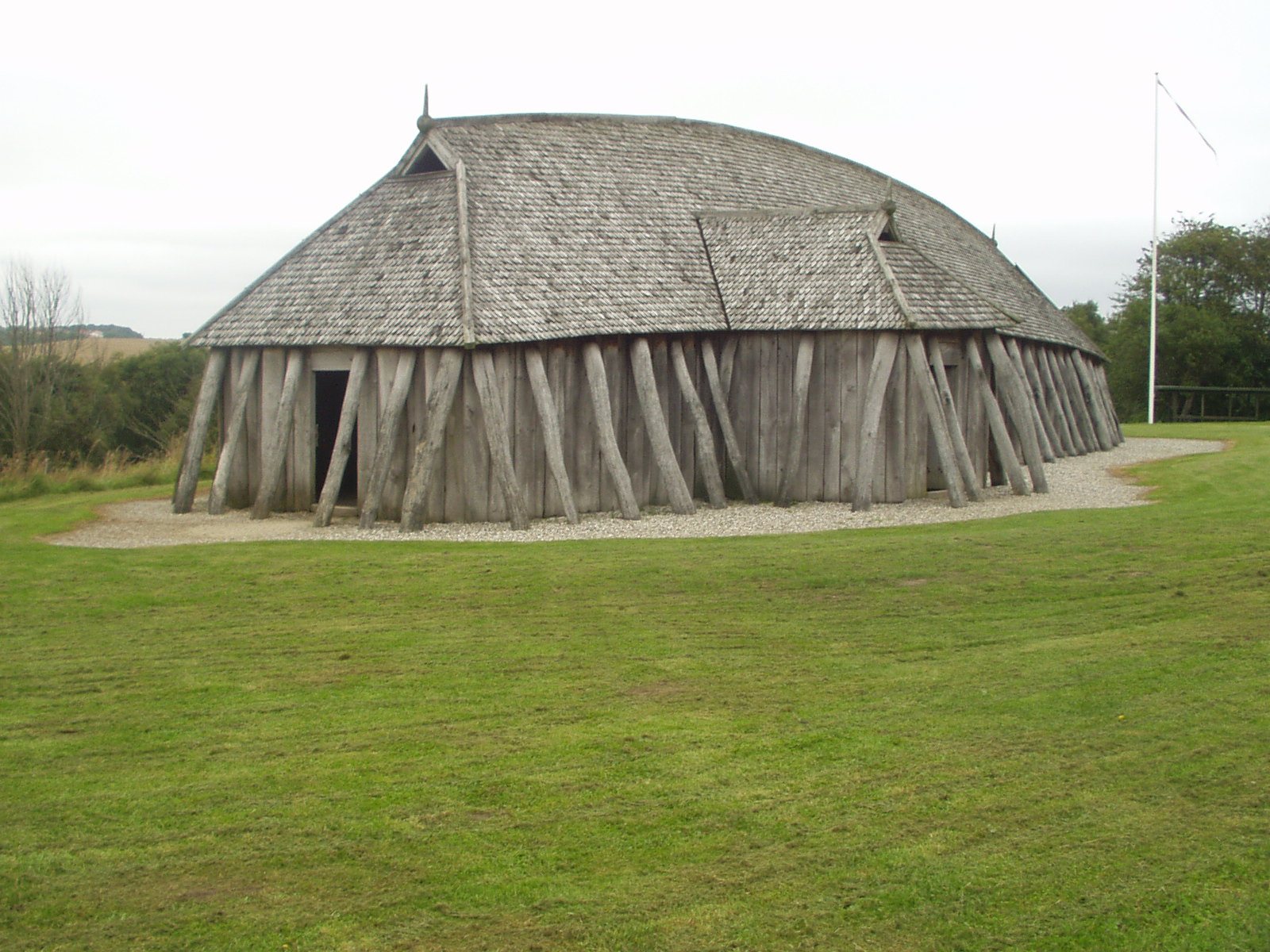
If the custom had a Nordic origin, it ought to be visible in the Old Norse texts. Fire does appear there – constantly. The hall of a farmstead had a long fire, a hearth lined or edged with stones that ran for several metres down the middle of the room. It gave heat, light and a place to cook; how it was built and how smoky the air beneath the roof remained is described in our article on the Viking longhouse. At Yule this fire naturally burned, and probably brighter than usual, because there were guests.
The most famous description of a sacrificial feast, chapter 14 of Hákonar saga góða in Snorri Sturluson's Heimskringla, places the fire at the centre of the cult building: the cauldrons of sacrificial meat hung over it, and the cups were passed across the flames. Snorri wrote this scene around 1230, more than two centuries after Norway's conversion, and he is describing a sacrificial banquet in general terms, not a special Yule fire. Our reconstruction of a Yule feast in the North follows this scene step by step. For our question only one thing matters: the fire is a cooking place and a focal point, not the object of a ritual in its own right. Nobody fetches a special trunk, nobody keeps a remnant, nobody scatters ashes.
A second scene is eerier. In Eyrbyggja saga, written down in the thirteenth century, the household at Fróðá holds the funeral feast at Yule for the farmer Þóroddr, who has drowned. On the first evening he and his men walk into the hall dripping wet and sit down by the fire, and they return evening after evening for as long as the feast lasts. Here too the Yule fire is simply the place where people gather – the living and the dead alike. No Yule log appears. If anything, the scene says something about the idea that the dead are close in the midwinter season, a theme taken up in the article on ancestor veneration at Yule.
However clearly the hearth fire burns in the sagas, everything that defines the later Christmas log is just as clearly missing. The key witnesses to midwinter among Germanic-speaking peoples are silent about it. Bede, writing around 725, explains the Anglo-Saxon month names and Modranecht, the "night of the mothers", but mentions no fire. Procopius, in the sixth century, reports that the inhabitants of Thule hold a feast when the sun returns after the long darkness – again without any fire ritual; more on this in the article on the solstice. Thietmar of Merseburg describes the great sacrifice at Lejre in January, with humans, horses, dogs and cocks, but no sacred log.
As early as 1899, Alexander Tille noted in "Yule and Christmas" – according to the summary I was able to consult – that while the sagas know of fires in feasting halls, they attach no particular importance to the wood being burnt. Tille also found no British record of the log before about 1600. How closely later historians of the British ritual year, such as Ronald Hutton, follow this line in detail is something I could not check against their texts. It is an argument from silence, and such arguments are never conclusive. But it carries real weight when, at the same time, clear traces of the custom appear in southern Europe half a millennium earlier.
Scandinavian folklore of the modern period, too, puts light rather than the log at the centre. In "Christmas in Ritual and Tradition" (1912), Clement A. Miles summarises what collectors in Denmark and Norway had recorded about the Yule candle. In West Jutland two tallow candles stood on the table for husband and wife, and whichever burned longer foretold which of the two would outlive the other. In Norway people placed money, clothing, food and drink in the light of the Yule candlestick so that none of these would be lacking in the new year. Leftover tallow was smeared on the plough in Sweden, burned against lightning during thunderstorms in Denmark, or used to mark a cross on the cattle. For Sweden Miles also mentions, very briefly, "some form of Yule log", without details. A fixed term such as "julkubbe" for a ritual log was not to be found in any of the sources I checked.
And the word "Yule fire" (German Julfeuer)? In the Old Norse texts I examined there is no set expression for a special fire at Yule. When the German word came into use I was unable to establish; it ties the Christmas log to the midsummer and solstice bonfires in the mind and describes an idea, not a finding in the sources.
The oldest trace leads not to Scandinavia but to the far western edge of Europe. Martin, a monk from Pannonia, was bishop of Braga in the Suebian kingdom, in what is now northern Portugal and Galicia. Around 572 he wrote a model sermon for a fellow bishop on how to wean country people from their old habits: "De correctione rusticorum", "On the correction of the peasants". In section 16 he lists what baptised Christians still do – keep the Vulcanalia and the Kalends, decorate tables, set up laurel, watch which foot they cross a threshold with, and, in his own words, "fundere in foco super truncum frugem et vinum": pour grain and wine over the log in the hearth.
This is not a Christmas log in the later sense. Martin mentions neither Christmas nor any special tree, and truncus may simply mean the burning piece of wood. Yet the building blocks are remarkably complete: the wood on the hearth, the offering of grain and wine poured on it, the link with the Kalends of January and with the good fortune of the household that people tried to secure at the start of the year. Precisely these acts – grain and wine on the log – reappear thirteen centuries later among Serbian heads of household and Provençal grandfathers.
The background is Roman. In the late antique Mediterranean, the Kalends of January were the great New Year festival, with gifts, banquets, masquerades and luck-bringing customs for the year ahead. Church fathers preached against it again and again from the fourth century to the eighth. The historian Jacob Latham argued in 2022 – according to a summary – that by late antiquity the Kalends had long since become a mixed festival in which Christians took part as a matter of course. What Martin forbids, then, is not some exotic idolatry but the domestic custom of people who went to church on Sunday.
Martin's sermon was read and reused. Pirmin, the founder of monasteries who was active on the island of Reichenau around 724, copied whole passages from it into his handbook for missionaries, the "Scarapsus". What he changed is telling, according to Ernst Jecker's study of 1927: in Pirmin's version the hearth disappears altogether, and fruit and wine are poured over a tree stump. Whether Pirmin was describing an Alemannic custom or simply smoothing the text cannot be decided. What it does show is how lists of forbidden practices travelled – from Galicia to Lake Constance – often without anyone being able to say which of them people actually did on the spot.
A few decades later, in 742, Boniface complained in a letter to Pope Zacharias that simple folk among the Alemanni, Bavarians or Franks came back from Rome saying that the Kalends of January were celebrated there with dances, feasting and songs in the streets – right next to St Peter's. In the same breath he describes a custom he says was observed in Rome as well: in those days nobody was willing to lend a neighbour fire, an iron tool or anything else from the house. Alexander Tille concluded from this in 1899 that the household fire was regarded as especially in need of protection around the New Year. In 1912 Clement Miles connected the same passage with a rule from northern England: in the days when fire was still struck with a tinderbox, no light was to be given out of the house between Christmas Eve and New Year. In Shropshire, the folklorist Charlotte Burne recorded that during the Christmas days no light could be struck or lent, and that ashes were not carried out on Christmas Day so as not to throw them "in the Saviour's face".
Between the letter of 742 and the notes from Shropshire lie eleven centuries without an unbroken chain. They should not be glued together into a single tradition. What the passages do share is an idea that crops up in many parts of Europe: the fire of the house carries the fortune of the house, and on the threshold of the year it must neither go out nor be given away.
The first record that explicitly links Christmas with a tree for the fire comes from the Münsterland in Westphalia. In "Balder the Beautiful" (1913), the fire volume of "The Golden Bough", James George Frazer reports that in 1184 the parish priest of Ahlen mentioned a tree being brought "to kindle the festal fire at the Lord's Nativity". According to the summary of Tille's account, the record concerns dues and rights: the parsonage of Ahlen was entitled to a whole tree for a domestic festive fire on Christmas Eve. I was not able to see the Latin wording myself; the statement rests on Frazer and on Tille as summarised.
Almost a century later the custom surfaces on the Adriatic. The statute book of Ragusa, today's Dubrovnik – the "Liber statutorum civitatis Ragusii" of 1272 – records, according to Tille, that shipmasters and sailors brought the comes, the head of the city, a large log on Christmas Eve, and received two gold coins and wine in return. Here the log is already public and political: it is handed over to the lord of the city, just as peasants rendered dues to their lord. Frazer knows something similar from medieval Berry, where several fiefs obliged the vassal to bring his lord a Yule log in person every year.
Both records come from Christian times and Christian institutions. One lies in Westphalia, the other on the border between the Latin and the Orthodox world, some 1,500 kilometres apart. That argues neither for nor against any particular origin, but it does suggest that by the High Middle Ages the custom was already widespread and so self-evident that it found its way into rules about dues. According to the Wikipedia summary, which draws on Tille, German charters of 1577 and 1591 also describe public Christmas fires at which anyone could warm themselves – one obliging a tenant to let the public warm themselves at the fire, the other requiring a mayor to keep a large fire burning near the church on Christmas morning. I have not examined these charters myself.
Milan shows how splendid the custom could become at a princely court. In 1994 the historian Gregory Lubkin studied the household of Duke Galeazzo Maria Sforza. According to his account, which I know only from summaries, a log covered in fruit and foliage – juniper and laurel above all – was brought into the court at sunset on Christmas Eve between 1466 and 1476 and burned. Clement Miles quotes a Milanese book from the end of the fifteenth century in which the master of the house blessed the ceppo in the name of the Trinity, laid juniper and money on it – the money then went to the servants – and poured wine over it three times.
The laurel is worth noting. Some nine hundred years earlier Martin of Braga had condemned the setting up of laurel at the Kalends. Here it is part of a Christian court ceremony. Miles traces the ceppo in Italy back as far as the eleventh century, though I was unable to check his source; the Wikipedia summary speaks only of attestations since the fifteenth century. In the Val di Chiana in Tuscany, blindfolded children struck the log with the fire tongs while singing an "Ave Maria del Ceppo" – a custom we will meet again in Catalonia.
In England the record begins late, but it begins with a poet. Robert Herrick, vicar of Dean Prior in Devon, published his collection "Hesperides" in 1648. It contains a whole series of small poems on rural festive customs, among them "Ceremonies for Christmasse". The voice is that of a host calling his people together:
Come, bring with a noise,
Robert Herrick, "Ceremonies for Christmasse", Hesperides (London 1648); text in the modernised spelling of A. W. Pollard's edition, The Works of Robert Herrick, vol. 2 (London 1891), via Wikisource/Luminarium; the 1648 print differs in spelling ("Christmasse", "merrie", "yeeres")
My merry, merry boys,
The Christmas log to the firing;
While my good dame, she
Bids ye all be free,
And drink to your hearts' desiring.
With the last year's brand
Light the new block, and
For good success in his spending
On your psaltries play,
That sweet luck may
Come while the log is a-teending.
Three things that later belong to the standard picture are already together here. Young men fetch the log, and they are rewarded with drink. The new block is lit with the remains of the old one, so that the fire in a sense lives on from one year to the next. And the burning is meant to bring luck. "Teend" is an old word for "kindle"; the psalteries the lads are told to play are stringed instruments.
A second poem in the same collection explains what happens to the remnant. "The Ceremonies for Candlemas Day" tells the household to kindle the Christmas brand and let it burn until sunset, then quench it and lay it up until Christmas comes round again: "Part must be kept wherewith to teend / The Christmas log next year". And where it is safely kept, "the fiend" can do no mischief. Candlemas, 2 February, closes the Christmas season in Herrick's world; on that day the remnant is lit one last time and then put away.
Herrick is therefore the first English witness both to the log and to its protective power. He speaks of a Christian feast, of Candlemas and of the devil – not of the sun or of old gods. That he was describing an old rural custom is likely; how old it was, he does not say.
The next step was a scholarly one. John Aubrey, a collector of antiquities and superstitions, noted the name "Yule log" alongside "Christmas block" in the second half of the seventeenth century. With that, the old word for the Christmas season was attached to the custom itself. In 1725 Henry Bourne, a curate in Newcastle, published his "Antiquitates Vulgares", a critical survey of popular customs from a Protestant point of view. He did for the first time what almost everyone did after him: he traced the Yule clog back to the heathen Anglo-Saxons, read it as an emblem of the returning sun, and derived the name from the old designation Yule for December and January. In 2025 the historian Francis Young, writing in "The Spectator", soberly called this interpretation nothing more than speculation.
Bourne's book gained a second life when John Brand republished it in Newcastle in 1777, expanded with his own notes as "Observations on Popular Antiquities". In later revisions Brand's work became the standard reference of English folklore in the nineteenth century. That is how the sun theory travelled from an early eighteenth-century aside into the handbooks, and from the handbooks into newspaper Christmas features. This is the key finding of the section: the link between the Yule log and the solstice is not a tradition handed down by ordinary people but an explanation offered by scholars, some eighty years after the first English record of the custom.
What English collectors of the eighteenth and nineteenth centuries actually found on farms is colourful and very practical. Frazer gathers the evidence in 1913. In Yorkshire, farm servants were entitled by custom to ale at their meals for as long as the Christmas block was burning. At Belford in Northumberland the lord of the manor sent Yule logs round to every house. In Whitby pieces were kept to protect the house from fire; in Filey a tall Yule candle burned beside the log. At Clee in Lincolnshire the new log was lit from the old one, just as in Herrick. At Wootton Wawen in Warwickshire a horse drew the Yule block into the house, and it was not to go out before the twelve days were over. In Herefordshire a piece was kept for the following year, against fire and lightning; in Wales the old and the new fire were left to burn together on the next Christmas Eve to keep witches away.
In Shropshire, Charlotte Burne's informants described how horses dragged the Christmas brand right up to the farmhouse door, and how the embers were raked together each night so that they would not go out during the whole of Christmastide. In some places a log that went out on its own was a bad omen, and relighting it brought misfortune. Herrick, Burne and the Yorkshire collectors describe different times and places, but the same logic: the fire must last through the festive season.
A special form was at home in the South-West. In Devon and Somerset people burned the ashen faggot on Christmas Eve, a bundle of ash sticks bound with bands of hazel, withy or bramble. Each time a band burst in the heat, another round of cider was poured. Simpson and Roud date the first record of the custom only to the early nineteenth century. A Christian legend explained the ash wood by saying that Mary had lit the first fire after Christ's birth with ash. In Cornwall the log was called "the Mock". With the triumph of coal, according to Francis Young, the great log largely vanished from the middle of the nineteenth century, surviving mainly in the far north and in the South-West.
Nowhere is the Christmas log as well described as in France, and nowhere is it so clearly set in a Christian frame. Already in the seventeenth century, Frazer reports, a French churchman listed with indignation the powers people attributed to the tréfoir, or Christmas brand: kept under the bed, it protected the house for a year against fire and thunder, helped against chilblains, cattle diseases and mildew, and eased the cows' calving. This is a clerical critique and so a source from outside, but it shows how firmly people believed in the power of the charred wood.
Nineteenth-century folklore fills in a dense picture. In Marseille the master of the house sprinkled an oak log, the calendeau, with wine and oil. In Berry the cosse de Nau, a huge oak trunk, was lit for midnight Mass; its remains went under the bed of the head of the house. In the Bocage of Normandy the oldest man blessed the log when the church bell rang; in the Orne holy water was poured on it; in Upper Brittany a piece was thrown into the well so the water would stay good. In the Ardennes the grandmother sprinkled the log with holy water at midnight and the family walked round it three times. In the Franche-Comté it had to burn during midnight Mass to protect the house. In Périgord the charcoal healed swollen glands, the unburnt part of the trunk became a wedge in the plough to make the seed thrive, and the women kept pieces until Twelfth Night for the hens.
The most beautiful account comes from Frédéric Mistral, the Provençal poet and Nobel laureate in literature, in his childhood memoirs. As Miles retells it, the whole family fetched the cacho-fio, a log from a fruit tree, and carried it three times round the kitchen; the father poured wine over it and spoke a blessing for the new year, to which the household answered in chorus. Then the father made the sign of the cross and the flame leapt up. In parts of France people burned not a single log but a piece on each of the thirteen nights up to Twelfth Night, keeping the charcoal from every one.
Wine on the wood, a blessing for harvest, children and livestock, the house as the centre of everything – this is closer to Martin of Braga's prohibition than to any Norse text. And the Christian frame here is not a coat of whitewash over a heathen core; it has been part of the custom since the earliest records.
In Italy the ceppo mattered so much that it gave Christmas its name, and in Lombardy it was called the zocco. Its ashes were meant to protect against hail, and splinters from its fire, burned in the heating fires used for rearing silkworms, were supposed to keep disease away from the larvae.
In Catalonia the log has turned into a figure that hardly anyone would recognise as a fire custom. The tió de Nadal is a piece of wood that many families "feed" in the house during the weeks before Christmas – often, it is said, from 8 December – and keep warm under a blanket. On Christmas Eve the children beat it with sticks and sing so that it will produce sweets and small presents from under the blanket. Today it usually has a painted face and a red cap. The similarity to the Tuscan children striking the ceppo with the fire tongs is obvious. When exactly the custom arose I could not establish with certainty; as a gift-bringer it is known above all from the folklore of the nineteenth and twentieth centuries.
In the German-speaking world the Christmas log is attested earlier than anywhere else north of the Alps – Ahlen, 1184 – but its description by folklorists only begins in the nineteenth century. Frazer and Miles summarise the collections of their day. In the Eifel, west of Koblenz, the Christbrand was laid on the hearth on Christmas Eve; its charred remains went into the corn bin to keep the mice away. In the Westphalian villages of Weidenhausen and Girkshausen the log was pulled out of the fire as soon as it was charred and kept carefully; whenever a thunderstorm broke it was put back on the fire, because lightning would not strike a house in which the Christbrand was smouldering. In villages near Berleburg it was tied into the last sheaf of the harvest.
In the Meiningen uplands the Christklotz burned all night, and its remains protected against fire, burglary and misfortune. Between the rivers Sieg and Lahn a heavy oak block was set into the floor of the hearth or into a wall recess so that it glowed beneath the fire but was hardly consumed in a year. When the new block came the following year, the remains of the old one were ground to powder and scattered over the fields during the Twelve Nights to make them fertile. From Thuringia, Mecklenburg, Pomerania, East Prussia, Saxony and Bohemia collectors recorded fires that were left burning all through Christmas Night or New Year's Eve; their ashes were meant to rid livestock of vermin and to protect the fruit trees.
These German records show three recurring motifs: protection from lightning, fertility of the fields and protection of stores. There is no mention of the sun. Nor should the time layer be forgotten. What a collector heard around 1860 in a village on the edge of the Rothaar mountains is evidence for that village around 1860. It may be old, but its age does not follow automatically. The customs of the Twelve Nights, into which the Christbrand and its ashes reach, have a body of evidence of their own, set out in the article on the Rauhnächte and Modranecht and in our Rauhnacht calendar.
The richest living form of the custom was kept by the South Slavs. The Serbian badnjak is not a piece of firewood but a young tree, usually a Turkey oak (Serbian cer), in some areas another oak, a beech, a pear or a hornbeam, and on the Montenegrin coast even an olive or a laurel. Early on Christmas Eve the head of the household goes into the woods, often with the male relatives; gunshots or small firecrackers announce the departure. According to the descriptions that the English Wikipedia article on the subject brings together from Serbian ethnographies, he turns to the east, throws grain on the tree, greets it, crosses himself, prays and kisses it. He cuts at a slant from the east side; the tree is meant to fall towards the east and must not be left standing half cut. The first chip is taken home and placed by the beehives, in the henhouse or under the leaven for the bread.
In the evening a man carries the trunk over the threshold right foot first, and the woman of the house throws grain from a sieve over him and the wood. Then the badnjak is laid on the hearth, straw is spread on the floor, and the head of the household pours wine on the log and speaks a toast for health and harvest. As Miles had already described, in the uplands near Risano grain, an orange and a ploughshare were placed on the upper end, and in Montenegro bread with a libation of wine. One was not allowed to jump over the log, step on it or blow into its fire.
On Christmas morning comes the polaznik, the first visitor, often a young man chosen specially for the role. He enters with the greeting "Christ is born", and the family replies "Truly he is born". Then he strikes the embers with the poker so that sparks fly, and wishes the household as much luck, as many calves, lambs and piglets as there are sparks. The log is never burned completely. Its remains are taken to the fruit trees and the beehives, set as small crosses in fields and vineyards; ash is strewn on the fields or mixed into the animals' fodder. Some keep a piece for the next badnjak.
Dating matters here. The custom in this fullness has been described since nineteenth-century Serbian folklore, for example by Vuk Karadžić and Milan Milićević (1867). Because the Serbian Orthodox Church has kept the Julian calendar, Serbian Christmas Eve now falls on 6 January. Under the kings of Yugoslavia in the 1930s the badnjak became part of court and army ceremonial; in the socialist period it disappeared from public life; and since the early 1990s parishes have organised large badnjak fires in their churchyards. Anyone who sees a burning oak trunk outside a church in Belgrade today is therefore seeing an old household custom in a public form only a few decades old. Many urban households buy a bundle of oak branches with brown leaves instead, which is kept until the following Christmas Eve.
The circle widens further. In Albania a log was burned at Christmas, together with corn, maize and beans, and according to Frazer its ashes were scattered on the fields. The Bulgarians have the bădnik. In Greece the burning wood was supposed to keep away the kallikantzaroi during the Twelve Days – goblins who climb up from the underworld at this season and try to get into the house through the chimney.
In the Baltic, finally, the log was dragged through the village rather than burned on the hearth: in Latvian this is bluķa vilkšana, in Lithuanian blukio vilkimas, the "log-dragging" at the winter solstice, at the end of which the log is burned. Here the link with the solstice really does lie in the date, and some modern accounts see in it a particularly ancient piece of Baltic religion. Francis Young points out, however, that the word bluķis was probably borrowed from the German "Block". That suggests a custom that arrived with German words – and with German traders, pastors and landowners – rather than a primeval Baltic cult. With the sources available to me the question cannot be settled.
Lay the evidence from across Europe side by side and a surprisingly consistent pattern of beliefs emerges.
Most common is protection from lightning: in Westphalia, Herefordshire, Berry, Flanders, the Vosges and the Jura, and similarly with the tallow remnants of the Danish Yule candle. Almost as widespread is the fertility of the soil: ash or powder on the fields between Sieg and Lahn, in Albania and among the Serbs, wood in the plough in Périgord, crosses cut from the badnjak in the vineyards. Then comes the protection of stores and animals: charcoal against mice in the corn bins of the Eifel, splinters for the silkworms, wood for the hens, ash against vermin on livestock. And finally healing power: charcoal against chilblains and swollen glands, and in Serbia ash in water against headaches.
Common to all of this is a single thought: whatever has burned in the hearth of the house on the holy night carries that night's blessing into the everyday life of the whole year. It is the same logic as that of blessed herbs, palm branches, Easter candles or Epiphany water – sacramentals, objects blessed by the Church that, in popular belief, have protective power. It is no coincidence, then, that the log was so often sprinkled with holy water, blessed with the sign of the cross, or lit for midnight Mass. Whether an older, pre-Christian idea lies behind this Christian practice is a fair question. But the sources show the belief almost exclusively in its Christian form.
Since Bourne, every generation has explained the log differently. Wilhelm Mannhardt saw the badnjak as the embodiment of the vegetation spirit, its burning an image of the sunshine of the coming year. In 1913 Frazer took up a remark by John Brand and declared the Christmas log the winter counterpart of the midsummer bonfire, moved indoors because of the cold. Arthur Evans interpreted the Serbian Christmas as a festival of the dead and the log as the renewal of the ancestral hearth fire; Veselin Čajkanović saw the badnjak as a dying and reborn deity, linked with Perun and the oak.
Alexander Tille placed the custom among the household rites of the Roman Kalends in 1899 and found no basis in the sagas for a special Yule log. There is no consensus on its ultimate origin. The only secure thing is the sequence of the evidence: first the Kalends prohibitions in south-western Europe, then high medieval dues in Westphalia and Dalmatia, then the early modern descriptions. The sun enters the picture as an interpretation only in 1725.
As open hearths disappeared, the real log went with them, and its image took its place. The bûche de Noël, a sponge roll filled and covered with buttercream to look like bark, comes from French pastry shops of the nineteenth century; who invented it is unknown, and the attributions range from a Parisian apprentice around 1834 to Pierre Lacam in 1898. According to Radio France Internationale, it only became popular after 1945. In Britain the chocolate roll is still called a Yule log, and since the 1960s American television stations have shown hours of crackling fireplace footage at Christmas.
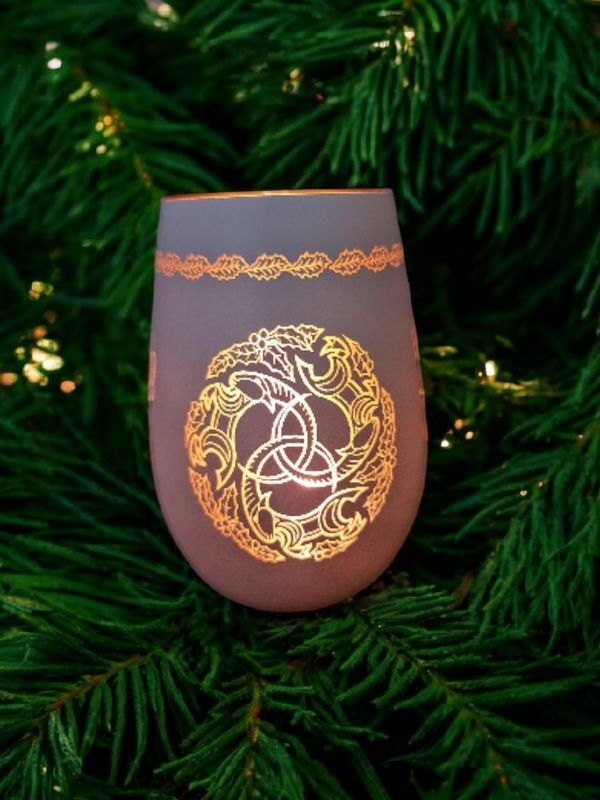
In modern paganism, in Wicca as in Ásatrú, a Yule fire often belongs to the winter solstice celebration, sometimes with a decorated piece of wood whose remnant is kept. This is a deliberate new creation drawing on English, German and Slavic folk custom, not an unbroken tradition. If you burn a log yourself, use dry, untreated wood that fits your fireplace or fire bowl, and make the embers safe before going to bed. In our workshop in Alsdorf we laser-engrave Norse motifs into wood – though an engraved log belongs on the table, not in the fire.
What is a Yule log? A large block of wood that burned on the hearth on Christmas Eve or over the Christmas days, a remnant of which was often kept for protection and to light the next year's log – in German regionally called Christbrand or Christklotz.
Is the Yule log pagan? Its origin is an open question. The oldest traces are New Year customs of the Roman Kalends; all the detailed records date from Christian times.
Did the Vikings have a Yule fire? They had the long fire of the hall, around which Yule was celebrated. A special Yule fire or a ritual log is not attested.
Why was a piece of the log kept? So that the fire would live on through the year and protect the house from lightning and fire – as early as Herrick in 1648.
Where does the bûche de Noël come from? From French pastry shops of the nineteenth century; it imitates the real log, which was called the bûche or souche de Noël.
Christmas customs and their Nordic roots · Yule · A Yule feast in the North · Yule among the Germanic peoples · The Viking longhouse · The solstice · Ancestor veneration at Yule · The Rauhnächte and Modranecht · The Rauhnächte night by night · Hákon the Good
Christmas customs with Norse roots? · Jól – the Yule feast · How a Norse Yule feast unfolded · The Viking Longhouse · The solstice festivals.
All Festivals & Belief articles →
Four festivals structure the "Celtic year": Samhain, Imbolc, Beltane and Lughnasadh. Almost everything we know about …
Read more →The Celts did not write their faith down. What we know comes from Caesar, Strabo, Pliny and Tacitus, from votive stones …
Read more →Few terms are as popular and as misunderstood as the "place of power". People make pilgrimages to stone circles …
Read more →When a ship drew near a coast, the dragon head had to come off the stem so the landvættir would not be frightened. So …
Read more →