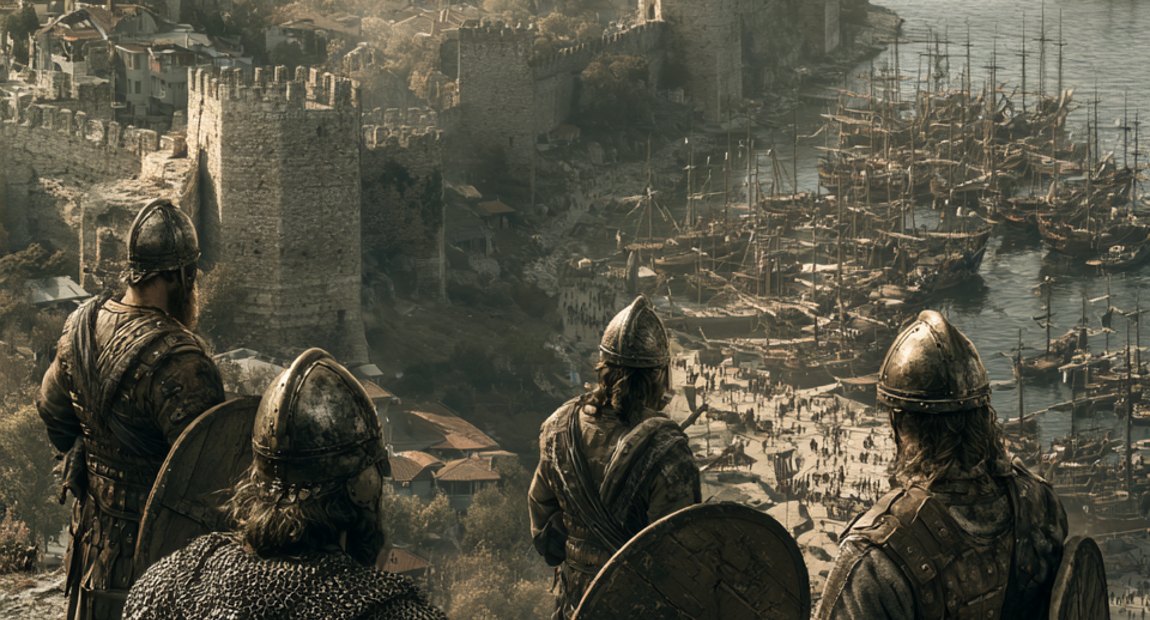
Around 1108 a young Norwegian king left home with a fleet and did not return for more than three years. In between lay winter camps in England and Galicia, fighting along the coasts of Iberia, a feast in Sicily, a bathe in the Jordan, the siege of Sidon and a reception in Constantinople. This is why Sigurd I Magnusson is remembered as Jórsalafari, the "Jerusalem-farer". This article separates what the Icelandic sagas tell, what contemporary crusader chronicles confirm, and where the tradition can be shown to be wrong.
Sigurd Magnusson was a son of the Norwegian king Magnus Barefoot, who was killed on campaign in Ireland in 1103. The Norwegian encyclopedia Store norske leksikon (SNL) gives his birth as "around 1090"; other reference works say 1089. According to SNL he died in Oslo on 26 March 1130. He was king of Norway from 1103 to 1130, first together with his half-brothers Eystein (Øystein) and Olaf, and alone after their deaths. Norwegians call him Sigurd Jorsalfare; in Old Norse he is Sigurðr Jórsalafari. "Jórsalir" is the Old Norse name for Jerusalem.
He owes his fame to a single enterprise: the voyage to the Holy Land in the years after 1107. SNL calls him the first European king to take part in a crusade. The point is that the leaders of the First Crusade (1096–1099) were counts and dukes, not reigning kings. He came as an ally of the king of Jerusalem, Baldwin I, and helped him take the port city of Sidon in present-day Lebanon.
Most of what is told about Sigurd comes from the Icelandic kings' sagas. The main ones are Morkinskinna ("mouldy parchment", after the state of the manuscript), Fagrskinna ("fair parchment") and Heimskringla, attributed to Snorri Sturluson. All three were written in the early 13th century, roughly a hundred years after Sigurd's death. To these comes the older and much shorter Ágrip, a brief history of the Norwegian kings from the late 12th century. In Heimskringla the relevant section is Magnússona saga, the "saga of Magnus's sons"; Samuel Laing translated it into English in 1844 as the "Saga of Sigurd the Crusader and His Brothers Eystein and Olaf".
The saga writers drew on skaldic verse, praise poems by court poets composed in strict metres and therefore thought to have been transmitted fairly faithfully. For the voyage, Laing's translation cites three skalds in particular: Einarr Skúlason, Halldórr skvaldri and Þórarinn stuttfeldr. These verses are the oldest Norse layer of the tradition, but they are praise poetry: defeats do not appear in them.
What is unusual for a Norse king is that Sigurd's voyage also appears in Latin sources from the crusader states. According to SNL, Fulcher of Chartres, chaplain to King Baldwin and an eyewitness of much that happened in Jerusalem, confirms the figure of sixty ships that the sagas also give. Albert of Aachen, who wrote a large history of the First Crusade and the years that followed, speaks of forty ships, again according to SNL. I know both chronicles here only through SNL, not in full text. They do show, however, that the fleet is no Icelandic invention.
For readers around Aachen, Albert is a nice point of contact: the chronicler bears the city's name and wrote from the reports of returning travellers, without having been to the Holy Land himself.
Sigurd's childhood coincided with his father's western campaigns. Around 1098 Magnus Barefoot brought the Orkneys and the Hebrides back under the Norwegian crown and installed his young son there as nominal ruler, with advisers at his side. On a later expedition to Ireland, Sigurd was betrothed or married to a daughter of the Irish king Muirchertach Ua Briain, whom the saga calls Biadmynja. Whether this child marriage was ever consummated is unclear. When Magnus fell in Ulster in 1103, Sigurd went home to Norway and left his Irish bride behind. More on these campaigns in the article on Magnus Barefoot.
Magnus left three sons by different mothers: Eystein, Sigurd and Olaf. Instead of fighting over the throne, all three were accepted as kings in 1103. Olaf was still a child and died in 1115; Eystein died in 1123. After that Sigurd ruled alone until his death in 1130. The shared kingship stayed peaceful for a remarkably long time.
This division of labour made the crusade possible: while Sigurd was away, Eystein stayed at home. Later it tells of a "comparison of men" (Old Norse mannjafnaðr), a contest of words in which the brothers, at a feast, weigh up their achievements: one his deeds abroad, the other his work at home. I have not read the exact wording of this scene for this article; it is 13th-century storytelling, not a transcript.
Dating is where the difficulties begin. Laing's translation inserts the year 1107 in brackets for the departure, "four years after the fall of King Magnus". SNL considers autumn 1108 the most likely date and gives 1107 as an alternative. The saga speaks of sixty ships.
According to the saga, the first winter was spent in England. SNL suggests a camp on the Isle of Sheppey at the mouth of the Thames and considers a meeting with King Henry I possible but not certain. The following year the fleet sailed along the French coast to Galicia, which the saga calls "Jacobsland" after the shrine of St James at Santiago de Compostela. There it wintered a second time.
In Galicia, in Laing's text, the local earl broke an agreement to supply food, so Sigurd seized a castle and took its stores. Christian territory was not safe from a hungry fleet either.
In spring the fleet moved south. The Iberian Peninsula was divided: Christian kingdoms in the north, and in the south al-Andalus, Muslim Spain, ruled since the 1090s by the Almoravids, a Berber dynasty from North Africa. The saga now lists a series of battles. According to Laing's text Sigurd first defeated a fleet of "vikings" – pirates, in this context – and captured eight galleys. Then he took a castle called "Sintre", today's Sintra near Lisbon, where, the saga says, those who refused baptism were killed.
Of Lisbon Laing writes that it was "a great city in Spain, half Christian and half heathen", lying on the border between Christian and heathen Spain. Here Sigurd fought his "third battle with the heathens" and took great booty. SNL also names Alcácer do Sal south of Lisbon and speaks of brutal fighting. The region was contested borderland, but the saga's details can hardly be checked. According to SNL the fleet met an Almoravid fleet at the mouth of the Guadalquivir and lost some engagements there, a detail the skalds' praise poems naturally leave out.
The Norwegians then passed the Strait of Gibraltar and reached the Balearics. The best-known episode is set on Formentera. In Laing's text, pirates had fortified themselves in a cave high above a precipice and closed the entrance with a stone wall. Sigurd had two boats lowered on ropes in front of the cave mouth; the men in them drove the defenders back with missiles, then the attackers climbed up, broke the wall and lit a fire at the entrance. The saga calls the booty the greatest of the whole voyage; I know of no independent confirmation of the scene. Fighting on Ibiza and Minorca followed.
In early summer 1110 the fleet reached Sicily. The island belonged to Norman counts, descendants of the adventurers from Normandy who had conquered southern Italy in the 11th century (see the Normans in southern Italy). Its ruler was the young Count Roger, later King Roger II.
The saga goes further. In Laing's text Sigurd hailed his host as king at this feast, so that Sicily would always have a king rather than an earl or duke. Historically Roger was crowned king only in 1130, twenty years later and on the basis of a papal grant, not a greeting at a banquet. The scene is best read as a retrospective honour for Sigurd that writes Roger's later kingship into Norwegian history.
In the summer of 1110 the Norwegians landed on the coast of Palestine; SNL gives August 1110 and Jaffa as the probable landing place. King Baldwin I of Jerusalem, brother of Godfrey of Bouillon and king since 1100, received them. According to the saga Sigurd rode with him to Jerusalem and to the Jordan, where, as SNL notes, he bathed in the river as pilgrims did.
What Baldwin needed above all was ships, since a port city could hardly be blockaded without a fleet. Sidon was held by the Fatimids, the dynasty ruling Egypt. The Norwegian ships closed the city off from the sea. According to SNL a Venetian fleet under Doge Ordelafo Faliero kept away a Fatimid fleet from Tyre that was meant to relieve Sidon.
After a siege of about seven weeks the city surrendered in early December 1110; English Wikipedia gives 19 October to about 5 December. In that account the inhabitants were granted safe conduct, and some were allowed to stay. The saga places the gift of the relic before the siege and says Sigurd gave his share of the booty to Baldwin. SNL speaks of Sigurd "exchanging" part of his force for the fragment of the Cross; the saga describes a solemn gift under oath.
That gift is one of the most revealing passages in the saga, because it names conditions that lead straight into Norwegian church history:
"By the orders of King Baldwin and the patriarch, there was taken a splinter off the holy cross; and on this holy relic both made oath, that this wood was of the holy cross upon which God Himself had been tortured. Then this holy relic was given to King Sigurd; with the condition that he, and twelve other men with him, should swear to promote Christianity with all his power, and erect an archbishop's seat in Norway if he could; and also that the cross should be kept where the holy King Olaf reposed, and that he should introduce tithes, and also pay them himself."Snorri Sturluson, Heimskringla, Saga of Sigurd the Crusader and His Brothers Eystein and Olaf, ch. 11 ("Sidon Taken"), trans. Samuel Laing (1844), public domain
Three things are bundled here: an archbishopric for Norway, keeping the relic at the shrine of St Olaf in Nidaros (today's Trondheim), and the tithe, a tenth of produce owed to the Church. Norway then belonged to the archdiocese of Lund; its own archbishopric at Nidaros was created only in 1152/53, more than twenty years after Sigurd's death. According to SNL the introduction of the tithe was at least begun under Sigurd. The condition about keeping the cross with Olaf, on the other hand, Sigurd did not fulfil, as we shall see. On Olaf and his cult see Olaf the Saint.
Around the turn of 1110/11 Sigurd left the Levant. SNL mentions stops on Cyprus and the Peloponnese. Then the fleet entered Constantinople, which the Norse called Miklagard, "the great city". The emperor was Alexios I Komnenos, whom the saga calls "Kirjalax", a fusion of Greek kyrios ("lord") and Alexios.
In Laing's text the emperor had the Golden Gate opened and precious cloths laid out to the palace, and offered Sigurd either six lispund of gold or games in the Hippodrome; Sigurd chose the games. At his return feast Sigurd supposedly burned walnuts instead of firewood, a stock saga motif of open-handedness that cannot be checked.
The end of the stay sounds more sober. According to the saga Sigurd gave the emperor his ships, whose decorated prows were set up in a church of St Peter. Many of his men stayed in Constantinople and entered imperial service. That fits what is known of the Varangian Guard, the Byzantine emperors' bodyguard, in which Scandinavians had served since the 10th century. More in Miklagard and the Varangians; a famous predecessor in that service was Harald Hardrada.
Sigurd himself travelled home overland. Laing lists "Bulgaria" and "Hungary, Pannonia, Suabia, and Bavaria". In Bavaria he is said to have met "the Roman emperor, Lotharius, who received him in the most friendly way". Here the saga is demonstrably wrong. Lothar of Supplinburg became German king only in 1125 and emperor later still. In 1111 the ruler was Henry V, who came to Rome for his imperial coronation that year. Whether the saga writers substituted a later, better-known name or confused a meeting with Lothar, then already duke of Saxony, cannot be decided. What is certain is that no Emperor Lothar can have received Sigurd in 1111.
From Germany the road led to Schleswig, then Danish, where according to the saga an earl named Eilif gave a feast for him; after that Sigurd met the Danish king Niels (Nikolas in the saga). According to SNL the small company was back in Norway late in 1111. Laing's bracketed date of 1110 for the return does not fit the fall of Sidon in December 1110.
Sigurd's second great enterprise is often called the "crusade to Småland". According to Heimskringla, the Danish king Niels asked him for help in baptising the people of Småland in the south of present-day Sweden, who had little regard for Christianity. Sigurd called out the whole country and, the saga says, came to the agreed meeting place on the Øresund with about 300 ships. Niels had arrived early, waited a long time and then left with his army, because his farmers grumbled that the Northmen were not coming at all.
Sigurd went anyway. In Laing's text the Norwegians first plundered a village called Tumathorp not far from Lund, in answer to the Danish king's supposed breach of faith. Then they sailed to the market town of Kalmar, plundered there and in Småland, and laid on the country a tribute of 1,500 cattle as ship's provisions. "And the people of Smaland received Christianity," the saga says briefly. Laing calls the campaign the "Calmar levy" and the saga dates it to "the summer before the eclipse". That eclipse is usually taken to be the one of 1124, which gives 1123 as the year of the expedition.
The baptism of the Smålanders is a subordinate clause in the saga; booty and tribute are the main matter. Scholars sometimes place the Kalmar expedition in the prehistory of the later Nordic crusades in the Baltic region; see the article on the Swedish crusades.
With the tithe, the Church in Norway gained a lasting economic foundation. SNL puts it carefully: its introduction was at least begun under Sigurd. The diocese of Stavanger is also associated with his reign. A well-known tradition links its foundation to Sigurd's wish to divorce and remarry after the bishop of Bergen had refused him. How close that connection really was is disputed.
His favourite place seems to have been Konungahella on the Göta älv, today Kungälv north of Gothenburg. In Laing's text Sigurd enlarged the town, built a castle and a church, and obliged the people of the district to supply missile stones or stakes for its defence. The church of the Cross was consecrated "in the 24th year of King Sigurd's reign", that is, around 1127. There he kept the relic from Jerusalem, together with gilded panels from Greece and an altar book said to have been given by the patriarch.
In doing so Sigurd broke the promise made in Jerusalem to keep the cross at the shrine of St Olaf. The saga gives no reason; that the relic was meant to strengthen his rule in the contested south is an interpretation, not something the sources state.
The late chapters of the saga paint a darker picture. In Laing's text Sigurd was at a feast in the Uplands when a bath was prepared for him. In the tub he thought he saw a fish beside him, whereupon such laughter came over him that he was beside himself; such fits often returned afterwards. SNL speaks of periodic instability, possibly a mental illness, and mentions episodes in which he struck his queen Malmfrid. According to the reference works Malmfrid was a daughter of Prince Mstislav of Kiev.
The question of succession had greater consequences. With Malmfrid Sigurd had only a daughter, Kristin. His son Magnus came from a relationship with Borghild Olavsdotter. In Sigurd's later years a man from the British Isles also appeared, Harald Gille, who claimed to be another son of Magnus Barefoot. According to SNL Sigurd had him undergo an ordeal, walking over red-hot iron, then acknowledged him and made him swear not to claim the throne while Sigurd and Magnus lived.
Sigurd died in Oslo on 26 March 1130 and was buried in St Hallvard's church, according to the saga in the stone wall on the south side outside the choir. (For the date of death, "Mary's-mass", Laing's translation inserts 15 August in brackets; modern reference works give 26 March.) Hardly was he dead when Harald Gille broke his oath. He and Sigurd's son Magnus briefly shared power, then war broke out. In 1135 Magnus was captured, blinded and mutilated, and has been known as "the Blind" ever since. This began the long era of Norwegian civil wars, which ended only in the 13th century. One of their later protagonists was Sverre Sigurdsson.
The sagas already made Sigurd richer and more generous than the rulers of the south. In the 19th century Norwegian national romanticism took up the material again. Bjørnstjerne Bjørnson wrote a historical play "Sigurd Jorsalfar", for which Edvard Grieg composed the incidental music. For national romanticism the crusader king offered an image of Norwegian greatness in Europe.
What does "Jorsalfar" mean? "Jerusalem-farer". Jórsalir is the Old Norse name for Jerusalem, and fari means "farer, traveller".
When did Sigurd's crusade take place? The departure is dated to 1107 or 1108; SNL considers autumn 1108 more likely. In August 1110 Sigurd was in Palestine, in December 1110 Sidon fell, and late in 1111 he was back in Norway.
Is there evidence outside the sagas? Yes. Fulcher of Chartres and Albert of Aachen mention the Norwegian fleet in the Levant. Many details of the voyage, such as the fighting in Spain or the reception in Constantinople, are known only from sagas and skaldic verse.
What happened to the relic of the Cross? According to the saga Sigurd kept it in the church of the Cross at Konungahella, consecrated around 1127. I know of nothing secure about the relic's later fate.
Magnus Barefoot · Miklagard and the Varangians · Harald Hardrada · Olaf the Saint · Norse Kings.
All History & Finds articles →
Sigurd Snake-in-the-Eye is said to have been a son of Ragnar Lodbrok who bore a ring in his pupil that looked like a …
Read more →Silver was the money of the Viking Age, weighed rather than counted, chopped rather than struck. Three finds show how …
Read more →The Silingi appear once, in the second century, in a geographer's list of peoples. Then the sources fall silent for …
Read more →The Silures were a people in south-east Wales who kept Rome busy for a quarter of a century. We know them almost only …
Read more →