Sigurd Snake-in-the-Eye is said to have been a son of Ragnar Lodbrok who bore a ring in his pupil that looked like a coiling snake, and later a king in Denmark. Both claims come from Norse texts written between 300 and 450 years after the events. In the chronicles of the ninth century he does not appear under this name. What does appear there is a Danish king Sigifrid and later a Sigfred on the Rhine, at Paris and at Leuven, and scholars have long asked whether one man stands behind them. This article separates what the annals attest from what Saxo and the sagas narrate, and from what later tellers made of it.
Sigurðr ormr-í-auga, "Sigurd Snake-in-the-Eye", is in the Norse tradition one of the sons of Ragnar Lodbrok. His epithet is descriptive: according to the Ragnarssona tradition he bore a mark in his eye "as if a snake lay around the pupil", and that gave him his name. One can imagine a pale ring around the iris; whether the sagas mean that or a fanciful image cannot be decided. That anyone in the ninth century really looked like this cannot be shown, and a physical trait that stands in no contemporary source proves nothing for or against a person.
The name Sigurd calls for care, because in this tradition it is taken several times over. Ragnar's own father is called Sigurd Ring in the sagas. Aslaug, Sigurd Snake-in-the-Eye's mother, is in the saga a daughter of the dragon-slayer Sigurd Fáfnisbani, the hero this blog treats in the article on Sigurd and Siegfried. Sigurd Hart, in the sagas a grandson of our Sigurd through his daughter, is another namesake. Whoever reads "Sigurd" has to ask each time which one is meant. This article is only about Ragnar's son with the snake mark in his eye.
According to the sagas he is the third or fourth son of Ragnar, brother of Ivar the Boneless, Björn Ironside and Hvitserk. In the revenge on King Ælla it is Ivar who stands in the foreground in the sagas, while Sigurd stays pale. In the Ragnarssona tradition he rules over Zealand, Scania and Halland and counts as the forefather of a royal line said to run down to Gorm the Old. That line is the real weight of his figure: he is less a war hero than a link in pedigrees. And here the problem begins, because pedigrees are the part of the tradition that scholarship trusts least.
For the family see the articles on Ragnar Lodbrok, on Ragnar's sons and on Aslaug. Here stands the man about whom least can be said and who nevertheless appears most often on family trees.
No contemporary source names him with name and epithet. The Anglo-Saxon Chronicle and the Annals of St Neots name for the time after 865 Ivar (Hingwar), Halfdan and Ubba (Hubba), but no Sigurd; the Irish annals know Halfdan. That is a finding but not a disproof: whoever is missing from the English sources may simply not have been in England. It shows only that the English side offers no foothold.
The Frankish annals. This is the only ground from the period itself. The Annales Fuldenses, the Annals of Fulda, are an East Frankish court chronicle kept continuously in the ninth century. For the year 873 they name two Danish kings, Sigifrid and Halbdeni, who send envoys to Louis the German. For 891 they report, in the battle on the Dyle near Leuven, the death of the kings Sigfrid and Gottfried. The word "Sigurd" stands in none of these passages. That the Sigfrid of the Franks could be the Sigurd of the sagas is a conjecture of scholars, resting on the similarity of the names, on the shared brother Halfdan and on the date. It is no more than that.
Adam of Bremen, around 1075. Adam wrote his Hamburg church history between 1073 and 1076 (see Adam of Bremen). He knows a series of Danish kings: a Helge, then Olof, who comes from Sweden, later Sigtrygg and a Hardegon, son of a Sven; as Gorm's father he names, according to the account on this website, Hardegon. A Sigurd Snake-in-the-Eye he does not name, as far as I saw. I have not read Adam in full, so I can say only this: I found no link from Sigurd to Gorm through Adam, and the Danish royal sequence reads differently in him than in the sagas.
Chronicon Roskildense, around 1138. The chronicle of Roskilde lists, according to the summary I could read, the sons of Ragnar as Ywar, Inguar, Ubbi, Byorn and Ulf. A Sigurd is missing from that list. It is a further sign that the name was not yet firmly tied to Ragnar in the Danish tradition of the twelfth century.
Saxo Grammaticus, around 1200. In the Gesta Danorum (see Saxo Grammaticus) "Siward" is in Book 9 a son of Ragnar. Aslaug does not appear under that name in the translation I could read; Ragnar's wives there are Ladgerda, Thora and Swanloga, and Swanloga is regarded in scholarship as the counterpart of Aslaug. Which mother Siward has, the text does not say clearly. Saxo explains the epithet with a story of its own: the wounded Siward is healed by a man of gigantic size named Rostar, who demands that Siward consecrate to him the souls of all he fells, and on leaving he pours dust on Siward's eyes. Hence, says Saxo in Elton's translation, Siward got the widespread name of Snake-Eye. The rule looks different too: Ragnar makes Siward and Radbard masters of provinces in Scotland and the isles, and later the whole Danish assembly delivers to Siward his father's rule. In Saxo's telling he also goes with Biorn against Ella, who is put to death with the blood eagle. Siward later lives peacefully, says Saxo, and of his end the text says only: he died.
Ragnars saga loðbrókar and Ragnarssona þáttr. The saga was written in the thirteenth century, the "Tale of Ragnar's Sons" (þáttr, a short narrative section) around 1300. In them, in the version I read in English translation through a retrieval tool, Aslaug is the mother, and after the brothers' raids Sigurd receives Zealand, Scania and Halland, and lands in Norway besides. He marries Blæja, daughter of King Ælla of Northumbria, and has a son Knut, called Hörda-Knut, and a daughter Aslaug. He falls in battle against Emperor Arnulf; his brother Helgi brings the news to the mother. Knut's son is called Gorm. Eystein Beli also appears, who kills Ragnar's sons Eirik and Agnar in Sweden and later falls for it, not by Sigurd's own hand. All of this stands only here, and the texts are younger than the events by several centuries.
Skjöldunga saga. The Skjöldunga saga is an Icelandic royal history written around 1180 to 1200, lost in the original; parts are said to live on in the Ragnarssona tradition. What it said about Sigurd I cannot judge, because I have seen neither the Latin extract by Arngrímur Jónsson nor the Sögubrot in the original wording.
Sven Aggesen. A summary on Ragnar mentions that in Sven Aggesen (around 1190) a "son Sigurd" invades Denmark. Whether this Sigurd is Ragnar's son does not emerge from the text I saw; I therefore leave the passage open.
As with Ragnar's sons in general, two columns are needed. First what can be grasped in annals and neighbouring sources, and only as the question whether Sigurd could be meant:
Here is a calculation anyone can make: a Sigfred who dies in 887 cannot fall at Leuven in 891. Either there were several men of that name, or one of the reports is imprecise, or the annalists confused names. Scholars discuss exactly that, and there is no clear assignment. Whether the Sigifrid of 873 is identical with the Sigfred of 881 or 885 cannot be shown either.
And the sequence as the sagas tell it (the years are mostly modern assignments, not statements of the texts): Sigurd is born as son of Ragnar and Aslaug; the brothers Eirik and Agnar are killed in Sweden by Eystein Beli; Ragnar dies in Ælla's snake pit, traditionally around 865; the sons avenge him, Ælla is killed, and the brothers divide the lands; Sigurd marries Blæja; Sigurd falls against Arnulf, which is nowadays associated with 891; Knut follows him. How little firm this sequence is shows in the contradiction between Saxo and the sagas, which already concerns the mother.
Kingship in Denmark. Ninth-century Denmark was no unified realm with a fixed law of succession. From Frankish sources one knows kings of Godfred's dynasty who were at times grouped around southern Jutland, the frontier with the Frankish realm and the trading place Hedeby (see Hedeby and Danevirke). Several kings could reign at once; the annals speak of two in 873. Whoever, following the sagas, makes Sigurd lord of Zealand, Scania and Halland paints a map that looks like the later Danish heartlands and is drawn from the viewpoint of the thirteenth century.
The brothers. The sagas have Ragnar's sons divide the lands after the revenge on Ælla: Björn gets Uppsala and central Sweden, Hvitserk Reidgotaland and Wendland, Sigurd Zealand, Scania and Halland and, in the telling, tracts in Norway. Ivar, by contrast, stays in England. In this picture the division of roles is clear: some fight in the west, Sigurd holds the south of Scandinavia. Whether such a division ever took place is unknown. It looks like what a storyteller does to give every brother a realm. The Annals of Fulda name two brothers in 873, Sigifrid and Halbdeni; scholars have suggested that one was Sigurd and the other the Halfdan of the English sources (see Halfdan Ragnarsson). This rests on a shared name and a closeness in time, neither of which is compelling, since Halfdan was a common name.
The Great Army. The micel here, the "Great Army" of the Anglo-Saxon Chronicle, landed in East Anglia in 865 under Ivar, Halfdan and Ubba (see The Great Army). Sigurd does not belong among its leaders in the English tradition, and the sagas show him rather at home; Saxo, by contrast, has him sail with Björn and 400 ships against Ælla. If the Halbdeni of 873 were the Halfdan of the English sources, he would have moved between England and Denmark in the 870s: conceivable, but speculation. That Sigurd and Halfdan are sons of Ragnar stands only in the Norse texts.
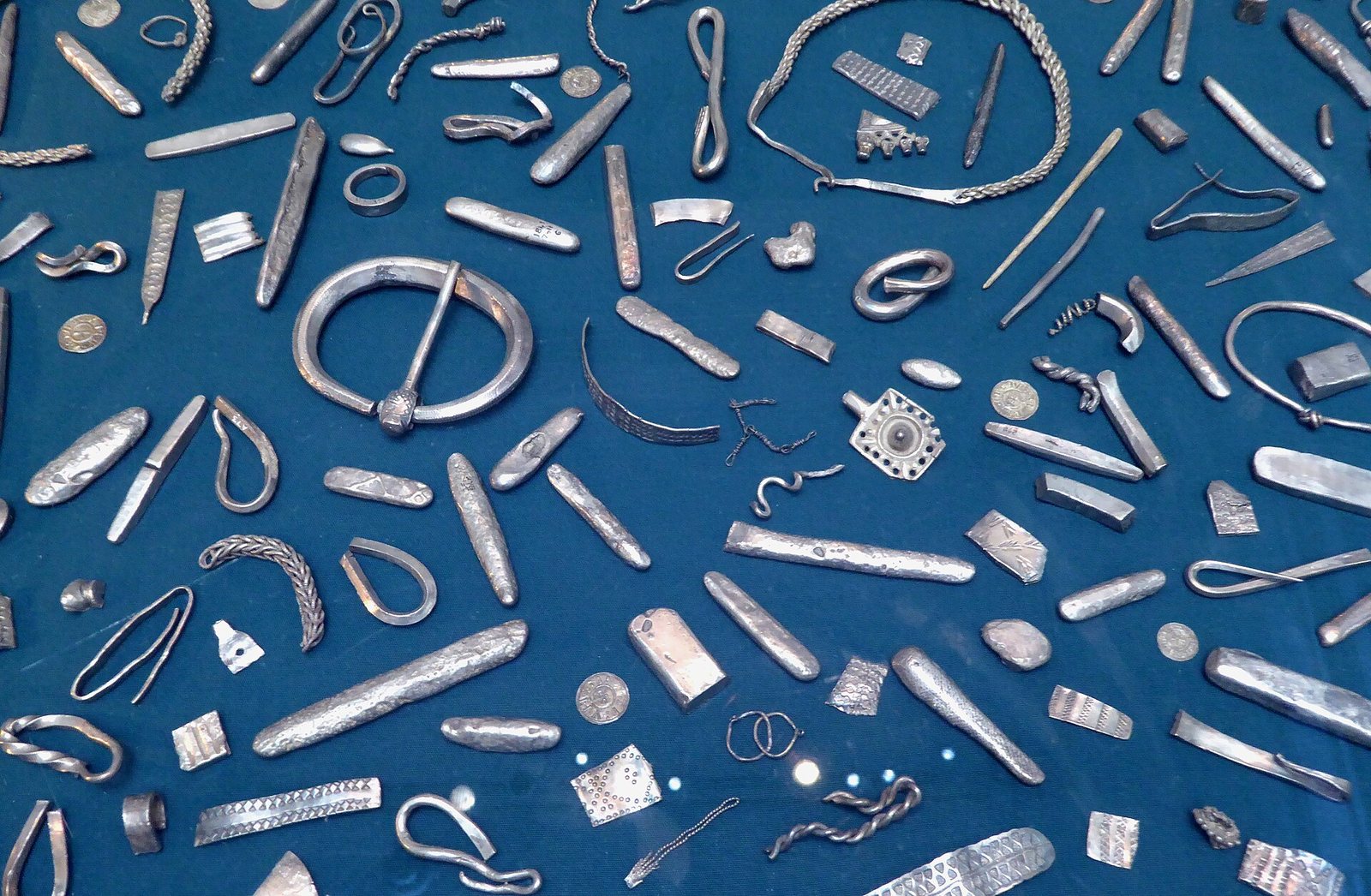
Power and means. What a king concretely owned can be read from the annals: envoys, a sword with a golden hilt as a gift, agreements on trading rights, a camp, silver. That is the picture of a lord who commands ships and a retinue, makes treaties and takes money. The annals give nothing more. Whether Sigurd ever ruled over Scania or Halland, as the sagas claim, stands in no source of the time.
A link to Aachen or the Rhineland arises only through the question whether the Sigfrid of the annals is Sigurd Snake-in-the-Eye. If one assumes what cannot be shown, the traces lead to Worms and Metz (the envoys of 873), to the Meuse at Asselt or Elsloo (881 to 882), to Aachen, plundered in late autumn 881, and to Leuven and the Geule near Maastricht (891). The article Vikings in Aachen 881 describes the raid; there the kings Godfrid and Sigfred act. That this Sigfred is the same as the one of 873 is proved nowhere.
On the North Sea coast and in northern Germany the only attested trace runs over the Eider, the frontier river between the Danish sphere and Saxony, where a meeting was agreed in 873. That speaks for southern Jutland belonging to the two kings' sphere. It connects with Sigurd only for those who equate the two. Frisia, which Godfrid received as a fief in 882, is attested nowhere for Sigurd (see Frisians). Further claims that Sigurd fought in the Eifel or in North Rhine-Westphalia I found in no source.
I know of no find that could be assigned to Sigurd Snake-in-the-Eye: no coin with his name, no runic inscription, no grave. The Jelling stones, which attest Gorm the Old (see Gorm the Old), name, to my knowledge, neither Ragnar nor any of his sons; I have not checked the wording for this article. The sagas too give no burial place for Sigurd. That is not unusual for figures of this age, but it means: whoever speaks of "Sigurd's grave" is telling something on top.
The pedigree. The Ragnarssona tradition gives Sigurd a daughter who is also called Aslaug. She marries Helgi the Sharp, and their son is Sigurd Hart, king of Ringerike. His daughter Ragnhild becomes the mother of Harald Fairhair. So the line runs from Sigurd Snake-in-the-Eye, via the dragon-slayer Sigurd and Brynhild as ancestors of his mother, to the unifier of Norway. The text in the translated version ends with the sentence that their son was King Harald Fairhair, who was the first to become sole ruler over the whole of Norway (see Harald Fairhair). That is a dynastic myth of the kind many dynasties have, and no proof of kinship: the Wikipedia page on Sigurd Hart regards the arithmetic as practically impossible in time, unless two men of that name existed.
The line to Gorm. In the Ragnarssona tradition Sigurd is followed by his son Knut, called Hörda-Knut (Harthacnut), and he by Gorm, who is said to be big and strong but not as wise as his forebears. Gorm the Old is a historical figure, but the connection to Sigurd is attested only here. Adam of Bremen names as Gorm's father Hardegon, a son of Sven, and Saxo makes a Knut the son of an Erik; the names do not coincide. Whether Hardegon is to be equated with Hörda-Knut cannot be shown; Wikipedia calls Harthacnut semi-legendary.
The emperor. Death in battle against Arnulf is a fine moment of the sagas, because it ties Sigurd to an actual event: the battle of 891. But in 891 Arnulf was king of the East Frankish realm and became emperor only in 896, whereas the saga calls him "Emperor Arnulf". The link is rather a recourse to a known name. It may be a remnant of memory, say of the death of a Sigfrid at Leuven, or a later join made by narrators who had a "Sigurd" and a "Sigfrid" before them in the annals; that is a possible explanation, not a finding.
The figure consists of connections: a name, a mark in the eye, a place in a line meant to create order. For each of them holds what stands above on the sources.
"Hence it happened that Siward got the widespread name of Snake-Eye."
"Daher kam es, dass Siward den weit verbreiteten Namen Schlangenauge erhielt."Saxo Grammaticus, Danish History, Book 9, in Oliver Elton's translation (1905), read through a retrieval tool that summarised the page and gave this line as wording; comparison with the Latin original still to be done; German version my own translation
Open is whether a historical Sigurd Snake-in-the-Eye existed. Open is whether he is to be equated with the Sigifrid of 873 or with a later Sigfrid, and whether the Sigfreds of 873, 881, 885 and 891 were one man, two or four. Open is whether Ragnar's sons were really brothers, as the sagas tell, and whether Ragnar himself was a single person. Open is how far the line to Gorm is invention. A contemporary text naming Sigurd and Ragnar together, or a coin find with a royal name Sigfred, could clarify some of this. So far both are missing.
Who was Sigurd Snake-in-the-Eye? According to the sagas a son of Ragnar Lodbrok and Aslaug, with a snake-like mark in his eye and king over Zealand, Scania and Halland. His existence cannot be shown unambiguously in the contemporary sources.
Why is he called Snake-in-the-Eye? The sagas name a mark in his eye, as if a snake lay around the pupil. Saxo tells another origin: a giant named Rostar poured dust on his eyes, and from then on he bore the name.
Is he identical with the Sigfred of the Frankish annals? It is possible but not proved. The Annals of Fulda name a Danish king Sigifrid beside Halbdeni in 873. The equation rests on names and date.
How did Sigurd Snake-in-the-Eye die? The Ragnarssona tradition has him fall in battle against Emperor Arnulf, Saxo writes only that he died. In 891 Arnulf was not yet emperor.
Is there a link to Aachen or the Rhineland? Only indirectly. A king Sigfrid was on the Rhine and the Meuse in 881 and 882, and Aachen was plundered in 881, but whether that man was Sigurd cannot be shown.
Related articles: Ragnar Lodbrok, Ragnar's Sons, Aslaug, Ivar the Boneless, Björn Ironside, Halfdan Ragnarsson, Ubba, Lagertha, The Great Army, Gorm the Old, Saxo Grammaticus, Adam of Bremen, Vikings in Aachen, Sigurd and Siegfried and Nordic Kings.

Ragnar's sons · Ragnar Lodbrok · Halfdan Ragnarsson · Ubba · The Great Heathen Army.
All History & Finds articles →
Silver was the money of the Viking Age, weighed rather than counted, chopped rather than struck. Three finds show how …
Read more →The Silingi appear once, in the second century, in a geographer's list of peoples. Then the sources fall silent for …
Read more →The Silures were a people in south-east Wales who kept Rome busy for a quarter of a century. We know them almost only …
Read more →We know the Sitones from exactly one sentence. Around AD 98 Tacitus closes his Germania by naming them as neighbours of …
Read more →