Around 1176 a priest raised in the Faroe Islands leaves the islands, claims to be a king's son, and a year later leads a band of ragged fighters. By 1184 he rules Norway alone; in 1202 he dies a king under church ban. Sverre Sigurdsson no longer belongs to the Viking Age proper, but he shows what Nordic kingship became in the high Middle Ages: civil war, canon law, propaganda. This article sets out what Sverris saga and church sources tell us, where the saga takes sides, and which questions stay open.
Say "Viking" and most people think of longships, raids and Odin. Sverre fits only partly. The Viking Age is usually counted from the Lindisfarne raid of 793 to events around the middle of the eleventh century, often the death of Harald Hardrada at Stamford Bridge in 1066 (see the end of the Viking Age). Sverre's reign begins more than a hundred years later. Norway is Christian and church-organised by then, with an archbishop at Nidaros (modern Trondheim), and the crown is contested in civil wars.
He still belongs here. Many of his fights were fought on ships and fjords; Fimreite and Strindafjord were sea battles. And he stands in a line that runs from Harald Fairhair through Olaf the Holy and Harald Hardrada. For the overview, see our piece on the Nordic kings. Here we deal with a chapter that the Heimskringla (see our article) no longer tells: it ends, as modern accounts put it, where Sverre's story begins.
Put plainly: "Viking" is the wrong label for Sverre. Late Nordic kingship, a medieval succession struggle, fits better.
Almost everything we know about Sverre's life comes from Sverris saga. It is one of the few royal sagas written, at least in part, during the ruler's lifetime. The preface names the Icelandic abbot Karl Jónsson as author of the first part; according to the secondary literature I used, he was in Norway from 1185 and began the work in Sverre's circle. That first part is called Grýla. It is strongly shaped by Sverre's own view. Accounts differ on where it ends: at the battle of Kalvskinnet in 1179 or only at Fimreite in 1184. The second part was written after Sverre's death in 1202, by Karl or by unknown continuers, and is considered more sober and fairer to the opponents.
The saga survives only in copies; the original is lost. Complete versions exist in several manuscripts, among them Eirspennill (around 1300) and Flateyjarbók (around 1380). Eirspennill is much shorter, and whether it is the original form or an abridgement is debated.
What does this mean for its value as a source? A biography shaped by its subject is no neutral chronicle. Scholars describe Grýla as a propaganda text in which Sverre plays David against Goliath, God helps him repeatedly, and a storm at Voss clearly echoes the storm on the Sea of Galilee. That is literary construction, not an eyewitness report. Numbers are suspect too: troop strengths and losses, such as the reported dead at Fimreite, are probably exaggerated.
Other evidence cuts across the saga. Church letters, the correspondence between popes and Norwegian bishops, are collected in the Diplomatarium Norvegicum. Foreign authors also report: Saxo Grammaticus and English historians (William of Newburgh is named in the secondary literature) give Sverre's opponents a voice. I have not read these texts in full. Where I mention them, I rely on summaries and say so.
One more text from Sverre's circle deserves mention, En tale mot biskopene ("A speech against the bishops"). It exists and is documented, and it raises its own question below: who wrote it?
The saga gives 1151 as Sverre's birth year. Other accounts say around 1145 or around 1150; the year is not secure. His mother was Gunnhild, his legal father Unas (Unås), a comb-maker from the Faroes. At about five, according to the saga, Sverre went to his uncle, Bishop Roe, in the Faroes. In Kirkjubøur he was brought up and ordained a priest. The Faroes then lay within the Norwegian sphere; more in our article on Vikings in the Faroe Islands.
At about 24, says the saga, his mother told him that his real father was the Norwegian king Sigurd Munn (Sigurd II). A year later, in 1176, Sverre set out for Norway. The sources I could consult disagree on where he was born: Faroese tradition says on the islands, others probably in Bergen. Neither can be established clearly.
Whether he really was Sigurd's son cannot be proved. Contemporaries did not accept the descent, and the saga itself has Sverre voicing doubts. There are also inconsistencies: his age at ordination sits badly with the canonical minimum age if the saga's figures are used. And Sverre refused the ordeal by fire that was normal for claimants then. Why remains open. Some historians reject the claim, others find it possible, many say it cannot be settled. This text takes no side.
For the question of power the truth mattered less anyway. In the twelfth-century Norwegian succession struggle, descent counted, but above all who had enough armed men behind him. How far illegitimate birth weakened a claim, I have not checked in the sources used.
The following timeline rests on summaries of encyclopaedia articles (Wikipedia and Store norske leksikon), which in turn cite the saga, letters and scholarship. Some dates differ between accounts; this is noted.
The Birkebeiners were no army in the modern sense. Their nickname ("birch-legs") refers to makeshift footwear of birch bark. In the first years, 1177 and 1178, Sverre waged a small war against the opposing party, according to the summaries. Against the Heklungs (Magnus Erlingsson's party) he had no chance in the open field. He evaded, surprised, laid ambushes. This mobility, not numbers or equipment, is what the saga stresses most. Keep in mind that narrative sharpening is at work here: a text that draws Sverre as an outsider and God's instrument needs the small band against the odds.
The turning point is better documented. At Kalvskinnet near Nidaros, Erling Skakke was killed in 1179. The date, 19 June, is given consistently in the encyclopaedia articles, and the battle was the first great decision in Sverre's favour. After it he held Trøndelag, the core region of Norwegian kingship with the archiepiscopal seat of Nidaros. The rest of the country did not fall at once.
On 15 June 1184 Sverre met Magnus Erlingsson, son of Erling Skakke, in the Sognefjord. Magnus's fleet was broken and Magnus himself drowned. That ended the Heklungs as a party. Sverre had lost his most dangerous rival; peace did not follow.
Treat battle numbers with care. The encyclopaedia articles mention about 2,000 dead at Fimreite; the figure comes from the saga tradition and is probably exaggerated. The result is clear: a sea battle in a fjord ended a civil war with roots almost two decades older.
After Fimreite Sverre was sole king, but not unchallenged. Risings followed at once: the Kuvlungs (1185 to 1188), then the Øyskjeggs (1193 to 1195), said in the encyclopaedia article to have been supported by Earl Harald Maddadsson of Orkney, and from 1196 the Baglers. The Baglers formed in Denmark with the backing of Archbishop Eirik and proclaimed Inge Magnusson king. In 1197 they took Nidaros, and in August 1198 Bergen burned. Much of Sverre's reign consisted of putting down risings.
What can be read about his way of ruling: he relied on a following personally bound to him, the Birkebeiners, and on continuous campaigning in Trøndelag, Viken and along the west coast. He sought support abroad, in Sweden and England, according to the encyclopaedia articles. And he claimed the right to appoint bishops, which leads to the conflict that marks his reign.
Judgements need care. Whether Sverre was a statesman or a usurper depends on which source one reads. The saga draws a pious, clever man led by God. His church opponents and foreign historians paint another picture. Both sides have an interest.
The core of Sverre's reign is the quarrel with the church. After the death of Archbishop Øystein Erlendsson (26 January 1188, according to Wikipedia), Eirik Ivarsson, until then bishop of Stavanger, succeeded him. Dates for the election differ; another encyclopaedia article gives 1189. Eirik saw Sverre as a usurper. A joint peace agreement failed because Eirik would not crown him without papal consent. In 1190 Sverre accused him of keeping too many armed men around him, and Eirik fled to Lund and, according to the accounts, turned to Rome.
Sverre had himself crowned in 1194 regardless, by Bishop Nikolas Arnesson and other Norwegian bishops. Pope Celestine III, in a letter of 15 June 1194, took Eirik's side on the rights of the church. Eirik then pronounced the ban on Sverre. Around 1195 Sverre sent Bishop Tore of Hamar to Rome. He returned in early 1197 with a letter said to lift the ban. Its authenticity is doubted; most historians consider it a forgery. The saga's account of how the letter reached Sverre is not confirmed.
In October 1198, according to the English Wikipedia, Pope Innocent III imposed an interdict on Norway and accused Sverre of forgery. An interdict is a church prohibition on services and sacraments that affects a whole territory. In 1200 Innocent warned the Archbishop of Canterbury against accepting gifts from Sverre. A caution: the sources do not agree on who did what. The Store norske leksikon also notes that the saga is silent on the ban. Whether Eirik or a pope first pronounced the ban I cannot establish conclusively. That Sverre was banned and Norway under interdict is the common statement of the accounts I used.
The constellation is unusual: Sverre had himself been ordained a priest, so the king stood against the bishops of his own country, and he argued in canon law. Later ages remembered the holy king Olaf very differently.
From Sverre's circle comes one of the most remarkable documents of this quarrel: En tale mot biskopene, a title coined only by Gustav Storm in 1885. It is a canon-law pamphlet meant to show that the ban was invalid. Formally it addresses the attitude of the pope, but it lays the main blame on the native bishops and priests, who are said to have misinformed him.
What is documented: it draws on the Decretum Gratiani, the great collection of canon law from the mid-twelfth century. From it the text derives that kingship is instituted by God and that oversight of the church belongs to royal duties. It was probably written around 1199; the accounts also give periods between 1196 and 1202. It survives in a single manuscript from about 1320/1330. Anne Holtsmark published the critical edition in 1931.
The author remains open. That Sverre gave the impulse is thought likely; the author was probably a clergyman schooled in canon law close to him. That Sverre wrote it himself cannot be shown. That the author studied in Bologna is put forward in the Norwegian account only as a conjecture. So we can write: a pamphlet from Sverre's circle, not securely by him.
In substance: Abbot Karl Jónsson of Iceland, according to the preface, was in Norway, and King Sverre is said to have decided largely what stands in the saga.
Paraphrase based on summaries of the preface of Sverris saga (Wikipedia en/no, Store norske leksikon); the wording of the preface was not read in the original or in a public-domain translation, so this is not a verbatim quotation
That Sverre helped shape the saga is decisive for its assessment. Two examples from scholarship: the saga tells Sverre's successes in a pattern recalling David and Goliath. And it has him experience God's help; the storm at Voss is described in a way that recalls the Gospel. Both are means of presenting Sverre as a king willed by God.
Anyone using such texts can check three things. First: who is telling, and who benefits? Second: is there independent evidence, such as letters or foreign chronicles? Third: do the numbers fit? For troop strengths and losses, scepticism is in order. The saga is very detailed, which gives an impression of precision but does not guarantee it.
That a ruler co-shaped a biography in his lifetime sets the saga apart from later works. The later royal sagas, such as those written by Snorri Sturluson, look back on kings long dead. That raises the saga's value, because it shows contemporaries, and lowers it, because the patron was in the room.
Sverre died in March 1202 in Bergen after falling ill on the way back. He named his son Håkon as successor and advised him in a letter to seek reconciliation with the church. Håkon III followed him; the civil war with the Baglers went on beyond Sverre's death. Sverre was buried in Christ Church in Bergen, demolished in the 16th century (one source gives 1591, which looks doubtful; Christ Church in Bergen is otherwise dated to 1531). There is no grave to visit.
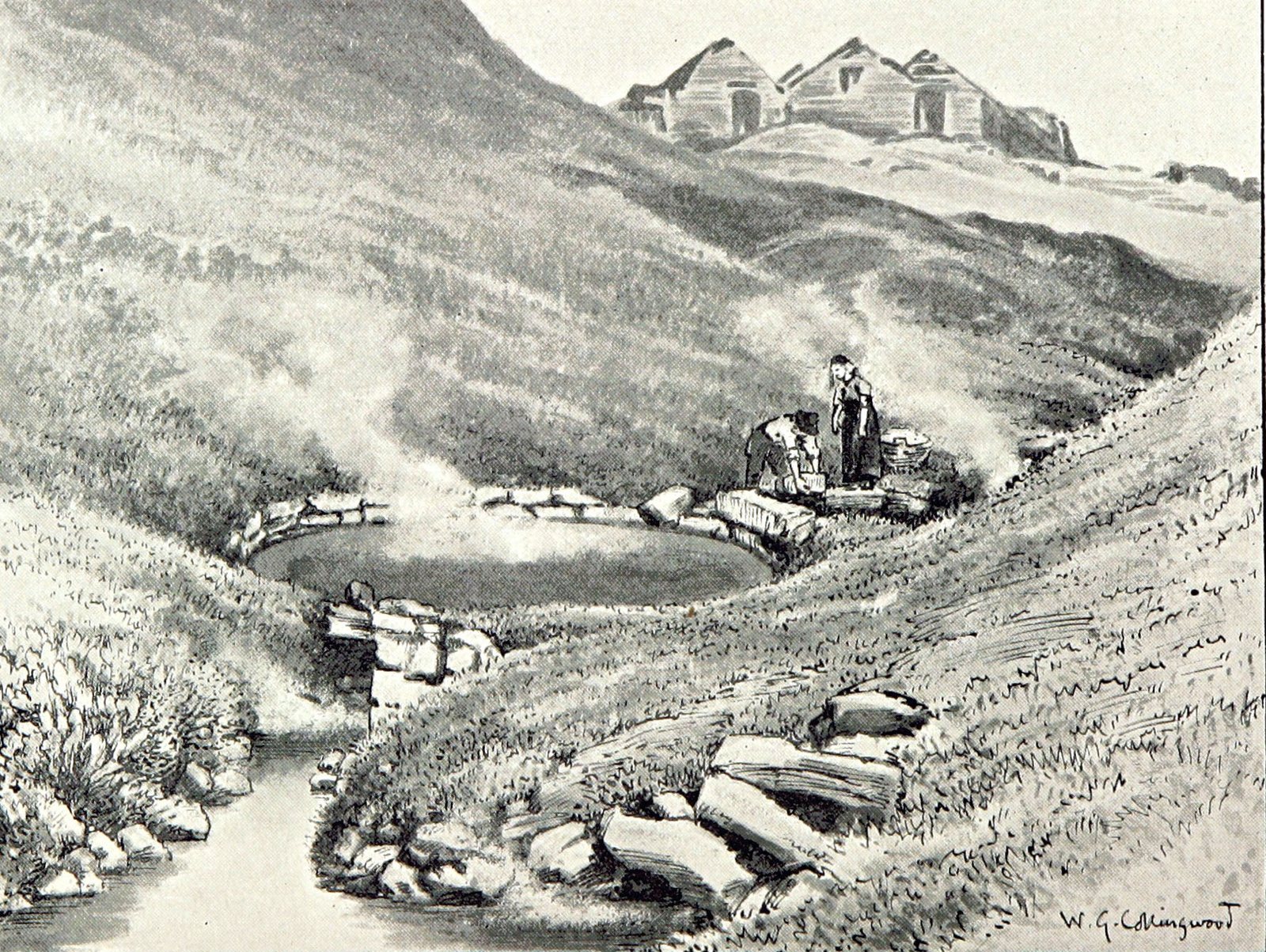
Legends have survived mainly in the Faroes. A cave is shown there in which Sverre is said to have hidden, supposedly giving the mountain the name Sverrahola. That is local tradition, not a source in the strict sense.
In Norway Sverre remained a figure who resists judgement. The title of Claus Krag's book, Sverre – Norges største middelalderkonge (2005), shows that some historians regard him as the greatest king of the Norwegian Middle Ages. Whether one shares that is an evaluation. The title of an older book by Geoffrey Gathorne-Hardy, A Royal Impostor (1956), takes the opposite view. That both titles exist says something about the range of interpretation. I have not read the books, only seen them cited in reference lists.
On the architecture of the time: the twelfth and thirteenth centuries are also when many stave churches were built in Norway, among them Hopperstad and Kaupanger. I found no link between Sverre and any of these churches in the sources used, and I claim none. They only show the church-shaped country in which he ruled.
Was Sverre a Viking king? Not in the narrow sense. His reign (1177 to 1202) lies long after the usual end of the Viking Age. He was a ruler of the Norwegian high Middle Ages.
Where did Sverre come from? He grew up in the Faroes, where his uncle was bishop. His birthplace is not certain; Bergen and the Faroes are named. The birth year varies between about 1145 and 1151.
Who were the Birkebeiners? A fighting party that rose from 1174 against the ruling line. The name derives from the birch bark wrapped around the legs.
Was Sverre excommunicated? Yes, according to the accounts I used, Archbishop Eirik pronounced the ban, and Pope Innocent III imposed an interdict in 1198. On details, such as the authenticity of the letter of 1197 said to come from Rome, scholars disagree; most consider it forged.
How reliable is Sverris saga? Indispensable but partisan. Parts arose under Sverre's supervision, and it should be checked against letters and foreign chronicles.
Nordic kings at a glance · Hopperstad and Kaupanger · Stave churches · Heimskringla · Snorri Sturluson · Harald Hardrada · Olaf the Holy · End of the Viking Age · Vikings in the Faroe Islands

Norse Kings · Heimskringla: Snorri's history of the kings · Stave churches: Norway's wooden cathedrals · Magnus Barefoot · Harald Hardrada.
All History & Finds articles →
Around the year 1000, King Olaf Tryggvason of Norway lost his fleet, his throne and most likely his life, somewhere in …
Read more →Few questions reach our workshop as often as this one: „Is that symbol really old?" We love engraving Norse signs – but …
Read more →When did a Viking get up, what did he eat, who worked where, and how often did he go to the Thing? Anyone expecting a …
Read more →They hardly loom large in any history book, yet their trail runs from the plains north of the lower Danube to Poitou …
Read more →