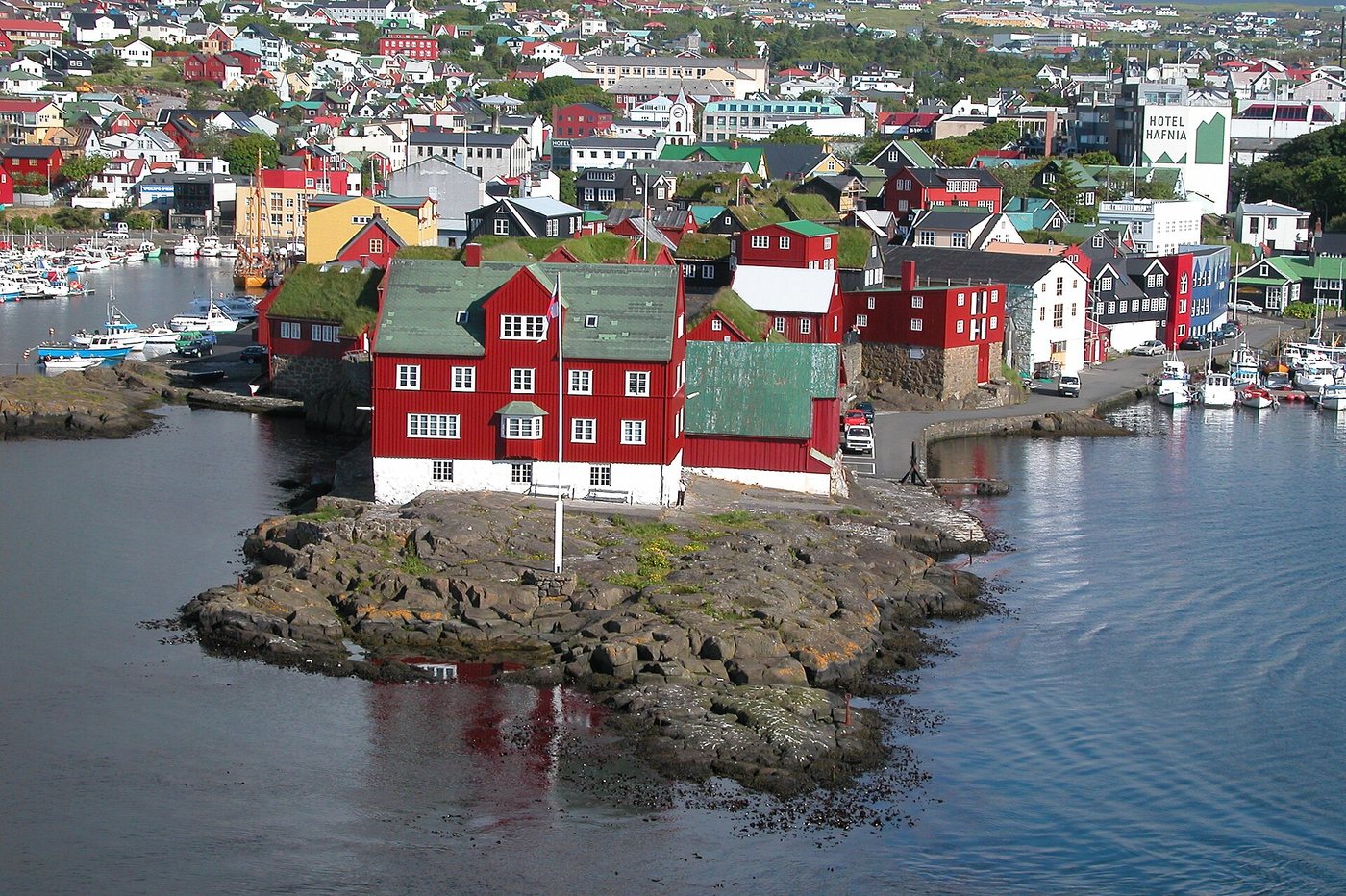
As late as 1988 an archaeologist could write that nothing in the ground supported a settlement of the Faroes before about 900. Today we have charred barley grains from the 4th to 6th centuries. This article follows the islands' history from the monk Dicuil to the bishop's seat at Kirkjubøur, and keeps three things apart: what comes out of the soil, what a contemporary wrote down, and what an Icelander told two hundred years later. The three strands do not always agree, and the places where they part are the most instructive.
Anyone writing the early history of the Faroes has very uneven witnesses to work with. There is a single Latin paragraph from 825 that does not even name the islands. There is Færeyinga saga, the Saga of the Faroe Islanders, composed in Iceland and transmitted only in pieces. And there is archaeology, whose dates have shifted dramatically over the past forty years.
Our article on the Faroese people tells how these islands produced a people, and covers the assembly, the genetics of origin and the Sheep Letter of 1298. This one has a different subject: chronology itself. When did what begin, how do we know, and how sure can we be?
The Irish monk Dicuil finished his work on the measurement of the earth, the Liber de mensura orbis terrae, in 825. The date is no later estimate; as the philologist Povl Skårup stresses, it stands at the end of the text itself. In chapter VII, sections 14 and 15, Dicuil describes a group of small northern islands, nearly all separated by narrow straits. For nearly a hundred years hermits from his homeland, Ireland, had lived there. Now, because of the “Northman pirates”, the islands were empty of anchorites and full of sheep and seabirds instead.
Dicuil gives no name. That he means the Faroes is the majority view of scholars, not a proof. Skårup reread the passage closely in 2009 and rejected two common objections. One holds that the Faroes are too large to count as “small”. Skårup replies that the word refers to the individual islands, which are indeed not large. The other, older one holds that Dicuil describes two groups of islands. According to Skårup, the Latin allows only one. His conclusion is cautious: the Faroes fit well and should be given up only if other islands fit better.
Two things Dicuil explicitly does not say. He does not say the Norse settled there, only that their raids drove the hermits away. And he speaks of hermits, not a monastery or a community.
For a long time nothing in the ground answered to Dicuil. In his 1988 paper on Toftanes, Steffen Stummann Hansen noted that there was no archaeological support for the hermits, nor for any settlement before about 900. Símun V. Arge, for many years an archaeologist at the Faroese National Museum, recalled that in his own 1986 thesis the evidence could not be pushed securely back beyond about 1000.
The turn came from Sandur on the island of Sandoy. At the farm mound of Á Sondum, a team in 2006 and 2007 opened a three-metre sequence of midden and structural remains. Near the top was an early Viking Age longhouse with a two-metre external wall and a large central hearth. Below, in an extensive deposit of wind-blown sand, were patches of burnt peat ash. They came from hearths, and two of those patches held charred barley grains, probably burned by accident.
Mike Church, Arge and their co-authors published the radiocarbon dates in 2013 in Quaternary Science Reviews under a title that leaves no room for doubt: “The Vikings were not the first colonizers of the Faroe Islands”. The grains gave two phases, one in the 4th to 6th and one in the late 6th to 8th century. By the authors' reckoning that is at least 300 to 500 years before what had previously been shown archaeologically. Radiocarbon dating measures the decay of carbon-14 in once-living material, and cereal grain suits it especially well: it grew for a single year, and unlike driftwood it brings no long prior history with it.
In 2014 Arge assembled further early dates, among them 670 to 860 from Undir Keisarafløtti and a pit at Við Kirkjugarð falling between the late 7th and late 9th centuries. Independently, Lorelei Curtin and her team in 2021 detected sheep DNA in Lake Eiðisvatn on Eysturoy from around 500 (range 370 to 610).
Here the temptation begins to join the strands into a story: Dicuil's monks sow barley, bring sheep and flee from the Vikings. It does not work out so neatly. Taken at his word, Dicuil puts the start of the hermits' time roughly in the early 8th century, and says that before them the islands had been deserted since the beginning of the world. The first phase at Á Sondum, however, lies centuries earlier. Either Dicuil knew nothing of it, or the early visitors left no memory, or he means other islands. That is my inference from the dates, not a statement of the study.
The researchers themselves hold back. Church said at publication that it was not yet known who these people were or where they came from. Arge stresses that the early layers are not tied to any buildings or artefacts, so their origin and identity remain open. Curtin and her co-authors write that their data cannot speak directly to this, while considering Norse visitors unlikely because the Norse adopted the sail late. They also note that apart from the Á Sondum finds, no other archaeological evidence yet corroborates an early arrival.
Whether “settlement” is even the right word cannot be firmly established. Ash, grain and sheep dung show people and livestock on the islands. They do not show whether families lived there continuously or whether groups came and went. Arge himself speaks of two separate episodes.
Icelandic tradition knows nothing of all this. It begins with a single man: “Maður er nefndur Grímur kamban; hann byggði fyrstur manna Færeyjar.” A man called Grímr Kamban was the first to settle the Faroes.
Even this sentence does not come down in one form. According to the overview in English Wikipedia, the oldest version, in the great saga of Olaf Tryggvason, carries no date, and only then mentions that many fled from Harald Fairhair. Flateyjarbók, an Icelandic compilation manuscript, instead sets Grímr's settlement in Harald's days, roughly 872 to 930. F. York Powell's English translation of 1896 reflects that: “He first settled the Færeys in the days of Harold Fairhair”.
That has consequences. On one reading Grímr comes before Harald, on the other under him, and Dicuil's report moves closer or further away accordingly. The claim common in overviews that Grímr landed at Funningur on Eysturoy around 825 is a modern combination with Dicuil and later local tradition. No medieval source with that date is known to me.
The byname is regarded as Gaelic and read as a hint that Grímr came from Norse-Gaelic settlements in Scotland or Ireland. That is plausible, but it rests on one word. Whether the man existed at all cannot be tested.
The life of the Norse settlers shows most clearly at Toftanes near Leirvík on Eysturoy, excavated from 1982 to 1987. The dwelling still measured about 20 by 5 metres inside, with its western end destroyed. There was also an outhouse of 13 by 4 metres and other buildings, including, according to Arge, a small firehouse with an ember pit. How such a building worked is explained in our article on the longhouse.
Hansen counted more than 700 pieces of steatite, or soapstone, mostly fragments of bowls and pots, and more than fifty spindle whorls. Then come a Borre-style brooch of the 10th century, two ringed pins of the western Viking type, an armring of jet or lignite and around 30 beads. Because damp conditions preserved wood, things survived that usually rot: counting sticks, toy boats and a 70-centimetre oak board cut for hnefatafl on one side and nine men's morris on the other. Steatite, schist and timber probably came from western Norway, the finer pieces via Britain and Ireland, possibly through Orkney.
For dating, Hansen had three radiocarbon dates from the floors of the outhouse, calibrated to roughly 890 to 975. A foundation around 900 thus sat comfortably with Harald's time in the saga. Later reassessment, including the work of Vickers and colleagues in 2005, now places the farm in the 9th to 10th centuries. So a site that once seemed to confirm the saga has moved a little away from it.
Sandur offers the second view, and it shows an economy adapting to the islands. There were hardly any trees; the landscape was grass and heath, and so, according to Arge, the settlers turned to driftwood, peat and turf. At the midden of Undir Junkarinsfløtti nearly 60,000 bone and shell fragments have been studied, from five phases running from the 9th century into the post-medieval period. Besides sheep, cattle and pigs, the inhabitants depended remarkably long on seabirds, especially puffins, and more heavily than other settlers in the North Atlantic. Pigs were kept up to and beyond the 13th century. It fits the picture our article on Viking farming draws for the North as a whole: farmers lived from many sources at once.
Inland lay summer pastures. Argisbrekka on Eysturoy was such a shieling, Faroese ærgi, in use according to Curtin from the mid-9th to the mid-11th century. Arge connects the later disappearance of this practice with the growing weight of fishing and extensive sheep farming.
Sandur was wealthy too. Just outside the cemetery wall, says Trap Færøerne, eleven graves came to light in 1989 whose goods point to high status; Arge reports three of seven graves with silver or silver ornament. They include a clipped Kufic silver coin, the only one known from the islands; Arge identifies it as a late 9th-century imitation of an Abbasid dirham. The hoard of 98 silver coins of about 1000 to 1100, found by the gravedigger in 1863, also comes from here; according to Trap Færøerne it lay under the flagstone floor of a large building older than the cemetery.
For the rest of the Viking Age we depend almost entirely on the Icelanders. Færeyinga saga was composed, according to the overviews, shortly after 1200; Trap Færøerne says about 1215. The author is unknown and no manuscript of its own survives. Pieces sit inside the great saga of Olaf Tryggvason and Flateyjarbók. Carl Christian Rafn assembled them into a whole in 1832, so the saga as we read it is in this form a modern montage. There is more on the genre under the Sagas of Icelanders.
The feud between Þrándr of Gøta and the cousins Sigmundr and Þórir is the thread running through it. For history one question counts above all: how close can a text from after 1200 come to events around the year 1000? Oral tradition from the islands is often assumed, but it is not demonstrated.
According to the saga, King Olaf Tryggvason summoned Sigmundr to Norway. Sigmundr was baptised with his companions and sent back with “wise men” to baptise and teach. At the assembly he failed: the gathering threatened him with death unless he gave it up, and he gave way. Later he sailed unseen to Eysturoy, had the farm at Gøta surrounded and the door broken in.
“Thou didst cow me last harvest-tide, and gave me two hard things to choose between; and now I will give thee two very unlike things to choose between: the one is good—that thou take the true faith and let thyself be baptized, or else thou shalt be slain here on the spot.” […] But Thrond said, “I will not fail my old friends.” Then Sigmund sent a man to kill Thrond, and put a great axe in his hand. […] Then Thrond was baptized by the priest and all his household.Færeyinga saga, ch. 31; transl. F. York Powell, The Tale of Thrond of Gate (1896)
Þrándr stops the axeman by asking to speak, turns to his kinsman and offers to take the faith as Sigmundr wishes. Þórir shouts to strike, warning that it will be the ruin of them all if Þrándr gets away today. Sigmundr takes the risk. He then tries twice to bring the new convert to Norway, and twice storms drive the ship back. In the end Þrándr swears his oaths and goes home.
A few chapters later, after Olaf's death at Svolder, Þrándr attacks Sigmundr's farm on Skúvoy with sixty men. Sigmundr escapes by swimming. He reaches Sandvík on Suðuroy exhausted, and the farmer Þorgrímr and his sons murder him in the seaweed and take his gold ring. That comes from Peter Foote and Trap Færøerne; I could not read these last chapters in full text. The years 1005 and 999 appear in modern overviews; in the chapters I read the saga gives no years.
If conversion came from above, Christianity ought to be new around the year 1000. The soil says otherwise. Toftanes produced, according to Trap Færøerne, two small wooden crosses of the 10th century. At Velbastaður on Streymoy a small church ruin stands in a round cemetery, with finds of a gilded silver ring decorated with a cross and grapes and a rare English silver coin of 910 to 915. Barley from there was dated to 765 to 905. That does not show it belongs to the church.
There are also signs of pagan burial: a woman's grave at Tjørnuvík with a ringed pin dates to the 10th century. Both evidently existed side by side for a time. The first church clearly identifiable as a building at Sandur is a small 11th-century building resembling a stave church, followed by four more on the same spot before the present one of 1839. On Skúvoy, where according to Trap Færøerne the saga places the first church, coffin timber gave dates from the 9th to 10th centuries and the early Middle Ages. The so-called Sigmund's stone with its cross is taken to be his gravestone, but that is tradition, and the origin of the cross stones is disputed.
Conversion thus appears more as a process than an event. Whether the assembly ever formally decided what the saga narrates cannot be established.
Baptism and tribute belonged together. A second source shows this especially clearly, Snorri Sturluson's Heimskringla of the 13th century. Under Olaf the Saint the king complains, in Samuel Laing's translation, that “the scat which they promised me” is not forthcoming. The men he approaches refuse. Finally a former Viking named Karl of Møre takes on the task, with about twenty men.
Leif Össursson and the lawman Gille support him. At the assembly in Tórshavn, which Þrándr follows, ill, from a darkened tent, a quarrel breaks out over a purse of bad silver, and Karl is killed with an axe. Olaf threatens revenge, and a long enmity follows between Þrándr's kin and Leif. This is kings' saga, not a record, but it shows what 13th-century Icelanders found believable: Norwegian overlordship still had to be imposed on the Faroes, and the local houses had interests of their own.
The history of the bishop's seat lies beyond the Viking Age, but it follows on from it. English Wikipedia names a missionary bishop Bernhard in the 11th century and gives a foundation in 1076, while its timeline says about 1100; Trap Færøerne says about 1120. I have not checked them against charters. Wikipedia puts the see first under Hamburg-Bremen, from 1104 under Lund. Its placing under the new archbishopric of Nidaros in 1152/53 is well attested.
Kirkjubøur lies at the south-western end of Streymoy below high cliffs, and the sea has since taken much land. A Viking Age runestone is said to have been found in 1832, near the cathedral or in St Olaf's Church depending on the account; I know its story only from tertiary sources. The place's most famous pupil would be King Sverre of Norway: according to Sverris saga he came as a boy to his uncle Roe, bishop from 1162, and was ordained priest. That he went to school in the farmhouse still standing was something Ian Keillar already left to “the more credulous” in 1983.
The Kirkjubøargarður farmhouse stands on the stone basement of the former bishop's palace; its roykstova, the smoke room, is of log construction, and tradition says the timber came ready-cut from Norway. St Olaf's Church is the only medieval church on the islands still in use. Arge, writing in Trap Færøerne, dates it to the 13th century, and the National Museum places the type around 1250 to 1300; travel guides write 1111 or simply the 12th century. Excavations of 1963 to 1967 found remains of older churches and graves beneath the floor.
Magnus Cathedral measures about 26.5 by 10.75 metres externally and is regarded as the largest medieval building in the Faroes. It is usually credited to Bishop Erlendur (1269–1308), but the National Museum explicitly calls that unproven. Keillar argued for a foundation around 1420 under Johannes Theutonicus. Whether it was ever finished is also open: the museum doubts it, while traces of a vault and old plaster, according to Visit Tórshavn, suggest use. In 1905 seven labelled relics turned up in the wall of the sanctuary, four of them identifiable: a fragment of the Cross, a piece of cloth from Mary's dress, a bone of the Icelander Þorlákr and one of Magnus of Orkney. With the link to Orkney, treated in our article on the Orkney earls, and to Iceland, the island world of the sagas suddenly stands revealed as a church network. The Reformation ended the Catholic line around 1538; Wikipedia has the Lutheran bishop Jens Riber in office until about 1556, and Trap Færøerne gives 1557 for the see's abolition.
When were the Faroes settled? Human traces reach back to the 4th to 6th centuries. Norse farms are visible from the 9th century. Whether the early traces mean permanent settlement is open.
Were they really Irish monks? That remains a possibility for the 8th century, resting on Dicuil alone. The hermits have still not been shown archaeologically.
How reliable is Færeyinga saga? It was composed in Iceland about two centuries after the events and is reconstructed only from other works. Its people cannot be tested outside saga literature.
What makes Toftanes special? It was the first excavation to show a whole Viking Age farm on the islands, and thanks to damp soils many wooden objects survived.
Does Kirkjubøur still belong to the Viking Age? Hardly. The visible buildings are high and late medieval, and a runestone is the main reported older trace.
The Faroese · The Vikings in the North Atlantic · Olaf Tryggvason · Olaf the Saint · Harald Fairhair · The Sagas of Icelanders · The longhouse · The Orkney earls · Vikings in Ireland

The Faroese · The Vikings in the North Atlantic – From the Faroes via Iceland and Greenland to Vinland · The Vikings in Ireland, Scotland & the Isles · Raven-Flóki · Ingólfr Arnarson.
All History & Finds articles →
Part of the Viking story was written on rivers, not at sea. The Seine, Loire, Somme, Meuse and Rhine carried …
Read more →In September 2020 the news went round the world: the largest DNA study of the Viking Age had shown that Vikings were …
Read more →The image of the Viking as a mere raider hides what really held the Norse world together: a far-reaching trade network …
Read more →There is one number that sobers up everyone approaching Norse arms and armour for the first time: from roughly two and …
Read more →