About 28 medieval stave churches still stand in Norway, and even that number depends on how you count. Behind them lie probably hundreds, perhaps thousands, of lost buildings, a timber tradition that took shape during the conversion of Scandinavia, and dragon heads that look as if someone had unbolted them from a ship. This overview sets numbers, building types and dates side by side, explains what tree-ring research has changed, and separates what is documented from what is interpretation. Where sources disagree, the text says so.
A stave church is a timber building whose walls and roof frame rest on upright posts, the "staves" (Norwegian stav). The posts stand on stones or ground sills, and planks fill the spaces between them, so the walls are not made of horizontal logs as in log construction. For Heddal the sources name Scots pine; for other churches I saw no separate statement on material, although pine is usual in Norwegian timber building. Some buildings have lasted more than 800 years, though parts have been replaced along the way.
The term describes a method, not a single type. A small one-room chapel with no free-standing interior post counts just as much as the stepped, multi-roofed church known from postcards. Most people picture Borgund: dark wood, steep roofs, dragon heads on the gables. According to the English Wikipedia, Roar Hauglid estimated that 80 to 90 percent of medieval Norwegian stave churches were plain single-nave buildings. I saw this only in that summary, not in Hauglid himself.
The usual answer is 28. The English Wikipedia says so, UNESCO says of Urnes that it is "one of the roughly 28 surviving medieval stave churches", and the German Wikipedia gives 33 in total, of which 28 count as authentic, meaning a substantial share of medieval fabric survives. Three more are reconstructed or heavily altered; the German article names Vågå (1625 to 1627) and Fåvang (1630 to 1631) as rebuilt.
Elsewhere on the same page the English Wikipedia also says 29, citing a guide by Havran, without explaining the difference. I cannot document the reason; presumably it concerns altered buildings. Then there is Kvernes. It was long thought medieval but, according to Wikipedia, tree-ring dating put it at 1633, making it the one post-Reformation stave church in that group. Anyone quoting a figure should say which list they follow.
The Wikipedia pages point to literature I have not seen, such as Gunnar Bugge, Stavkirkene i Norge (1981), and Roar Hauglid (according to the German Wikipedia: Norwegische Stabkirchen, 1977). I did not consult the national heritage register. "Just under 30, of which 28 are widely accepted" is a defensible working figure; more cannot be said on this basis.
The reverse count is even less secure. The German Wikipedia speaks of about 750 stave churches before the Reformation out of roughly 1,200 churches in the country. The English Wikipedia says about 1,000 were long assumed for Norway and recent research considers "closer to 2000" possible. These are estimates on different foundations: how many churches appear in written sources, how many farms and parishes one extrapolates, and whether small private chapels count. That cannot be settled with certainty.
The post-medieval figures are firmer but again exist only as Wikipedia statements: around 1650 about 270 stave churches are said to have stood, and 136 of them vanished in the following hundred years. For 1800 the English page gives 95 buildings, the German page about 100 for the early 19th century. Between 1850 and 1885, 32 more are said to have disappeared, and since then, per the English page, only Fantoft. That the chain does not quite add up (figures for 1800 range from 95 through about 100 to 322 "known") shows how thin the counting base is. The order of magnitude holds: a very large share was lost, and the decline accelerated in the modern period, not the Middle Ages.
Researchers divide stave churches roughly into two groups. The scheme goes back to 20th-century Norwegian architectural history (often tied to names like Hauglid and Bugge); I report it as the two Wikipedia pages summarise it.
Type A has no free-standing interior posts; the walls carry the load. It includes the single-nave church (common in the early 12th century), the long church (common in the late 13th century) and the centre-post church (around 1200, mainly in Numedal and Hallingdal).
Type B has a raised central nave whose roof rests on free-standing posts, with lower aisles or an ambulatory around it. That produces the stepped silhouette. Wikipedia names two subgroups: the Kaupanger group (Kaupanger, Urnes, Hopperstad, Lom), with column arcades, and the Borgund group (Borgund, Gol, Hegge, Høre, Lomen, Ringebu, Øye), with St Andrew's crosses between the posts. "Group" matters here: these are families of similar buildings, not fixed blueprints, and some churches mix traits.
Heddal is an example of such mixing. The English Wikipedia describes it as a three-nave long church combining Borgund and Kaupanger features, on a stone foundation with load-bearing staves. It is said to be the largest surviving stave church; that is a claim, not a measurement I checked.
Classic stave churches stand on a sill or stone foundation. Before them came churches whose posts were set directly into the earth. Such post-built churches rot at ground level, so archaeologically they survive almost only as dark stains in the soil. That is what excavators found at Urnes: according to the English Wikipedia, digging in 1956 revealed two earlier buildings under the present church. The first, from the transition to Christianity, was of palisade construction; the second, from the later 11th century, was pulled down in the mid-12th. The summary gives no exact years.
No stave church survives in Denmark, but the German Wikipedia reports post traces and a 12th-century floor found at Hørning in 1960. The "Hørning plank", discovered in 1887, is said to be dated by tree rings to 1060. In England, Greensted is the oldest partly surviving timber church; it is a palisade church, and modern dating gives, per the English Wikipedia, "just after 1053" with a margin of plus 10 and minus 55 years. The picture: timber churches existed around the North Sea, and the Norwegian stave method is a development that keeps wood off the ground. How exactly it developed, and where, is not established by my sources.
Dendrochronology dates wood by its annual rings: thickness and sequence form a pattern that can be matched against reference series. If the waney edge, the outermost ring under the bark, survives, the felling year can often be fixed to the year or season. Without it only a "not before" period remains. A felling date is a date for the tree, not for the consecration: timber can be used later or reused.
The English Wikipedia summarises a 2019 study like this: Hopperstad dates to 1131 to 1132 (earlier estimate 1125 to 1250), Kaupanger to 1137 (the Kaupanger page itself gives only 1137; earlier 1170 to 1200), Gol to 1204 to 1205 (earlier 1170 to 1309) and Borgund to 1180 to 1181 (earlier 1150 to 1250). The page names Skram and Svarstad in an NRK article as the source; I have not read the study itself. Independently confirmed are Hopperstad 1131/32 (a report on the NTNU work under Terje Thun, phys.org) and Borgund, felled winter 1180/81 (Store norske leksikon). I could not check Gol independently; the attribution to Skram and Svarstad rests on Wikipedia alone.
Not every church benefits equally. For Heddal, Wikipedia says tree-ring dating gave 1086 to 1196, but the samples were incomplete and the dates may be inaccurate. Runic inscriptions in the chancel might point to 1167 for the chancel, with the nave about 95 years later. Gol, too, has conflicting figures: the list says 1212, the dendrochronology section 1204 to 1205. It shows that older dates rest on style comparison and documents and are being replaced piece by piece.
The stave church is not a Viking church in the strict sense. The Viking Age is conventionally put at about 800 to roughly 1050; the surviving stave churches date, where dated, to the 12th and 13th centuries, after the raids. The German Wikipedia says the form was adopted at the start of the 11th century, after Christianity had gained a foothold in Scandinavia following some 200 years of transition, with impulses from England and Germany. It names Ansgar, Haakon I, Olav I and Olav II in this connection. Conversion in Norway was thus a process over several generations, pursued by rulers with varying energy. For the two kings Olav, see our articles on Olaf Tryggvason and Olaf the Holy; their role in the mission is heavily embellished in the sagas and has to be read critically.
What does that mean for the churches? First, simpler timber churches existed before sill-based stave churches (see above), fitting the early mission years. Second, that carpenters who built houses and ships also built churches is plausible but, in my sources, not documented. Third, the theory that the stepped roof imitates upturned Viking ships is called "outdated" by the German Wikipedia. For the ships themselves see longships and Viking shipbuilding; for housing, the longhouse.
He had the foundations laid for the large Christ church, which was to be a stone church […] Besides, he completed the old Christ church, which was of wood.Heimskringla, Saga of Olaf Kyrre, section "Of King Olaf's Manner of Living", Samuel Laing's English translation (19th c.). Olaf Kyrre reigned 1066–1093; the place is Nidaros (Trondheim). Snorri wrote around 1230, so this is later tradition. Not a stave-church text, but a hint that timber and stone churches stood side by side in Norway. Wording seen only as two sentence fragments through a retrieval tool, not the full page in the original.
The passage is late and concerns Nidaros, not a stave church, but it shows timber and stone churches standing side by side in eleventh-century Norway. No compact document survives from the Norwegian conversion itself, but there are church buildings in which the old imagery still appears. The German Wikipedia suggests the Church tolerated pagan elements because many symbols could be reinterpreted as Christian and securing rule played a part. That is an interpretation, not a decision one could look up.
The dragon heads on the roof ridges are the stave church's trademark, and they are where interpretation and evidence diverge most. The shape is documented: Borgund has one head on each of its four gables. According to the English Wikipedia these are possibly 18th-century replacements, with similar older originals at Lom and Urnes. Their function is disputed. The German Wikipedia gives an apotropaic reading (warding off harm): the heads were meant to protect against demons and nature spirits and resemble gargoyles as well as ship fittings.
Whether the heads are memories of Viking ships cannot be proven. The similarity of form is plain; the descent is a hypothesis. For the Viking Age itself we know dragon heads on ships from finds and images; more in The Dragon in the North.
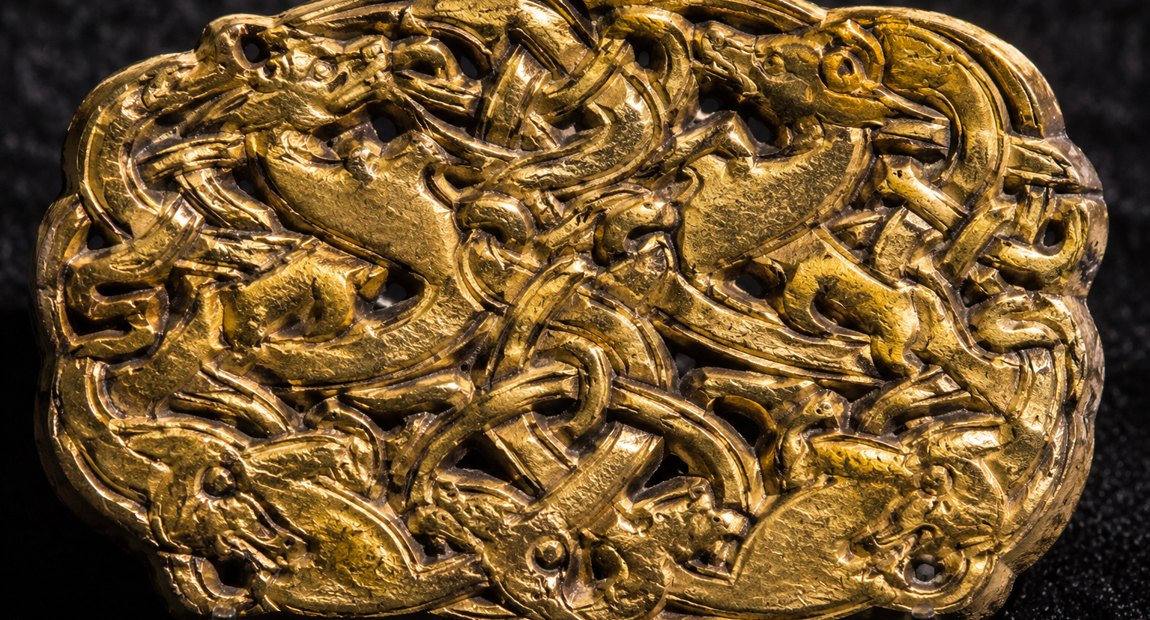
Urnes on the Lustrafjord gave its name to the last animal style of the Viking Age. The English Wikipedia dates the building to about 1130 or shortly after, with 1132 from tree rings in the infobox; UNESCO speaks more generally of the 12th and 13th centuries. What matters is what the building contains: parts of its predecessor, including the north portal and wall planks, were reused. Wikipedia places that timber in the second half of the 11th century, and the English page on stave churches gives 1070 to 1080 for the reused parts. A report on the NTNU tree-ring work (Terje Thun, 2019, phys.org) gives an older part as 1069/70 and a slightly younger one as 1129/30; the figures differ slightly, and I have not seen the original publications. UNESCO's justification (criterion iii) stresses precisely this large-scale reuse of decorative and structural elements from a church about a century older.
World Heritage status came in 1979, reference number 58. UNESCO describes the church as a timber basilica that translates Romanesque stone forms into wood, with cylindrical columns, cube capitals and round arches, and the carvings as a link between pre-Christian Nordic culture and medieval Christianity. Since 1881, the year the parish was dissolved and regular use ended, the church has belonged to the Fortidsminneforeningen, the Norwegian society for the preservation of ancient monuments. A fuller reading of the portal and its serpents is in our article The Urnes portal; the style history from Oseberg to Urnes is under art styles of the Viking Age.
Caution is needed with the popular reading that the portal shows Ragnarök or the dragon Níðhöggr gnawing at the roots of the world ash Yggdrasil. The English Wikipedia presents this as interpretation, as it does the suggestion that the older church bore scenes from Norse myth and that this prompted the rebuilding. Both are speculative. The ornament is secure; its message is not.
Borgund in Lærdal is considered the best-preserved stave church in Norway. The English Wikipedia dates it to "around 1200", or between 1180 and 1250; the 2019 study cited above puts it at 1180 to 1181. The church went out of use in 1868 when a new one was built beside it, and the preservation society bought it in 1877. A restoration in the early 1870s, which Wikipedia says the architect Christian Christie led, removed pews, a gallery, a chancel ceiling and several windows. The free-standing bell tower is probably from the mid-13th century and, according to the page, the only surviving stave-built one in Norway.
Heddal in Telemark shows how uncertain the dating of large churches can be (see above) and how heavily a restoration decision weighs. From 1848 to 1851 Johan Henrik Nebelong rebuilt it; the work gave the interior an Empire style, led to moisture and fungal damage, and was sharply criticised. In the 1950s Gudolf Blakstad and Herman Munthe-Kaas reversed much of it and replaced many posts, foundations and sills. The English Wikipedia lists only the four corner posts, the half-plank walls and two intermediate posts as original.
A legend attaches to Heddal: a stranger unmasked as the mountain troll Finn is said to have built it in three days. The portal carvings show, per the German Wikipedia, scenes from the Sigurd legend (Heddal and Hyllestad); what they meant inside a church remains an open question.
The reasons for the decline are many, and war is rarely among them. Wood burns, rots and proves too small. The German Wikipedia names plague, fire, replacement by stone churches and demolition. In Sweden most churches were burned in plague times in the 17th century, it says. In Norway, by the figures above, the modern period was decisive: growing parishes needed larger rooms, and small, dark stave churches were often judged unsound. The Vang church in Valdres is the textbook case.
According to the English Wikipedia, the parish council decided in 1832 to demolish it as too small and unsafe. The painter J. C. Dahl, the page says, tried in 1826 to save it through repairs, proposed in 1839 to re-erect it in Christiania or Bergen, and finally bought it at auction in January 1841 on condition that the site be cleared by year's end. King Frederick William IV of Prussia (on the throne since 1840; the Wikipedia summary speaks of a crown prince, which cannot be right) bought the church for 427 marks according to the church's own website in Karpacz and bore the cost; the parts went via Szczecin and Berlin to Silesia. The foundation stone was laid on 2 August 1842, and the church was consecrated at Karpacz in July 1844 (Wikipedia gives the 27th, the church website the 28th). Even here dating is uncertain: the page treats "around 1200" as an estimate and the year 1200 on the 1843 roof turret as "rather dubious". I have not checked how Dahl and the king cooperated in detail against primary sources.
Other losses: Gol was moved to Oslo in 1884, where it has stood since; a copy was built on the original site in 1994 (German Wikipedia). The church at Hyllestad was destroyed in the 19th century; its portal is in Oslo. The best-known recent loss is Fantoft near Bergen: the church (originally probably second half of the 12th century, built at Fortun) burned on 6 June 1992. According to the English Wikipedia Varg Vikernes is strongly suspected but was not convicted for it; he was convicted for other church fires. The German Wikipedia wrongly dates the Fantoft fire to 1997, which is the year of rebuilding; the English page is right.
In the 19th century stave churches were increasingly treated as monuments, even as many were demolished (see above). A uniform conservation practice evidently did not yet exist. Heddal was rebuilt in 1848 to 1851 in a way Wikipedia describes as heavily criticised and harmful to the wood; Borgund was cut back in the 1870s, losing fittings of later centuries so that its presumed medieval form could be revealed.
For Urnes and Borgund, acquisition by the preservation society (1881 and 1877) was a turning point, because an owner with a preservation mandate appeared. UNESCO lists restorations at Urnes in 1906 to 1910 and foundation work in 2009 to 2010. Anyone standing before a stave church sees several layers of time at once. "Authentic" in the lists therefore does not mean "unaltered" but "with a substantial medieval share".
How many stave churches are left in Norway? The usual figure is 28; depending on the count 29 or 33 if altered buildings are included. What decides is how much medieval fabric survives.
How old is the oldest stave church? It depends on the dating. Urnes is dated to about 1130 (1129/30 or 1132 depending on the source), with some parts from the late 11th century (1069/70). For Heddal the dates are not clear.
Why do stave churches have dragon heads? The common reading sees a protective sign against evil spirits. Whether they descend from Viking ships cannot be proven.
Were the churches saved in the 19th century? Partly. There was rescue (Vang), but also alterations that harmed the building (Heddal) and rollbacks (Borgund) meant to restore the presumed medieval form.
Can you visit stave churches? Many are open in summer; opening times change and I have not checked them. According to Wikipedia, Heddal is not heated from October to May, with winter services held in a separate barn.
The Urnes portal · Art styles of the Viking Age · Olaf Tryggvason · Olaf the Holy · Christianisation of the Germanic peoples · The Dragon in the North · Viking wood carving · Longhouse · Viking museums

The Urnes portal – the last animal style · Viking-age art styles · Olaf the Saint · The Christianisation of the Germanic Peoples · Dragons of the North.
All History & Finds articles →
On 25 September 1066 a Norwegian invasion army was caught off guard at Stamford Bridge in Yorkshire by King Harold …
Read more →Some time in the 750s someone on the Volkhov felled trees to build a house. The tree rings in those logs are the oldest …
Read more →Starigard – Slavic for "old fortress" – was the chief stronghold of the Wagri, a branch of the Abodrite Slavs, from the …
Read more →The Battle of Stiklestad was fought, according to tradition, on 29 July 1030 in Trøndelag, Norway: King Olaf …
Read more →