When did a Viking get up, what did he eat, who worked where, and how often did he go to the Thing? Anyone expecting a "typical day" will be disappointed: no diary survives from the Viking Age, and no source describes a day from morning to night. What exists are fragments – a verse about rising early, a dictionary entry on meals, isotope values from graves, house plans. This article sets them side by side, says where each piece comes from, and separates what is attested from what modern reconstruction adds. There is no invented scene here.
The Viking Age runs roughly from the late 8th to the 11th century. People then wrote in runes in everyday life, but briefly: ownership marks, memorial stones, trade notes. Longer texts about life on a farm were written later and elsewhere, above all in Iceland, where sagas and Eddic poems were put on vellum in the 12th and 13th centuries. Add the accounts of foreign observers, such as Frankish or Arabic authors, who mostly had merchants, warriors and strangers in view, not ordinary farm routine.
The conclusion is uncomfortable but clear: I know of no source that describes a Viking day in one piece. Anyone who speaks of "the" daily routine builds it from fragments, and those fragments come from different centuries, countries and social ranks. A farmer in western Norway, a trader in Birka, a retainer at a royal hall and an enslaved worker on an Icelandic farm did not live the same day.
So this text follows a simple rule. Each section first says what the source actually gives, then marks what goes beyond it as merely plausible. Where the word "reconstruction" appears, it is meant seriously: a reasoned guess, not a find.
Four kinds of evidence can carry an everyday-life article, and each has its own weaknesses.
Archaeology. House plans, hearths, refuse pits, animal bones, plant remains, tools. They show what was present, not when in the day it was used. A hearth proves cooking or heating, not a time of day.
Scientific analysis. Stable isotopes in bone roughly reveal what people ate over years, for example whether much marine food was on the menu. For Birka in Sweden, Anna Linderholm, Charlotte Hedenstierna Jonson, Olle Svensk and Kerstin Lidén compared stable isotopes with grave goods (Antiquity 82, 2008). I could read only the abstract, not the full text; the authors themselves call the results early.
Poetry. The Hávamál, the "Sayings of the High One", is a collection of rules for living placed in Odin's mouth. It was written down in the 13th century; how old individual stanzas are cannot be said with certainty for each one. It shows ideals and advice, not statistics.
Language. Old Norse words for meals and times of day show how people divided the day, provided the attestations are not all late. Here too a word attests an idea, not every single household.
Before clock times, consider what cannot be negotiated. In Scandinavia summer days are very long and winter days short, and more so the further north you go. That is astronomy, not interpretation. A day in June and a day in December therefore offered different amounts of usable light, and work followed: hay, sowing, fishing and travel in summer; repairs, craft, spinning and weaving indoors in winter.
How exactly people filled the winter we know only in outline. That craft and textile work played a large part in the house is well supported by finds such as loom weights, spindle whorls and needles. That people followed the light of the hearth is a likely assumption drawn from how the houses were built, not from a description of a day.
Place matters too. A farm in Iceland, with little woodland and much pasture, had different tasks from a homestead on the Danish plain or a craft settlement such as Hedeby or Birka. Trading towns knew market routines and division of labour; the single farm leaned toward self-sufficiency with peaks at harvest time.
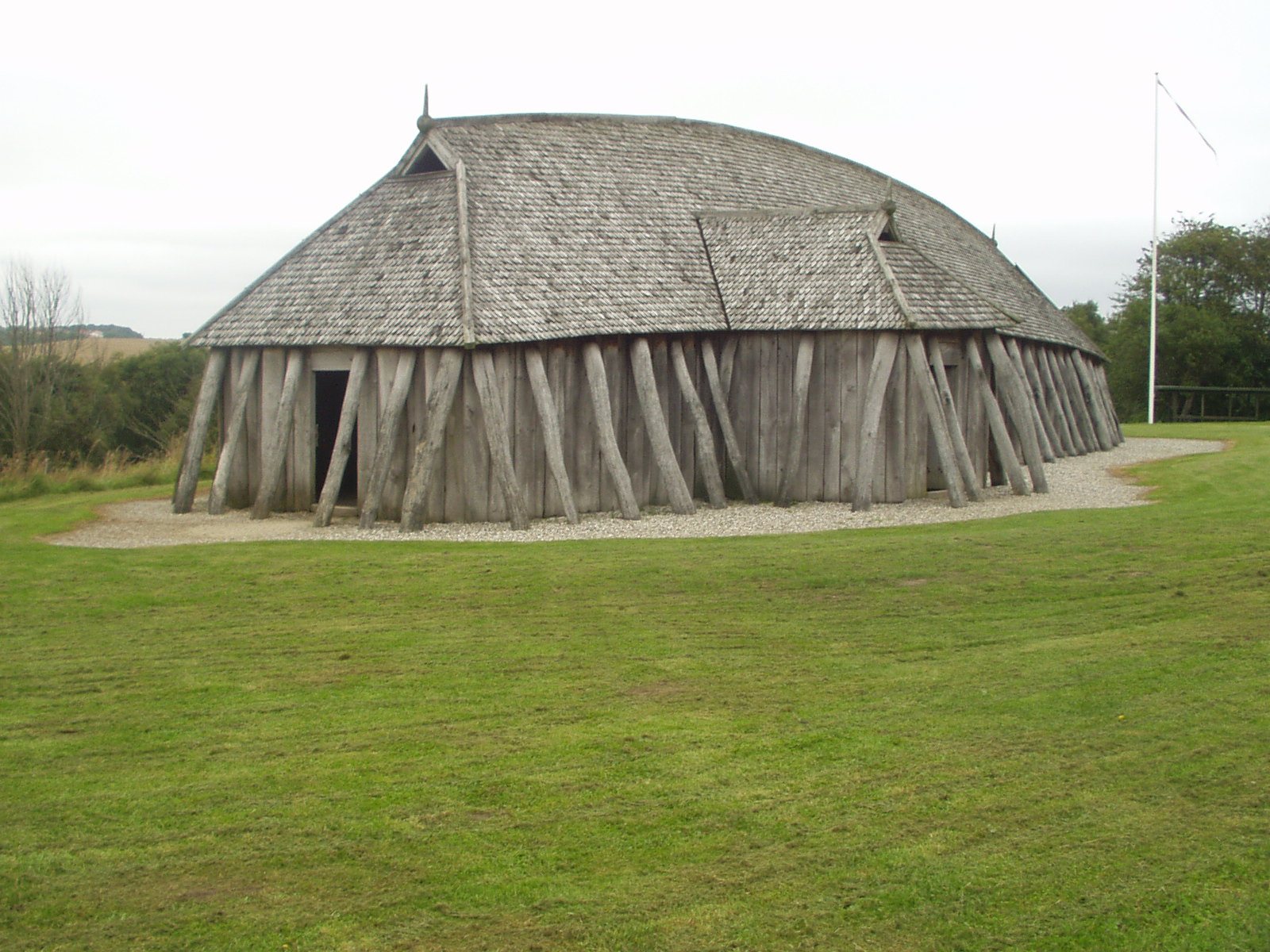
The centre of a rural household was the longhouse. Construction varies by region and material: timber, turf, stone, posts or wall trenches. Many plans share a long room with a central hearth, often flanked by benches or platforms, plus outbuildings for livestock, stores and workshop. The architecture is covered in more detail in the article on the longhouse.
What follows for the day is reconstruction: a household that combined living, cooking, sleeping and parts of its craftwork under one roof had no sharp line between working time and free time. Whether and how rooms were used at particular times of day is not recorded. The popular picture of a whole extended family eating at one long table is likewise a picture from saga and hall literature, not an archaeological finding for every house.
Who lived on the farm depended on rank. Alongside the farming family there were servants, farmhands and maids, and in some households unfree labourers. Unfreedom is clear in the sources, but patchy in detail; more in the article on slavery. For the daily routine this means work was unevenly distributed, and whoever gave the orders did not necessarily sleep earlier or later than whoever carried them out.
For the morning there is one of the few direct textual attestations. According to the summary of the Simrock translation that I read through a retrieval tool, the Hávamál advise that whoever has few workers should rise early and see to his work; whoever sleeps through the morning misses much. A second stanza recommends early rising to whoever means to take something from others. Stanza numbering varies between editions; in Simrock these are stanzas 57 and 58.
What does this advice attest? It attests that early rising was regarded as a virtue of the master of the house, especially when labour was scarce. It does not attest at what hour people got up. Hours as we count them did not exist; times of day were named by the sun and by habit. See the article on time reckoning.
Whether everyone on the farm rose equally early is also unknown. The saying addresses a householder, not everyone. The reconstruction "all out of bed early" is plausible for farming, uncertain in winter, and hard to document for traders in towns.
The cliché of the unwashed Northman barely survives a check, and finds support that: combs, ear scoops, tweezers and razors occur in Viking-Age settlements and graves. The Hávamál advise riding to the Thing "washed and fed" (more below). What that meant in daily practice, how often people washed and with what, is not recorded. More on finds and sources in the article on hygiene.
The same goes for hair and beards. There are images and comb finds, but no evidence that every man did the same thing every day. For more, see hairstyles.
Here language offers a real clue. The Old Norse dictionary of Cleasby and Vigfússon records dagverðr, a "day meal" described as the chief meal of the old Scandinavians and eaten in the forenoon, and náttverðr, the evening meal. The attestations the entry lists range from Tacitus (Germania) through the Hávamál to sagas such as Egil's saga and Njáls saga.
These are attestations, with limits. First, many passages come from sagas written in the 13th century and later, which reflect Viking-Age conditions only in part. Second, a dictionary entry shows that two meals had names, not that there were only two or that everyone ate at the same times. Snacks, leftovers, provisions on journeys and eating at work are not ruled out, merely not attested.
So one may say: according to linguistic evidence there was a main meal in the forenoon and an evening meal. What was served, who waited at table, and whether everyone ate together cannot be read from that.
There is comparatively much material on diet, because food remains stay in the ground. Typical of the picture drawn by research are cereals such as barley and oats, porridge and bread, meat from cattle, sheep, goat and pig, fish, dairy products, berries and nuts. For this round I did not re-check individual findings against excavation reports, so the list stays deliberately general; the weighting differs by place and period. The article on diet goes into detail, and the one on stew covers a typical one-pot dish.
The difference between groups becomes easier to grasp through the Birka isotope study. According to its abstract, men buried with weapons relied more on marine food, while a group of women associated with trade ate similarly. A later study (Price et al., Journal of Anthropological Archaeology 49, 2018) summarises the work as showing only a slight difference for weapon graves, wide variation within groups, and no difference in carbon and nitrogen between chamber graves and simple graves, so rank did not show up in diet. I cannot give numbers or sample sizes, since I have not read the full text of Linderholm et al. Still, the result shows that "the Viking ate meat" is too coarse: who ate what depended on place, rank, and access to sea, land and trade.
On drink, the sources say more about ideals than quantities. The Hávamál warn against ale as a travelling companion because drunkenness dulls the senses, and consider drinking acceptable as long as the mind stays clear. Brewing and mead have their own articles: beer and mead. That alcohol was drunk daily is a common assumption that no source supports for ordinary farm life.
Most people in the Viking Age lived from agriculture. That is the basic statement of research on the period; the image of the Viking as a permanent sea raider fits only a minority and only in certain seasons. For the daily routine this meant: tending livestock, milking, working fields or making hay, keeping fences, roofs and tools in repair. Depending on the region came fishing, hunting, peat cutting or felling timber.
Craft had many faces. In the household it was above all spinning, weaving and sewing, as loom weights and needles show, plus carving, tanning, simple smithing and repairs. Specialised workshops such as comb makers, smiths or bead makers are attested in trading centres. Which tasks men and women each took on can be partly inferred from graves, sources and images; a strict division for every household is not secure. An overview of trades is in the article on occupations, and one on clothing.
Children were part of this everyday life. How early and with what is hard to say in detail. More on what is known about them is in the article on children.
Part of farm life was dealing with visitors. The Hávamál open with rules for guests and hosts. The stranger who comes in from the road needs, in Simrock's translation, warmth, food and clothing, as well as water, a towel and friendly words. These are ideals of poetry. Whether people always kept to them in daily life we do not know, but the stanzas show what was expected of a host.
The evening is often imagined as a feast. There are sources, but they come mainly from poetry and saga and often describe festivals, royal halls and special occasions, not the ordinary evening. An ordinary farm was probably plainer. That is, however, reconstruction: no account of the evening of a middling farmer exists.
What was actually done in the evening emerges rather from finds. Gaming pieces and board games such as hnefatafl are archaeologically attested, as are musical instruments such as flutes and lyres. What became of them on any given evening remains open. On music, see music.
The Thing was the assembly where free men settled disputes, gave judgments and took decisions. It was not part of the daily routine but met at set times and in fixed places. How often an individual man attended depended on place, period and occasion. There is no rhythm for "all Vikings".
Well attested is the expectation about appearance. According to Simrock's Hávamál (stanza 60, as reported by the retrieval tool) one should ride to the assembly "clean and fed" without worrying about splendid clothes; nobody need be ashamed of shoes, breeches or horse. That shows two things: the Thing was a place of public standing, and finery was, at least in this poetry, not made a requirement.
"Clean and fed, ride to the assembly" (own rendering of the German fragment "Rein und gesättigt reit zur Versammlung")Hávamál, stanza 60, after Karl Simrock's German translation (Die Edda); only this fragment, read through a retrieval tool, wording not checked against the full text; English rendering by the author
What roles women, the unfree and children played at the Thing is weighted differently in the sources than in modern accounts. For Iceland, where the tradition is denser, legal practice is better described than for Denmark or Norway. For the structures, see the articles on the Thing, Thing sites and law.
A recurring idea is moderation. In the Simrock translation, stanza 20 says roughly that only the foolish man does not know the measure of his stomach, while the herd knows when to go home. That is advice, not a statement of fact, and it teaches that excess in eating and drinking was criticised, presumably because it happened. Nothing more can be concluded.
The wish for one's own house is similar. Stanza 36, as far as I read it, says a house of one's own is better than begging, even if it is cramped; whoever must ask for his meal every day suffers. One can see independence as a value in this without inferring how many people actually owned a house.
A practical ordering helps tell the building blocks apart. Some statements rest on finds or texts. Some are plausible because they fit several pieces of evidence but are not explicitly attested. And some come from film, novels or games and have only a loose connection to the Viking Age.
Attested are therefore: long summer days and short winter days, longhouses with hearths, tools for textile and wood work, combs and grooming instruments, the word for two meals, the literary advice to rise early, expectations of hospitality, the Thing as an assembly. Plausible but not attested are fixed mealtimes, the exact division of labour between the sexes, the course of an ordinary evening. Not attested are all scenes in which someone gets up "at six o'clock" or watches the smoke leave the roof hole at dawn; such images come from storytellers, not from the sources.
The same holds for reconstructions in museums or reenactment. They are valuable because they show how long baking bread or weaving takes and which movements are needed. As evidence for the daily routine they do not serve, for they presuppose the assumptions they want to test. The article on reenactment offers background.
Research is reserved on everyday questions for good reasons. The finds span more than 250 years and an area from Greenland to the Baltic. They were recovered by different excavations with different methods. A routine that holds for Hedeby in the 10th century need not hold for a farm in the Faroes in the 9th.
There is also the bias of survival. Graves often hold the special, not the everyday. Refuse pits preserve bones but vegetable and bread remains less well. Sagas tell of conflict, not of ordinary days. The ordinary person – the one who spent most of his time turning hay – left the fewest traces. That is why many portrayals look more heroic than life was, and why it is more honest to show gaps than to fill them.
For the wider picture, see What is typically Viking?, which sets cliché and evidence side by side, and the article on medicine, which deals with everyday risks such as illness and injury.
Anyone who still wants to picture a routine can do so as a thought model, explicitly not as a report. Take a farm in summer. Attested: long days allowed outdoor work, there were terms for a forenoon meal and an evening meal, and the head of a household was advised to rise early. Reconstructed would be the order: tending the livestock, work in field or pasture, the main meal in the forenoon, more work, supper, tasks in the house. Everything beyond that – clock times, seating, conversation – is free addition and does not belong in a factual text.
What matters is what the model does not do: it says nothing about winter, about traders in towns, about voyages, about war bands. For those cases one would have to ask again which evidence exists. Each time the result would be a different day.
When did Vikings get up? That is not recorded. The Hávamál advise a householder with few workers to rise early; they give no hour.
How many meals a day did Vikings eat? Old Norse knows a day meal (dagverðr) and an evening meal (náttverðr). Inferring exactly two meals for everyone would be too much; snacks are not ruled out, merely not attested.
Did Vikings go to the Thing every day? No. The Thing was an assembly at set times and places, not a daily appointment.
What did most Vikings do for a living? The majority lived from farming, supplemented by fishing, craft and trade. Raiding involved only a part of the men.
Is there a genuine report of a Viking day? None that I know of. Whatever appears as a "daily routine" is assembled from finds, poetry and late sagas.

Typically Viking? · The Viking Longhouse · Viking food & drink · Trades & Crafts · The Thing.
All History & Finds articles →
They hardly loom large in any history book, yet their trail runs from the plains north of the lower Danube to Poitou …
Read more →Little is recorded about the Tarbelli, and that little is unusually solid. A geographer calls their land the richest in …
Read more →The Taurisci were a Celtic tribal group on the eastern edge of the Alps, in what is now Carinthia and Slovenia. Their …
Read more →Anyone looking for the Tectosages finds them in three places thousands of kilometres apart: in Tolosa, today's …
Read more →