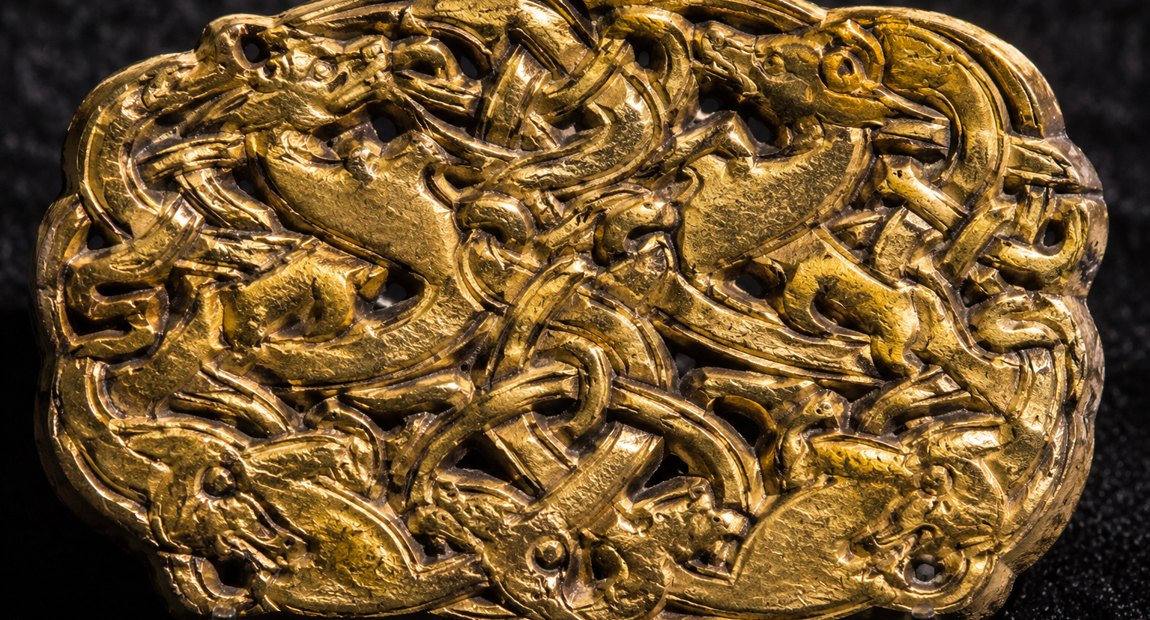
Two timber churches on the Sognefjord belong to the 1130s, yet they survived in very different ways. Hopperstad in Vik was abandoned in 1877, bought by a preservation society and largely completed in the 19th century. Kaupanger near Sogndal stayed a parish church, was "modernised" in 1862 and returned to its 17th-century state in the 1960s. This article sets dates, building evidence and restorations side by side, names the points where the sources contradict each other, and separates original fabric from reconstruction.
Hopperstad stands at the edge of Vikøyri in the municipality of Vik; Kaupanger lies on the northern shore of the Sognefjord in the municipality of Sogndal. Both belong to the region of Sogn in today's Vestland. Both are stave churches: timber buildings whose walls and roof load are carried by vertical posts, the staves.
Researchers often sort stave churches into groups. According to English Wikipedia it is now common to distinguish Type A (no free-standing posts) from Type B (a raised roof over interior posts). Type B splits there into a Kaupanger group (Kaupanger, Urnes, Hopperstad, Lom) and a Borgund group (Borgund, Gol, Hegge, Høre, Lomen, Ringebu, Øye). The Norwegian encyclopaedia Store norske leksikon (SNL), by contrast, calls Hopperstad "treskipede, sognske typen", a three-aisled church of the Sogn type, while the English Wikipedia article on Hopperstad speaks of a "Borgund type". The same church thus carries different labels depending on the source; the typology is not cut uniformly.
Only a small remainder of the medieval stave churches survives. English Wikipedia gives 29 surviving churches in one place and 28 in another, and about 1,000 as the original number, with newer estimates possibly closer to 2,000. Both are approximations.
The church stands on its original site. The first written mention dates from 1322, according to English Wikipedia, but the church already existed then. For anything earlier we depend on the building. It is generally dated "antakelig fra 1130-tallet", probably to the 1130s (SNL); Fortidsminneforeningen, the Society for the Preservation of Ancient Norwegian Monuments, says it is believed to have been built around 1130.
That figure has its own small history. In 1997, seven tree-ring samples gave felling years between 1034 and 1116, according to English Wikipedia. SNL says the samples came from the construction under the chancel floor, and that one sample from a ground sill gave 1058–1059. The encyclopaedia explains this as reuse of older timber or as a "false sapwood edge", a last ring lost through wear. The results did not fit the stylistic evidence well, so no reliable date was reached.
In 2019 a different method was used. Researchers at the National Laboratory for Age Determination at the NTNU University Museum in Trondheim photographed timber in place and measured the rings on the photographs afterwards. The method is called photodendrometry and needs no cores. According to Norwegian SciTech News it gave 1131–1132 for Hopperstad (previously assumed: 1125–1250), 1137–1138 for Kaupanger (previously 1170–1200), 1180–1181 for Borgund and 1204–1205 for Gol. Terje Thun is quoted there as saying we now know the age of some stave churches almost to the year. I have not read the underlying scientific publication; the numbers rest on the press report and on the Wikipedia summary. The Hopperstad figure does agree with the older guess of the 1130s.
"We now know the age of some stave churches almost to the year."Terje Thun, NTNU University Museum, Trondheim, in: Norwegian SciTech News, "Stave churches in Norway older than previously believed", 2019. Short quotation from modern press, not public domain.
A felling date says when a tree was cut, not when the church was consecrated. Usually only a few years lie between the two, but with reused timber the gap can be much larger.
Two findings suggest an earlier church on the site. During the 1880s work, two fragments in the Urnes style, dated to about 1070–1080, were found (SNL). English Wikipedia adds that excavations in 1982 revealed post holes for large staves. A predecessor is assumed for the middle of the 11th century, possibly around 1060. What it looked like is unknown, and the sources I read do not say whether it was a stave or a post building. That reused timber survives in the present church, as the 1997 sample series suggests, is an interpretation; it fits the archaeological and building evidence but is not proven.
How the medieval church looked is not recorded, says English Wikipedia; sketches show a nave and chancel. In the 17th century the nave was lengthened to the west with a bell tower above it, a new log section was added to the east, and a south vestibule with its own entrance was built. In 1723 the church was sold into private ownership at the Norwegian church auction to pay debts from the Great Northern War. In the 18th century it was considerably larger than today, with extended chancel and nave, porch and bell tower, as a watercolour shows (SNL).
A royal decree of 11 December 1875 ordered Hopperstad and the neighbouring church at Hove closed and a new church built at Vikøyri, consecrated in 1877. After about 700 years of use the old church was abandoned (English Wikipedia). According to SNL it was afterwards used, among other things, as a fodder shed.
Here the sources contradict each other. Fortidsminneforeningen itself and English Wikipedia give 1880 as the year the society acquired the church. SNL says: "1882 kjøpte Fortidsminneforeningen kirken". The pages I read do not settle which is right.
All agree that only the medieval parts were bought. Later additions and later furnishings were demolished and sold.
The work was led by the architect and engineer Peter Andreas Blix (1831–1901), who financed part of it himself according to Fortidsminneforeningen and SNL. The period is given differently: English Wikipedia says 1884 to 1891, SNL 1885 to 1891, and Fortidsminneforeningen speaks of "the 1880s and 1890s". Whether these are different ways of counting is unclear.
Blix started from traces in the building. Where he did not know the original appearance he mostly took the stave church at Borgund as a model. According to Fortidsminneforeningen this applies most clearly to the ridge turrets and the dragon heads on the roof ridges, which are therefore not documented originals. SNL lists as added or newly made:
SNL regards the restoration today as disputed on several points. Fortidsminneforeningen puts it soberly: the original exterior is not known. Anyone standing in front of Hopperstad sees a late 19th-century reconstruction on a medieval core, not a photograph of the 12th century.
According to Fortidsminneforeningen the west portal, the chancel screen and the wooden canopy over the northern side altar are medieval. SNL describes the west portal as one of the oldest surviving dragon portals, together with Ulvik, of the Sogn-Valdres type, with dragons and tendrils in fine relief. It also reminds us that the upper parts and one cheek were supplied by Hirt, so original and addition sit side by side in the same portal. For art history this matters: anyone drawing conclusions from the portal should know which parts are meant. More on the ornament of the period is in the article on the Urnes portal and in the overview of Viking Age art styles.
The south portal is plainer, with columns and a twisted rope motif. According to SNL the door ring was broken off and stolen in the 1990s; the door leaf is probably original. The north portal at the chancel shows a knot motif with two animal heads, compared by SNL with Urnes and Danish loop portals, without a direct parallel in Norway. The chancel screen is, according to Fortidsminneforeningen, the only one still complete among the surviving stave churches; SNL traces its pointed trefoil openings probably to 13th-century alterations.
The canopy is a rare piece. Fortidsminneforeningen mentions paintings of scenes from the childhood of Jesus, probably from the late 13th century. SNL is inconsistent: style points to the early 13th century, a caption says late. English Wikipedia dates the ciborium to the 14th century.
English Wikipedia says the medieval timbers bear numerous runic graffiti and cites the catalogue "Norske runeinnskrifter" with the numbers N390 to N412. The SNL entry does not mention the subject. I have not seen the catalogue, so I cannot state the content or dating of the inscriptions. On the script as such: Runes.
Kaupanger lies on the north shore of the Sognefjord. SNL suggests that in the late 12th century the place may have been a small town with a harbour, and adds that the church may be the only surviving wooden "bykirke", town church, of the Middle Ages. That is carefully worded, and the caution belongs to it. According to SNL the name Kaupanger first appears in Sverris saga shortly after 1200.
For a long time Kaupanger counted as a building of the late 1100s. The reason is in SNL: beneath the present church lies a fire layer. A coin under it was minted between 1130 and 1150, the oldest coin above it dates from the reign of Sverre (1177–1202). The fire is usually connected with Sverre's raid on Sogndal and Kaupanger in 1184, which would put the new building shortly after. SNL admits that the coins alone only show that the earlier church burned after 1130. English Wikipedia adds that Sverris saga does not mention the burning of the church.
Against this stands the tree-ring sample. SNL says the timber from the south portal of the nave was felled "kort etter 1137", shortly after 1137. Fortidsminneforeningen gives 1137/1138; the 2019 photodendrometry gave 1137–1138 (previously assumed 1170–1200). English Wikipedia considers a building date around 1140 probable, newer research suggests 1140–1150, and the exact building and consecration dates remain debated.
SNL keeps the link to the 1180s, assigns Kaupanger to a group of churches it calls "Lustergruppen" and dates the group as a whole to 1175–1200. Next to the tree-ring evidence this reads like an unresolved tension, and the sources I read do not say how it resolves. One possible reading, which I mark as conjecture: the fire layer belongs to a predecessor, and the timber of the present church is older than the coin-based dating. The fire of 1184 would then not have been the occasion for the present church. This is not proven.
According to SNL, Kaupanger is built as a long church, with a rectangular nave and a narrower chancel. The nave is carried by 22 staves, eight per long side and three per short side; four free-standing staves carry the raised chancel (English Wikipedia). Fortidsminneforeningen says no other known stave church has more staves. On measurements the sources differ: SNL says the nave was lengthened in the Middle Ages by two bays, from about 10.2 to 13.6 metres; English Wikipedia gives an extension of about 3.5 metres to the west in the 13th century and afterwards roughly 13 by 7.5 metres. Both agree that the nave was lengthened to the west in the Middle Ages. The date "13th century" comes only from Wikipedia.
On predecessors the sources say different things: SNL names two post churches ("stolpekirker") from the late 11th and early 12th century, English Wikipedia two stave churches, the second of which probably burned in the 1130s. The building method thus stays open. For the post building see the article on the longhouse.
In the late 17th century the gallery disappeared, according to SNL, and the church received horizontal cladding and new windows. The roof turret was added in 1672, a porch is first mentioned in 1686. Altarpiece, pulpit and font date from the 1620s and 1630s and were donated by the bailiff Gjøde Pedersen. This is the phase to which the church was returned in the 1960s.
In between lies the great intervention of 1862. According to SNL the church was rebuilt to plans by Frederik Hannibal Stockfleth. Porch and burial chapel were demolished, the outside received white-painted vertical boards and 51 new windows, two galleries were built inside and the older decoration was painted over. The 17th-century furnishings went to a museum. The price of the modernisation, says SNL, was among other things that the preserved parts of the medieval portals were destroyed. English Wikipedia speaks of a "brutal modernization" with white exterior panelling and dark roof tiles over the old shingle roof.
A hundred years later major repair was needed, preceded by archaeological excavation. According to SNL the aim was the state of the 17th century, documented by building traces, church accounts and a painting of 1832. The 1862 windows were removed, the openings of the 17th century reglazed, the porch rebuilt, the oil paint taken off and older wall paintings uncovered. Altarpiece, pulpit, font and memorial tablets came back from the museum. A long band of musical notation painted on the wall belongs to this phase too.
The dates vary: an SNL caption says 1959–1965 and the text says 1969 as the end; English Wikipedia says 1959–1960; Fortidsminneforeningen says "in the 1960s". Without a primary source I cannot tell whether different building phases are meant. The medieval form was not the goal.
Fortidsminneforeningen states: "Little survives of the medieval interior." A round arch between nave and chancel probably comes from an altar canopy. SNL mentions a crucifix of about 1200; the altar frontal of about 1250 is in the Bergen Museum. The nave has a flat ceiling, the chancel an open roof with rafters, collar beams and a "hanebjelke"; SNL suggests the nave originally had the same roof form.
On ownership the sources diverge: English Wikipedia names Fortidsminneforeningen as owner, while the society itself says it does not own the church but runs guided tours there. SNL is silent. This cannot be settled here. In 2024 the church was closed because of building work (Fortidsminneforeningen).
Kaupanger and Kaupang. Both names probably contain the same Old Norse word for trade, but the place on the Sognefjord is not the Viking Age trading place of Kaupang in Vestfold. For that site see the article on Kaupang. The stave church stands in Sogndal, far to the west, and its timber was felled well over two centuries after the heyday of the trading place (roughly 800 to 930).
Hopperstad and Fantoft. The Fantoft stave church near Bergen is a reconstruction. The original was built around 1150 at Fortun in Sogn, bought in 1883 by consul Fredrik Georg Gade, moved in pieces to Fana near Bergen and destroyed by arson on 6 June 1992. The rebuilding took six years (English Wikipedia). Visiting a stave church in Bergen therefore means visiting a copy made after a fire. Hopperstad stands on its original site in Vik, but that does not mean it is unchanged; see above.
Borgund and Hopperstad. Borgund (photodendrometry: 1180–1181, previously 1150–1250) is younger and served Blix as a model. The dragon heads at Hopperstad follow Borgund, not the other way round.
The church at Kaupanger is often linked with King Sverre. According to English Wikipedia, Sverre had the market town burned in 1184 to punish the inhabitants for disobedience; Sverris saga, it adds, does not mention the burning of this church. I have not read the saga itself in full. J. Sephton's English translation (London 1899) is in the public domain but was not accessible to me, so I do not quote it. The quotation in this article comes from the press release on the dating (see above) and concerns the method, not the fire.
According to SNL the trading place itself appears by name in the saga shortly after 1200. That a fire in 1184 destroyed the older church thus remains an interpretation of the archaeological evidence (fire layer, coins), not a statement of the saga.
The sources I read name no pagan predecessor on the same spot for either Hopperstad or Kaupanger; the picture of the stave church as a "converted temple" is not documented for these two churches. Dragons, tendrils and animals on the portals also occur in older northern art. Whether older meanings lived on behind them is interpretation. For background see Christianisation, the dragon in the North and woodcarving. In time, English Wikipedia says that after the Reformation hardly any stave churches were built; Kvernes (1633) is the only known one.
When was Hopperstad built? It is usually dated to about 1130. Photodendrometry in 2019 gave 1131–1132, according to Norwegian SciTech News; the 1997 sample series was inconsistent. A predecessor is assumed for the middle or second half of the 11th century.
Is Hopperstad preserved in its original state? The medieval core with west portal, chancel screen and canopy survives. Apse, gallery, ridge turrets and dragon heads go back to the restoration under Peter Blix from about 1884/85 to 1891, which is partly disputed to this day.
How old is Kaupanger? According to the tree rings the timber was felled in 1137/1138, and the church was probably built shortly after. The earlier dating to 1170–1200, tied to a fire in 1184, no longer holds.
What happened at Kaupanger in 1862? The church was modernised to plans by Frederik Hannibal Stockfleth: 51 new windows, white exterior boards, two galleries, painting over of the older furnishings. The preserved parts of the medieval portals were destroyed.
Are Kaupanger and Kaupang the same? No. Kaupanger lies in Sogndal on the Sognefjord; Kaupang in Vestfold was a Viking Age trading place.
Urnes portal: stave church, Urnes style and its interpretation · Kaupang: Norway's earliest town site · Art styles of the Viking Age · Christianisation of the Germanic peoples · The dragon in the North · Viking Age woodcarving · Viking museums · The longhouse

The Urnes portal – the last animal style · Kaupang · Viking-age art styles · The Christianisation of the Germanic Peoples · Viking museums.
All History & Finds articles →
For a long time the housecarls passed for England's first professional army: Danish elite warriors brought over by Cnut …
Read more →Ibn Fadlan was the secretary of an embassy sent by the Abbasid caliph al-Muqtadir from Baghdad to the Volga Bulgars in …
Read more →Around the year 965 a stranger came to the Schlei. He came from Tortosa in al-Andalus, Muslim Spain, was Jewish, a …
Read more →Few peoples of Iron Age Britain left so many traces and at the same time vanished so completely behind a single person …
Read more →