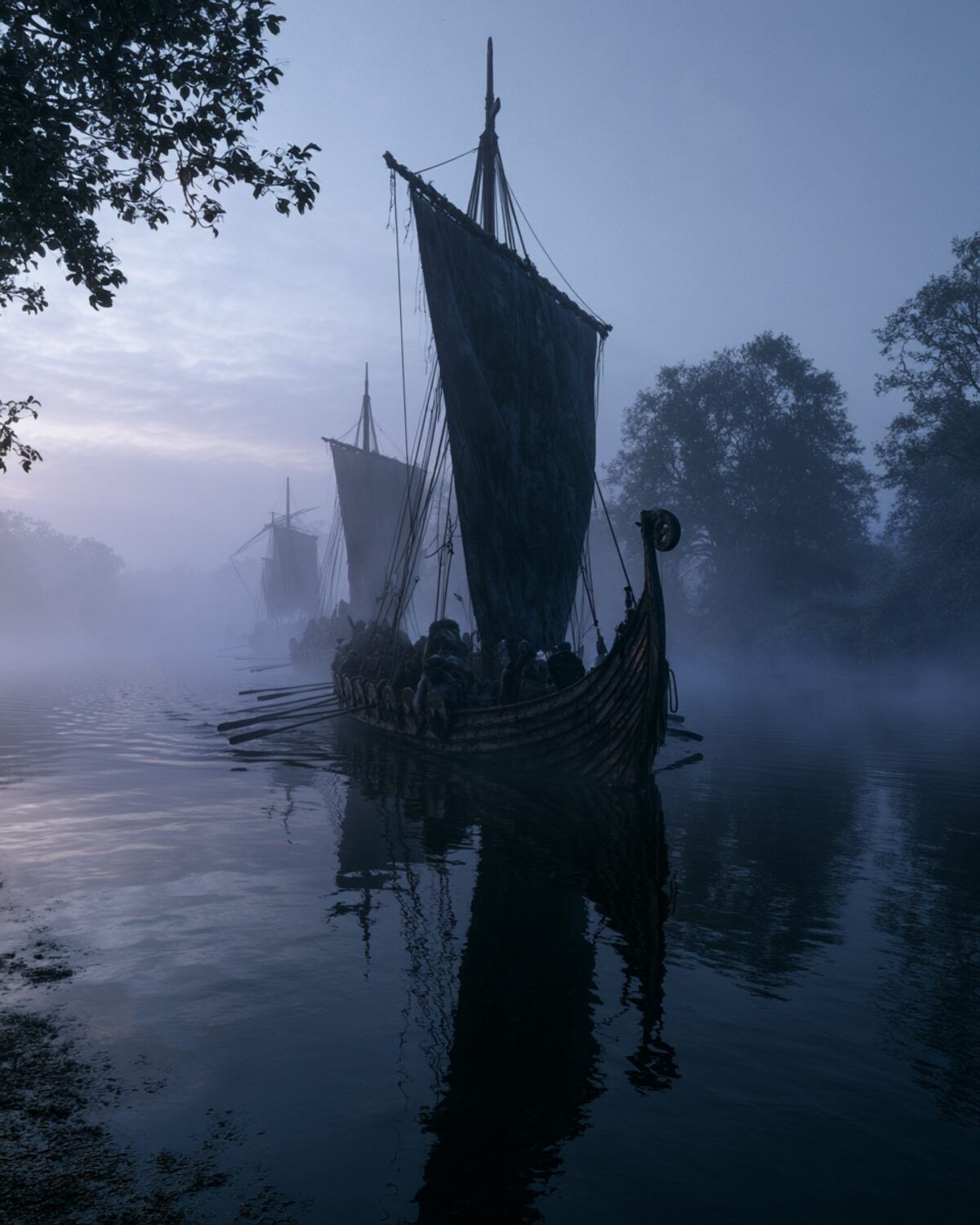
Around the year 1000, King Olaf Tryggvason of Norway lost his fleet, his throne and most likely his life, somewhere in the western Baltic or the Øresund. That much is solid. Nearly everything that made Svolder famous appears only in texts written two centuries later: the gilded Long Serpent, the shattered bow, the line "Norway, king, from thy hands". This article takes the tradition apart layer by layer and shows, for each celebrated scene, who tells it first.
Svolder has left no finds. No wreck, no battlefield, no rune stone naming the place. All we have is text, and that text falls into three groups. The first consists of stanzas by skalds, the court poets of the North, some of whom lived through these events. The second is a single church historian in Bremen, writing about 75 years later. The third is a run of Latin and Old Norse royal histories from around 1190 to around 1300, which grow longer with every generation.
Any retelling ends up with Snorri Sturluson, since only he and his immediate predecessors offer a continuous narrative. Our article on Olaf Tryggvason covers his life and reign, and the one on Svein Forkbeard the Danish side. The question here is narrower: where does each detail come from, and how much weight will it bear?
Olaf had ruled Norway since about 995. Against him stood three powers: King Svein Forkbeard of Denmark, King Olaf of Sweden, usually called Olof Skötkonung by historians, and Jarl Eirik Hákonarson of the jarls of Lade, whose father Hákon had died as Olaf came to power.
The sources disagree about why it came to battle. Adam of Bremen writes that Olaf was angered by the alliance of the two kings and was egged on to war against Denmark by his Danish wife Thyri, in Norse tradition Svein's sister. The sagas embroider this into a tangle of dowries, failed courtship and wounded honour. The political situation explains the conflict well enough without them, since a strong Olaf threatened the interests of all three opponents. That, however, is a modern reading and not a report from any source.
Four poets stand closest to the events. Their stanzas have a catch that is easy to forget: they do not survive as independent manuscripts of the early eleventh century, only as quotations in much later sagas. The saga writers chose them, assigned them and placed them where they suited the story, and the original context is often lost. Skaldic verse also works with kennings, riddling poetic circumlocutions, and rarely states plainly who stood where and when.
Hallfreðr vandræðaskáld, the "troublesome poet" (c. 965 to c. 1007), served, according to his saga, first Jarl Hákon, then Olaf Tryggvason, and finally Olaf's conqueror Eirik. After Olaf's death he composed a memorial poem known as the Erfidrápa. As far as his verses reveal, he was not at the battle, and that is exactly what makes them valuable: they show what a loyal follower heard soon afterwards and how uncertain it was. This poem should not be confused with the "Óláfsdrápa Tryggvasonar" in the Bergsbók manuscript, which is attributed to Hallfreðr but which scholars regard as an anonymous work of about 1200.
Halldórr ókristni, "the unchristian", celebrates the victor. Snorri quotes him repeatedly: his stanzas denounce the treachery of Jarl Sigvaldi, give Olaf 71 ships on his voyage from the south, and show Eirik fighting beside the Long Serpent until fate gives him victory. Þórðr Kolbeinsson also praises Eirik, yet gives admiring lines to a defender named Hyrning.
Skúli Þorsteinsson is the rare poet who speaks about himself. In the stanza Snorri quotes he recalls, as an old man, how in his youth he followed Sigvaldi and Eirik and stood in the thick of the fight. If we can trust the stanza, he fought against Olaf, and he gives the site a name that matters for locating it: in the Old Norse, as the scholarship reports it, the "mouth of Svolder". Laing's verse rendering turns this into "Svold fjord".
"Does Olaf live? or is he dead? / Has he the hungry ravens fed? / I scarcely know what I should say, / For many tell the tale each way."Hallfreðr vandræðaskáld, quoted in Snorri Sturluson, Heimskringla, Saga of Olaf Tryggvason (Laing: ch. 122), in Samuel Laing's free verse rendering of 1844.
A poet in the service of a dead king admits that he does not know. A second stanza adds that people soon believe what they wish, and that Olaf's death is too certain to doubt. Belief in his survival, then, is no late saga motif. It seems to have circulated in Hallfreðr's lifetime.
The oldest surviving prose account was written by Adam of Bremen around 1075/76 in his history of the archbishops of Hamburg (Book II, chapter 40). He did not draw on Icelandic tradition. His key informant for such matters was the Danish king Svein Estridsson, a grandson of Svein Forkbeard. Adam, in other words, hears the victors' side.
His battle takes place between Scania and Zealand, in the Øresund, where kings usually go to war at sea. In the excerpts available to me, neither a Long Serpent nor Einar nor a betrayal by Sigvaldi appears; I could not check the complete chapter in Latin. When all is lost, Olaf throws himself into the sea, and Adam remarks that this was the end befitting his life. That is a verdict on the man.
Some 120 years later, Saxo Grammaticus develops this Danish line. His Olaf prefers death to watching his enemies win and jumps overboard in full armour. I have read neither Adam nor Saxo in Latin, only in excerpts and summaries. More on the Danish historian who carried the scene forward is in our article on Saxo Grammaticus.
Norwegian and Icelandic prose begins around 1190. Three terse works come first: Theodoricus Monachus, the Historia Norwegie and Ágrip. Alongside them stands Oddr Snorrason, an Icelandic monk whose saga of Olaf offers the first fully narrated battle. Oddr writes with obvious veneration and moves the king close to sainthood. Fagrskinna and Snorri Sturluson follow around 1220/1230 and sift the material more coolly. The so-called Greatest Saga of Olaf, or Mesta, gathers everything it can find around 1300 and counts as the longest and least reliable version.
The famous scene in which Eirik and the two kings watch Olaf's ships pass from the shore and assess them one by one reads like an eyewitness report. Bjarni Aðalbjarnarson, editor of Heimskringla in the Íslenzk fornrit series, saw in it, according to Wikipedia's overview, a model from the Gesta Karoli by the monk of St Gall, where the Lombard king Desiderius watches Charlemagne's armies approach. Oddr would thus have taken the scene from a Latin source. I have not consulted the edition itself. If the finding holds, one of the most vivid passages in the tradition is craft and not memory.
The name itself is the problem. The sources offer at least five answers:
A place called Svolder is attested nowhere else. Modern scholars are divided: some look near Rügen, a few specifically at the Greifswalder Oie, while others stay with the Øresund. In favour of the Sound speak the age of Adam's report and his closeness to the Danish royal house. In favour of the Wendish coast speaks the fact that several traditions describe a voyage home from Wendland. Both arguments have weaknesses: Adam heard only the Danish side, and the sagas draw on one another, so their agreement does not count as multiple evidence. Walter Baetke devoted a study to the question in 1951, "Das Svoldr-Problem"; I know it only from citations. Per Linge's proposal to look at the Svinesund found no acceptance among specialists.
The question cannot be settled.
The date is in better shape, at least the year. All sources that give one arrive at 1000. Since some medieval reckoners began the year in September, September 999 also remains possible. The day given falls within a narrow range: the 9th, 10th or 11th of September in the tradition of Oddr and Mesta. The overviews I read do not agree on which work names which day. According to Wikipedia, Íslendingabók speaks more generally of a summer.
Snorri tells the trap this way. Olaf is coming from Wendland. Jarl Sigvaldi joins him with eleven ships and offers to pilot the fleet through the deep channels. Much of the fleet sails ahead onto the open sea. Near the island, a boat tells Sigvaldi that the Danish force lies in the harbour; he lowers his sails and rows into the shelter of the island. Olaf is left alone with eleven ships. For background on Sigvaldi, see our article on the Jomsvikings.
The sources agree strikingly on Olaf's eleven ships but not at all on his enemies. Oddr counts 139, Ágrip 82, the Historia Norwegie 71, the poem Rekstefja 80, and Theodoricus gives 70. Svein's share ranges from 30 to 60, Eirik's from 5 to 22. Nobody was counting. All one can say is that the tradition uniformly speaks of clear inferiority, which also suits the story too neatly to pass unchecked.
An older voice supports the ambush itself. Halldórr's stanza, in Laing's rendering, accuses the "false earl" of betrayal, in verses said to predate the sagas by a long way. Snorri's prose, by contrast, does not use the word, and simply narrates the action. Neither can be independently verified.
Ormrinn langi, the Long Serpent or in Norwegian Ormen Lange, is the most famous warship of the Viking Age, and nobody has ever seen it. Snorri has it built in the winter before the battle at Hlaðhamrar near Nidaros. He supplies the figures still quoted today: 74 ells of keel where the ship rested on the grass, 34 rowing benches, high sides, head and tail gilded, the best and most costly ship ever made in Norway. Then comes the master-builder Thorberg, who secretly cuts notches in the planking and planes them so beautifully that the king wants the other side done the same way.
The measurements fail close inspection, because no one knows which ell is meant. Laing's footnote gives some 150 feet, about 46 metres; the Encyclopaedia Romana, reckoning an ell of 18 inches, gets about 111 feet, just under 34 metres. Ágrip, for its part, gives 32 rowing places and not 34. When one line can produce differences of twelve metres, the length is no measurement one can adopt.
Archaeology offers a point of comparison. Roskilde 6, the largest Viking ship yet found, measures 36 to 37 metres, depending on the account. Niels Bonde and Frans-Arne Stylegar dated it in the journal Kuml in 2011 to 1025/26; the oak comes from around the Oslo Fjord, and it was probably built in Vestfold. A ship on that scale was thus technically possible some 25 years after Svolder, and even came from Norway. That proves nothing about the Long Serpent but makes a very large royal ship believable. Construction and finds are covered in our articles on longships and Skuldelev.
The skalds, too, seem to know a special ship. In Laing's rendering the stanzas speak of "the Serpent and the Crane" and of the Long Serpent, beside which Eirik wins. That supports the name. Laing translates freely, however, and I could not retrieve the Old Norse here. No stanza I have read records a keel length.
According to Snorri, Olaf has his ships lashed together side by side, the Long Serpent in the middle, the Little Serpent and the Crane beside it. The enemies attack separately. Svein's ship is cleared, meaning its crew is killed or driven off, and the king flees to other vessels. Olaf the Swede fares much the same. Eirik chooses the more effective approach: he lays his ship beside the outermost vessel, kills or drives off its crew, cuts the cables and lets it drift, then moves to the next. His ship, says Snorri, has iron fittings on its stem; the literature calls it Járnbarði.
The procedure is plausible, and our article on battle tactics places it among parallels. Halldórr seems to fit: he describes the series of attacks around Eirik, with fresh Danes and Swedes joining him. The last men forming a ring of shields around the king also appears already in his verses, not only in the prose. It recalls the shield wall of land warfare, on a quarterdeck instead. Many of Snorri's details, by contrast, sound like narrative art: the exchange with Ulf the Red about the forward-thrust bow, the men who go overboard in battle frenzy believing they stand on solid ground.
At the mast of the Long Serpent stands Einar Þambarskelfir, one of the sharpest of archers. He shoots at Eirik and hits the tiller just above the jarl's head. Eirik orders an archer named Fin to hit the tall man by the mast. Fin's arrow shatters Einar's bow. "What is that, that broke with such a noise?" asks Olaf. "Norway, king, from thy hands," cries Einar in Laing's wording. The king throws him his own bow; Einar draws it over the head of the arrow: "Too weak, too weak, for the bow of a mighty king!" Then he takes up sword and shield. The Old Norse line, according to Store norske leksikon, runs "Of veikr, of veikr, allvalds bogi".
A historian should be suspicious simply because it is so good. There are concrete objections too. According to Wikipedia's overview, Saxo knows the story too, but his archer aims at Svein and not at Eirik; I have not read the Saxo passage itself. If so, the point of the tale moves around. The Norwegian encyclopaedia Store norske leksikon considers Einar's presence altogether unlikely. It cites Hallfreðr's complaint that Olaf lacked a levy from Trøndelag and suspects that the anecdote comes from another tradition. Indeed, the stanza Snorri himself quotes laments that the king lacked his Throndheim men in this fight.
Einar himself is well attested, as far as the kings' sagas go. Almost everything about him dates from the twelfth and thirteenth centuries. He married Bergljot, a sister of the jarls Eirik and Sveinn, placing him within the circle of Svolder's victors. He opposed Olaf the Saint, fetched Olaf's son Magnus home from Gardarike around 1034/35 together with Kalv Arnesson, and was killed around 1050 with his son Eindride in Nidaros by men of Harald Hardrada. At the fall of Saint Olaf, covered in our article on Stiklestad, he was probably abroad, according to the same encyclopaedia. His nickname is explained in different ways: as "bowstring-shaker", or mockingly with a word for belly.
Almost every text has Olaf go overboard. Each decides differently what it means.
For Adam and Saxo it is suicide. Snorri tells the end most carefully. As Eirik's men storm the deck, Olaf and his marshal Kolbjorn, dressed alike, leap into the water on either side of the ship. Boats are already waiting. Olaf holds his shield over his head and sinks. Kolbjorn, whose shield lies beneath him, is hauled out and taken for the king until the jarl recognises him and spares his life. Whether the mistaken double is more than a narrative touch, nobody knows.
In Ágrip, by contrast, nothing is known of Olaf's fall: he is last seen on the raised stern, and when Eirik has it searched, a light flashes and the king is gone. Theodoricus, the Historia Norwegie and Oddr know of reports that he reached shore, depending on the version by swimming, with angelic help or on a Wendish ship. Afterwards he supposedly sought salvation abroad, perhaps in a monastery. Even Snorri, otherwise the soberest, repeats the rumour: Olaf cast off his mail under water, swam beneath the longships to a cutter of Astrid's and escaped to Wendland. He ends simply by saying that the king never returned to Norway. Mesta finally offers sightings in the Holy Land, the last in the 1040s.
The series shows a pattern: the greater the distance in time and the more pious the purpose, the more miraculous the rescue. It does not disprove the rumour's early date. Hallfreðr already hears it from the east and rejects it. None of the versions I have read mentions a body or a grave. Olaf probably drowned. That is not proven.
The consequences stand on firmer ground than the details of the day. The victors divided Norway. According to Snorri, the Swedish king received districts in Throndheim as well as Møre, Romsdal and Ranrike and passed them to Jarl Sveinn, Eirik's brother. Eirik gained the north and west. Svein Forkbeard kept Viken, the land around the Oslo Fjord. Both jarls were baptised but, in this account, forced no one to believe. Olaf's violently driven conversion thereby lost its strongest engine.
Later ages never let the material go. Icelandic rímur took it up, the Faroese ballad "Ormurin langi" is danced to this day, Johan Nordahl Brun made a play of it in 1772, and Henry Wadsworth Longfellow wrote verses. These works are reception history, not evidence for the year 1000.
When was the Battle of Svolder? The sources give the year 1000, with day references between 9 and 11 September. Since some medieval reckoners began the year in September, 999 is also possible.
What is the oldest source? The verses of Hallfreðr, Halldórr, Þórðr and Skúli count as the oldest material, though only later manuscripts transmit them. The oldest surviving prose account is by Adam of Bremen, around 1075/76.
Who won the battle? The alliance of Svein Forkbeard, the Swedish King Olaf and Jarl Eirik. Norse tradition gives Eirik the main share of the victory, and he also received the Long Serpent.
Are there archaeological traces? None known to me that could be tied to Svolder. Without a secure location, no targeted search is possible either.
Why is the ship called both Serpent and Worm? Old Norse ormr means both. "Long Serpent" is the usual English form, "Long Worm" sits closer to the word, and Ormen Lange is the Norwegian form.
Olaf Tryggvason · Svein Forkbeard · The jarls of Lade · Viking battle tactics · The shield wall · Longships · Adam of Bremen · Snorri Sturluson · Kennings

Olaf Tryggvason – missionary king and the fall at Svolder · Sweyn Forkbeard · The Earls of Lade · Jomsborg · How did Vikings really fight?.
All History & Finds articles →
Few questions reach our workshop as often as this one: „Is that symbol really old?" We love engraving Norse signs – but …
Read more →They hardly loom large in any history book, yet their trail runs from the plains north of the lower Danube to Poitou …
Read more →Little is recorded about the Tarbelli, and that little is unusually solid. A geographer calls their land the richest in …
Read more →The Taurisci were a Celtic tribal group on the eastern edge of the Alps, in what is now Carinthia and Slovenia. Their …
Read more →