A sea fortress with a harbour inside its walls, a stone arch over the entrance, an iron door and catapults: that is how an Icelandic saga describes Jomsborg. No text from the time it supposedly stood knows this stronghold, and no excavation has uncovered it. What is secure is a large Slavic trading town at the mouth of the Oder. Whether the two belong together is the real question. This article examines the place, not the warriors: what each source actually says, where the famous ship count comes from, and where the equation with Wolin holds and where it breaks.
The men of Jomsborg, their laws and their end at Hjörungavágr are covered in the article on the Jomsvikings. The town on the Dziwna, with its workshops, silver hoards and temples, has its own article on Wolin. Between the two lies a gap, and that gap is the subject here: did a structure exist that at least roughly matches the description in the sagas? And if so, where?
The question breaks into three parts that often get mixed together. First, is the town of Jumne in Adam of Bremen the modern Wolin? Second, is the Jóm of the sagas the same town? Third, did a fortress under Scandinavian control stand there? Scholars largely answer the first with yes and the second with a well-argued probably. The third still lacks proof. Anyone who turns the first yes into a yes to the third has skipped two steps.
Jómsvíkinga saga was probably written in Iceland around 1200, and its oldest manuscript dates from the late 13th century. It survives in several diverging versions, chiefly AM 291 4to, the Stockholm manuscript Holm perg 7 4to, AM 510 4to and Flateyjarbók. Roughly three centuries therefore separate the events it narrates from the earliest surviving text.
In Flateyjarbók, Pálnatóki, a refugee from Denmark, receives the district of Jóm from the Wendish king Búrizláfr in return for protecting it. There he builds. The Finnish historian Sirpa Aalto prints the passage in full in her essay on the Jomsvikings, and it deserves a close look, because every later debate hangs on it:
That was a sea fortress, hard to attack and strongly built, and it was called Jomsborg. There he had a harbour made reaching up into the fortress, in which three hundred longships could lie, and it had an entrance. Over the entrance was a stone arch, and before the entrance an iron door that could be drawn up and down. Above the stone arch stood a stronghold with catapults, and all the ships could be locked in there.Jómsvíkinga saga in Flateyjarbók, c. 132, edition Christiania 1860, p. 166; Old Norse wording as printed in Aalto, “Band of Brothers”, n. 17, the edition itself not consulted; my own translation, the phrases “hard uid”, “dyrra” and “lesa jnne” rendered with some uncertainty
The Swedish translation by Albert Ulrik Bååth, which according to its edition draws on AM 510, AM 291 and the Stockholm manuscript, adds a vivid detail: part of the fortress stood out in the water, and Palnatoke had it raised in haste. It also reads “trehundra” longships.
Popular accounts often mention 360 ships. The only passage whose Old Norse wording I could check does not say so: Flateyjarbók has “.iij. hundrut”, three hundred. Bååth’s translation and Alexander Bugge’s 1910 retelling likewise give 300.
The difference is probably arithmetic. The Old Norse hundrað normally denotes the long hundred of 120. Three of those make 360. On that reading, the higher figure is not a second tradition but a modern conversion of the same word. This derivation is my own inference; I found no scholarly statement that the 360 arose this way. Whether the scribe himself was counting in 120s cannot be proved from this passage. Whether another manuscript writes out 360 explicitly I could not establish, because the text pages for those versions were unavailable when I tried to retrieve them.
The English Wikipedia also states that the oldest records gave room for only three ships and later ones for up to 360. It relies on popular surveys (Chartrand et al., The Vikings, 2016, p. 88; Kendrick), which I could not consult. The claim remains unchecked. It is at least striking how easily a reading of “.iij.” without the following word could produce such a figure. That is only a guess.
How big would such a harbour be? A rough calculation of my own helps, though it only gives an order of magnitude. Skuldelev 5, according to the Viking Ship Museum in Roskilde one of the smallest longships of a war fleet, measures 17.3 by 2.5 metres. Three hundred such ships, treated as rectangles packed side by side with no room to manoeuvre, cover about 13,000 square metres, and 360 cover about 15,600. The interior of the Danish ring fortress of Trelleborg, some 136 metres across, works out at about 14,500 square metres. Even these small ships would nearly fill the whole fortress, and 360 would exceed it, before counting a single house, quay or channel.
This does not make the structure impossible. Aggersborg, the largest ring fortress, measures about 240 metres across on the inside, and ships can be moored in rafts. It does show what the saga demands: an artificial basin on a scale for which I know of no parallel in the Viking-Age Baltic. And that whole basin was to be reached through a single entrance under one arch. Aalto calls the description highly exaggerated.
The texts already part ways over the builder. Jómsvíkinga saga names Pálnatóki, a Danish nobleman serving a Slavic prince. Fagrskinna, a Norwegian royal history of the early 13th century, instead says that Harald Gormsson raided in Wendland and had a great fortress built there “which is called at Jóm”, known ever since as Jomsborg. According to the secondary literature, Knýtlinga saga also names Harald as founder. Snorri Sturluson does not tell the foundation story, but in Heimskringla, in the saga of Magnus the Good (c. 25 of the English edition), he remarks in passing that the Danish kings first founded Jomsborg; he names no one. Saxo Grammaticus does not use the name Jomsborg, which according to the introduction to the Spanish edition of the saga occurs only in Icelandic sources. He writes of Julin instead, where Harald hands command of the camp to a Swede named Styrbjörn. I have not read Saxo’s text for this myself.
Aalto considers a foundation by Harald Bluetooth very unlikely, since a permanent fortress in hostile territory would have required great resources and a secure position. She suspects that Harald’s Slavic family ties encouraged the attribution. Jakub Morawiec took up the subject in Scripta Islandica in 2014: according to the summary of his article, which is all I could read, the Jelling dynasty helped shape how the place and its heroes entered historical writing.
For the fortress question this means two traditions name two builders, neither stands close to the events in time, and either could have attached a ruler’s name to a well-known place after the fact.
The only detailed text from the 11th century comes from Adam of Bremen, writing around 1075. He places a city called Jumne at the mouth of the Oder and, in the second book of his history of the archbishops of Hamburg, describes it as the largest city in Europe. Slavs and other peoples lived there, as did incoming Saxons, provided they did not openly profess Christianity. Harald Bluetooth, Adam says, fled wounded to Jumne.
What is missing counts for a good deal. Adam knows no fortress under Danish command, no warrior brotherhood, no harbour behind an iron door, even though he says he was informed by the Danish king Svein Estridsson. The tone of Harald’s death is telling too: the Slavs received the king kindly, contrary to expectation, because they were pagans. That sentence sits badly with a king who maintained his own fortress and garrison in the same place. It is not conclusive, since Adam cares about mission rather than fortification, and silence proves little. Still, the one source with some proximity to the place offers the saga no support.
There is also a manuscript problem. The name on which the whole equation rests is not stable. According to the survey of the Vineta question, the oldest manuscript of Adam has a form like “uimne”, the second oldest “uimne” and “iumne”; Latin scribes did not distinguish u from v or i from j. From this name, Helmold of Bosau’s copy could produce “uineta”. That “Jumne” and Old Norse “Jóm” belong together is still a natural conclusion, but it is an inference from word forms, not something any source states.
Two texts date from the period in which Jomsborg was supposedly founded, and they are often brought into the argument. Widukind of Corvey, in the third book of his Saxon history, tells of the end of the renegade Count Wichmann, who fell fighting Mieszko I in 967. In chapter 69 Wichmann joins Slavs whom Widukind calls Wuloini and who wish to wage war on Mieszko; the translator’s note connects the name with the island of Wolin. I read this in English excerpts, not in the Latin. The passage shows a Slavic group fighting its own war. These excerpts say nothing of Danes, a sea fortress or a harbour.
The second witness is Ibrāhīm ibn Yaʿqūb, the traveller from al-Andalus whose report survives only in excerpts in later Arabic authors and whose travel date remains disputed. He mentions a great city by the sea with twelve gates and a harbour among a Slavic people called the Walitaba, north-west of Mieszko’s realm, who make war on Mieszko. For many this is Wolin, but one recent overview puts it cautiously, saying the city is “perhaps” identifiable as Jumne. The same overview calls it a mighty fortress, while the English translation I could read says a great city; I cannot judge the Arabic. Name and reading are uncertain.
Anyone hoping to use this passage for Jomsborg faces two difficulties. Ibrahim describes a Slavic place and says nothing of Scandinavians. And the twelve gates have no archaeological confirmation: Wojciech Filipowiak and his co-authors note in 2021 that no early medieval gates have yet been found in Wolin. This applies all the more to any gate of Jomsborg.
The finds are rich; they simply show something other than the saga. The settlement begins in the late 8th century. The earliest town defences are often placed in the second half of the 9th century; in 2024 Wojciech Filipowiak dated the oldest rampart on Silver Hill, using new radiocarbon dates, to the first half or middle of the 9th century. The description is of an oak palisade set in a ditch with an earth rampart behind it. Seven building phases have been described, the last probably ending around 1184. The southern suburb and Silver Hill were fortified too, with ramparts about 570 to 600 and 200 to 220 metres long.
Around the turn of the 10th century a harbour appeared, with quays of timber crates filled with brushwood, earth and stones. If the quay ran the full length of the stronghold, the estimate comes to 250 to 300 metres. With ships 2.5 metres wide, that makes, again as my own rough calculation, 100 to 120 berths side by side. Further landing places lay at Silver Hill, in the southern suburb, in the Ogrody settlement and at Hangman’s Hill.
The picture, then, is of a scattered harbour landscape along a river channel, open to the water, built of wood and earth. The difference from the saga is fundamental. According to the overview on medievalheritage.eu, masonry of stone and brick was added only in the first half of the 14th century. A 10th-century stone arch over a harbour entrance has no place in this record. Aalto puts it plainly: nothing of the kind has turned up in the excavations.
Nobody disputes a Scandinavian presence, but its weight is assessed differently. The preface to the Jómsvíkinga issue of Scripta Islandica points to recent excavations with a substantial quantity of high-status objects related to Scandinavia, including tools, pendants, game pieces and weapons, dated to about 970/980 to 1020. That fits strikingly well with the period in which the saga places its heroes in the region. Władysław Filipowiak, as summarised on Wikipedia, spoke of dated sources for an armed Viking company at the end of the 10th century, perhaps mercenaries of Bolesław the Brave. I have not read his text.
Against this, Wojciech Filipowiak, Mateusz Bogacki and Karolina Kokora state in 2021 that Scandinavian artefacts make up only a very small percentage of the finds. They explicitly criticise the open-air centre for showing too much Viking culture. The two views are not mutually exclusive: a small group can leave high-status things behind. In 2024 Wojciech Filipowiak also notes that scholars have pointed to a major Scandinavian role in the centre’s development, and leaves the interpretation of the process open. Aalto draws the sober line: Scandinavian finds do not prove that Wolin was Jomsborg, only that contacts were lively and that some Scandinavians settled among the West Slavs, perhaps as merchants or warriors.
Much speaks for Wolin: the closeness of the names Jóm, Jumne and Julin, the location in Wendland, the size, the part it plays in Harald’s death, the finds from around the year 1000. Adolf Hofmeister argued for equating the names in 1931/32, Morawiec simply uses Jómsborg as the Scandinavian name for Wolin, and Filipowiak and his co-authors write that most researchers see early medieval Wolin as the prototype of the legend. Prototype is exactly the right word. Four points resist any stronger identification.
The building type. The saga describes a walled inner harbour with a stone arch. The record shows timber-and-earth ramparts and open quays. The word “seborg” fits only loosely with a town on the Dziwna channel, which does not lie on the open coast.
The population. The saga’s fortress is a closed male community under Scandinavian command, with women barred from entering. Wolin was a town of several peoples, of craft and trade, ruled according to the written sources by tribal elders in the 10th and 11th centuries (so Filipowiak 2024).
The tradition. No text before the sagas and Saxo connects the place with a fortress in Scandinavian hands. Adam, the most talkative witness, does not know of one.
The end. According to Snorri, Magnus the Good took Jomsborg after the Wends there had renounced their submission to him, killed many and burned the town and the country around it. The year 1043 is not part of Snorri’s narrative; it comes from later chronology and is the date scholars use. Notably, Snorri speaks here of Wends in Jomsborg, not of a Scandinavian garrison. Wolin has burned layers that could fit this date. But Dariusz Adamczyk argued in 2019, from the number of hoards, that the place was already losing importance around 1000, before the attack of 1043 and perhaps before those burned layers. The date therefore works only partly as a bridge between text and soil.
In 2023 Wojciech Filipowiak of the Institute of Archaeology and Ethnology at the Polish Academy of Sciences made headlines with a new proposal. On Hangman’s Hill (Wzgórze Wisielców) south of the town, one of the large cemeteries of northern Europe, his team found in 2021 and 2022, under a layer of wind-blown sand, nearly complete burial mounds and two features that need not be graves: a ring-shaped bank on the hilltop and a linear bank with traces of burning and remains of wood. According to the Polish Press Agency, these might belong to a burnt fortification. Their course is hard to determine without further digging.
The theory has an elegant side: it separates the town of Jóm from the fortress of Jomsborg. Fagrskinna indeed already says the fortress is called “at Jóm”, and Flateyjarbók has Pálnatóki receive a district named Jóm. The hill also lies where the waters of the Szczecin Lagoon enter the Dziwna, on the shipping route to the town. Filipowiak points to the pattern at Birka and Hedeby, where ramparts are found close to the towns.
The limits matter just as much. Filipowiak himself calls the idea a hypothesis. The often-quoted claim that he is 80 per cent certain comes from an article by Andrew Higgins in The New York Times of May 2023, passed on by the online magazine ExplorersWeb, so from the press and not from a scholarly publication. Filipowiak dates the wood remains to the 10th century; in 2023, according to National Geographic Polska, radiocarbon dating was still under way, and I have found no published result. Even a confirmed 10th-century fortification would at first be just a fortification, whose builders would still have to be identified. Nor does a hill fort solve the saga’s harbour problem: a landing place is recorded at Hangman’s Hill, but no basin for hundreds of ships. I could not find any scholarly response to this theory from a third party. The Academy’s three-year project with Aarhus University is digging not on Hangman’s Hill but on Silver Hill in the north of the town. In 2025 it uncovered four huts of the 11th or 12th century whose construction recalls Scandinavian craft and trading sites; according to the report, Filipowiak does not take that as proof of Scandinavian occupants. By July 2026 the second season had reached 10th-century layers, and the main target is the harbour. The reports add nothing on Jomsborg, and I had found no results of this season as of November 2026.
Wolin is not the only proposal. Older and local-history writing looks for the fortress on Usedom, at the mouth of the Peene or at the Spandowerhagener Wiek near Kröslin, whose size and depth could hold many ships. Others think of drowned land between Ruden and the Greifswalder Oie. Klaus Goldmann and Günter Wermusch moved Vineta to Barth; Aalto criticises them for taking medieval texts too literally. None of these places can offer archaeological evidence. Menzlin on the Peene is also mentioned now and then, although the finds there fade out in the 10th century.
The village of Paprotno is a special case. An alleged chronicle called Gesta Wulinensis places the fortress there with a precise location. It surfaced in 2019 and belongs with the gold disc that appeared in Sweden in 2014 and was made known by Sven Rosborn; its inscription “ARALD CVRMSVN” and “JVMN” is read as Harald Gormsson and Jomsborg. In a 2022 review in the journal Fornvännen, Kurt Villads Jensen and Wojtek Jezierski consider both forgeries, pointing to anachronisms in the chronicle and the disc’s lack of parallels. Neither can serve as evidence for a fortress unless their authenticity is independently tested.
At the sceptical end stand Lauritz Weibull, who dismissed Jomsborg as legend, and Steven Fanning, who concluded in 1997 that all attempts to locate the fortress or encampments of the Jomsvikings had failed. At the other end is Filipowiak’s search in the field. Between them lies an explanation that brings many observations together without proving them all: a real place supplied the name and the setting, and Icelandic storytellers around 1200 gave it the shape a great fortress had to have for them.
The fittings point in this direction. Hilda Davidson and, after her, Aalto think of the Danish ring fortresses as an inspiration, which were indeed built around 980, though with no inner harbour and no stone arch. The “kastale” with catapults and the iron door that could be raised are more reminiscent of later castle-building than of 10th-century ramparts. That argument is my own interpretation, and the dating of individual features would need support from castle research. It is also conceivable that the Danish campaigns against Julin in the 12th century, reported by Saxo and in saga literature, kept alive the image of a fortified town in Wendland. This, too, cannot be proved.
The literary character of the saga does not rule out a smaller historical core. An armed Scandinavian group in the service of Slavic princes, with a fortified base at the mouth of the Oder, is conceivable and would also explain the finds. Such a base simply would not be the fortress of the saga.
Did Jomsborg really exist? This cannot be clearly established. A fortress as the saga describes it has not been found. A smaller base, or a literary reshaping of the real town of Wolin, remains possible.
Is Jumne the same as Wolin? On the current state of research, overwhelmingly yes. Between Jumne and the Jomsborg of the sagas, however, there is only a link of name and location, not direct evidence.
How many ships fit in the harbour? Flateyjarbók says “three hundred”, which as long hundreds would make 360. Both are storytelling numbers. The quay at Wolin, by my rough calculation, offered far fewer berths.
Who supposedly built the fortress? Jómsvíkinga saga names Pálnatóki; Fagrskinna and Knýtlinga saga name Harald Bluetooth; Snorri says only the Danish kings. None of these sources is older than about 1200.
What about Hangman’s Hill? Archaeologists found two bank features there, one with traces of burning, that might belong to a fortress. The excavator himself speaks of a hypothesis.
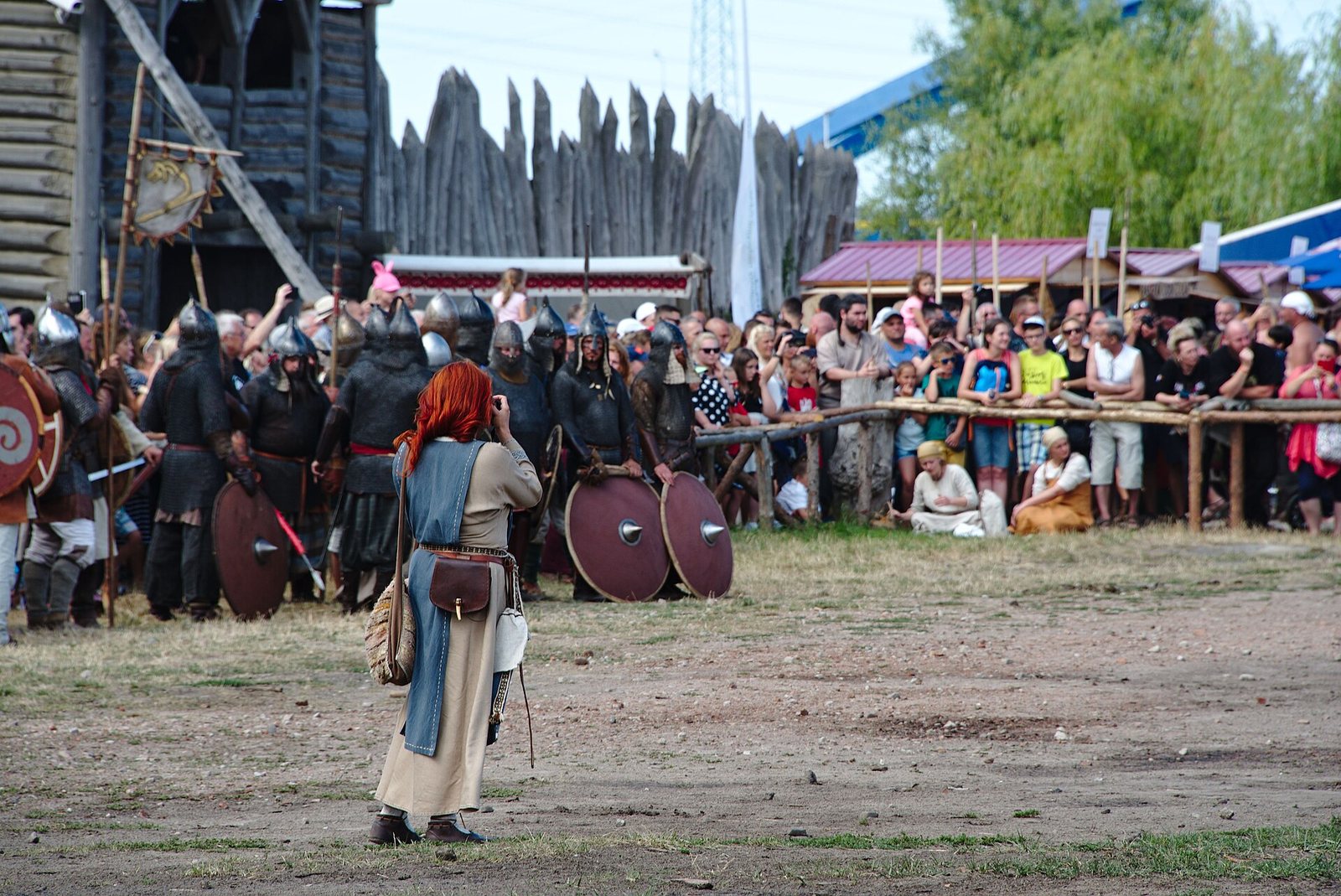
The Jomsvikings: brotherhood, laws and Hjörungavágr · Wolin at the mouth of the Oder · Adam of Bremen · Widukind of Corvey · Ibrāhīm ibn Yaʿqūb · Harald Bluetooth · The Trelleborg ring fortresses · Menzlin on the Peene · Longships · The Wolin festival

The Jomsvikings · Wolin & Jomsborg · The Curmsun Disc: a piece of gold bearing Harald's name and a find story nobody can check · Harald Bluetooth · Vikings on the Baltic.
All History & Finds articles →
A kingdom whose kings were pagans and Christians, Danes and Irish, that submitted to the English twice and twice broke …
Read more →The Jutes are the least conspicuous of the three peoples who, according to Bede, took Britain in the fifth century: no …
Read more →The Juthungi are a people who enter history almost only through chance finds and marginal notes: an altar in the gravel …
Read more →The Carantanians were part of the Alpine Slavs who settled in what is now Carinthia, Styria and East Tyrol from the …
Read more →