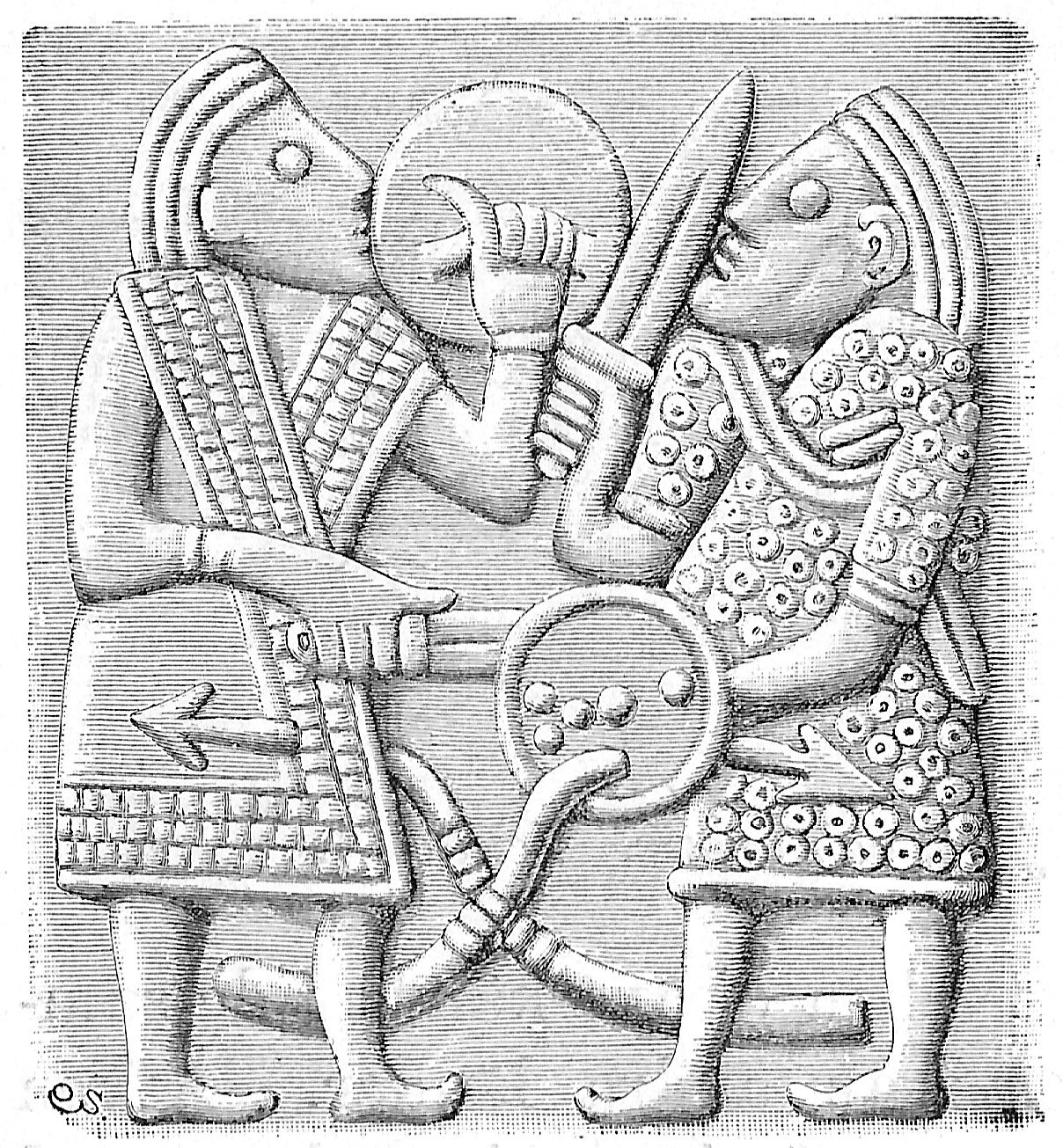
To say “before the Vikings” is to describe a period from its ending. Nobody in Scandinavia in the year 500 or 700 was waiting for anything. Between roughly 400 and 750 the North built halls and cult sites, buried horse gear as fine as late Roman work, lived through a climate disaster, and laid out a market in measured plots on the North Sea coast. This overview walks through the sites, separates finds from interpretation, and tests how much substance lies behind terms like Germanic Iron Age, Vendel Period and Merovingian Period, and how much is just labelling.
Open three Scandinavian handbooks and you will find three names for the same years. In Sweden the time from about 550 is the Vendel Period, after a cemetery in Uppland. In Norway it is the Merovingian Period, after a Frankish royal family. In Denmark it is the Younger Germanic Iron Age, yngre germansk jernalder. Before it comes the Migration Period, and in the Danish scheme the Germanic Iron Age covers both stretches: the National Museum of Denmark gives 400 to 550 for the early part and 550 to 800 for the late part. The people are the same everywhere, and so, often, are the types of find.
How did this happen? Mats Skare devoted a full paper to the question in 2024 (“Merovingian or Vendel Period?”). According to the summary available to me, Haakon Shetelig introduced the Norwegian term, Nils Åberg was the first to use vendeltid for a whole period, and neither explained his choice. So the split did not begin with a scholarly definition. It began more as a habit that hardened along a national border. Skare considers “Vendel Period” the least confusing option for non-Scandinavian publications and also suggests discussing alternatives, such as a “Scandinavian Dróttinn Age”, an age of warlords.
The dates are soft as well. Specialist texts consistently put the end of the Migration Period around 550. Its start varies: our article on Uppåkra follows the usual scheme with about 400, while one archaeological overview site says “very roughly” 300 to 550. Skare gives the end of the Vendel Period as 750/800, which leaves half a century of slack. The 400 to 750 frame of this article is likewise only a working arrangement. It stops at Salme, not at an event anyone at the time would have experienced as a turning point.
Each of these names implies something it cannot deliver. The criticism below is my own argument unless stated otherwise; only the point about “Merovingian Period” has direct support (Skare).
Merovingian Period. No Merovingian ever ruled Norway. The name borrows a Frankish dynasty as a time marker, and even as a marker it fits badly: Skare puts the continental Merovingian Period at about 450/480 to 721/751 and the Nordic one at about 550 to 750/800. He warns that the term is too easily confused with its continental namesake.
Vendel Period. Vendel is a parish north of Uppsala. That one elite cemetery in Uppland should name an entire age says more about the history of research than about the lives of farmers in Scania or Trøndelag. Hjalmar Stolpe dug there from 1881 to 1883, and the site became the yardstick.
Germanic Iron Age. The phrase ties a language family to a metal. It says nothing about what people called themselves, and the scheme offers no proof that they thought of themselves as “Germanic”. It sorts finds, not identities.
Migration Period. The name comes from the history of the Roman West. Whether, and how many, people from Scandinavia actually migrated is precisely the open question, as the section on Sösdala shows. Applied to the North, the word is an assumption.
“Before the Vikings”. This heading is a label too. The paper on the Salme ships speaks of the “Pre-Viking Age”, which is handy, but it turns one era into the waiting room of the next. A review of the new Ribe volumes (C. Hillerdal, 2025) says the town’s inhabitants apparently carried on with their crafts and trade without much regard for the start of the Viking Age in 793. The boundary sits in our books, not in the ground.
Scandinavia itself has left no narrative texts from this time. Daniel Löwenborg states plainly that central Sweden has almost no contemporary written sources. What words we have, outsiders wrote. In the sixth century the Byzantine historian Procopius described a land he called Thule, usually taken to mean Scandinavia:
“For it happens to be more than ten times the size of Britain. … In the inhabited land thirteen most populous nations are settled, and there are kings for each nation. … For around the summer solstice the sun does not set at all for about forty days.”Procopius, Gothic War (Wars VI) 15.4–6; own translation from the Greek (Perseus text, only these sentences read)
It reads like ethnography and is really hearsay in Constantinople. Procopius names the Gauti as one of the most numerous of these peoples and says Heruli settled beside them; our article on the Heruli examines how much of that holds. One thing can be noted: an observer in the Mediterranean pictured the North as a land of many kings, not one realm. That fits the archaeological impression of many centres of power, without proving it.
The second report is more warlike. Gregory of Tours, in his Histories (III.3), tells of a Chlochilaicus, king of the Danes, who came by sea during the reign of the Frankish king Theuderic I (died 534) and was defeated and killed by Theuderic’s son Theudebert. The passage gives no year. The often-quoted date of about 515/516 goes back to N. F. S. Grundtvig (1820), and 521 also circulates; A. S. Christensen disputes that Gregory’s text supports this and puts the book itself in the 570s, decades after the event. The Liber Historiae Francorum (726/727) copies Gregory; in the Latin wording I have seen they remain Danes, and I could not confirm the widespread statement that it calls him king of the “Goths”. The Liber Monstrorum names a King Higlacus who ruled the Getae, the Old English Beowulf a Hygelac of the Geats. Many identify them; Christensen calls that highly hazardous. I know the Latin from an online source collection, not the critical edition. The point stands all the same: some two and a half centuries before Lindisfarne, a Frankish bishop recorded a seaborne attack from the North.
The two most famous central places, meaning sites where power, cult, craft and long-distance contacts came together, lie either side of the Øresund and have their own articles: Gudme on Funen and Uppåkra in Scania.
Gudme starts before the Migration Period. The first great hall, according to the National Museum of Denmark 47 metres long and 10 metres wide, was built in the second half of the third century and stood for about a hundred years; 115 Roman silver coins and many fragments of gold jewellery lay spread over the area. Six buildings then succeeded one another over 200 to 300 years. On this dating, the most famous building of the “age of gold” belongs to the Roman Iron Age. The figures are not uniform: a caption on the same museum page says “around 300”, and the Danish encyclopedia lex.dk gives the hall’s size for the fourth and fifth centuries.
Uppåkra spans practically everything. Lars Larsson describes a 40-hectare site with surface finds from the second to the tenth century; our own article puts the start of settlement as early as about 100 BC. The tall timber house at its heart was rebuilt for centuries on the same spot. Larsson and Lenntorp stress that this long continuity sets Uppåkra apart from most south Scandinavian central places. A site that outlasts four labels is therefore a strong argument against sharp breaks, but it is not the norm.
Sösdala in Scania is a big name in European archaeology; according to the publisher of the main study, the fame of the name has overshadowed the find itself. The find consists of mounts from a richly decorated parade bridle. The volume edited by Charlotte Fabech and Ulf Näsman in 2017 places the pieces in the fifth century; the publisher’s text names the closest parallels in Austria, Poland, Romania and Ukraine and says the workmanship equals the best late Roman metalwork.
The manner of deposition is odder still. The horse gear was dismantled and placed in gravel ridges, and the volume catalogues three such finds from Sösdala and Fulltofta. The publisher’s text explains this by reference to the funerary rituals of nomadic riding peoples. I have not read the book, only the publisher’s text and one chapter abstract; a contribution in the journal Germania was blocked for my retrieval tool. So I cannot judge how far specialists accept this explanation.
The publisher concludes that Scandinavians were caught up in the turmoil as the late Roman Empire came apart. The fuller picture, mounted warriors in the Danube region, where some of the parallels lie, coming home with loot, pay and new customs, is my own elaboration; it is not stated in what I have read. It remains an interpretation. A mount does not reveal who wore it. It could have travelled with a returning warrior, as a gift or as merchandise; according to our Heruli article, not rechecked here, the find has also been read as a trace of Procopius’ Heruli, which is disputed. No horse remains survive. Erika Rosengren, in the same volume, infers from comparable finds animals of about 120 to 140 centimetres at the withers. By modern standards the parade rider sat on a pony.
For many people this age is above all golden. About 1,000 gold bracteates have so far been found in Scandinavia, according to a report on the Rennesøy find. Bracteates are thin pendants stamped on one side; large finds such as the Vindelev hoard have made them famous.
Why did so much of it end up in the earth? A recent find shows the range of answers. In 2023 a detectorist on the Norwegian island of Rennesøy reported nine bracteates, ten gold beads and three rings, together just over 100 grams. Håkon Reiersen, an archaeologist in Stavanger, dates the pendants to around 500 and offers two possibilities: hidden valuables or an offering to the gods. The find cannot decide between them.
Here lies the trap, as I see it. Hoards are readily tied to the crisis of 536, and for some that may be right. Usually, though, only the age of the youngest pieces can be fixed; the day of burial stays open. Pendants of “around 500” and Vindelev bracteates from the second half of the fifth century predate the disaster. They may have gone into the ground later, but they need not have.
Later the gold appears in another form. Guldgubber, paper-thin gold foil figures, belong at Uppåkra mainly to the time after 550.
The best-known break of these centuries does not come from archaeology but from the Mediterranean. For the year 536, Procopius notes in his history of the Vandal War (Wars IV 14.5) that the sun gave its light without brightness and looked like the sun in eclipse. Since 2015, revised ice-core chronologies have placed sulphate and volcanic glass in the same year, which points to a large explosive eruption. Our article on Fimbulwinter tells the details, including the tree-ring data and the second eruption around 540.
Which volcano it was remains unresolved. Krakatoa, Rabaul and Ilopango, which turn up in older books and documentaries, are now considered ruled out by newer dating and drilling (from an overview; originals not read). The darkening is certain. Its source is open, and so, above all, is the question of what it did in the North.
In 2012 Bo Gräslund and Neil Price set out the much-cited argument in Antiquity: good evidence for a climatic downturn, alongside good archaeological evidence for disrupted settlement and population displacement in the northern latitudes. Three studies show what this looks like in detail and where it wobbles.
Mälaren valley. Daniel Löwenborg calculated for Västmanland how many cemeteries of one period continued in use into the next. In most periods the figure lies between 57 and 86 per cent; for the Migration Period it is 29 per cent. That is a striking break. For the Mälaren valley as a whole, however, Löwenborg cites a study by Agneta Bennett with about 61 per cent, and he warns that most sites are not precisely dated, that graves do not count heads, and that more graves may mean more property claims. His thesis is framed cautiously: a crisis could have freed abandoned land for a small elite to take over, and burial mounds could have made that claim visible.
Southern Norway. Kjetil Loftsgarden and Frode Iversen analysed nearly 7,000 dated burials. Their number falls after the sixth century by more than 75 per cent compared with the preceding period. They see climate and plague as causes and stress that society was already vulnerable through population pressure. They also write that burials do not directly reflect population and that some regions fared better. A less elaborate burial custom would leave fewer graves as well, so other indicators are needed; the authors name reduced settlement activity and a decline in radiocarbon dates.
Helgö. In 2013 Birgit Arrhenius linked changes on this island in Lake Mälaren to the dust veil, and the journal printed the referee reports alongside. That lets you read the argument as it happened. Neil Price calls the darkening itself uncontroversial and sees in the valuable casting debris left lying a change in behaviour; Frands Herschend objects that the abrupt end of bronze casting has to be compared with other sites and explains some of it rather by a change of regime, which he in turn traces to demographic setback and famine. Arrhenius for her part suggests that long-distance sailing out of the Baltic was impossible for a couple of years and that traffic into Mälaren revived around 550. I know the paper, reports and reply only through a retrieval tool.
The sum of these findings: around the middle of the sixth century something breaks off in parts of Scandinavia. That it was the same thing everywhere, that 536 alone caused it, and how many people died is not established. I know of no reliable death toll for the North.
The boat graves of central Sweden look like an answer to the crisis. At Vendel, Stolpe found 14 graves running from the later sixth into the eighth century; at Valsgärde there were 15 unlooted boat graves, excavated by Sune Lindqvist and later by Bertil Almgren and Bengt Schönbäck. Helmets and picture plates are covered in our article on the Vendel Period.
For the question of periods, one plain detail matters: Uppsala University assigns the Valsgärde graves to both the Vendel and the Viking periods. The same custom runs on the same site across the supposed boundary between ages. Nobody buried there changed era.
Whether the Vendel elite was a new class that profited from the crisis in Löwenborg’s sense, or whether old families simply found new forms, cannot be clearly established.
Around 750, 41 men were buried in two ships on the Estonian island of Saaremaa, seven in one and 34 in the other. The full story is in our article on the Salme warriors. For this overview three things matter. First, the date: a good four decades before Lindisfarne. Second, the reach: Price and colleagues consider the Mälaren region the most probable homeland, based on strontium values from eight men and on the sword types. The claim rests on both lines of evidence together; isotopes alone cannot pin that down. Third, the technology: the larger ship measured about 17 to 17.5 metres according to the paper and had a keel for sailing, and cloth, probably from the sail, covered the dead.
Whether it was a raid, an embassy or a quarrel between foreign groups remains open. Armed men with ships crossing the Baltic existed before the name did.
On the west coast of Jutland, someone laid out a trading place on wind-blown sand. Claus Feveile dates the plot system by dendrochronology, meaning tree rings, to between 704 and 710; before that came a short, poorly understood phase with irregular ditches. He estimates at least 40 to 50 plots. More is in our article on Ribe’s coins.
How permanent the place was from the outset is reported differently. Feveile wrote in 2012 that permanent settlement cannot be proven for the first half of the eighth century, that the workshops were long used only seasonally, and he puts regular permanent buildings at about 750 to 800. One presentation of the new excavation volumes speaks of a seasonal market around 700 and lasting settlement from about 720. The 2025 review summarises the same volumes as saying Ribe was permanently occupied from the start and not a seasonal market. VikingeCenter mentions solid houses from 710. I have not read the volumes and cannot resolve this.
The direction is clearer. According to the same review, Ribe was a foundation linked to the Frisians; the traffic came first from the south and later reached north and east. The dating based on the solar particle event of 775, published in Nature by Bente Philippsen and colleagues in 2021, shows shipborne imports from Norway reaching Ribe by 750 at the latest, while the review gives the 730s for western Scandinavian goods. Beads from the Middle East arrive in large numbers only around 790, give or take ten years. According to Søren Sindbæk, then, the maritime networks predate the eastern connection by decades.
What is the correct name for the time before the Vikings? There is no single correct name. Before about 550 people speak of the Migration Period; afterwards of the Vendel Period in Sweden, the Merovingian Period in Norway and the Younger Germanic Iron Age in Denmark.
What is the difference between the Vendel and Merovingian Periods? In substance, hardly any. They are two national research traditions for the same span. On the continent, however, “Merovingian period” means something else: the time of the Frankish dynasty.
Did the crisis of 536 end the Migration Period? That is debated and not proven. The timing is striking, but prior strain, plague and changes of regime also come into play.
Were there seaborne raids before the Vikings? The attack of Chlochilaicus in the early sixth century is recorded by Gregory of Tours. Salme shows armed men on large ships around 750, though whether they raided or negotiated is open.
Is Ribe older than the Viking Age? Yes, by any of the usual definitions. The plot system was laid out between 704 and 710, nearly nine decades before the attack on Lindisfarne.
Gudme: home of the gods on Funen
Uppåkra: cult house and central place in Scania
The Vendel Period: helmets and boat graves
The Salme warriors
Fimbulwinter and the year 536
Ribe and its coins
The Heruli and Procopius’ Thule
Guldgubber: gold foil figures
The Vindelev gold hoard

The Vendel Period · Gudme · Uppåkra – Scandinavia's cult place · The Salme Warriors · Why Did the Viking Age Begin? Seven Explanations Put to the Test.
All History & Finds articles →
Say "Viking" and most people picture a sword – yet the majority of warriors in the Viking Age never owned one. Spear …
Read more →The Wagrians lived farther northwest than any other Slavic tribe, in eastern Holstein between the Kiel fjord, the …
Read more →While some Norsemen sailed west, others rowed, poled and hauled their boats east: past Ladoga and Novgorod to the …
Read more →The Warni are one of those tribes that surface in the sources again and again over five centuries and still cannot be …
Read more →