Some seventy metres of linen, ten shades of wool, 41 ships, and the most famous arrow of the Middle Ages is probably a repair. The Bayeux Tapestry is treated as a picture report of 1066, yet almost everything about it is contested: who paid for it, where it was made, which figure is the king, and what the fable animals in the margins are saying. There is also a striking gap. The Norwegian king Harald Hardrada, who attacked England only weeks before Hastings, appears in no caption. This article reads the cloth as an object: its seams, its holes, its gaps, and what the descendants of the Vikings do, or do not, say about themselves in it.
The name is wrong. In a true tapestry the picture comes into being on the loom, and the coloured threads are part of the weave. At Bayeux a finished, coarse linen cloth came first, and the wool was added afterwards with a needle. Technically, then, this is an embroidery. The Bayeux Museum names two stitches: stem stitch for lines and outlines, and couching for the filled areas, in which wool threads are laid flat and then fastened down over several stages. Hence its other name, “Bayeux stitch”.
The earliest certain mention already knew better than later usage. The 1476 treasury inventory of Bayeux Cathedral speaks of “une tente tres longue et estroicte de telle a broderie d'ymages et escripteaulx”, a very long, narrow hanging of linen embroidered with images and inscriptions. The entry also records its use: it hung in the nave during the feast of relics. So “broderie” is already there. “Tapestry” won out because older usage took pictorial wall hangings more broadly than specialists do today.
The museum's 2024 press kit gives these figures: nine linen pieces sewn together, about 50 centimetres high, 58 scenes, of which 25 are set in France and 33 in England, 626 characters, 37 buildings, 41 ships, 202 horses and mules, ten shades of wool. For the length the same document offers both “70 metres” and 68.58 metres. Others differ: Elizabeth Carson Pastan and Stephen D. White, introducing their edited volume, give about 68 metres, a height of 45 to 54 centimetres and 627 human figures. A thousand-year-old cloth is not the same width everywhere, and whoever counts decides what qualifies as a figure. The scene count is convention too: its numbers were only added around 1800.
The story runs from 1064 to the Battle of Hastings. Harold Godwinson travels to Normandy, is captured, fights alongside William in Brittany, swears on relics, returns, is crowned after King Edward's death, and falls. The end is lost. According to Wikipedia, Lucien Musset estimated that about a metre and a half is missing, while Christopher Norton reckons with some three metres and a coronation scene. Both are reconstructions. Even the last surviving caption, “ET FUGA VERTERUNT ANGLI” (“And the English turned to flight”), is regarded as an addition from around 1814.
The conquerors themselves left not a line about the work. There is no contract, no bill, no chronicle of the eleventh or twelfth century that clearly names it. The earliest certain trace remains the inventory of 1476. More than four centuries separate the events from that note, and every further statement has to live with this limit.
Dating therefore rests on content and style. Pastan and White note that most scholars place the work in the last third of the eleventh century. They accept that it was begun under William I (who died in 1087), but reject both a date immediately after 1066 and the idea that Bishop Odo's imprisonment from 1082 to 1087 provides a firm frame. Matthew Symonds, in Current World Archaeology (2026), gives the years after 1072 as the majority view.
Even the cloth's whereabouts are uncertain. In 2005 George T. Beech drew attention to an entry in the 1430 inventory of Duke Philip the Good of Burgundy: “Ung grant tapiz de haulte lice, sans or, de l'istoire du duc Guillaume de Normandie, comment il conquist l'Engleterre”. Beech asks whether this could be the same hanging that surfaces at Bayeux in 1476, and leaves the question open. One objection is that “haute lice” properly denotes a weaving technique, whereas the Bayeux inventory speaks of embroidery; how closely a Burgundian clerk looked, we cannot know. According to Beech, some specialists also suspect the cloth reached the cathedral only shortly before 1476, perhaps from a noble's castle. The museum, by contrast, reports two medieval cathedral fires that it survived. The accounts differ.
The standard answer is Odo, Bishop of Bayeux, William's half-brother and Earl of Kent. The museum says “most probably” and connects the commission with the consecration of the cathedral on 14 July 1077. The argument is a bundle of clues, not proof.
First, Odo is conspicuous on the cloth. He blesses the meal (“HIC EPISCOPUS CIBUM ET POTUM BENEDICIT”), and in mid-battle, staff in hand, he urges on the young warriors (“HIC ODO EPISCOPUS BACULUM TENENS CONFORTAT PUEROS”). Second, the embroidery names three men nobody would otherwise know: Turold, Wadard and Vital. Hugh M. Thomas has followed them through Domesday Book, the land survey of 1086. Wadard held about forty estates, by value roughly 87 per cent from Odo and 13 per cent from the abbey of St Augustine's in Canterbury. A Vitalis held considerably less. A Turold of Rochester is attested as Odo's steward. Thomas reads the names as the gesture of a lord honouring his followers. He concedes, though, that the identifications are unproven, and calls Odo only the likeliest patron. Third, the work later turned up in Odo's cathedral, and according to Wikipedia Christopher Norton has argued it was designed for that very nave and fitted its arcades.
Stephen D. White explains Wadard and Vital through their links to St Augustine's rather than to Odo; Thomas disagrees, while not treating everything as settled himself. The volume edited by Pastan and White includes a chapter titled “Imagined Patronage”. According to Wikipedia, Carola Hicks proposed Queen Edith in 2006, King Edward's widow and Harold's sister. Symonds summarises the 2026 position as an open question. Anyone reading that Odo ordered the tapestry is reading the most plausible hypothesis, not a transmitted fact.
In France the work is still sometimes called “La Tapisserie de la Reine Mathilde”. Legend has William's wife stitching it with her ladies. No contemporary evidence supports this, and twentieth-century scholarship dropped the story in favour of Odo.
As for the place of making, most scholars favour England, more precisely Canterbury. They point to similarities with local manuscripts, Odo's power base in Kent, Anglo-Saxon traces in the Latin of the captions, and dyes common in England. Other theses stand alongside: George Beech argued in 2005 for the abbey of Saint-Florent at Saumur on the Loire, Janina Ramirez in 2022 for the nuns of Barking, and Wolfgang Grape questioned the Anglo-Saxon attribution altogether. I know all of these only from summaries. Symonds writes that the place remains uncertain.
We know little about the embroiderers. That they were mainly women is considered probable, but no name survives, and that too is inference rather than evidence. The cloth itself reveals something of the working method: the first seam between the linen pieces, at the end of scene 13, is badly aligned, while the later ones are almost invisible, as if the workshop had learned. Narrative pictures on long textile bands were also known in the North. Among the finds from the Oseberg burial are fragments of woven picture bands from the ninth century, which the literature treats as possible precursors, though in a different technique. A direct line to Bayeux cannot be clearly shown.
The Norse origin of the Normans is real, but it is hard to see on the cloth. Rollo, the Viking leader, received land on the lower Seine in 911, and William stood five generations further down that line. In the century and a half between, the elite learned French, accepted baptism and took over Frankish forms of rule. The Norman chronicler Dudo relates, according to secondary accounts, that Rollo's son already sent his heir to Bayeux to learn the language, because Danish was scarcely heard any more in Rouen. Whether that is true is open; the anecdote shows how early the old tongue was seen as a matter for the margins.
In the two transcriptions of the captions I read, William's warriors in battle are not “Normanni” but “Franci”: “HIC CECIDERUNT SIMUL ANGLI ET FRANCI IN PRELIO”, here English and French fell together in battle, and “HIC FRANCI PUGNANT”. “Norman” appears only in William's ducal title, and only once (“WILGELMUM NORMANNORUM DUCEM”). There may be a factual reason: his army did not come only from Normandy; English Heritage names men from other parts of France, especially Brittany. Still, it sits badly with the popular formula that Vikings conquered England in 1066. “Grandsons of the Vikings” describes ancestry. The cloth uses another word.
How Northmen became Normans, and what grew out of it in the south, is covered in our articles on Vikings, Normans and Varangians and the Normans in southern Italy.
The heritage shows most clearly where technology is concerned. The museum counts 41 ships and boats. The preparation sequence is among the most vivid in the whole work: “HIC WILLELM DUX IUSSIT NAVES EDIFICARE”, Duke William orders ships to be built; “HIC TRAHUNT NAVES AD MARE”, the ships are hauled to the sea; then men carry weapons aboard and drag a cart “CUM VINO ET ARMIS”, with wine and arms.
The hulls look like what archaeologists know from Scandinavia: long, narrow, pointed at both ends, with a single mast, a square sail, overlapping planks and animal heads on the stems. English Heritage accordingly describes the fleet as Viking-style longships, clinker-built, meaning with overlapping planks, with ports for 12 to 16 oars a side. How such hulls were made is explained in our article on Viking shipbuilding, and more on the animal heads and their limits as a source in the piece on longships.
This does not amount to a special Norman line, however. The embroidery draws Harold's own ships at the start of the story on the same basic pattern, and the method was widespread around the North Sea in the eleventh century. English Heritage puts it generally: other peoples copied the designs of the successful Vikings. So the ships show a shared northern European shipbuilding tradition in which the English also took part, and not an unbroken yard-to-yard line from Rollo's men to William's fleet. And an embroidery is not a construction drawing. The image follows its own conventions. I know of no wreck from William's fleet, so a comparison with an original is not possible.
One detail does not fit the Viking formula at all. The embroidery shows horses aboard, and the caption after the landing at Pevensey names them outright: “HIC EXEUNT CABALLI DE NAVIBUS”, here the horses come out of the ships. English Heritage reckons with over 2,000 horses and calls their carriage in open ships new for northern Europe. It suggests the know-how may have come from Normans who had served the emperors of Constantinople. If so, the picture reverses: the hull from the North, the horse cargo from the Mediterranean.
In September 1066 the Norwegian king Harald Sigurdsson, known as Hardrada, landed in northern England with the exiled Tostig Godwinson, and on 25 September both fell at Stamford Bridge. Harold had led his army north to meet them, and three days after the battle, according to the museum, William crossed the Channel. None of this is in the embroidery.
I have gone through the full transcription of the captions: no Hardrada, no Tostig, no Norway, no York. The only brothers named are Gyrth and Leofwine, at the moment of their death (“HIC CECIDERUNT LEWINE ET GYRD”). Mark Cartwright in the World History Encyclopedia explicitly notes the omission. A single spot might touch on the event: shortly before the battle William receives news of Harold (“HIC NUNTIATUM EST WILLELMO DE HAROLDO”), and a note in English Wikipedia considers it possible that this concerns Harold's victory in the north. The caption does not say so; it says only that news came. As a recognisable, named person, Harald Hardrada is not on the cloth.
Why not? There is no statement from the designer, and my research did not turn up a study that settles it. Two considerations suggest themselves, both interpretation. The narrative turns on two men and an oath. Harold swears to William, breaks his word, and the story runs towards the consequences; a third claimant from Norway disturbs that clean line. There is also the effect a picture of Stamford Bridge would have had. It would have shown Harold as England's victorious defender and also explained why his army came south exhausted and depleted. For a cloth in which William wins by right, both would be awkward. Against this explanation, recent scholarship does not read the work as plainly partisan at all. Symonds calls it surprisingly difficult to pin down a consistent pro- or anti-Norman message.
For our subject the gap has its own point. The work so often cited as a document of the Viking legacy leaves out the one Scandinavian ruler who actually fought for England in 1066.
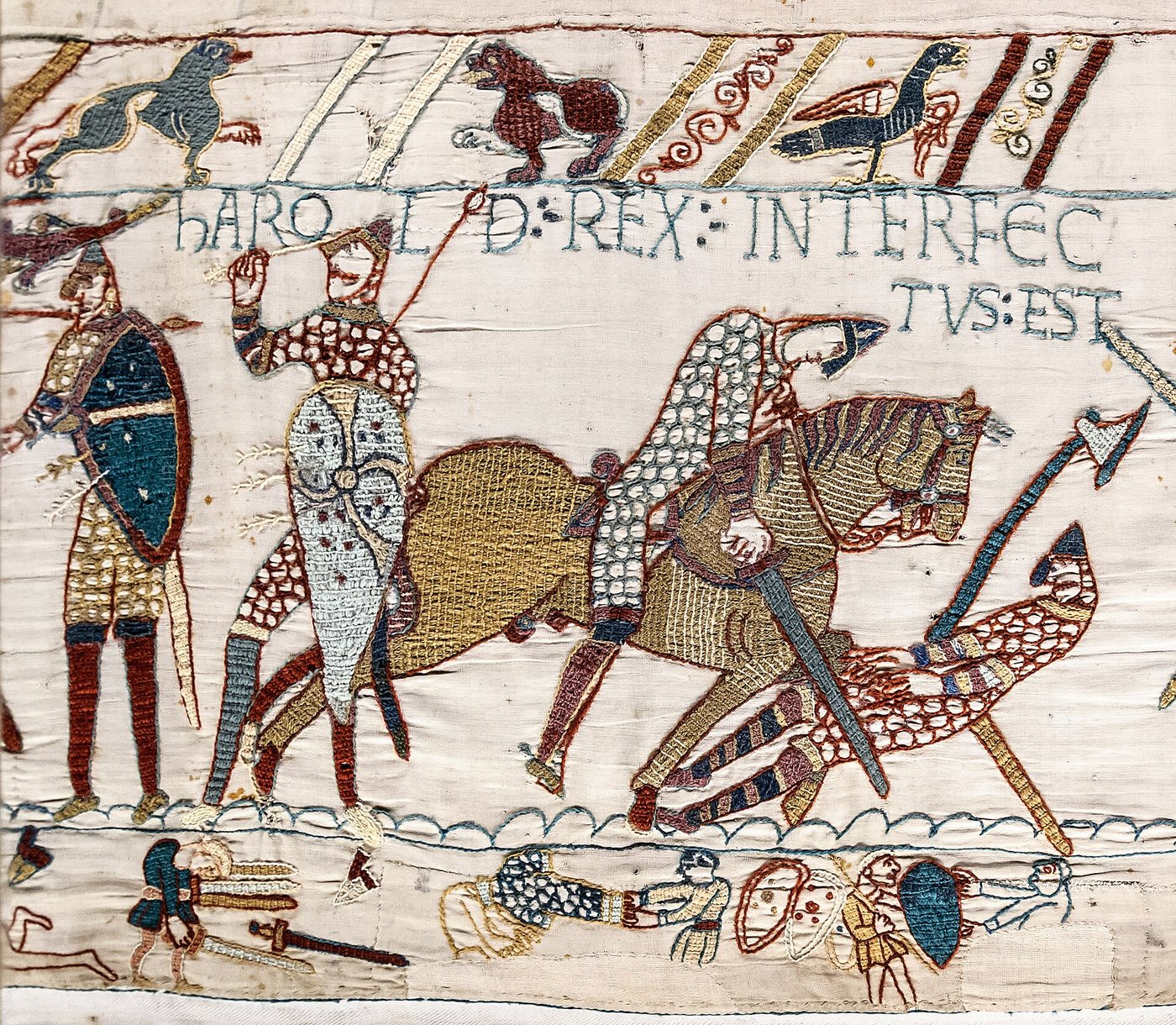
The most famous spot lies beneath the words “HIC HAROLD REX INTERFECTUS EST”, here King Harold is killed. Two figures stand below. On the left a standing man clutches at his head, in which an arrow now sticks; on the right a man with an axe is cut down by a rider. The chain of written sources, in which the eye only gradually arrives, is traced in our Hastings article. Here the thread itself counts.
Martin Foys has compared the spot with eighteenth-century reproductions. These show a spear shaft above the standing man's head. It first appears as an arrow in Charles Stothard's watercolour of 1818. According to Michael Livingston, N. P. Brooks and H. E. Walker saw no reason to doubt Stothard's honesty. Today, at any rate, the spot holds modern stitching: the French repairs of the nineteenth century, on Brooks and Walker's view (quoted by Livingston) above all those of 1842, according to Foys turned the shaft into an arrow and lowered its angle. Foys counts at least seven such modern arrows, all longer than the medieval ones.
Stranger still are the holes by the second figure. From the head of the falling axeman a straight line of 17 empty stitch holes runs out. According to Livingston, David Bernstein read them as the trace of an original arrow. Foys, by contrast, asks whether the restorers themselves put an arrow there for a time and removed it again because it contradicted Wace, the twelfth-century Norman poet in whose account Harold pulls the arrow out. The evidence alone does not decide this. The text itself is under debate too: according to Livingston, M. K. Lawson proposed that the line originally read “in terra iactus est”, thrown to the ground, which would fit the axeman.
So where does the picture of the arrow come from? One clue leads to the two Harolds themselves. Livingston considers that tradition may have blended Harold's end with that of the Norwegian, whose death the saga describes like this:
“King Harald Sigurdson was hit by an arrow in the windpipe, and that was his death-wound. He fell, and all who had advanced with him, except those who retired with the banner.”Snorri Sturluson, Heimskringla, Saga of Harald Hardrade, section “Fall of King Harald”, translated by Samuel Laing (1844)
Snorri wrote only in the thirteenth century, so his detail is itself late tradition. The point remains: the man missing from the cloth may have supplied the arrow the other still carries in his head. That is not proven.
Above and below the main story runs a narrow border of birds, fabulous beasts, farming and hunting, with naked figures and, during the battle, with the dead. Halley's Comet appears up there, marvelled at by the men in the main image (“ISTI MIRANT STELLAM”). Beneath the enthroned Harold, in the lower border, ghost ships drawn only in outline pass by, often read as an anticipation of the invasion.
The most discussed elements are the animal fables after Aesop. Stephen D. White shows that a run of them in the lower border accompanies Harold's journey without interruption, from Bosham to his capture. He speaks of eight “canonical” fables, among them Fox and Crow (the fox flatters the cheese out of the beak), Wolf and Lamb (the wolf eats the lamb after making false charges), Wolf and Crane (the crane pulls a bone from the wolf's throat and does not get the promised reward), the Bitch who lends her lair and does not get it back, the Lion King who swears off meat and then devours his subjects anyway, and Frog, Mouse and Kite. Daniel Terkla in 1995 arrived at nine.
Nearly all these stories deal with broken promises and property gained by trickery, which is just what the main narrative is about. But who is the wolf? Terkla read the margins as reinforcing a Norman view in which Harold is the faithless one. Andrew Bridgeford, according to Wikipedia, suspected hidden anti-Norman messages throughout the work. White, according to the same source, warns against tying the cloth to a purely English or Norman story at all; the fables might speak rather of the futility of conflict. The fable itself says only that someone is cheated. Who is meant is for the viewer to decide.
During the Revolution it was to cover army wagons and was rescued at the last moment; the museum names a captain of the National Guard, Lambert Léonard Le Forestier, other accounts a lawyer. Under Napoleon it was shown in Paris in 1803 or 1804. From 1983 it hung in the Centre Guillaume le Conquérant, and in 2007 it entered UNESCO's Memory of the World register.
From 10 September 2026 to 11 July 2027 the British Museum in London shows it, by the museum's account for the first time in the UK since it was made almost 1,000 years ago. Michael Lewis leads the curating, and the cloth lies horizontally in one continuous case. It is then due back in Bayeux, where a new museum is announced for October 2027.
Why is it called a tapestry if it is an embroidery? The word comes from an older, broad usage for pictorial wall hangings. The 1476 inventory correctly called it “broderie”.
Is Harald Hardrada on the tapestry? No, at least not by name. No caption mentions him, Tostig or Stamford Bridge. A news scene before Hastings might refer to Harold's victory in the north, but that remains interpretation.
Did Harold really die from an arrow in the eye? That cannot be clearly shown. The earliest accounts describe a death in close combat; the arrow on the cloth is, in its present form, probably a restoration.
Where was it made? The majority think of England, usually Canterbury. Saint-Florent at Saumur and Barking have also been proposed; no place is established.
Hastings 1066 · Stamford Bridge 1066 · Harald Hardrada · Rollo · Normans in southern Italy · Vikings, Normans, Varangians · Longships · Viking shipbuilding · Oseberg

The Battle of Hastings · Rollo of Normandy · Stamford Bridge 1066 · The longships · The Normans in Southern Italy.
All History & Finds articles →
Of the Slavic groups that become visible around the Aegean in the seventh century, we usually know little more than …
Read more →When Caesar marched into northern Gaul in 57 BC, his allies the Remi named one tribe as the strongest of the Belgae …
Read more →Amber counts as a classic commodity of the Viking Age. Yet the only surviving account of a voyage to the trading place …
Read more →A single sentence survives about the Berzites: a name in a list of Slavic groups that pressed upon Thessalonica in the …
Read more →