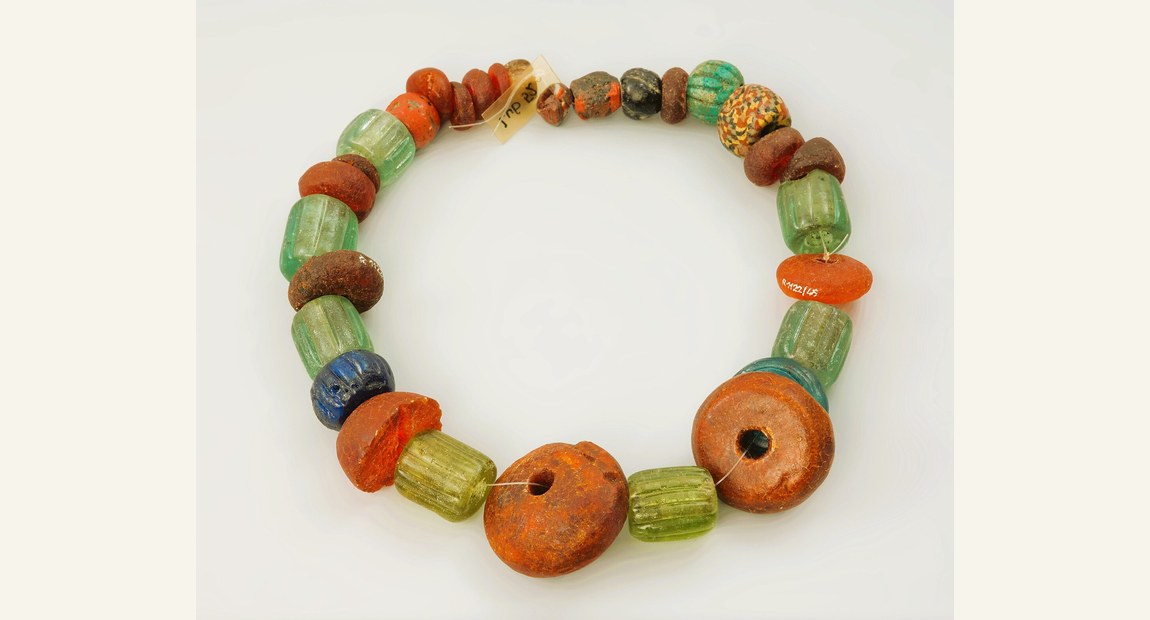
Amber counts as a classic commodity of the Viking Age. Yet the only surviving account of a voyage to the trading place of Truso does not mention it once. What we know of this trade comes from workshop debris at Ribe, Hedeby, York and Dublin, from graves in Samland and from occupation layers near the Vistula. This article follows the raw material from the beaches to the lands of the Rus and separates what the ground shows from what scholars infer from it.
The material itself plays only a minor part here. What amber is, how it formed and how people used it from the Stone Age to the Romans is covered in our article Amber: the gold of the North. This piece asks a narrower question: how did the raw material travel from the shore to the craftsman in the Viking Age, and how much of that can we actually prove?
The answer opens with a gap. For furs we have Ohthere, telling King Alfred about the tribute he collected in the far north (see Ohthere of Hålogaland). For slaves and silver we have Arabic authors. For amber I know of no Viking Age text that records a specific purchase, a price or a ship's cargo. The trade appears almost only indirectly, as fragments, roughouts and raw nodules lying wherever someone worked them.
That gives no reason to doubt the trade as such. Anyone carving amber in Dublin had to get it from somewhere. It does mean we know far less about routes, traders and volumes than popular accounts suggest. Every map with neatly drawn Viking amber routes is a reconstruction, not a picture of a documented business.
Two regions stand at the centre, and both were familiar to people at the time. One is Samland, the peninsula in today's Kaliningrad region. It holds the largest known deposit, bound up in a glauconite-rich layer that miners call the Blue Earth. Industrial mining began only in the nineteenth century. In the Viking Age amber arrived, as far as we can tell, mainly as beach wrack and from the shallows. Around AD 98 Tacitus already describes people gathering it among the shoals and on the shore; the story of those coast-dwellers is told in our article on the Aesti.
The other is the North Sea coast, above all western Jutland. Glaciers and the sea reworked amber-bearing sediments there, and after storms pieces lie among the seaweed. Large nodules are rare, but small ones will do for beads. For a craftsman at Ribe the raw material lay practically on the doorstep, whereas a craftsman in Dublin had to have it brought by sea. Amber also occurs on the Pomeranian coast and on parts of England's east coast.
This distribution shows why "Samland or Denmark?" is the wrong question if it is meant as either-or. There were several gathering areas, and workshops very probably drew on whatever lay within easiest reach. That remains a reasonable argument, though. It can hardly be measured, and the reason is chemical.
Since the 1960s infrared spectroscopy has been able to separate Baltic amber, known as succinite, from other fossil resins. That is how amber from the Mediterranean world came to be assigned to the Baltic type. Amber from Viking Age York, too, proved by this method to be largely Baltic, according to the publication by Mainman and Rogers.
The catch lies in the word "Baltic". It names a type of resin, not a beach. A specialist paper by Katie Haworth on amber bead production in early medieval England (EXARC Journal, 2025) puts it plainly: true Baltic amber cannot be distinguished chemically from the amber found around the wider North Sea zone. A piece from Samland and a piece from Jutland give the same result, because both can derive from the same deposits, shifted by ice and sea.
For the trade this has hard consequences. "Baltic amber at York" does not mean "goods from Samland at York". It may have come from the east via Hedeby, from Danish beaches or, at least in part, from the English coast. The same paper calls the contribution of native sources in the early medieval period explicitly uncertain, and the caveat applies no less to the Viking Age. Anyone writing of "Samland amber in Dublin" claims more than the analysis can deliver.
At Ribe, the early trading place on the west coast of Jutland, amber is a mass find. Ribe VikingeCenter speaks of several kilos from the excavations at the market place, mostly raw pieces and half-finished beads, some of them charred. In his finds table of 2012 the archaeologist Claus Feveile lists 12,935 pieces of amber (raw material, waste and products) weighing 6.615 kilograms in total; he names beads and gaming pieces as end products. By simple arithmetic that is about half a gram per piece. Amber is a light, fine-grained commodity. That makes it easy to carry and makes any estimate of how much was ever moved very difficult.
The recent publication Northern Emporium (ed. Søren Sindbæk, 2023) also covers amber. As Haworth's paper reports it, the differing distribution of amber and bone waste there shows that these were separate crafts.
Was Ribe therefore an exporter? The VikingeCenter regards amber as an important trade good, and that may well be so. The distribution of finds alone cannot prove it, because waste shows where people worked, not where the finished beads went. That workshops took their raw material from the nearby beaches seems likely, but for the reason above it has not been shown by analysis.
The most thorough single study comes from Hedeby. Ingrid Ulbricht analysed the material in 1990. Most unworked nodules weigh under five grams. Tool marks, discarded roughouts and fine waste are plentiful, yet they lie scattered across the settlement with almost no spatial pattern. Ulbricht concluded that carving was probably not a specialised profession, because the raw material was available locally.
That is telling for the trade: small nodules could be gathered or bartered in small lots. The finds do not require a large amber house, though they cannot exclude one either.
At the same time Hedeby was the hub of the region. Adam of Bremen writes in the eleventh century (Gesta IV.1) that from this port on the Schlei ships usually sailed to the land of the Slavs, to Sweden, to Samland and as far as Greece. This is the passage that explicitly ties Samland into the Danish trading network, even if it dates from a time when Hedeby had passed its peak. Adam mentions no amber cargo there; he names a destination, not a commodity.
Long-distance trade shows most clearly where raw material did not simply lie on the beach, or lay there only in small amounts. At York, Viking Jórvík, raw pieces already occur in ninth-century deposits. They are small: the largest weighs 5.18 grams. In the mid to late tenth century amber was worked there alongside iron and non-ferrous metal, as Mainman and Rogers show. Knife marks, split beads and roughouts prove work on the spot. Chalk cores apparently served to polish amber and jet; for the black sister material see our article on jet.
Dublin offers the most striking picture at the western edge of the Norse world. The brief report on the Fishamble Street excavation of 1975–76 already lists "quantities of amber including many fragments and roughouts of beads and pendants". According to Patrick Wallace, the excavator of Wood Quay, work centred on individual workshops; his account is also cited for the occasional use of a lathe. That sets Dublin apart from Hedeby. That this has to do with the material being imported seems likely, but it is interpretation.
Where did Dublin's amber come from? The Baltic region is the usual answer, and a sensible one. Direct evidence for the route is lacking, however. It may have run through Danish ports, through York or through other stages. Whether Dublin traders themselves sailed into the Baltic, or whether the material passed from hand to hand through several markets, cannot be clearly established.
Further sites follow the same pattern. Kaupang produced 161 unworked pieces plus bead roughouts with incised drilling marks, and its specialist Heid Gjøstein Resi considers discrete workshops possible (see Vestfold). Paviken on Gotland shows similar roughouts. At Wolin and other sites of the south-western Baltic, amber and antler waste occur in the same layers. M. Gerds therefore considers it possible that the two crafts were practised together, whereas they appear separate at Hedeby, Ribe and Dublin. There was evidently no uniform organisation of this craft.
Alongside Ohthere's narrative, the Old English version of Orosius from King Alfred's circle contains the account of a man named Wulfstan. He describes a voyage from Hedeby to Truso, near the mouth of the Vistula.
"Wulfstan said that he set out from Hedeby and was at Truso in seven days and nights, and that the ship was running under sail the whole way. […] Estland is very large, and there are very many strongholds there, and in each stronghold there is a king. And there is very much honey there, and fishing."Old English Orosius, account of Wulfstan (late 9th century), text after Bright's Anglo-Saxon Reader (public domain, Wikisource); my own translation
Then come the customs: the king and the wealthiest men drink mare's milk, the poor and the unfree drink mead, and there follows the long description of funeral rites with the horse race for the dead man's property (summarised in our article on the Vikings in the Baltic). Honey, fish, mare's milk, mead, fast horses. Amber does not appear, and neither does any buying or selling at Truso.
This silence has to be read correctly. It does not prove there was no amber trade. The compiler was evidently interested in geography and ethnography rather than in lists of goods, and he may have left out much of what Wulfstan told him. It does rule out the statement that Wulfstan sailed for the sake of amber. That is written nowhere. Even his being a merchant is an inference from the voyage and its destination, because the text gives no occupation. The common label "of Hedeby" rests only on his having set out from there; his origin remains open.
The account remains valuable, even for our subject. It shows that the run from Hedeby to the Vistula could be sailed in one stretch, with the land of the Wends to starboard and the Danish islands and Scania to port, later Bornholm, Blekinge, Öland and Gotland.
Only archaeology makes the link with amber. From the 1980s Marek F. Jagodziński of the museum in Elbląg excavated at Janów Pomorski on the edge of the Vistula delta, near today's Lake Drużno. Wulfstan describes Truso as standing on the shore of a mere. Scholars now regard the identification of this site with his Truso as secure. The excavator gives its area as about 15 hectares, up to 20 with possible fortifications, and dates occupation from the late eighth to the beginning of the eleventh century. The start at the end of the seventh century found in overviews does not appear in his paper.
The range of finds is that of a trading place: scales, some 300 weights, coins, Scandinavian jewellery, horseshoe-shaped brooches, weapons. The numismatist Mateusz Bogucki gives fragments of 322 Arabic and 4 West European coins in 2004, Jagodziński in his later paper 274 coins, likewise including four West European ones. So the figures differ. Amber is no side issue here: according to the Elbląg museum, large pieces caught the eye when the site was discovered in the early 1980s. Bogucki speaks of very intensive working, with more than 10 kilograms of raw material by then, plus finished beads, amulets and gaming pieces, and Jagodziński places amber and horn working as early as the first phase, from the late eighth to the mid ninth century. That exceeds what Feveile's table shows for Ribe, although the two figures can be compared only roughly because excavated areas and counting methods differ. I could not consult a workshop analysis comparable to Ulbricht's Hedeby study for this article.
One often reads that Scandinavian traders and craftsmen lived in the centre and by the harbour, with Balts and Slavs nearer the edge. I have found that zoning only in overviews. Jagodziński himself regards Truso as mainly Scandinavian in population, with particular Danish influence, while most of the pottery is Slavic or Slavic-Prussian. That rests on building forms and finds, not on any record of origin, and Wulfstan does not say who lived there. The end is equally open. Overviews draw on a museum publication by Jagodziński that attributes a layer of ash with many arrowheads to pirates or invaders, and they mention silting in the second half of the tenth century. I have not read that publication. Bogucki dates the end of the emporium to the middle or third quarter of the tenth century and sees a strong power, probably Piast, as a possible cause. Opinions differ on this.
Wulfstan calls the people east of the Vistula Este. On the usual reading he means West Baltic groups, ancestors or neighbours of those later sources call Prussians. The word "Prussian" does not occur in his account; that equation is the work of scholars, and it has nothing to do with Estonia in the modern sense. The name Bruzi appears in the so-called Bavarian Geographer in the ninth century, and the first fuller record is connected with the missionary Adalbert of Prague, killed in the Prussian border region in 997.
The Prussians were neither Germanic nor Slavic but speakers of a West Baltic language that died out around 1700. They left no texts of their own from the Viking Age. That is decisive here: the people who presumably gathered and passed on the raw material in Samland nowhere speak for themselves. We do not know who claimed the beach, whether gathering was free or belonged to a lord, or on what terms goods were exchanged. The amber monopoly of the Teutonic Order belongs to a later time: the Order controlled gathering and sale only after conquering the land, a privilege of 1312 regulates gathering in return for dues, and the bishops of Samland and the abbey of Oliwa held rights of their own. None of that may be projected back into the Viking Age.
In the eleventh century Adam of Bremen lists Semland among the islands of the Baltic (Gesta IV.18). There lived the Sembi vel Pruzzi, homines humanissimi, most humane people who came to the aid of the shipwrecked and of those attacked by pirates. They set little store by gold and silver and had an abundance of exotic furs. Then comes the sentence that matters most to us: for woollen cloths, the faldones, they offered precious marten skins. That is a rare written reference to an exchange on this coast, and it concerns fur. Amber is absent from the excerpts of the Latin text I could consult; I have not searched the whole work for it. The passage is also a sermon: Adam holds these pagans up as a mirror to the fur-hungry Christians of his world, while noting that they persecute preachers and that Adalbert met his death among them. In 2021 Arturas Mickevičius even asked whether the praise applies to the Sambians at all, or to Christian settlers in the land, such as Danes.
The strongest archaeological sign of Scandinavian interest in Samland lies close to the coast, near today's Mokhovoye in the Kaliningrad region. In a small wood called Kaup lies a cemetery discovered in 1865, with over 500 burial mounds and an unknown number of flat graves from the ninth to the eleventh century. By 1939, according to overviews, German and Swedish archaeologists had uncovered about 300 graves. The finds are predominantly Scandinavian in character.
The matching settlement was missing for a long time. A German-Russian project of the Centre for Baltic and Scandinavian Archaeology in Schleswig and the Russian Academy of Sciences from 2005 surveyed a large area by geomagnetics (the Centre's figures range from 150 to almost 200 hectares) and until 2011 excavated at more than 20 spots. It found house plans, wells and rubbish pits showing use from the fifth century until the arrival of the Teutonic Order. That does not quite fit the old image of a Norse colony. In 2010 Timo Ibsen and J. Frenzel read the graves as those of Scandinavian settlers but assigned most settlement finds to the Prussian culture; typically Scandinavian settlement finds were still missing. The Centre itself points to two settlement concentrations contemporary with the cemetery, found in 2009–2011 and most likely connected with Scandinavians. According to its project description of 2021, only preliminary reports existed on these. The excavation reports on the project page sound more cautious: in 2010 it is an open question whether Scandinavians or local Prussians lived in the houses, in 2011 the expected Scandinavian metal finds are absent, and the old theory of an important port of trade could not be confirmed. The site was perhaps of only minor importance.
Why did people from the North come precisely here? Amber is the obvious answer, and overviews name it first. There is a find to support this: in the excavation area about a kilometre east of the cemetery, finished and unfinished beads and a large quantity of raw amber came to light in 2009, with radiocarbon dates from that trench ranging from AD 782 to 1154. In 2010 mostly raw material with traces of working followed. That shows working on the spot. The project reports give neither figures nor proof of export to Scandinavia. Furs, which Adam of Bremen highlights on this coast, would be another possible motive. The site makes it likely that Northerners moved closer to the raw material rather than obtaining everything through middlemen. That is not proven.
The Viking Age eastern route is known above all as the road of silver. The framework is set out in our articles on Kievan Rus and on Viking trade. Amber is attested among the Rus, but whether it came along these routes in the Viking Age has not been settled. Olga Zhelentsova (also Zelentsova), Inna Kuzina and Sergey Milovanov of the Institute of Archaeology in Moscow presented the state of research at a symposium in Gdańsk in 2013. At Novgorod amber appears from the mid tenth century, peaking in the mid twelfth. The largest single witness is a store of 207.4 kilograms of amber found in 2008 at Vladimir on the Klyazma, in the underground level of a large building. The authors date it to between the second half of the twelfth century and 1238, when the Mongols devastated the town, so well after the Viking Age. I have found this figure only in their paper. They read sulphur levels in pieces from Vladimir, Gnezdovo and other sites as typical of Baltic deposits, yet they regard the origin before the thirteenth century as unresolved: the Baltic or the Dnieper region. Amber made up only about 2 to 5 per cent of ornaments in several towns, and the authors think the raw material served above all to make boiled oil. Scandinavians play no part in their report.
Ibn Fadlan reports on the Rus on the Volga in 922 and singles out green beads, for which they paid a lot. He does not mention amber. English-language overviews of the Volga and Dnieper trade also list slaves, furs, silver and silk. On this record, amber in the east was a commodity that existed but ranked low in the texts. For the image of Vikings swapping caliphate silver for amber, direct evidence is lacking.
How was the raw material paid for? No price has come down to me. Only the framework is certain: scales and weights lie at places such as Truso, Kaupang and Hedeby, and the Baltic region long reckoned in weighed silver, as our article on hack-silver shows. That amber could be paid for this way is possible. Barter for other goods is equally possible.
A multi-stage model seems plausible. Coast-dwellers gather, local traders bundle, ships take small lots as additional freight. Amber weighs little, does not spoil and takes up almost no space. That suits a side cargo on mixed-freight ships better than dedicated amber voyages. No written evidence supports this model; it is a conclusion from the qualities of the commodity and the small scale of the finds.
Was amber a leading commodity of the Viking Age? That cannot be put into figures. Workshops at many trading places show a broad and steady demand. Written sources tend to highlight furs, slaves and silver. A widespread but small-scale commodity seems plausible.
Can the origin of a piece of Viking amber be determined? The resin type, yes; the beach, no. Infrared analysis identifies Baltic succinite but does not separate Samland from the North Sea.
Where was Truso? At Janów Pomorski near Elbląg in northern Poland, on the edge of the Vistula delta by Lake Drużno. Scholars regard its identification with Wulfstan's Truso as secure.
Were the Prussians Vikings? No. They spoke a West Baltic language. Scandinavians, however, probably lived beside them, as the graves at Wiskiauten suggest.
Why is there amber in Dublin when Ireland has no amber coast? Because the raw material came by sea. The Fishamble Street excavations produced many fragments and roughouts, which means work on the spot. We do not know the exact route.
Amber: the gold of the North · The Aesti · Vikings in the Baltic · Viking trade · Ohthere of Hålogaland · Hedeby · The Curonians · Jet

Amber – the gold of the North · Viking Trade · Vikings on the Baltic · Hedeby · The Norse of Jórvík.
All History & Finds articles →
A single sentence survives about the Berzites: a name in a list of Slavic groups that pressed upon Thessalonica in the …
Read more →Bifrost (Old Norse Bifröst) is the bridge in Norse mythology that leads from the earth up to the gods – from Midgard to …
Read more →There is a list in Caesar, eleven names long, set down in 56 BC like an administrative memo. Most of these peoples then …
Read more →The Gotland picture stones are upright, image-covered limestone slabs raised on the Swedish Baltic island of Gotland …
Read more →