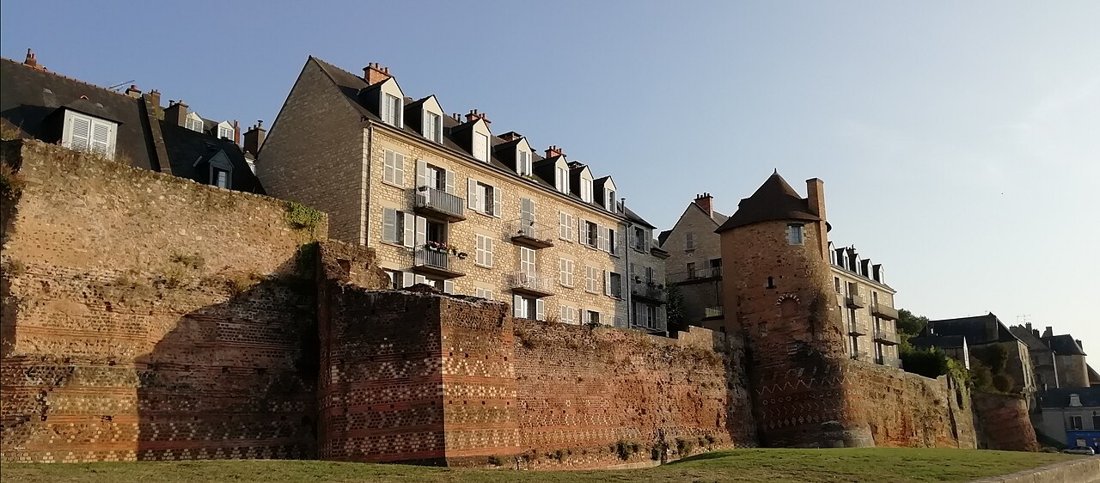
Walk along the red Roman wall of Le Mans and you stand on the ground of the Cenomani. Visit the Capitolium in Brescia and you do the same. More than a thousand kilometres and the Alps lie between the two cities. The same people-name appears at both places in antiquity, and the Romans already made a story of it: the Italian Cenomani had once come over the mountains from Gaul. Whether that is true remains an open question today. That is exactly why it is worth setting the two groups side by side and keeping cleanly apart what the sources say and what we read into them.
Ancient authors know Cenomani in two places, strictly speaking in three. One group lived in western Gaul between the Seine and the Loire, in today's département of Sarthe; its chief town became Le Mans. The other sat in northern Italy, in the eastern Po plain between the Oglio and the Adige, with Brixia, modern Brescia, at its centre. On top of this comes a brief note by the elder Cato placing Cenomani near Massalia among the Volcae.
The obvious guess is: one people that split, or emigrants who took their name with them. The ancient tradition suggests as much; scholarship is more cautious. This article looks at both groups in turn and asks at the end what really connects them. Readers who already know the other Celtic peoples of northern Italy, such as the Insubres, the Boii or the Senones, will recognise a good deal. For an overview of the Celtic world as a whole, see our article on the Celts.
In Gaul the Cenomani never appear alone but with a first name: Aulerci Cenomani. The Aulerci were evidently a larger league whose parts each bore their own epithet. Caesar knows the Aulerci Eburovices on the lower Seine, whose name lives on in Évreux, and the Aulerci Cenomani. Then there are the Diablintes, whose chief town Noviodunum lay at modern Jublains, and, in a list of the clients of the Aedui, the Aulerci Brannovices.
No source tells us what held these groups together. The French Celticist Venceslas Kruta has suggested they may have been districts of an older people that became independent over time. Pliny the Elder, in his list of Gaul, phrases it as if these were surnames: Aulerci who are called Eburovices, and those who are called Cenomani. The Cenomani are generally taken to be the largest and most powerful part of the league.
Anyone searching Caesar for the Cenomani finds less than expected. In several passages he speaks only of the Aulerci in general. In 57 BC Publius Crassus reports to him the submission of the peoples along the Ocean, among them the Aulerci, without any epithet. In the revolt of 52 BC the Aulerci join Vercingetorix according to Book VII.4, again without detail. And old Camulogenus, who leads the Gallic army before Lutetia, is simply called Aulercus in VII.57. Which branch of the league these passages mean cannot be decided.
The Cenomani are named explicitly exactly where Caesar lists the contingents for the relief army at Alesia. In VII.75, after a series of peoples with five thousand men each, we read: Aulercis Cenomanis totidem, the same number from the Aulerci Cenomani. A little further on in the same chapter the Eburovices appear with three thousand men alongside the Veliocasses and Lexovii, whom we discussed in our article on the Veliocasses. Five thousand men is a lot by comparison: more than the Atrebates, fewer than the Senones or the Carnutes. Like every figure in that list, these are demands set by the Gallic war council, not counted soldiers.
In the 2nd century AD Ptolemy names the chief town of the Aulerci Cenomani Vindinon, in Latin Vindinum or Vindunum. The town sits on a spur above the Sarthe. Whether an oppidum stood there before the Roman period is not established; archaeologically, one of the things found so far is a site from the middle of the 1st century BC interpreted as a small spring sanctuary. The town proper only takes shape around the turn of the era, grows through the 1st and 2nd centuries and, according to recent syntheses, reaches about sixty hectares around AD 200.
As with many Gallic chief towns, the people's name later replaced the place-name. From the 3rd century there is talk of the civitas Cenomannorum; around 400 the Notitia has the form Ceromannos. From Cenomannis, through medieval intermediate forms, came Le Mans, and the surrounding region is still called Maine. Even geology bears the name: in the 19th century the French palaeontologist Alcide d'Orbigny named a stage of the Upper Cretaceous after the area around Le Mans, the Cenomanian.
The urban setting included the large sanctuary of Allonnes a few kilometres to the south-west, where a Mars with the epithet Mullo was worshipped. A temple to this god was also built in the town itself towards the end of the 1st century.
The most striking monument of the Gallic Cenomani is not a Celtic structure but a late Roman one. The city wall of Le Mans ran for about 1,300 metres around an irregular rectangle of roughly 450 by 200 metres, enclosing little more than eight hectares. Some 500 metres survive, along with several towers. The wall is famous for its decorative patterns of differently coloured stone and brick, which earned Le Mans the name of the red city. It has been a protected monument since 1862.
For a long time the wall was dated to the late 3rd century. More recent studies place it rather in the early 4th century. For our question, what matters more is what the wall shows: the town had shrunk and withdrew behind a small, representative fortification. The structure stands some three centuries after Caesar's Cenomani. It is a monument of the civitas that bore the people's name, not of the people itself.
For the Italian Cenomani we have an origin story, and it comes from Livy. In his fifth book he tells how Ambigatus, king of the Bituriges, sent out his nephews Bellovesus and Segovesus with bands of emigrants, Segovesus into the Hercynian Forest, Bellovesus to Italy. Bellovesus founds Mediolanum, later Milan. Then comes the passage in which the Cenomani appear:
Alia subinde manus Cenomanorum Etitovio duce vestigia priorum secuta eodem saltu favente Belloveso cum transcendisset Alpes, ubi nunc Brixia ac Verona urbes sunt locos tenuere.
"Soon afterwards another band, that of the Cenomani, followed in the footsteps of those before them under the leadership of Etitovius. With the support of Bellovesus it crossed the Alps by the same pass and occupied the country where the cities of Brixia and Verona now stand."Livy, Ab urbe condita 5.35.1; Latin text after the standard editions (the leader's name also appears as Elitovius), English rendering made by us
The sentence says surprisingly little. It names no homeland and does not say that these Cenomani came from the Sarthe. It merely assumes that, like Bellovesus, they came from Gaul beyond the Alps. And it places the whole migration in the time of the Roman king Tarquinius Priscus, that is, around 600 BC. Most other ancient sources and modern scholarship put the Celtic settlement of northern Italy considerably later, in the late 5th and 4th centuries.
The British ancient historian J. H. C. Williams has read the narrative as a deliberately constructed foundation story: it ties the arrival of the Gauls to the founding of Massalia and turns an invasion into an orderly colonial enterprise. That gave peoples like the Insubres and Cenomani, who were still classed as Gauls in Rome, a less barbarous past. One need not follow this reading in every point to take away the basic rule: Livy writes centuries after the events, and his migration legend is literature with a purpose.
The territory of the Italian Cenomani lay east of the Insubres. To the west the Oglio separated them from their often hostile neighbours; to the south it reached the Po, to the north the moraine country around Lake Garda, and to the east the Tartaro or the Adige, where the Veneti began. Polybius, writing in the 2nd century BC and using the form Gonomanoi, describes them as the easternmost Gallic people north of the Po.
Their centre was Brixia. In 32.30 Livy explicitly calls the town caput gentis, the chief place of the people, just as Mediolanum was for the Insubres. The surrounding land, on the archaeological evidence, was marked by many small, scattered settlements. They are known mostly through cemeteries, for instance in the moraine amphitheatre of Lake Garda and in the plain between the Mella, the Chiese and the Oglio. The dead were buried unburnt, men with sword, spear and shield, women often with neck-ring and arm jewellery.
Famous pieces come from this area: a decorated helmet from Gottolengo of the late 4th century BC, the exceptional grave of Castiglione delle Stiviere with repoussé bronze sheet of Celtic workmanship, and the Manerbio treasure with silver phalerae and about 1,400 silver drachms. The drachms bear a legend in Lepontic script and circulated between Milan and Verona. Whether they may be called a coinage of the Cenomani in particular is disputed.
Livy names Brixia and Verona in one breath. That sounds like a clear attribution, but it is not. In his description of the tenth region of Italy, Pliny the Elder counts Verona among the towns of the Raeti and Euganei. Cenomanian sites are nevertheless well attested around Verona, above all between Povegliano and Vigasio, and in the city itself the cemetery at the Seminario Vescovile has produced burials of the 3rd to 1st centuries BC. A study published in 2024 examined, among other things, graves there in which people were buried together with animals.
The contradictions dissolve once one takes seriously a distinction pointed out by the archaeologist Ermanno Arslan: control of a territory by a leading group does not mean that all its inhabitants shared the same culture. Verona may have lain in an area dominated by the Cenomani and still have had an older, non-Celtic population. Incidentally, not even Livy claims the Cenomani founded Verona; he only says they occupied the country where the city now stands.
In the great struggle between Rome and the Gauls of northern Italy the Cenomani long stood on the Roman side. Polybius reports that before the great Gallic attack of 225 BC the Veneti and Cenomani sent envoys, and Rome chose them as allies. Together with the Umbrians both peoples provided troops meant to threaten the territory of the Boii and so tie down Gallic forces.
Rome did not fully trust its new friends. For the campaign against the Insubres in 223, Polybius reports that the consul Flaminius distrusted the Gallic allies and did not let them fight alongside the legions in the decisive battle. The battle of Clastidium in 222, in which Marcus Claudius Marcellus killed the Gaesatan leader in single combat, was fought against Insubres and Gaesatae. The sources do not mention any Cenomanian participation there.
The strongest statement about Cenomanian loyalty again comes from Livy. When Hannibal stands in Italy in 218 BC and the Romans draw up their army at the Trebia, he lists, besides eighteen thousand Romans and twenty thousand allies, auxilia praeterea Cenomanorum, and adds that this was the only Gallic people that had remained loyal. With all the other Gauls of northern Italy leaning towards Hannibal, the Cenomani became a valuable foothold north of the Po. The colony of Cremona was founded on their land in the same year.
The loyalty did not last to the end. After the Hannibalic War, in 200 BC, Insubres, Cenomani and Boii, according to Livy under the leadership of a Carthaginian named Hamilcar, attacked and destroyed the colony of Placentia. Three years later, in 197, the consul Gaius Cornelius Cethegus marched against the Insubres and Cenomani, who were encamped together on the Mincius, the river flowing out of Lake Garda.
Livy tells what happened next with striking caution. Cethegus sent negotiators to the villages of the Cenomani and to Brixia. There he learned that the young men had taken up arms without the consent of the elders; the defection had not been a decision of the people. The Cenomani then held back. For the ensuing battle, in which the Insubres were heavily defeated, Livy adds that some authors claimed the Cenomani fell upon the Insubres from behind in the middle of the fighting. A betrayal on the Mincius is therefore not established tradition but a report that Livy himself only passes on as the claim of some of his sources.
After 197 there were no more major Gallic wars in the plain north of the Po. An episode from 187 BC shows what the relationship now looked like: a Roman praetor had the Cenomani disarmed even though they were keeping the peace. They complained to the Senate, and the Senate returned their weapons. The Cenomani were now dependent allies, but with a claim to justice.
In his speech for Balbus, Cicero mentions treaties with Gallic peoples that explicitly barred individual members from receiving Roman citizenship. Modern editions usually read the Insubres and Cenomani there; the form of the name at this point, however, rests on an editorial correction. With the law of Pompeius Strabo in 89 BC the communities north of the Po received Latin rights, and later full citizenship.
Brixia received a sanctuary on the Italian model as early as the early 1st century BC and became a colony under Augustus. In the Augustan reorganisation of Italy the Gallic label disappeared from the map: the land north of the Po was now called Transpadana, while Ligurians and Veneti kept their names in regional designations. In the countryside, however, weapon burials and old funerary customs persisted into the 1st century BC, at a time when Brixia had long been building Roman temples.
This brings us to the real question. In favour of a connection is first of all the name, which occurs in both lands and is rare. Then there is the ancient conviction that the Gauls of northern Italy had migrated from Transalpine Gaul, and Livy's account of a band of Cenomani crossing the Alps. Cato's note about Cenomani near Massalia led some scholars to think of a stopover on the way to Italy.
Several things speak against a simple equation. Livy names no homeland. In Gaul the Cenomani are part of the Aulerci and bear the name as an epithet; in Italy they are simply Cenomani, with no reference to the Aulerci. The French Celticist Henri d'Arbois de Jubainville also argued from sound development: the survival of the syllable man in Le Mans presupposes a stressed, long syllable, whereas the Italian form was built differently; he therefore held the two peoples to be distinct. Cato's Cenomani fit poorly in time as well: according to Guy Barruol the Volcae only reached Languedoc in the early 3rd century, too late for a stage before the migration into Italy.
Archaeology helps only so far. In the territory of the Italian Cenomani, La Tène finds appear, according to Williams, considerably later than the literary tradition would lead one to expect; most published pieces belong to the 3rd century BC. And an archaeological culture never reveals where a people-name came from anyway. The only honest finding is this: the same designation is attested in both lands. Whether a common origin, a split or simply a similarly formed name lies behind it cannot be decided from the sources. Similar doublings are known from other peoples, such as the Volcae, the Boii or the Galatians in Asia Minor.
The meaning of the name is uncertain. The first element is usually linked to a Celtic root ceno-, which may have meant "far, long". For the second element there are two proposals: a word for "good" or a root meaning "to go". The linguist Patrizia de Bernardo Stempel has accordingly interpreted the name as "the far-goers". Pierre-Yves Lambert, by contrast, proposed a link to a verbal stem meaning "to descend from, to spring from", in which case the name would mean something like "the begotten ones".
The first interpretation is tempting because it fits the migration legend. That is exactly why caution is due: an etymology that confirms a story one wants to tell anyway does not prove that story. The name may refer to a migration, it may be an honorific, it may mean something else entirely. As with the Caletes or the Eburovices, it survives mainly as a place-name, here in Le Mans and in Maine. In Italy, by contrast, it has vanished, although the history of the Cenomani is recorded there in far greater detail.
The Eburovices · The Veliocasses · The Insubres · The Boii · The Senones · The Caleti · The Volcae · The Galatians.
