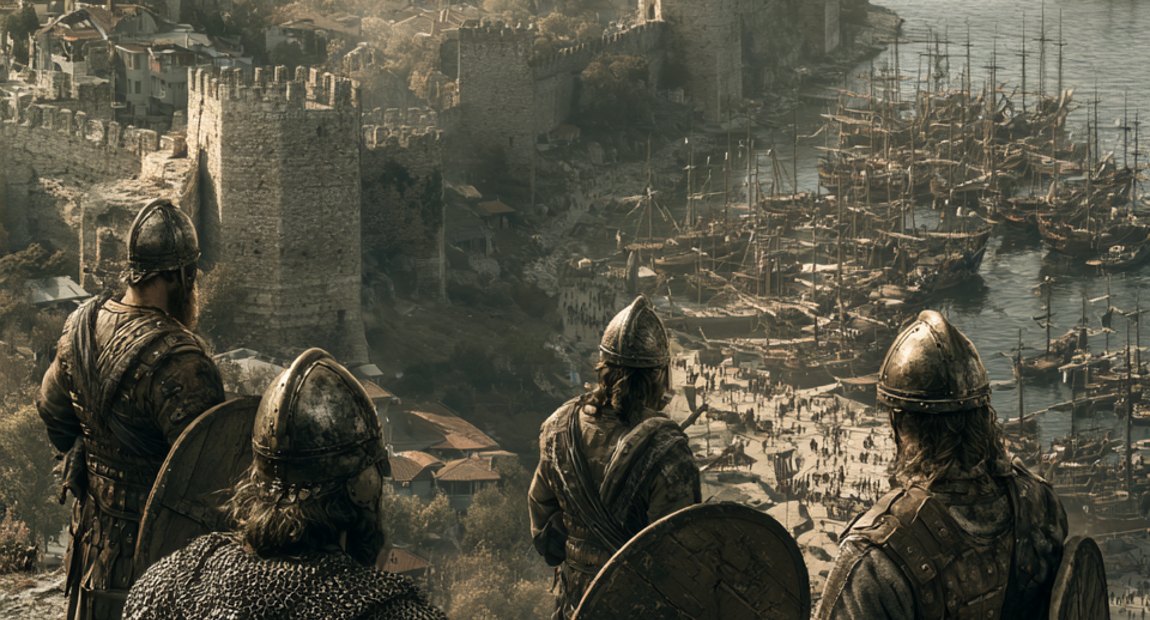
In the summer of 860 a fleet nobody expected appeared off Constantinople. The attackers plundered the surrounding country, the city itself did not fall, and after a while they were gone. That much is firm. Everything else depends on very different kinds of text: two sermons by the patriarch who lived through it, a terse list of emperors from the eleventh century carrying the famous date, and a chronicle from Kyiv that places the event six years too late and supplies two leaders. This article reads the witnesses in order and shows where a procession turned into a storm at sea.
Anyone retelling the attack of 860 can easily blend layers written centuries apart. They can be pulled apart, and doing so is the interesting part. First come the contemporaries: Patriarch Photios with two sermons from the year of the raid, plus a letter of Pope Nicholas I from 865 that uses the incident as a reproach to the emperor. Next come the Byzantine chronicles of the tenth century, in which a storm suddenly destroys the ships. The third layer is the “Brussels Chronicle”, the only source with a day and month. Last comes the Old Rus chronicle, which reached its surviving form only in the early twelfth century and took over the Greek story.
I know of no archaeological traces of the raid. This article therefore works almost entirely from texts, and each of those texts cared about how the story ended. The wider frame, who the Rus were and how their power developed along the Dnieper, belongs to the articles on Kievan Rus and on Vikings, Normans and Varangians. The piece on Miklagard and the Varangian Guard follows the long history of Scandinavians in Byzantium. The subject here is this one summer and how it was handed down.
Photios was patriarch of Constantinople and so the highest-ranking churchman of the empire. He preached twice on the attack. Scholars describe these pieces as the earliest reliable Byzantine texts that narrate anything about the Rus. They exist in English in Cyril Mango's edition (1958) and have existed in Russian since 1882 in Evgraf Lovyagin's translation, which is what I read in excerpts for the second sermon. The first sermon reached me only through quotations in the scholarship.
The first sermon is regarded as delivered while the danger was still present, though I know that only from secondary statements. According to the 2025 study by A. Yu. Vinogradov, Photios speaks of a terrible “hyperborean” thunderstorm, a tempest from the far north, and calls the attackers a Scythian people. Alexander Vasiliev, in his “History of the Byzantine Empire”, gives the phrases “the Scythian, coarse and barbarian people” and “a terrible northern storm”. This is classical stereotype, not ethnography: “Scythians” had long been what Greek authors called the peoples beyond the Black Sea.
The second sermon looks back. The blow came “like lightning from heaven”, Photios says; the sea lay still and smooth and gave the barbarians a pleasant voyage. He describes infants torn from the breast, and he calls the Rus a people ranked with slaves and unknown, who gained a name only through this campaign. The Greek phrase is translated in different ways, as an “unknown” or as an “obscure” people. That matters for what Constantinople knew about the Rus. Above all, though, the passage is rhetoric: the lower the enemy, the greater the shame of the congregation Photios is calling to repentance.
That is exactly the limit of this source. Photios gives no situation report. He names no date, no number of ships, no leader and no place of origin. His subject is sin and conversion, and the raid serves him as God's punishment. Even so, he remains the only witness we hear from inside the city.
A close look pays off here, because one often reads, in shortened form, that Photios is silent about the miracle. That is only half true. Of the storm and the dipping into the sea the second sermon says nothing. Of the Mother of God's garment, however, he speaks explicitly, and as a participant.
“Her garment […] the whole city carried with me, to repel the besiegers and to shield the besieged […]. It flowed all round the walls, and the enemy inexplicably turned their backs.”Photios, second sermon on the attack of the Rus; fragments, my own English rendering of the Russian translation by E. I. Lovyagin (Khristianskoe chtenie 1882), not from the Greek
The garment meant is the Marian relic from the church in the Blachernae quarter, in Greek the maphorion, a veil or mantle. According to Photios it was carried along the wall in a procession of supplication, after which the barbarians began to give up the siege. He reads the withdrawal as an answer to prayer. That is the pious interpretation of a contemporary, but the procession itself was something his listeners had seen. He could hardly have told them about an invented one.
What is missing is just as striking. The emperor does not appear in this second sermon. The enemy is not destroyed. A real storm is absent too: “thunderstorm” and “tempest” occur only as figures of speech, and the one concrete piece of weather is the calm sea on the way in. Photios puts the ending in a plain sentence: unexpected was the enemy's invasion, and just as unlooked-for their departure. Oleksandr Fylypchuk concludes in his 2022 study that Photios knew nothing of any “destruction” of the Rus bands.
There is little that is solid about how it unfolded. Niketas David writes in his life of Patriarch Ignatios that the Rus advanced across the Black Sea to the Bosphorus, plundering every region on the way. Pope Nicholas I writes to Emperor Michael III in September 865 that the pagans had burned churches and suburbs, and adds pointedly that no vengeance had been taken on them: “et vere de istis nulla fit ultio, qui pagani sunt”. The sentence stands in a polemical letter and serves as a weapon against the emperor. That is what makes it revealing: five years after the events, nobody in Rome had heard of a destroyed fleet.
All the accounts agree that the city did not fall. The emperor was away. Photios himself laments it in a sermon, judging by its content probably the first: where now is the Christ-loving emperor, where are the armies? They have gone to meet an attack by other barbarians, and the emperor is labouring far beyond the frontiers. I know this wording only from a secondary quotation. That the campaign was against the Arabs in the east comes only from the later chronicles. That a raid from the north took the capital by surprise, Photios says plainly.
No ninth-century source says where the fleet came from. Vasiliev in 1946 assumed a principality at Kyiv founded around 840. That presupposes that the Kyivan chronicle is reliable for this early period, which is precisely what more recent work doubts. The question also stays open because nobody knows how large the enterprise was. The river route is described in the article on the route from the Varangians to the Greeks, from sources that are considerably younger.
For a long time historians dated the expedition to 865 or 866, trusting the Kyivan chronicle. The Italian scholar Assemani in the eighteenth century and the Russian church historian Golubinsky had already inferred 859 to 861 from Byzantine evidence, but the turning point was a find. In 1894 the Belgian scholar Franz Cumont published in his “Anecdota Bruxellensia” a short anonymous list of emperors from Julius Caesar to Romanos III (d. 1034). It survives in a single thirteenth-century manuscript, codex 11376 of the Royal Library in Brussels, on folios 155 to 165.
Under Michael III it says that in the month of June, on the 18th, in the 8th indiction, in the year 6368, in the fifth year of his reign, the Rus came with 200 ships. Through the intercession of the Mother of God they were overpowered by the Christians and utterly destroyed. The indiction was a fifteen-year tax cycle the Byzantines used for dating. The year 6368 is counted in the Byzantine era from the Creation. Do the arithmetic and both fit the summer of 860. Vasiliev later recalled the “excitement and surprise” that Cumont's edition caused. After a paper by Carl de Boor in 1895 most scholars adopted the date; objections came chiefly from Ukrainian and Russian scholarship, for example Hrushevsky and Kazhdan.
The year 860 stands on firm ground today, the day on narrower ground. For 18 June there is exactly one witness, and it is neither contemporary nor independent in the way one would wish. Fylypchuk shows that the Brussels Chronicle draws its account mainly from the Continuator of George the Monk, and he suggests it was written around 1043, when the Rus again stood before Constantinople. The Continuator's error, that Michael ruled with his mother Theodora for four rather than fourteen years, came along too.
So where did the day come from? Külzer and Schreiner thought of a lost local chronicle, which Fylypchuk rejects. He proposes two other routes: liturgical memory, since the feast of the Marian relic was kept on 2 July, and the account of the Rus attack of 941, which also fell in June. He does not explicitly discard 18 June in the process. His judgement is aimed at the description of the victory: that is the construct of a later compiler and no basis for reconstructing the events of 860. For the date, this means it is the usual one and nothing refutes it, but its origin cannot be established with certainty.
The end is in worse shape. Reference works state that the attack lasted until 4 August, sometimes even citing the Brussels Chronicle. In its wording, as far as scholars quote it, this does not appear. A Russian-language encyclopedia entry instead relates the day, as a conjecture, to the second sermon. That would make it a date for the sermon, not for the withdrawal. I could not check the derivation against a primary source. How long the Rus stayed therefore cannot be stated exactly.
The great miracle story appears only in the chronicles around Symeon the Logothete in the tenth century and in the Continuator of George the Monk. There the emperor hurries back, crosses with difficulty, goes with Photios to the Blachernae church, and the garment is dipped in the sea. A violent storm then scatters the ships, and only a few Rus get home. Set beside the sermon, the shift is plain. In Photios the garment circles the wall on land; here it touches the water. In Photios the enemy withdraws; here they go down. In the second sermon the emperor does not appear; here he helps drive the action.
This is more than decoration; it fits a pattern. A city that saw itself under the protection of the Mother of God told its rescues as her intervention, and the robe counted as a kind of palladium, a sacred guarantee of the city's safety. Vinogradov also points to a peculiarity: of all the versions of Symeon, only that of the so-called Pseudo-Symeon uses the word maphorion; the Symeon version printed by Fylypchuk has omophorion. John of Antioch (Oxeites) tells the scene as well and has the ships sink with all the barbarians aboard. The tradition was in motion, not cast in one piece. The Brussels Chronicle takes it furthest when it has the Rus “destroyed”. The chronicle known as Theophanes Continuatus, also tenth-century, stays sober by contrast: the Rus had their fill of divine wrath and went home.
How stubborn the storm version is shows in a small detail. A scholarly article as late as 2014 still says that Photios himself dipped the hem of the relic in the Bosphorus. The second sermon does not say so. In Russia the story stayed visible in images too: a wall painting of 1644 in the Moscow Kremlin is said to show the miracle, though I found that only in a reference work.
The Old Rus chronicle, in English usually the Primary Chronicle, in Russian “Povest' vremennykh let” (Tale of Bygone Years), took its earliest reconstructible form around 1113 and was reworked in 1116 and afterwards. It survives above all in the Laurentian Codex of 1377 and the Hypatian Codex of the fifteenth century. Nestor's authorship is tradition, and scholars partly question it. Some 250 years separate the event from the text.
Under the year 6374, that is 866, it tells the following: Askold and Dir march against the Greeks in the fourteenth year of Emperor Michael. The emperor is facing the Arabs and returns; the Rus surround the city with 200 boats. Michael and Photios pray through the night in the Blachernae church and dip the garment in the sea; a sudden storm throws the boats ashore, and only a few get home. This is the Greek storm narrative in Slavonic dress. According to overview accounts it comes from the Continuator of George the Monk.
The error in the year probably has a simple cause. The chronicle starts its fixed count of years under 852 with the accession of Michael III. In fact Michael came to the throne in 842. From the false starting point of 852, the “fourteenth year of Michael” arrives at 866, if one counts full years. This calculation is my reading of the evidence. It explains the number and no more. Nor does the error itself imply a second expedition in 866, although Russian scholarship has discussed that question. The title of a 1992 article by Oleg Tvorogov already asks how many times Askold and Dir actually went against Constantinople. Later chronicles such as the Nikon Chronicle even multiply the raids.
No Byzantine or Western source names a leader for 860. The names Askold and Dir come only from the Rus tradition. The chronicle says they were followers of Rurik, not of his kin, and settled in Kyiv until Oleg had them killed in an ambush under the year 882. The Novgorod First Chronicle calls them two Varangians who styled themselves princes. According to one overview article, however, it does not name them as leaders of the expedition against Constantinople. That is an important clue: the Russian philologist Shakhmatov and others regard the connection as a later addition by the compiler.
Vasiliev disagreed. He “firmly” believed in the historicity of Rurik, Askold and Dir, and Oleg. A. S. Shchavelev arrives at a different picture in his reconstruction: Askold and Dir were probably independent Varangian princes in Kyiv, unconnected to Rurik, and probably died only around the turn of the tenth century. Their expedition of 860, however, belongs among the chronicler's speculations. That the two existed is one matter; that they led the fleet is another. The Arab writer al-Masʿudi mentions a king “al-Dir”, but whether he is the same man is disputed. More on the princely background is in the article on Rurik.
One voice from the West contradicts the Greek victory reports most sharply. The Venetian chronicler John the Deacon, writing around the year 1000, reports “Normans” who appeared off Constantinople with 360 ships, ravaged the surrounding land and went home “cum triumpho”, in triumph. In substance that agrees with Photios and the pope: the city holds, the attackers get away. That he calls them Normans bears on the question of origin, even though he does not mention the Rus.
Whether he is actually talking about 860 is disputed, however. Vasiliev saw a separate thrust in it, probably of 861, coming not from the north but from the south through the Mediterranean. He supported this partly with Saxo's mention of the “Hellespont”. The thesis touches on the voyages covered in the article on Vikings in the Mediterranean. Overview accounts, by contrast, list the passage under the attack of 860. There are differing views on this, and the texts do not force a decision.
Alexander Vasiliev, a Byzantinist who emigrated from Russia to the United States, published “The Russian Attack on Constantinople in 860” at Cambridge, Massachusetts, in 1946. It is the most extensive monograph on the subject known to me. Its merit lies in pulling together and discussing the widely scattered Greek, Latin and Slavonic evidence. Its introductory part also shows the limits of its time. He reads the chronicle for the ninth century more literally than many do today, and the Rus appear early as a finished state. I could consult only roughly the first 30 pages of the book through the retrieval tool; I do not know his treatment of the sermons and the robe at first hand, and so I do not report it here.
The aftermath is almost the most surprising turn. In a circular letter datable to early 867, the same Photios claims that after the Bulgars the Rus too had turned to Christ, so zealously that he had sent them a bishop. Seven years earlier they had been his very image of the coarse barbarian. How much advertising the letter contains cannot be determined; it belongs to a dispute over the power and rank of the churches. Byzantine historians from Theophanes Continuatus onward, on the other hand, relate that the Rus sent envoys of their own accord and asked to be Christianized; whether the text speaks of baptism or of a bishop I could not check against the Greek. Constantine VII in turn credits Basil I and Patriarch Ignatios, Photios's rival. The two accounts sit badly together, and the episode evidently did not last, since the baptism of Vladimir around 988 had to start the matter afresh.
For relations between Byzantium and the Rus, 860 marks a beginning, though not a clean one. Those who came later relied on threat and contract at once, as the Rus treaties of the tenth century show.
Why was 866 accepted for so long? Because the Old Rus chronicle files the expedition there. Only Cumont's 1894 edition of the Brussels Chronicle established 860, although individual scholars had doubted the later date before.
How many men attacked? Unknown. The often-quoted 8,000 is an extrapolation: 200 ships times about 40 men, and the 40 come from the chronicle's Oleg story. Even the 200 come only from later texts; Photios gives no number.
Were the attackers Vikings? The Greek texts call them Rus or Scythians. Only John the Deacon speaks of Normans, and whether he means the same expedition is disputed. That the Rus elite had Scandinavian roots follows from other evidence, not from this event.
Was Emperor Michael III in the city? No. Photios himself laments that emperor and army are far beyond the frontiers; the Arabs as the enemy are named only by the later chronicles. The quick return belongs to the miracle story, and the emperor does not appear in the second sermon.
Kievan Rus · Miklagard and the Varangians · The Rus treaties · Oleg of Kyiv · Rurik · The Varangian route · Vikings in the Mediterranean · Vikings, Normans, Varangians

The Rus (Kiev) · Miklagard and the Varangians · The Men of the Rus Treaties · Oleg of Kyiv · The Varangian route.
All History & Finds articles →
Some peoples gave themselves a name. Some had one pinned on them by their neighbours. And then there are the Convenae …
Read more →The Krivichs were an East Slavic tribal league at the headwaters of the Daugava, Dnieper and Volga, with centres at …
Read more →The early Croats are a people with a famous origin story and remarkably few documents. The Byzantine emperor …
Read more →Anyone who says "the Kuyavians" usually means a people that sat between Lake Gopło and the Vistula since time …
Read more →