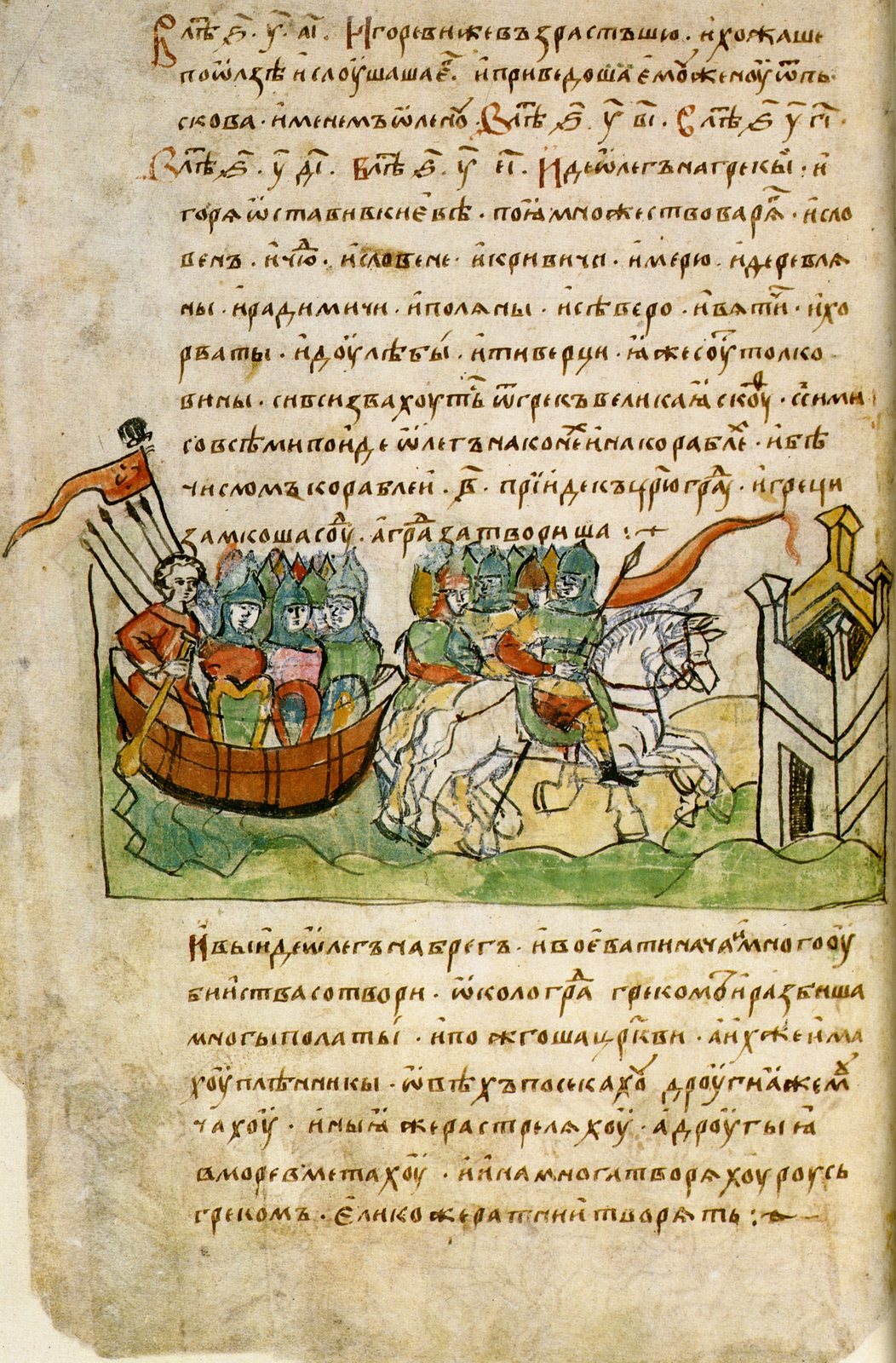
Oleg, in the Primary Chronicle the prince who takes Kyiv in 882, marches on Constantinople in 907 and dies of a snakebite in 912, is the first figure of the Rus who can be outlined from the chronicle, and at the same time one of the least secure. His story was written down about two centuries after the events, in a chronology that contains its own arithmetical errors. This article separates what archaeology, a treaty text and foreign sources support from what the chronicle narrates, and from what poets and folk tales made of it.
The name Oleg is the East Slavic form of Old Norse Helgi, which belongs to helgr, "holy". Igor goes back to Ingvarr, Olga to Helga. That the early princes of the Rus bore Norse names, and Slavic names appear only with Sviatoslav in the 10th century, is taken as a sign of where the ruling stratum came from. It says nothing about Oleg's life.
The epithet is a problem of its own. Research literature gives it as Vešč'ij (though it does not occur in the pages I could read for this article). The word means something closer to "the knowing one, the foreteller" than simply "the wise"; in English and German "the Wise" has become established. According to the chronicle, people gave him the epithet after he returned from Byzantium. I have not read the wording of that passage myself.
Who was Oleg in the story? A man who takes over rule in Novgorod after Rurik's death in 879 because Rurik's son Igor is still a child. He is described as Rurik's kinsman. From the north he moves south, takes Smolensk, takes Kyiv, subjects tribes, marches on Constantinople, concludes treaties and dies. The background, the calling of the princes and the question of who Rurik actually was are treated in the article on Rurik. Here the subject is the man between Rurik and Igor, and how much of him can be grasped outside the chronicle. The answer is short: very little.
The Primary Chronicle. The Povest' vremennykh let ("Tale of Bygone Years", PVL) is the main source. It was compiled in Kyiv in the early 12th century; the original version is regarded as a work of the 1110s. For a long time the monk Nestor was named as its author. That rests solely on the Khlebnikov manuscript and is mostly seen today as a later insertion. A likelier editor is Sylvester, abbot of St Michael's monastery at Vydubychi, who produced a version in 1116 favouring Prince Vladimir Monomakh; a third version two years later centred on his son Mstislav. The narrative ends in 1117.
The chronicle does not survive in the original. The most important manuscripts are the Laurentian Codex of 1377, copied by a monk Laurentius for a prince Dmitry Konstantinovich, and the Hypatian Codex from around 1425. Both lie more than three centuries after Oleg's death. Between the events and the writing lie about 200 years for Oleg's death in 912 and a good 230 for the Kyiv episode of 882. The gap was filled by oral tradition, heroic songs (byliny), Norse narrative material, Byzantine chronicles and copied treaties with Byzantium.
The years. The PVL counts by the Byzantine world era, that is, from the supposed creation of the world; 6390 corresponds to 882. Since Alexei Shakhmatov (1897) scholarship has held that these years for the 9th and 10th centuries were largely inserted into the text afterwards, probably in the 11th century, unless they come from the Greek chronicle of George the Monk (Hamartolos). Even the starting point has slipped: the chronicle puts the accession of Emperor Michael III in 852, whereas it was 842. "882", "907" and "912" are therefore chronicle years. They tell where the narrators placed an event, not when it happened.
The Novgorod First Chronicle. It forms a second line of tradition and differs, at important points. According to it Oleg is not related to Rurik but a Scandinavian client prince serving as army commander for the young Igor. It dates his death to 922 rather than 912 and has him buried in Ladoga after going "overseas", while the Kyivan line shows his grave in Kyiv.
The Schechter Letter. A Hebrew fragment from the Cairo Geniza describes a Rus war leader named HLGW (Helgu), whom a Khazar general named Pesach defeats near Taman; he then attacks Constantinople, fails, flees to "FRS" (tentatively read as Persia) and dies there. Emperor Romanos I (r. 920 to 944) is said to have instigated the attack. Whoever relates the text to Oleg places him after 940, which cannot be reconciled with the chronicle years. Most of the leaf is illegible; Shaul Stampfer regards it as unreliable. The equation of HLGW with Oleg is a possibility, not a finding.
Foreign sources. Arab geographers know the Rus. Ibn Khordadbeh describes in his book of roads merchants who carry beaver and black fox pelts and swords from distant Slavic lands to the "Greek Sea", where the ruler of Byzantium levies a tithe. The work is dated to 846 or to around 870 (second version about 885); I could not establish which version holds which sentence. It attests Rus merchants before the chronicle sends Oleg to Kyiv, and names neither him nor Kyiv. Ibn Fadlan, who observed Rus merchants on the Volga in 921/922, does not mention Oleg either. I have not come across a Byzantine mention of the campaign of 907. On the routes see the Varangian Route and Ibn Fadlan.
A timeline for Oleg needs two columns, because what is secure and what is narrated cannot be put in one row. First the points supported by finds or sources outside the chronicle:
And what only the chronicle reports, in its sequence. 879: Rurik dies, Oleg takes over, Igor is small. 881/882: Oleg moves south with Varangians, Slavs and other contingents, takes Smolensk and Lyubech, and kills Askold and Dir at Kyiv. 883: tribute of the Drevlians. After that, as the chronicle tells it, he releases the Severians and Radimichs from tribute to the Khazars (details and years not checked in the wording). 907: the campaign against Constantinople. 912: the death.
Kyiv 882. The chronicle tells the conquest as a ruse. Askold and Dir, two Varangians who in the story had been released by Rurik to go to Constantinople and stayed on in Kyiv, rule there over the Polans, who pay tribute to the Khazars. Oleg comes down from Novgorod, takes Smolensk and Lyubech on the way, hides his warriors in boats at the "Hungarian Hill" before the town, and sends messengers saying he is a merchant on his way to the Greeks. He carries the small Igor with him, as Rurik's son. When Askold and Dir come to the bank, the men leap from the boats. Oleg tells the two they are neither princes nor of princely birth, whereas he is of princely descent. They are struck down and buried on the hill. Oleg makes Kyiv his seat.
The story brings its moral with it: the rightful prince takes the town from usurpers. Scholarship has several objections. The chronicle was written a good 230 years later. The only foreign witness, the Arab historian al-Masʿudi, names only "al-Dir"; many therefore assume Dir ruled after Askold and died alone. In the Novgorod First Chronicle it is Igor, not Oleg, who acts at the central point. Omeljan Pritsak and Constantine Zuckerman have also proposed that Kyiv remained under Khazar rule into the 920s, relying among other things on the Schechter Letter and the Kyivan Letter. Zuckerman also reckons with a missing generation between Rurik and his documented successors and lets Igor reign only from 941 to 945; Pritsak's "lost generation" he himself called "outright speculation". The Kyivan Oleg of 882 thus stands against a Rus rule in Kyiv that arose later and gradually. Both readings are reconstructions from thin traces.
Archaeologically the picture is no clearer. Pritsak held that Kyiv was not a town before the late 9th or early 10th century; that the Khazars had a base there in the 8th and 9th centuries is a possibility, based on the chronicle and on the name of a fortress, Sambat, interpreted as Turkic. I know of no find that would support or refute "Oleg 882".
Regent or kinsman? The relationship to Rurik and Igor is the sore point of the whole narrative. The Kyivan chronicle makes Oleg a kinsman of Rurik who takes charge of the son Igor. The Novgorod version makes him a client prince and army commander. The treaty text of 911 calls Oleg kъnjazja, "prince", in one place; apart from the chronological table at the start, that is the only place where the chronicle gives him this title. Since the treaty survives only in the PVL, that helps only conditionally. Zuckerman and Christian suspect a power struggle between Oleg's and Igor's followers, which Oleg lost. That is a hypothesis. That Oleg was related to Rurik is stated only in the chronicle, which had an interest in tracing the Kyivan princes back to a single forefather.
The tribes. The chronicle has Oleg bind peoples through tribute. The Drevlians must pay to Kyiv in 883 and are said to have joined the campaign of 907. That the tribes paid the Khazars before and now pay the prince in Kyiv is the logic of the story. Whether this tribute existed cannot be checked.
907: the campaign against Constantinople. Under the year 6415 (907) the PVL describes an army of Varangians, Slavs, Chuds, Krivichians, Meryans, Polans, Severians, Drevlians, Radimichs, Croats, Dulebians and Tivercians, in 2000 ships. Reckoning forty men per ship, as one overview does, gives 80,000 men, a magnitude hardly sustainable on grounds of supply alone.
The chronicle goes on to say the Greeks shut themselves into their city. Oleg ordered his men to build wheels and set the ships on them. So the ships moved across land towards the city, and the Greeks offered peace; Oleg demanded that they pay tribute for the 2000 ships. The text version I read through a retrieval tool gives twelve grivnas "per man"; another summary says per boat. I could not settle this. After that, says the chronicle, the Rus hung their shields on the gates as a sign of victory and withdrew.
That is the narrated action. The overviews I read assign the wheels and the shield at the gate to folklore. Both are treated here as legend of the chronicle until a find or a parallel source shows otherwise.
What the Byzantines say: nothing. In the accounts I read, no Byzantine source is named that mentions the campaign or the treaty. Scholarship explains this in different ways. One reading holds the PVL's chronology to be wrong; some name 904, when Byzantium was fighting Leo of Tripoli. The other sees a smaller raid. Vladimir Shikanov argues that the Rus landed on the Thracian coast, were beaten at Cape Tricephalus by fire ships under the patrikios John Rodin, and that the chronicle recast the defeat as a victory; he calls the treaty a "gift" to the barbarians. Vladimir Pashuto, by contrast, saw it as beneficial to the Rus in every respect. Both interpretations are hypotheses.
The treaties. Here the state of affairs is both the best and the most complicated. The PVL includes two treaty texts, one under 907 and one under 912 (6420). The text of 907 is often regarded as a preliminary to 911 (in the overview I read, without a citation). A summary of the text lists fifteen Rus representatives with mostly Old Norse names, the reception of the merchants in the St Mamas quarter of Constantinople, entry only unarmed, in groups of up to fifty, and provisions for six months; the oath gods are Perun and Veles. Whether this summary is faithful to the text I could not verify.
The text of 911/912 contains envoys' names such as Karl, Ingjald and Farulf, read as Scandinavian. Rules on salvage (according to Christian Raffensperger modelled on the Rhodian sea law) and on runaway slaves, which he describes for the treaties of 912 and 945, show how practical the texts were meant to be; as oath formula the chronicle names for the Rus weapons and Perun. According to Raffensperger the treaties entered the PVL as copies of exemplars kept in the Rus. What was changed in copying, translating and editing is not known. Whoever reads the text as a genuine document has in it the only near-contemporary text on Oleg; whoever reads it critically has a document transmitted only through the chronicle and whose age cannot be proved.
Staraya Ladoga on the Volkhov is where archaeology speaks most clearly, and it speaks of a time before Oleg. The tree rings of the oldest layers date a settlement to 753; the oldest coins, Arab dirhams, are from 786/787. At the edge of the settlement lie large burial mounds, one of which is said to be Rurik's grave and one Oleg's. The Novgorod First Chronicle states explicitly that Oleg was buried in Ladoga. Whether a man of that name lies in either mound is not established by the sources I saw; the attribution belongs to local tradition. On the site see Staraya Ladoga.
Gnezdovo lies on the Dnieper, about twelve kilometres downstream from Smolensk, and counts as a transshipment point on the route "from the Varangians to the Greeks". The remains of a Slavic-Scandinavian settlement flourish in the 10th century; the site cannot be tied to Oleg's person.
Kyiv is the place that would matter. Overviews note traces of trade in the Podil as early as the 7th or 8th century and, according to one source, tree-ring dates from log buildings there that are no earlier than 887. That roughly matches the chronicle year 882 but says nothing about who founded the settlement. I know the date only from a summary. More on this world in the articles on Kyivan Rus and on the treaties of the Rus.
A link between Oleg and the Rhineland or Aachen is not documented, and there is no indication of one. Neither the chronicle nor western annals connect him with the West. The Annals of St Bertin report for 839 envoys of the Rhos who came with a Byzantine embassy to Louis the Pious at Ingelheim near Mainz, called themselves Sueones, that is Swedes, and whom Louis distrusted as scouts. Ingelheim lies south of what one associates with the Rhineland around Cologne and Aachen, and the episode lies a good forty years before Oleg's chronicle years. It shows that Rus people could reach a Frankish court by way of Byzantium. Nothing more. Aachen plays no role in the history of the early Rus; that is the finding, not an omission.
The second trace leads to the Danube. The toll regulations of Raffelstetten near Linz, made between 903 and 905/906 in the name of the roughly nine-year-old King Louis the Child, regulate duties on the way east. The text names merchants de Rugis; whether Rugii or the Rus are meant is unclear. The coin name skoti recalls Old East Slavic skotъ, which goes back to Old Norse skattr; a link to the Rus has been considered, not decided. The Rhine does not appear in this text.
The snake in the horse's skull. Under 912 the chronicle tells of Oleg's death. Pagan priests (volkhvy) foretell that his horse will kill him. Oleg sends the animal away but has it looked after. Years later he learns that the horse is dead, goes to the bones and nudges the skull with his foot. A snake crawls out and bites him in the leg. He falls ill and dies, and all weep for him. The chronicle and the later Kyivan chronicle show his grave in Kyiv, the Novgorod line in Ladoga.
The scene has relatives. In the Örvar-Odds saga, according to what I read written down in the later 13th century by an Icelander, a seeress foretells that Odd's horse Faxi will kill him. Odd kills and buries the horse and leaves home; years later he stumbles over a horse's skull, and a snake bites him to death. A similar story about Sir Robert de Shurland on the Isle of Sheppey was written down in the 17th century. Some scholars read it as a variant of an Indo-European motif of the threefold death. Whether the chronicle's narrator knew the Norse story or both drew on a common source is not known. The scene has the form of a wandering motif and is therefore regarded as legend, not as a report of a death.
"Oleg commanded his warriors to make wheels and to fit the ships with wheels." … "The Russians hung their shields upon the gates as a sign of victory, and they left Tsargrad."
"Oleg befahl seinen Kriegern, Räder zu machen und die Schiffe mit Rädern zu versehen." … "Die Russen hängten ihre Schilde zum Zeichen des Sieges an die Tore und verließen Zargrad."Povest' vremennykh let, entry for 6415 (907), English excerpts from the compilation "Excerpts from Tales of Times Gone By" (darkwing.uoregon.edu/~kimball), read through a retrieval tool that summarised the page and gave these sentences as wording; the page names no translator and the editor says the texts are adapted; the German lines are my own translation
Pushkin. Alexander Pushkin wrote the ballad "The Song of the Wise Oleg" in 1822 at Kishinev, during his exile in the south. It tells of the priests' prophecy, the farewell to the horse, the prince's return after years, the walk to the bones and the death by the snake, in a solemn, ballad-like tone. Its model is held, in the literature I found, to be Karamzin's "History of the Russian State", not the chronicle itself. A study of 2022 reads the poem as an allegory of Pushkin's relationship with Tsar Alexander I; that is an interpretation of the poem, not a statement about the historical Oleg.
The equation of Oleg with Helgi is a linguistic statement, not a historical one: the name is explained, the person is not. The Schechter Letter names a Helgu, and scholars disagree whether he is Oleg. Parkomenko proposed that "Helgu" was a hereditary title of a pagan priest-ruler; Vernadsky took the Helgu for Igor's eldest son; Petrukhin linked him with the princes of Chernigov. These are proposals about a text that is barely legible.
Open are Oleg's dates and year of death (912 by the Kyivan, 922 by the Novgorod line), his relationship to Rurik and Igor, and his rank. Open is whether he took the town of Kyiv in 882, whether the campaign of 907 took place, how it went and whether it was a defeat or a success. Open is how old the treaty text is that the chronicle copies verbatim, and whether the chronicle merges one or several men under the name Oleg. And open remains how the figure relates to the Helgu of the Schechter Letter. A find with a name, a coin, a seal, a Greek chronicle passage or a clearly dated grave could clear up some of this. So far it is missing.
Who was Oleg of Kyiv? A prince of the Rus who, according to the Primary Chronicle, ruled from 879 to 912, took Kyiv and concluded treaties with Byzantium. His picture rests almost entirely on a chronicle of the early 12th century.
Is Oleg the same as Helgi? Linguistically Oleg is the Slavic form of Old Norse Helgi. Whether a Helgi named in sources is meant to be Oleg remains uncertain.
Did Oleg attack Constantinople in 907? The chronicle says so, with wheels under the ships and a shield on the gate. Byzantine sources are silent, and scholars dispute course and outcome.
Is the treaty of 911 genuine? The text survives only in the chronicle, names mostly Norse names and contains practical rules. How much of it is unchanged cannot be proved.
Did Oleg really die of a snakebite? That is the chronicle's legend. It resembles an episode of the Örvar-Odds saga; nothing is known about the actual death.
Related articles: Rurik, Kyivan Rus, Treaties of the Rus, Staraya Ladoga, The Varangian Route, Miklagard and the Varangians, Ibn Fadlan, Vikings on the Baltic and Vikings, Normans and Varangians.

Rurik · The Rus (Kiev) · The Men of the Rus Treaties · Staraya Ladoga and Gnezdovo · The Varangian route.
All History & Finds articles →
In the late 10th century an island in the middle of Opole carried a stronghold with a timber-and-earth rampart, and its …
Read more →The Ordovices were a Celtic mountain people in north Wales. Together with the Silures they were among Rome's most …
Read more →For three centuries Orkney was ruled by earls who served two kings and fully obeyed neither. They fought in Ireland, in …
Read more →